1993 Edition
CIA World Factbook 1993 (Project Gutenberg)
Geography
Area
total area: 56,790 km2 land area: 54,390 km2 comparative area: slightly smaller than West Virginia
Climate
tropical; hot, humid in south; semiarid in north
Coastline
56 km
Environment
hot, dry harmattan wind can reduce visibility in north during winter; recent droughts affecting agriculture; deforestation
International disputes
none
Irrigated land
70 km2 (1989 est.)
Land boundaries
total 1,647 km, Benin 644 km, Burkina 126 km, Ghana 877 km
Land use
arable land: 25% permanent crops: 1% meadows and pastures: 4% forest and woodland: 28% other: 42%
Location
Western Africa, bordering the North Atlantic Ocean beween Benin and Ghana
Map references
Africa, Standard Time Zones of the World
Maritime claims
exclusive economic zone: 200 nm territorial sea: 30 nm
Natural resources
phosphates, limestone, marble
Terrain
gently rolling savanna in north; central hills; southern plateau; low coastal plain with extensive lagoons and marshes
People and Society
Birth rate
47.87 births/1,000 population (1993 est.)
Death rate
11.8 deaths/1,000 population (1993 est.)
Ethnic divisions
37 tribes; largest and most important are Ewe, Mina, and Kabye, European and Syrian-Lebanese under 1%
Infant mortality rate
91.3 deaths/1,000 live births (1993 est.)
Labor force
NA by occupation: agriculture 78%, industry 22% note: about 88,600 wage earners, evenly divided between public and private sectors; 50% of population of working age (1985)
Languages
French (official and the language of commerce), Ewe (one of the two major African languages in the south), Mina (one of the two major African languages in the south), Dagomba (one of the two major African languages in the north), Kabye (one of the two major African languages in the north)
Life expectancy at birth
total population: 56.46 years male: 54.45 years female: 58.53 years (1993 est.)
Literacy
age 15 and over can read and write (1990) total population: 43% male: 56% female: 31%
Nationality
noun: Togolese (singular and plural) adjective: Togolese
Net migration rate
0 migrant(s)/1,000 population (1993 est.)
Population
4,104,657 (July 1993 est.)
Population growth rate
3.61% (1993 est.)
Religions
indigenous beliefs 70%, Christian 20%, Muslim 10%
Total fertility rate
6.96 children born/woman (1993 est.)
Government
Administrative divisions
21 circumscriptions (circonscriptions, singular - circonscription); Amlame (Amou), Aneho (Lacs), Atakpame (Ogou), Badou (Wawa), Bafilo (Assoli), Bassar (Bassari), Dapango (Tone), Kande (Keran), Klouto (Kloto), Pagouda (Binah), Lama-Kara (Kozah), Lome (Golfe), Mango (Oti), Niamtougou (Doufelgou), Notse (Haho), Pagouda, Sotouboua, Tabligbo (Yoto), Tchamba, Nyala, Tchaoudjo, Tsevie (Zio), Vogan (Vo) note: the 21 units may now be called prefectures (prefectures, singular - prefecture) and reported name changes for individual units are included in parentheses
Capital
Lome
Chief of State
President Gen. Gnassingbe EYADEMA (since 14 April 1967)
Constitution
1980 constitution nullified during national reform conference; transition constitution adopted 24 August 1991; multiparty draft constitution sent to High Council of the Republic for approval in November 1991; adopted by public referendum September 1992
Digraph
TO
Diplomatic representation in US
chief of mission: Ambassador Ellom-Kodjo SCHUPPIUS chancery: 2208 Massachusetts Avenue NW, Washington, DC 20008 telephone: (202) 234-4212 or 4213
Executive branch
president, prime minister, Council of Ministers (cabinet)
FAX
[228] 21-79-52
Flag
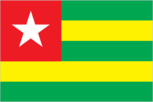
five equal horizontal bands of green (top and bottom) alternating with yellow; there is a white five-pointed star on a red square in the upper hoist-side corner; uses the popular pan-African colors of Ethiopia
Head of Government
interim Prime Minister Joseph Kokou KOFFIGOH (since 28 August 1991)
Independence
27 April 1960 (from UN trusteeship under French administration)
Judicial branch
Court of Appeal (Cour d'Appel), Supreme Court (Cour Supreme)
Legal system
French-based court system
Legislative branch
National Assembly dissolved during national reform conference; 79-member interim High Council for the Republic (HCR) formed to act as legislature during transition to multiparty democracy; legislative elections scheduled to be held in 1993
Member of
ACCT, ACP, AfDB, CCC, CEAO (observer), ECA, ECOWAS, Entente, FAO, FZ, G-77, GATT, IBRD, ICAO, ICC, IDA, IFAD, IFC, ILO, IMF, IMO, INTELSAT, INTERPOL, IOC, ITU, LORCS, NAM, OAU, UN, UNCTAD, UNESCO, UNIDO, UPU, WADB, WCL, WHO, WIPO, WMO, WTO
Names
conventional long form: Republic of Togo conventional short form: Togo local long form: Republique Togolaise local short form: none former: French Togo
National Assembly
last held 4 March 1990; dissolved during national reform conference (next to be held 1993); results - RPT was the only party; seats - (77 total) RPT 77; interim legislative High Council of the Republic (HCR) in place since August 1991
National holiday
Independence Day, 27 April (1960)
Political parties and leaders
Rally of the Togolese People (RPT) led by President EYADEMA was the only party until the formation of multiple parties was legalized 12 April 1991; transition regime in place since August 1991
President
last held 21 December 1986 (next to be held 1993); results - Gen. EYADEMA was reelected without opposition
Suffrage
universal adult at age NA
Type
republic under transition to multiparty democratic rule
US diplomatic representation
chief of mission: Ambassador Harmon E. KIRBY embassy: Rue Pelletier Caventou and Rue Vauban, Lome mailing address: B. P. 852, Lome telephone: [228] 21-29-91 through 94 and 21-77-17
Economy
Agriculture
accounts for 33% of GDP; cash crops - coffee, cocoa, cotton; food crops - yams, cassava, corn, beans, rice, millet, sorghum; livestock production not significant; annual fish catch, 10,000-14,000 tons
Budget
revenues $284.8 million; expenditures $407 million, including capital expenditures of $NA (1991 est.)
Currency
1 CFA franc (CFAF) = 100 centimes
Economic aid
US commitments, including Ex-Im (FY70-90), $142 million; Western (non-US) countries, ODA and OOF bilateral commitments (1970-90), $2 billion; OPEC bilateral aid (1979-89), $35 million; Communist countries (1970-89), $51 million
Electricity
179,000 kW capacity; 209 million kWh produced, 60 kWh per capita (1990)
Exchange rates
Communaute Financiere Africaine francs (CFAF) per US$1 - 274.06 (January 1993), 264.69 (1992), 282.11 (1991), 272.26 (1990), 319.01 (1989), 297.85 (1988)
Exports
$512 million (f.o.b., 1991 est.) commodities: phosphates, cotton, cocoa, coffee partners: EC 40%, Africa 16%, US 1% (1990)
External debt
$1.3 billion (1991)
Fiscal year
calendar year
Imports
$583 million (f.o.b., 1991 est.) commodities: machinery and equipment, consumer goods, food, chemical products partners: EC 57%, Africa 17%, US 5%, Japan 4% (1990)
Industrial production
growth rate 9.0% (1991 est.); accounts for 20% of GDP
Industries
phosphate mining, agricultural processing, cement, handicrafts, textiles, beverages
Inflation rate (consumer prices)
0.5% (1991 est.)
National product
GDP - exchange rate conversion - $1.5 billion (1991 est.)
National product per capita
$400 (1991 est.)
National product real growth rate
0% (1991 est.)
Overview
The economy is heavily dependent on subsistence agriculture, which accounts for about 33% of GDP and provides employment for 78% of the labor force. Primary agricultural exports are cocoa, coffee, and cotton, which together account for about 30% of total export earnings. Togo is self-sufficient in basic foodstuffs when harvests are normal. In the industrial sector phosphate mining is by far the most important activity, with phosphate exports accounting for about 40% of total foreign exchange earnings. Togo serves as a regional commercial and trade center. The government, over the past decade, with IMF and World Bank support, has been implementing a number of economic reform measures to encourage foreign investment and bring revenues in line with expenditures. Political unrest, including private and public sector strikes throughout 1991 and 1992, has jeopardized the reform program and has disrupted vital economic activity.
Unemployment rate
2% (1987)
Communications
Airports
total: 9 usable: 9 with permanent-surface runways: 2 with runways over 3,659 m: with runways 2,440-3,659 m: 2 with runways 1,220-2,439 m:
Highways
6,462 km total; 1,762 km paved; 4,700 km unimproved roads
Inland waterways
50 km Mono River
Merchant marine
2 roll-on/roll-off ships (1,000 GRT or over) totaling 11,118 GRT/20,529 DWT
Ports
Lome, Kpeme (phosphate port)
Railroads
570 km 1.000-meter gauge, single track
Telecommunications
fair system based on network of radio relay routes supplemented by open wire lines; broadcast stations - 2 AM, no FM, 3 (2 relays) TV; satellite earth stations - 1 Atlantic Ocean INTELSAT and 1 SYMPHONIE
Military and Security
Branches
Army, Navy, Air Force, Gendarmerie
Defense expenditures
exchange rate conversion - $43 million, about 3% of GDP (1989)
Manpower availability
males age 15-49 862,427; fit for military service 452,974 (1993 est.); no conscription