2023 Edition
CIA World Factbook 2023 (factbook.json @ 0d4fa4984ecb)
Introduction
Background
Lucayan Indians inhabited the islands when Christopher COLUMBUS first set foot in the New World on San Salvador in 1492. British settlement of the islands began in 1647; the islands became a colony in 1783. Piracy thrived in the 17th and 18th centuries because of The Bahamas close proximity to shipping lanes. Since attaining independence from the UK in 1973, The Bahamas has prospered through tourism, international banking, and investment management, which comprise up to 85% of GDP. Because of its proximity to the US - the nearest Bahamian landmass being only 80 km (50 mi) from Florida - the country is a major transshipment point for illicit trafficking, particularly to the US mainland, as well as Europe. US law enforcement agencies cooperate closely with The Bahamas, and the US Coast Guard assists Bahamian authorities in maritime security and law enforcement through Operation Bahamas, Turks and Caicos, or OPBAT.
Geography
Area
- land
- 10,010 sq km
- total
- 13,880 sq km
- water
- 3,870 sq km
Area - comparative
slightly smaller than Connecticut
Climate
tropical marine; moderated by warm waters of Gulf Stream
Coastline
3,542 km
Elevation
- highest point
- 1.3 km NE of Old Bight on Cat Island 64 m
- lowest point
- Atlantic Ocean 0 m
Geographic coordinates
24 15 N, 76 00 W
Geography - note
strategic location adjacent to US and Cuba; extensive island chain of which 30 are inhabited
Irrigated land
10 sq km (2012)
Land boundaries
- total
- 0 km
Land use
- agricultural land
- 1.4% (2018 est.)
- agricultural land: arable land
- arable land: 0.8% (2018 est.)
- agricultural land: permanent crops
- permanent crops: 0.4% (2018 est.)
- agricultural land: permanent pasture
- permanent pasture: 0.2% (2018 est.)
- forest
- 51.4% (2018 est.)
- other
- 47.2% (2018 est.)
Location
chain of islands in the North Atlantic Ocean, southeast of Florida, northeast of Cuba; note - although The Bahamas does not border the Caribbean Sea, geopolitically it is often designated as a Caribbean nation
Map references
Central America and the Caribbean
Maritime claims
- exclusive economic zone
- 200 nm
- territorial sea
- 12 nm
Natural hazards
hurricanes and other tropical storms cause extensive flood and wind damage
Natural resources
salt, aragonite, timber, arable land
Population distribution
most of the population lives in urban areas, with two-thirds living on New Providence Island where Nassau is located
Terrain
long, flat coral formations with some low rounded hills
People and Society
Age structure
- 0-14 years
- 21.37% (male 38,851/female 37,765)
- 15-64 years
- 68.8% (male 122,134/female 124,530)
- 65 years and over
- 9.83% (2023 est.) (male 13,922/female 21,306)
Alcohol consumption per capita
- beer
- 3.66 liters of pure alcohol (2019 est.)
- other alcohols
- 0.31 liters of pure alcohol (2019 est.)
- spirits
- 4.08 liters of pure alcohol (2019 est.)
- total
- 9.48 liters of pure alcohol (2019 est.)
- wine
- 1.43 liters of pure alcohol (2019 est.)
Birth rate
13.1 births/1,000 population (2023 est.)
Children under the age of 5 years underweight
NA
Current health expenditure
7.6% of GDP (2020)
Currently married women (ages 15-49)
38.9% (2023 est.)
Death rate
5.7 deaths/1,000 population (2023 est.)
Dependency ratios
- elderly dependency ratio
- 11.9
- potential support ratio
- 8.4 (2021 est.)
- total dependency ratio
- 39.3
- youth dependency ratio
- 27.3
Drinking water source
- improved: total
- total: 98.9% of population
- unimproved: total
- total: 1.1% of population (2017 est.)
Education expenditures
2.8% of GDP (2021 est.)
Ethnic groups
- African descent 90.6%, White 4.7%, mixed 2.1%, other 1.9%, unspecified 0.7% (2010 est.)
- note
- note: data represent population by racial group
Gross reproduction rate
0.71 (2023 est.)
Hospital bed density
3 beds/1,000 population (2017)
Infant mortality rate
- female
- 8.4 deaths/1,000 live births
- male
- 10.7 deaths/1,000 live births
- total
- 9.6 deaths/1,000 live births (2023 est.)
Languages
English (official), Creole (among Haitian immigrants)
Life expectancy at birth
- female
- 77.9 years
- male
- 74.5 years
- total population
- 76.2 years (2023 est.)
Literacy
- female
- NA
- male
- NA
- total population
- NA
Major urban areas - population
280,000 NASSAU (capital) (2018)
Maternal mortality ratio
77 deaths/100,000 live births (2020 est.)
Median age
- female
- 30.2 years
- male
- 30.2 years
- total
- 30.2 years (2023 est.)
Nationality
- adjective
- Bahamian
- noun
- Bahamian(s)
Net migration rate
3.2 migrant(s)/1,000 population (2023 est.)
Obesity - adult prevalence rate
31.6% (2016)
Physicians density
1.94 physicians/1,000 population (2017)
Population
358,508 (2023 est.)
Population distribution
most of the population lives in urban areas, with two-thirds living on New Providence Island where Nassau is located
Population growth rate
1.06% (2023 est.)
Religions
Protestant 69.9% (includes Baptist 34.9%, Anglican 13.7%, Pentecostal 8.9% Seventh Day Adventist 4.4%, Methodist 3.6%, Church of God 1.9%, Brethren 1.6%, other Protestant .9%), Roman Catholic 12%, other Christian 13% (includes Jehovah's Witness 1.1%), other 0.6%, none 1.9%, unspecified 2.6% (2010 est.)
Sanitation facility access
- improved: total
- total: 98.2% of population
- unimproved: total
- total: 1.8% of population (2017 est.)
Sex ratio
- 0-14 years
- 1.03 male(s)/female
- 15-64 years
- 0.98 male(s)/female
- 65 years and over
- 0.65 male(s)/female
- at birth
- 1.03 male(s)/female
- total population
- 0.86 male(s)/female (2023 est.)
Tobacco use
- female
- 2.4% (2020 est.)
- male
- 18.8% (2020 est.)
- total
- 10.6% (2020 est.)
Total fertility rate
1.44 children born/woman (2023 est.)
Urbanization
- rate of urbanization
- 1.02% annual rate of change (2020-25 est.)
- urban population
- 83.6% of total population (2023)
Youth unemployment rate (ages 15-24)
- female
- 35.6%
- male
- 27.5%
- total
- 30.8% (2021 est.)
Government
Administrative divisions
31 districts; Acklins Islands, Berry Islands, Bimini, Black Point, Cat Island, Central Abaco, Central Andros, Central Eleuthera, City of Freeport, Crooked Island and Long Cay, East Grand Bahama, Exuma, Grand Cay, Harbour Island, Hope Town, Inagua, Long Island, Mangrove Cay, Mayaguana, Moore's Island, North Abaco, North Andros, North Eleuthera, Ragged Island, Rum Cay, San Salvador, South Abaco, South Andros, South Eleuthera, Spanish Wells, West Grand Bahama
Capital
- daylight saving time
- +1hr, begins second Sunday in March; ends first Sunday in November
- etymology
- named after William III (1650-1702), king of England, Scotland, and Ireland, who was a member of the House of Nassau
- geographic coordinates
- 25 05 N, 77 21 W
- name
- Nassau
- time difference
- UTC-5 (same time as Washington, DC, during Standard Time)
Citizenship
- citizenship by birth
- no
- citizenship by descent only
- at least one parent must be a citizen of The Bahamas
- dual citizenship recognized
- no
- residency requirement for naturalization
- 6-9 years
Constitution
- amendments
- proposed as an "Act" by Parliament; passage of amendments to articles such as the organization and composition of the branches of government requires approval by at least two-thirds majority of the membership of both houses of Parliament and majority approval in a referendum; passage of amendments to constitutional articles such as fundamental rights and individual freedoms, the powers, authorities, and procedures of the branches of government, or changes to the Bahamas Independence Act 1973 requires approval by at least three-fourths majority of the membership of both houses and majority approval in a referendum; amended many times, last in 2016
- history
- previous 1964 (preindependence); latest adopted 20 June 1973, effective 10 July 1973
Country name
- conventional long form
- Commonwealth of The Bahamas
- conventional short form
- The Bahamas
- etymology
- name derives from the Spanish "baha mar," meaning "shallow sea," which describes the shallow waters of the Bahama Banks
Diplomatic representation from the US
- chief of mission
- Ambassador (vacant); Charge d' Affaires Usha E. PITTS (since 1 January 2021)
- email address and website
- acsnassau@state.govhttps://bs.usembassy.gov/
- embassy
- 42 Queen Street, Nassau
- FAX
- [1] (242) 356-7174
- mailing address
- 3370 Nassau Place, Washington, DC 20521-3370
- telephone
- [1] (242) 322-1181
Diplomatic representation in the US
- chancery
- 600 New Hampshire Ave NW, Suite 530, Washington, DC 20037
- chief of mission
- Ambassador Wendall Kermith JONES (since 19 April 2022)
- consulate(s) general
- Atlanta, Miami, New York, Washington, DC
- email address and website
- embassy@bahamasembdc.orghttps://www.bahamasembdc.org/
- FAX
- [1] (202) 319-2668
- telephone
- [1] (202) 319-2660
Executive branch
- cabinet
- Cabinet appointed by governor-general on recommendation of prime minister
- chief of state
- King CHARLES III (since 8 September 2022); represented by Governor-General Cynthia A. PRATT (since 1 September 2023)
- elections/appointments
- the monarchy is hereditary; governor-general appointed by the monarch on the advice of the prime minister; following legislative elections, the leader of the majority party or majority coalition usually appointed prime minister by the governor-general; the prime minister recommends the deputy prime minister
- head of government
- Prime Minister Philip DAVIS (since 17 September 2021)
Flag description
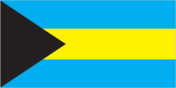
three equal horizontal bands of aquamarine (top), gold, and aquamarine, with a black equilateral triangle based on the hoist side; the band colors represent the golden beaches of the islands surrounded by the aquamarine sea; black represents the vigor and force of a united people, while the pointing triangle indicates the enterprise and determination of the Bahamian people to develop the rich resources of land and sea
Government type
parliamentary democracy under a constitutional monarchy; a Commonwealth realm
Independence
10 July 1973 (from the UK)
International law organization participation
has not submitted an ICJ jurisdiction declaration; non-party state to the ICCt
International organization participation
ACP, AOSIS, C, Caricom, CDB, CELAC, FAO, G-77, IADB, IAEA, IBRD, ICAO, ICC (NGOs), ICRM, IDA, IFAD, IFC, IFRCS, ILO, IMF, IMO, IMSO, Interpol, IOC, IOM, ISO (correspondent), ITSO, ITU, LAES, MIGA, NAM, OAS, OPANAL, OPCW, Petrocaribe, UN, UNCTAD, UNESCO, UNIDO, UNWTO, UPU, WCO, WHO, WIPO, WMO, WTO (observer)
Judicial branch
- highest court(s)
- Court of Appeal (consists of the court president and 4 justices, organized in 3-member panels); Supreme Court (consists of the chief justice and a maximum of 11 and a minimum of 2 justices)
- judge selection and term of office
- Court of Appeal president and Supreme Court chief justice appointed by the governor-general on the advice of the prime minister after consultation with the leader of the opposition party; other Court of Appeal and Supreme Court justices appointed by the governor general upon recommendation of the Judicial and Legal Services Commission, a 5-member body headed by the chief justice; Court of Appeal justices appointed for life with mandatory retirement normally at age 68 but can be extended until age 70; Supreme Court justices appointed for life with mandatory retirement normally at age 65 but can be extended until age 67
- note
- note: The Bahamas is a member of the 15-member Caribbean Community but is not party to the agreement establishing the Caribbean Court of Justice as its highest appellate court; the Judicial Committee of the Privy Council (in London) serves as the final court of appeal for The Bahamas
- subordinate courts
- Industrial Tribunal; Stipendiary and Magistrates' Courts; Family Island Administrators
Legal system
common law system based on the English model
Legislative branch
- description
- bicameral Parliament consists of:Senate (16 seats; members appointed by the governor-general - 9 selected on the advice of the prime minister, 4 on the advice of the leader of the opposition party, and 3 on the advice of the prime minister in consultation with the opposition leader; members serve 5-year terms)House of Assembly (39 seats; members directly elected in single-seat constituencies by simple majority vote to serve 5-year terms)
- election results
- Senate - appointed; composition as of August 2023 - men 12, women 4, percent of women 25%House of Assembly - percent of vote by party - PLP 52.5%, FNM 36.2%; seats by party - PLP 32, FNM 7; composition as of August 2023 - men 32, women 7, percent of women 18%; note - total Parliament percent of women 20%
- elections
- Senate - last appointments on 24 May 2017 (next appointments in 2022)House of Assembly - last held on 16 September 2021 (next to be held by September 2026)
- note
- note: the government may dissolve the parliament and call elections at any time
National anthem
- lyrics/music
- Timothy GIBSON
- name
- "March On, Bahamaland!"
- note
- note: adopted 1973; as a Commonwealth country, in addition to the national anthem, "God Save the King" serves as the royal anthem (see United Kingdom)
National holiday
Independence Day, 10 July (1973)
National symbol(s)
blue marlin, flamingo, Yellow Elder flower; national colors: aquamarine, yellow, black
Political parties and leaders
Democratic National Alliance or DNA [Arinthia KOMOLAFE]Free National Movement or FNM [Michael PINTARD]Progressive Liberal Party or PLP [Philip "Brave" DAVIS]
Suffrage
18 years of age; universal
Economy
Agricultural products
sugar cane, grapefruit, vegetables, bananas, tomatoes, poultry, tropical fruit, oranges, coconuts, mangoes/guavas
Budget
- expenditures
- $2.899 billion (2020 est.)
- revenues
- $2.087 billion (2020 est.)
Budget surplus (+) or deficit (-)
-2.6% (of GDP) (2017 est.)
Credit ratings
- Moody's rating
- Ba2 (2020)
- note
- note: The year refers to the year in which the current credit rating was first obtained.
- Standard & Poors rating
- BB- (2020)
Current account balance
- Current account balance 2019
- -$345.481 million (2019 est.)
- Current account balance 2020
- -$2.373 billion (2020 est.)
- Current account balance 2021
- -$2.592 billion (2021 est.)
Debt - external
- Debt - external 31 December 2012
- $16.35 billion (31 December 2012 est.)
- Debt - external 31 December 2013
- $17.56 billion (31 December 2013 est.)
Economic overview
high-income tourism and financial services economy; major income inequality; strong US bilateral relations; several tax relief programs; targeted investment in agriculture, energy, light manufacturing, and technology industries
Exchange rates
- Currency
- Bahamian dollars (BSD) per US dollar -
- Exchange rates 2017
- 1 (2017 est.)
- Exchange rates 2018
- 1 (2018 est.)
- Exchange rates 2019
- 1 (2019 est.)
- Exchange rates 2020
- 1 (2020 est.)
- Exchange rates 2021
- 1 (2021 est.)
Exports
- Exports 2019
- $5.164 billion (2019 est.)
- Exports 2020
- $1.65 billion (2020 est.)
- Exports 2021
- $3.202 billion (2021 est.)
- note
- note: Data are in current year dollars and do not include illicit exports or re-exports.
Exports - commodities
- refined petroleum, ships, aluminum, lobsters and crawfish, styrene polymers (2021)
- note
- note: Bahamian cannabis production remains a significant illicit trade export
Exports - partners
United States 26%, Germany 16%, Singapore 13%, Poland 13%, Thailand 9% (2021)
Fiscal year
1 July - 30 June
GDP - composition, by end use
- exports of goods and services
- 33.7% (2017 est.)
- government consumption
- 13% (2017 est.)
- household consumption
- 68% (2017 est.)
- imports of goods and services
- -41.8% (2017 est.)
- investment in fixed capital
- 26.3% (2017 est.)
- investment in inventories
- 0.7% (2017 est.)
GDP - composition, by sector of origin
- agriculture
- 2.3% (2017 est.)
- industry
- 7.7% (2017 est.)
- services
- 90% (2017 est.)
GDP (official exchange rate)
$12.16 billion (2017 est.)
Household income or consumption by percentage share
- highest 10%
- 22% (2007 est.)
- lowest 10%
- 1%
Imports
- Imports 2019
- $4.84 billion (2019 est.) note: data are in current year dollars
- Imports 2020
- $3.411 billion (2020 est.) note: data are in current year dollars
- Imports 2021
- $4.924 billion (2021 est.) note: data are in current year dollars
Imports - commodities
refined petroleum, ships, aircraft, crude petroleum, floating docks (2021)
Imports - partners
United States 37%, South Korea 12%, Germany 9%, China 7%, Russia 6% (2021)
Industrial production growth rate
8.51% (2021 est.)
Industries
tourism, banking, oil bunkering, maritime industries, transshipment and logistics, salt, aragonite, pharmaceuticals
Inflation rate (consumer prices)
- Inflation rate (consumer prices) 2019
- 2.49% (2019 est.)
- Inflation rate (consumer prices) 2020
- 0.04% (2020 est.)
- Inflation rate (consumer prices) 2021
- 2.9% (2021 est.)
Labor force
224,400 (2021 est.)
Labor force - by occupation
- agriculture
- 3%
- industry
- 11%
- services
- 49%
- tourism
- 37% (2011 est.)
Population below poverty line
9.3% (2010 est.)
Public debt
- Public debt 2018
- 56.78% of GDP (2018 est.)
- Public debt 2019
- 57.05% of GDP (2019 est.)
- Public debt 2020
- 84.45% of GDP (2020 est.)
Real GDP (purchasing power parity)
- note
- note: data are in 2017 dollars
- Real GDP (purchasing power parity) 2019
- $14.225 billion (2019 est.)
- Real GDP (purchasing power parity) 2020
- $10.836 billion (2020 est.)
- Real GDP (purchasing power parity) 2021
- $12.323 billion (2021 est.)
Real GDP growth rate
- Real GDP growth rate 2019
- 1.9% (2019 est.)
- Real GDP growth rate 2020
- -23.82% (2020 est.)
- Real GDP growth rate 2021
- 13.72% (2021 est.)
Real GDP per capita
- note
- note: data are in 2017 dollars
- Real GDP per capita 2019
- $35,200 (2019 est.)
- Real GDP per capita 2020
- $26,700 (2020 est.)
- Real GDP per capita 2021
- $30,200 (2021 est.)
Reserves of foreign exchange and gold
- Reserves of foreign exchange and gold 31 December 2019
- $1.758 billion (31 December 2019 est.)
- Reserves of foreign exchange and gold 31 December 2020
- $2.382 billion (31 December 2020 est.)
- Reserves of foreign exchange and gold 31 December 2021
- $2.433 billion (31 December 2021 est.)
Taxes and other revenues
19.16% (of GDP) (2020 est.)
Unemployment rate
- Unemployment rate 2019
- 10.06% (2019 est.)
- Unemployment rate 2020
- 13.32% (2020 est.)
- Unemployment rate 2021
- 13.24% (2021 est.)
Youth unemployment rate (ages 15-24)
- female
- 35.6%
- male
- 27.5%
- total
- 30.8% (2021 est.)
Energy
Carbon dioxide emissions
- from coal and metallurgical coke
- 0 metric tonnes of CO2 (2019 est.)
- from consumed natural gas
- 7,000 metric tonnes of CO2 (2019 est.)
- from petroleum and other liquids
- 3.976 million metric tonnes of CO2 (2019 est.)
- total emissions
- 3.984 million metric tonnes of CO2 (2019 est.)
Coal
- consumption
- 0 metric tons (2020 est.)
- exports
- 0 metric tons (2020 est.)
- imports
- 0 metric tons (2020 est.)
- production
- 0 metric tons (2020 est.)
- proven reserves
- 0 metric tons (2019 est.)
Electricity
- consumption
- 2,103,248,000 kWh (2019 est.)
- exports
- 0 kWh (2019 est.)
- imports
- 0 kWh (2020 est.)
- installed generating capacity
- 578,000 kW (2020 est.)
- transmission/distribution losses
- 245,000 kWh (2019 est.)
Electricity access
- electrification - total population
- 100% (2021)
Electricity generation sources
- biomass and waste
- 0% of total installed capacity (2020 est.)
- fossil fuels
- 99.8% of total installed capacity (2020 est.)
- geothermal
- 0% of total installed capacity (2020 est.)
- hydroelectricity
- 0% of total installed capacity (2020 est.)
- nuclear
- 0% of total installed capacity (2020 est.)
- solar
- 0.2% of total installed capacity (2020 est.)
- tide and wave
- 0% of total installed capacity (2020 est.)
- wind
- 0% of total installed capacity (2020 est.)
Energy consumption per capita
- Total energy consumption per capita 2019
- 140.505 million Btu/person (2019 est.)
Natural gas
- consumption
- 4.417 million cubic meters (2019 est.)
- exports
- 0 cubic meters (2021 est.)
- imports
- 4.417 million cubic meters (2019 est.)
- production
- 0 cubic meters (2021 est.)
- proven reserves
- 0 cubic meters (2021 est.)
Petroleum
- crude oil and lease condensate exports
- 0 bbl/day (2018 est.)
- crude oil and lease condensate imports
- 0 bbl/day (2018 est.)
- crude oil estimated reserves
- 0 barrels (2021 est.)
- refined petroleum consumption
- 25,800 bbl/day (2019 est.)
- total petroleum production
- 0 bbl/day (2021 est.)
Refined petroleum products - exports
0 bbl/day (2015 est.)
Refined petroleum products - imports
19,150 bbl/day (2015 est.)
Refined petroleum products - production
0 bbl/day (2015 est.)
Communications
Broadband - fixed subscriptions
- subscriptions per 100 inhabitants
- 21 (2020 est.)
- total
- 83,000 (2020 est.)
Broadcast media
The Bahamas has 4 major TV providers that provide service to all major islands in the archipelago; 1 TV station is operated by government-owned, commercially run Broadcasting Corporation of the Bahamas (BCB) and competes freely with 4 privately owned TV stations; multi-channel cable TV subscription service is widely available; there are 32 licensed broadcast (radio) service providers, 31 are privately owned FM radio stations operating on New Providence, Grand Bahama Island, Abaco Island, and on smaller islands in the country; the BCB operates a multi-channel radio broadcasting network that has national coverage; the sector is regulated by the Utilities Regulation and Competition Authority (2019)
Internet country code
.bs
Internet users
- percent of population
- 94% (2021 est.)
- total
- 385,400 (2021 est.)
Telecommunication systems
- domestic
- 22 per 100 fixed-line, 115 per 100 mobile-cellular (2020)
- general assessment
- the telecom sector has seen a decline in subscriber numbers (particularly for prepaid mobile services the mainstay of short term visitors) and revenue; fixed and mobile broadband services are two areas that have benefited from the crisis as employees and students have resorted to working from home (2021)
- international
- country code - 1-242; landing points for the ARCOS-1, BICS, Bahamas 2-US, and BDSN fiber-optic submarine cables that provide links to South and Central America, parts of the Caribbean, and the US; satellite earth stations - 2; the Bahamas Domestic Submarine Network links all of the major islands; (2019)
Telephones - fixed lines
- subscriptions per 100 inhabitants
- 22 (2020 est.)
- total subscriptions
- 91,000 (2020 est.)
Telephones - mobile cellular
- subscriptions per 100 inhabitants
- 115 (2020 est.)
- total subscriptions
- 466,000 (2020 est.)
Transportation
Airports
54 (2021)
Airports - with paved runways
- civil airports
- 3
- note
- note: paved runways have a concrete or asphalt surface but not all have facilities for refueling, maintenance, or air traffic control; the length of a runway required for aircraft to safely operate depends on a number of factors including the type of aircraft, the takeoff weight (including passengers, cargo, and fuel), engine types, flap settings, landing speed, elevation of the airport, and average maximum daily air temperature; paved runways can reach a length of 5,000 m (16,000 ft.), but the “typical” length of a commercial airline runway is between 2,500-4,000 m (8,000-13,000 ft.)
- other airports
- 21
- total
- 24
Airports - with unpaved runways
- 37
- note
- note: unpaved runways have a surface composition such as grass or packed earth and are most suited to the operation of light aircraft; unpaved runways are usually short, often less than 1,000 m (3,280 ft.) in length; airports with unpaved runways often lack facilities for refueling, maintenance, or air traffic control
Civil aircraft registration country code prefix
C6
Heliports
1 (2021)
Merchant marine
- by type
- bulk carrier 337, container ship 40, general cargo 63, oil tanker 213, other 654
- total
- 1,307 (2022)
National air transport system
- annual freight traffic on registered air carriers
- 160,000 (2018) mt-km
- annual passenger traffic on registered air carriers
- 1,197,116 (2018)
- inventory of registered aircraft operated by air carriers
- 35
- number of registered air carriers
- 5 (2020)
Ports and terminals
- container port(s) (TEUs)
- Freeport (1,642,780) (2021)
- cruise port(s)
- Freeport, Half Moon Cay, Nassau
- major seaport(s)
- Freeport, Nassau, South Riding Point
Roadways
- paved
- 1,620 km (2011)
- total
- 2,700 km (2011)
- unpaved
- 1,080 km (2011)
Military and Security
Military - note
established in 1980; the RBDF's primary responsibilities are disaster relief, maritime security, and counter-narcotics operations; it also provides security at a detention center for migrants and performs some domestic security functions, such as guarding embassies; the RBDF is a naval force, but includes a lightly-armed marine infantry/commando squadron for base and internal security, as well as a few light non-combat aircraft; the maritime element has coastal patrol craft and patrol boats; the RBDF maintains training relationships with the UK and the US (2023)
Military and security forces
- Royal Bahamas Defense Force (RBDF): includes land, air, maritime elements; Royal Bahamas Police Force (RBPF) (2023)
- note
- note: the RBPF maintains internal security; both the RBDF and the RBPF, as well as the Department of Corrections, report to the Minister of National Security
Military and security service personnel strengths
approximately 1,500 active RBDF personnel (2023)
Military equipment inventories and acquisitions
most of the RBDF's major equipment inventory is supplied by the Netherlands (2023)
Military expenditures
- Military Expenditures 2018
- 0.7% of GDP (2018)
- Military Expenditures 2019
- 0.7% of GDP (2019)
- Military Expenditures 2020
- 0.9% of GDP (2020)
- Military Expenditures 2021
- 0.9% of GDP (2021)
- Military Expenditures 2022
- 0.8% of GDP (2022 est.)
Military service age and obligation
18-30 years of age for voluntary service for men and women (18-60 for Reserves); no conscription (2023)
Transnational Issues
Disputes - international
The Bahamas-US: in declaring its archipelagic waters and 200 nm EEZ in 1993 legislation, The Bahamas did not delimit the outer limits of the EEZ; but in areas where EEZs overlap with neighbors, The Bahamas agreed to equidistance as a line of separation; however, The Bahamas has yet to define maritime boundaries with any of its neighbors, including the US, whose Florida coast lays about 70 nm from Grand Bahama Island
Illicit drugs
a transit point for illegal drugs bound for the United States; small scale illicit production of marijuana continues
Environment
Air pollutants
- carbon dioxide emissions
- 1.79 megatons (2016 est.)
- methane emissions
- 0.23 megatons (2020 est.)
- particulate matter emissions
- 5.2 micrograms per cubic meter (2019 est.)
Climate
tropical marine; moderated by warm waters of Gulf Stream
Environment - current issues
coral reef decay; solid waste disposal
Environment - international agreements
- party to
- Biodiversity, Climate Change, Climate Change-Kyoto Protocol, Climate Change-Paris Agreement, Comprehensive Nuclear Test Ban, Desertification, Endangered Species, Hazardous Wastes, Law of the Sea, Nuclear Test Ban, Ozone Layer Protection, Ship Pollution, Wetlands
- signed, but not ratified
- none of the selected agreements
Land use
- agricultural land
- 1.4% (2018 est.)
- agricultural land: arable land
- arable land: 0.8% (2018 est.)
- agricultural land: permanent crops
- permanent crops: 0.4% (2018 est.)
- agricultural land: permanent pasture
- permanent pasture: 0.2% (2018 est.)
- forest
- 51.4% (2018 est.)
- other
- 47.2% (2018 est.)
Revenue from coal
0% of GDP (2018 est.)
Revenue from forest resources
0.01% of GDP (2018 est.)
Total renewable water resources
700 million cubic meters (2020 est.)
Total water withdrawal
- municipal
- 30 million cubic meters (2020 est.)
Urbanization
- rate of urbanization
- 1.02% annual rate of change (2020-25 est.)
- urban population
- 83.6% of total population (2023)
Waste and recycling
- municipal solid waste generated annually
- 264,000 tons (2015 est.)