2011 Edition
CIA World Factbook 2011 Archive (HTML)
Introduction
Background
Lucayan Indians inhabited the islands when Christopher COLUMBUS first set foot in the New World on San Salvador in 1492. British settlement of the islands began in 1647; the islands became a colony in 1783. Since attaining independence from the UK in 1973, The Bahamas has prospered through tourism and international banking and investment management. Because of its geography, the country is a major transshipment point for illegal drugs, particularly shipments to the US and Europe, and its territory is used for smuggling illegal migrants into the US.
Geography
Area
- 13,880 sq km 10,010 sq km 3,870 sq km
- total
- 13,880 sq km
- water
- 3,870 sq km
Area - comparative
slightly smaller than Connecticut
Climate
tropical marine; moderated by warm waters of Gulf Stream
Coastline
3,542 km
Elevation extremes
- Atlantic Ocean 0 m Mount Alvernia on Cat Island 63 m
- highest point
- Mount Alvernia on Cat Island 63 m
- lowest point
- Atlantic Ocean 0 m
Environment - current issues
coral reef decay; solid waste disposal
Environment - international agreements
- Biodiversity, Climate Change, Climate Change-Kyoto Protocol, Desertification, Endangered Species, Hazardous Wastes, Law of the Sea, Ozone Layer Protection, Ship Pollution, Wetlands none of the selected agreements
- party to
- Biodiversity, Climate Change, Climate Change-Kyoto Protocol, Desertification, Endangered Species, Hazardous Wastes, Law of the Sea, Ozone Layer Protection, Ship Pollution, Wetlands
- signed, but not ratified
- none of the selected agreements
Geographic coordinates
24 15 N, 76 00 W
Geography - note
strategic location adjacent to US and Cuba; extensive island chain of which 30 are inhabited
Irrigated land
10 sq km (2008)
Land boundaries
0 km
Land use
- 0.58% 0.29% 99.13% (2005)
- arable land
- 0.58%
- other
- 99.13% (2005)
- permanent crops
- 0.29%
Location
Caribbean, chain of islands in the North Atlantic Ocean, southeast of Florida, northeast of Cuba
Map references
Central America and the Caribbean
Maritime claims
- 12 nm 200 nm
- exclusive economic zone
- 200 nm
- territorial sea
- 12 nm
Natural hazards
hurricanes and other tropical storms cause extensive flood and wind damage
Natural resources
salt, aragonite, timber, arable land
Terrain
long, flat coral formations with some low rounded hills
Total renewable water resources
NA
People and Society
Age structure
- 24.4% (male 38,834/female 37,715) 69.2% (male 106,882/female 110,081) 6.3% (male 7,578/female 12,222) (2011 est.)
- 0-14 years
- 24.4% (male 38,834/female 37,715)
- 15-64 years
- 69.2% (male 106,882/female 110,081)
- 65 years and over
- 6.3% (male 7,578/female 12,222) (2011 est.)
Birth rate
16.1 births/1,000 population (2011 est.)
Death rate
6.88 deaths/1,000 population (July 2011 est.)
Drinking water source
- urban: 98% of population rural: 86% of population total: 96% of population urban: 2% of population rural: 14% of population total: 4% of population (2000)
- rural
- 14% of population
- total
- 4% of population (2000)
- urban
- 2% of population
Education expenditures
NA
Ethnic groups
black 85%, white 12%, Asian and Hispanic 3%
Health expenditures
7.2% of GDP (2009)
HIV/AIDS - adult prevalence rate
3.1% (2009 est.)
HIV/AIDS - deaths
fewer than 500 (2009 est.)
HIV/AIDS - people living with HIV/AIDS
6,600 (2009 est.)
Hospital bed density
3.1 beds/1,000 population (2008)
Infant mortality rate
- 13.49 deaths/1,000 live births 13.29 deaths/1,000 live births 13.69 deaths/1,000 live births (2011 est.)
- female
- 13.69 deaths/1,000 live births (2011 est.)
- total
- 13.49 deaths/1,000 live births
Languages
English (official), Creole (among Haitian immigrants)
Life expectancy at birth
- 71.18 years 68.8 years 73.63 years (2011 est.)
- female
- 73.63 years (2011 est.)
- total population
- 71.18 years
Literacy
- age 15 and over can read and write 95.6% 94.7% 96.5% (2003 est.)
- definition
- age 15 and over can read and write
- female
- 96.5% (2003 est.)
- male
- 94.7%
- total population
- 95.6%
Major cities - population
NASSAU (capital) 248,000 (2009)
Maternal mortality rate
49 deaths/100,000 live births (2008)
Median age
- 30.2 years 29.1 years 31.3 years (2011 est.)
- female
- 31.3 years (2011 est.)
- male
- 29.1 years
- total
- 30.2 years
Nationality
- Bahamian(s) Bahamian
- adjective
- Bahamian
- noun
- Bahamian(s)
Net migration rate
0 migrant(s)/1,000 population (2011 est.)
Physicians density
1.05 physicians/1,000 population (1998)
Population
313,312 (July 2011 est.) estimates for this country explicitly take into account the effects of excess mortality due to AIDS; this can result in lower life expectancy, higher infant mortality, higher death rates, lower population growth rates, and changes in the distribution of population by age and sex than would otherwise be expected
Population growth rate
0.922% (2011 est.)
Religions
Protestant 67.6% (Baptist 35.4%, Anglican 15.1%, Pentecostal 8.1%, Church of God 4.8%, Methodist 4.2%), Roman Catholic 13.5%, other Christian 15.2%, none or unspecified 2.9%, other 0.8% (2000 census)
Sanitation facility access
- urban: 100% of population rural: 100% of population total: 100% of population (2008)
- rural
- 100% of population
- total
- 100% of population (2008)
- urban
- 100% of population
School life expectancy (primary to tertiary education)
- 12 years 12 years 12 years (2006)
- female
- 12 years (2006)
- male
- 12 years
- total
- 12 years
Sex ratio
- 1.03 male(s)/female 1.03 male(s)/female 0.97 male(s)/female 0.62 male(s)/female 0.96 male(s)/female (2011 est.)
- 15-64 years
- 0.97 male(s)/female
- 65 years and over
- 0.62 male(s)/female
- at birth
- 1.03 male(s)/female
- total population
- 0.96 male(s)/female (2011 est.)
- under 15 years
- 1.03 male(s)/female
Total fertility rate
1.99 children born/woman (2011 est.)
Unemployment, youth ages 15-24
- 18.9% 16.7% 21.7% (2007)
- female
- 21.7% (2007)
- total
- 18.9%
Urbanization
- 84% of total population (2010) 1.3% annual rate of change (2010-15 est.)
- rate of urbanization
- 1.3% annual rate of change (2010-15 est.)
- urban population
- 84% of total population (2010)
Government
Administrative divisions
31 districts; Acklins Islands, Berry Islands, Bimini, Black Point, Cat Island, Central Abaco, Central Andros, Central Eleuthera, City of Freeport, Crooked Island and Long Cay, East Grand Bahama, Exuma, Grand Cay, Harbour Island, Hope Town, Inagua, Long Island, Mangrove Cay, Mayaguana, Moore's Island, North Abaco, North Andros, North Eleuthera, Ragged Island, Rum Cay, San Salvador, South Abaco, South Andros, South Eleuthera, Spanish Wells, West Grand Bahama
Capital
- Nassau 25 05 N, 77 21 W UTC-5 (same time as Washington, DC during Standard Time) +1hr, begins second Sunday in March; ends first Sunday in November
- daylight saving time
- +1hr, begins second Sunday in March; ends first Sunday in November
- geographic coordinates
- 25 05 N, 77 21 W
- name
- Nassau
- time difference
- UTC-5 (same time as Washington, DC during Standard Time)
Constitution
10 July 1973
Country name
- Commonwealth of The Bahamas The Bahamas
- conventional long form
- Commonwealth of The Bahamas
- conventional short form
- The Bahamas
Diplomatic representation from the US
- Ambassador Nicole A. AVANT 42 Queen Street, Nassau, New Providence local or express mail address: P. O. Box N-8197, Nassau; US Department of State, 3370 Nassau Place, Washington, DC 20521-3370 [1] (242) 322-1181, 328-2206 (after hours) [1] (242) 328-2206
- chief of mission
- Ambassador Nicole A. AVANT
- embassy
- 42 Queen Street, Nassau, New Providence
- FAX
- [1] (242) 328-2206
- mailing address
- local or express mail address: P. O. Box N-8197, Nassau; US Department of State, 3370 Nassau Place, Washington, DC 20521-3370
- telephone
- [1] (242) 322-1181, 328-2206 (after hours)
Diplomatic representation in the US
- Ambassador Cornelius A. SMITH 2220 Massachusetts Avenue NW, Washington, DC 20008 [1] (202) 319-2660 [1] (202) 319-2668 Miami, New York
- chancery
- 2220 Massachusetts Avenue NW, Washington, DC 20008
- chief of mission
- Ambassador Cornelius A. SMITH
- consulate(s) general
- Miami, New York
- FAX
- [1] (202) 319-2668
- telephone
- [1] (202) 319-2660
Executive branch
- Queen ELIZABETH II (since 6 February 1952); represented by Governor General Sir Arthur A. FOULKES (since 14 April 2010) Prime Minister Hubert A. INGRAHAM (since 4 May 2007) Cabinet appointed by the governor general on the prime minister's recommendation the monarchy is hereditary; governor general appointed by the monarch; following legislative elections, the leader of the majority party or the leader of the majority coalition is usually appointed prime minister by the governor general; the prime minister recommends the deputy prime minister
- cabinet
- Cabinet appointed by the governor general on the prime minister's recommendation
- chief of state
- Queen ELIZABETH II (since 6 February 1952); represented by Governor General Sir Arthur A. FOULKES (since 14 April 2010)
- elections
- the monarchy is hereditary; governor general appointed by the monarch; following legislative elections, the leader of the majority party or the leader of the majority coalition is usually appointed prime minister by the governor general; the prime minister recommends the deputy prime minister
- head of government
- Prime Minister Hubert A. INGRAHAM (since 4 May 2007)
Flag description
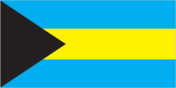
three equal horizontal bands of aquamarine (top), gold, and aquamarine, with a black equilateral triangle based on the hoist side; the band colors represent the golden beaches of the islands surrounded by the aquamarine sea; black represents the vigor and force of a united people, while the pointing triangle indicates the enterprise and determination of the Bahamian people to develop the rich resources of land and sea
Government type
constitutional parliamentary democracy and a Commonwealth realm
Independence
10 July 1973 (from the UK)
International law organization participation
has not submitted an ICJ jurisdiction declaration; non-party state to the ICCt
International organization participation
ACP, AOSIS, C, Caricom, CDB, FAO, G-77, IADB, IBRD, ICAO, ICRM, IDA, IFAD, IFC, IFRCS, ILO, IMF, IMO, IMSO, Interpol, IOC, IOM, ITSO, ITU, LAES, MIGA, NAM, OAS, OPANAL, OPCW, PetroCaribe, UN, UNCTAD, UNESCO, UNIDO, UNWTO, UPU, WCO, WHO, WIPO, WMO, WTO (observer)
Judicial branch
Privy Council in London; Courts of Appeal; Supreme (lower) Court; Magistrates' Courts
Legal system
common law system based on the English model
Legislative branch
- bicameral Parliament consists of the Senate (16 seats; members appointed by the governor general upon the advice of the prime minister and the opposition leader to serve five-year terms) and the House of Assembly (41 seats; members elected by direct popular vote to serve five-year terms); the government may dissolve the parliament and call elections at any time last held on 2 May 2007 (next to be held by May 2012) percent of vote by party - FNM 49.86%, PLP 47.02%; seats by party - FNM 23, PLP 18
- election results
- percent of vote by party - FNM 49.86%, PLP 47.02%; seats by party - FNM 23, PLP 18
- elections
- last held on 2 May 2007 (next to be held by May 2012)
National anthem
- "March On, Bahamaland!" Timothy GIBSON adopted 1973; as a Commonwealth country, in addition to the national anthem, "God Save the Queen" serves as the royal anthem (see United Kingdom)
- lyrics/music
- Timothy GIBSON
- name
- "March On, Bahamaland!"
National holiday
Independence Day, 10 July (1973)
National symbol(s)
blue marlin; flamingo
Political parties and leaders
Free National Movement or FNM [Hubert INGRAHAM]; Progressive Liberal Party or PLP [Perry CHRISTIE]
Political pressure groups and leaders
- Friends of the Environment trade unions
- other
- trade unions
Suffrage
18 years of age; universal
Economy
Agriculture - products
citrus, vegetables; poultry
Budget
- $1.3 billion $1.3 billion (2010 est.)
- expenditures
- $1.3 billion (2010 est.)
- revenues
- $1.3 billion
Budget surplus (+) or deficit (-)
-4% of GDP (2010 est.)
Central bank discount rate
5.25% (31 December 2010 est.) 5.25% (31 December 2009 est.)
Commercial bank prime lending rate
5.5% (31 December 2010 est.) 5.5% (31 December 2009 est.)
Current account balance
-$1.038 billion (2010 est.) -$893.3 million (2009 est.)
Debt - external
$342.6 million (2004 est.)
Economy - overview
The Bahamas is one of the wealthiest Caribbean countries with an economy heavily dependent on tourism and offshore banking. Tourism together with tourism-driven construction and manufacturing accounts for approximately 60% of GDP and directly or indirectly employs half of the archipelago's labor force. Prior to 2006, a steady growth in tourism receipts and a boom in construction of new hotels, resorts, and residences led to solid GDP growth but since then tourism receipts have begun to drop off. The global recession in 2009 took a sizeable toll on the Bahamas, resulting in a contraction in GDP and a widening budget deficit. The decline continued in 2010 as tourism from the US and sector investment lagged. Financial services constitute the second-most important sector of the Bahamian economy and, when combined with business services, account for about 36% of GDP. However, the financial sector currently is smaller than it has been in the past because of the enactment of new and stricter financial regulations in 2000 that caused many international businesses to relocate elsewhere. Manufacturing and agriculture combined contribute approximately a tenth of GDP and show little growth, despite government incentives aimed at those sectors. Overall growth prospects in the short run rest heavily on the fortunes of the tourism sector.
Electricity - consumption
1.907 billion kWh (2008 est.)
Electricity - exports
0 kWh (2009 est.)
Electricity - imports
0 kWh (2009 est.)
Electricity - production
1.945 billion kWh (2009 est.)
Exchange rates
Bahamian dollars (BSD) per US dollar - 1 (2009) 1 (2008) 1 (2007) 1 (2006)
Exports
$702.4 million (2010 est.) $710.7 million (2009 est.)
Exports - commodities
mineral products and salt, animal products, rum, chemicals, fruit and vegetables
Exports - partners
US 35.9%, Singapore 18.1%, Germany 15.6%, Dominican Republic 7.9% (2010)
GDP - composition by sector
- 1.6% 8.1% 90.4% (2010 est.)
- agriculture
- 1.6%
- industry
- 8.1%
- services
- 90.4% (2010 est.)
GDP - per capita (PPP)
$28,700 (2010 est.) $28,900 (2009 est.) $30,400 (2008 est.) data are in 2010 US dollars
GDP - real growth rate
0.5% (2010 est.) -4.3% (2009 est.) -1.7% (2008 est.)
GDP (official exchange rate)
$7.538 billion (2010 est.)
GDP (purchasing power parity)
$8.921 billion (2010 est.) $8.877 billion (2009 est.) $9.275 billion (2008 est.) data are in 2010 US dollars
Household income or consumption by percentage share
- NA% 27% (2000)
- highest 10%
- 27% (2000)
- lowest 10%
- NA%
Imports
$2.591 billion (2010 est.) $2.535 billion (2009 est.)
Imports - commodities
machinery and transport equipment, manufactures, chemicals, mineral fuels; food and live animals
Imports - partners
US 23.6%, Venezuela 19.3%, South Korea 11.3%, France 8%, India 7.5%, Japan 6.7%, Singapore 5.4%, China 4.6% (2010)
Industrial production growth rate
NA%
Industries
tourism, banking, cement, oil transshipment, salt, rum, aragonite, pharmaceuticals, spiral-welded steel pipe
Inflation rate (consumer prices)
1.3% (2010 est.) 2.1% (2009 est.)
Investment (gross fixed)
29.9% of GDP (2010 est.)
Labor force
184,000 (2009)
Labor force - by occupation
- 5% 5% 50% 40% (2005 est.)
- agriculture
- 5%
- industry
- 5%
- other services
- 40% (2005 est.)
- tourism
- 50%
Market value of publicly traded shares
$NA
Natural gas - consumption
0 cu m (2009 est.)
Natural gas - exports
0 cu m (2009 est.)
Natural gas - imports
0 cu m (2009 est.)
Natural gas - production
0 cu m (2009 est.)
Natural gas - proved reserves
0 cu m (1 January 2009 est.)
Oil - consumption
35,000 bbl/day (2010 est.)
Oil - exports
transshipments of 41,610 bbl/day (2009 est.)
Oil - imports
70,990 bbl/day (2009 est.)
Oil - production
0 bbl/day (2010 est.)
Oil - proved reserves
0 bbl (1 January 2011 est.)
Population below poverty line
9.3% (2004)
Stock of broad money
$6.15 billion (31 December 2010 est.) $5.99 billion (31 December 2009 est.)
Stock of domestic credit
$8.5 billion (31 December 2010 est.) $7.993 billion (31 December 2009 est.)
Stock of narrow money
$1.31 billion (31 December 2010 est.) $1.252 billion (31 December 2009 est.)
Taxes and other revenues
17.2% of GDP (2010 est.)
Unemployment rate
7.6% (2006 est.)
Communications
Broadcast media
2 television stations operated by government-owned, commercially run Broadcasting Corporation of the Bahamas (BCB); multi-channel cable TV subscription service is available; about 15 radio stations operating with BCB operating a multi-channel radio broadcasting network alongside privately-owned radio stations (2007)
Internet country code
.bs
Internet hosts
21,939 (2010)
Internet users
115,800 (2009)
Telephone system
- modern facilities totally automatic system; highly developed; the Bahamas Domestic Submarine Network links 14 of the islands and is designed to satisfy increasing demand for voice and broadband Internet services country code - 1-242; landing point for the Americas Region Caribbean Ring System (ARCOS-1) fiber-optic submarine cable that provides links to South and Central America, parts of the Caribbean, and the US; satellite earth stations - 2 (2007)
- domestic
- totally automatic system; highly developed; the Bahamas Domestic Submarine Network links 14 of the islands and is designed to satisfy increasing demand for voice and broadband Internet services
- general assessment
- modern facilities
- international
- country code - 1-242; landing point for the Americas Region Caribbean Ring System (ARCOS-1) fiber-optic submarine cable that provides links to South and Central America, parts of the Caribbean, and the US; satellite earth stations - 2 (2007)
Telephones - main lines in use
129,300 (2010)
Telephones - mobile cellular
428,400 (2010)
Transportation
Airports
62 (2010)
Airports - with paved runways
- 5 (2010)
- 1,524 to 2,437 m
- 13
- 2,438 to 3,047 m
- 3
- 914 to 1,523 m
- 5 (2010)
- over 3,047 m
- 2
- total
- 23
Airports - with unpaved runways
- 22 (2010)
- 1,524 to 2,437 m
- 5
- 914 to 1,523 m
- 12
- total
- 39
- under 914 m
- 22 (2010)
Heliports
1 (2010)
Merchant marine
- 1,170 barge carrier 1, bulk carrier 229, cargo 191, carrier 2, chemical tanker 80, combination ore/oil 8, container 50, liquefied gas 78, passenger 100, passenger/cargo 29, petroleum tanker 222, refrigerated cargo 106, roll on/roll off 12, specialized tanker 2, vehicle carrier 60 1,080 (Angola 5, Belgium 9, Bermuda 12, Brazil 1, Canada 102, China 4, Croatia 1, Cyprus 14, Denmark 59, Finland 8, France 19, Germany 39, Greece 209, Guernsey 6, Hong Kong 2, Indonesia 2, Ireland 3, Italy 5, Japan 93, Jordan 2, Kuwait 2, Malaysia 13, Monaco 14, Montenegro 2, Netherlands 22, Nigeria 2, Norway 198, Poland 32, Saudi Arabia 16, Singapore 7, Slovenia 1, Spain 9, Sweden 6, Switzerland 2, Thailand 4, Trinidad and Tobago 1, Turkey 3, UAE 27, UK 24, US 100) this country allows large numbers of ships owned by foreign entities to be registered in its national shipping registry and to fly its flag; these ships operate under the laws of the flag state 10 (Bolivia 1, Malta 1, Panama 7, Peru 1) (2010)
- foreign-owned
- 1,080 (Angola 5, Belgium 9, Bermuda 12, Brazil 1, Canada 102, China 4, Croatia 1, Cyprus 14, Denmark 59, Finland 8, France 19, Germany 39, Greece 209, Guernsey 6, Hong Kong 2, Indonesia 2, Ireland 3, Italy 5, Japan 93, Jordan 2, Kuwait 2, Malaysia 13, Monaco 14, Montenegro 2, Netherlands 22, Nigeria 2, Norway 198, Poland 32, Saudi Arabia 16, Singapore 7, Slovenia 1, Spain 9, Sweden 6, Switzerland 2, Thailand 4, Trinidad and Tobago 1, Turkey 3, UAE 27, UK 24, US 100)
- registered in other countries
- 10 (Bolivia 1, Malta 1, Panama 7, Peru 1) (2010)
- total
- 1,170
Ports and terminals
Freeport, Nassau, South Riding Point
Roadways
- 2,717 km 1,560 km 1,157 km (2002)
- total
- 2,717 km
- unpaved
- 1,157 km (2002)
Military and Security
Manpower available for military service
- 85,568 (2010 est.)
- males age 16-49
- 85,568 (2010 est.)
Manpower fit for military service
- 63,429 64,645 (2010 est.)
- females age 16-49
- 64,645 (2010 est.)
- males age 16-49
- 63,429
Manpower reaching militarily significant age annually
- 2,829 2,750 (2010 est.)
- female
- 2,750 (2010 est.)
- male
- 2,829
Military branches
- Royal Bahamian Defense Force: Land Force, Navy, Air Wing (2011)
- Royal Bahamian Defense Force
- Land Force, Navy, Air Wing (2011)
Military expenditures
0.7% of GDP (2009)
Military service age and obligation
18 years of age; no conscription (2010)
Transnational Issues
Disputes - international
disagrees with the US on the alignment the northern axis of a potential maritime boundary
Illicit drugs
transshipment point for cocaine and marijuana bound for US and Europe; offshore financial center
Trafficking in persons
- the Bahamas is a destination, source, and transit country for men, women and children subjected to forced labor and sex trafficking; women from South American countries such as Brazil, Colombia, and Panama may be subjected to forced prostitution; some workers from Haiti, Jamaica, China, Peru, and the Philippines could be vulnerable to involuntary servitude Tier 2 Watch List - despite making significant efforts to fully comply with the minimum standards for the elimination of trafficking, the government did not demonstrate evidence of an overall increase in its anti-trafficking or victim-assistance efforts (2011)
- current situation
- the Bahamas is a destination, source, and transit country for men, women and children subjected to forced labor and sex trafficking; women from South American countries such as Brazil, Colombia, and Panama may be subjected to forced prostitution; some workers from Haiti, Jamaica, China, Peru, and the Philippines could be vulnerable to involuntary servitude
- tier rating
- Tier 2 Watch List - despite making significant efforts to fully comply with the minimum standards for the elimination of trafficking, the government did not demonstrate evidence of an overall increase in its anti-trafficking or victim-assistance efforts (2011)