1997 Edition
CIA World Factbook 1997 (Project Gutenberg)
Geography
Area
total: 13,940 sq km land: 10,070 sq km water : 3,870 sq km
Area - comparative
slightly smaller than Connecticut
Climate
tropical marine; moderated by warm waters of Gulf Stream
Coastline
3,542 km
Elevation extremes
lowest point : Atlantic Ocean 0 m highest point: Mount Alvernia 63 m
Environment - current issues
coral reef decay
Environment - international agreements
party to: Biodiversity, Climate Change, Endangered Species, Hazardous Wastes, Law of the Sea, Nuclear Test Ban, Ozone Layer Protection, Ship Pollution, Whaling signed, but not ratified: none of the selected agreements
Geographic coordinates
24 15 N, 76 00 W
Geography - note
strategic location adjacent to US and Cuba; extensive island chain
Irrigated land
NA sq km
Land boundaries
0 km
Land use
arable land : 1% permanent crops: 0% permanent pastures: 0% forests and woodland: 32% other : 67% (1993 est.)
Location
Caribbean, chain of islands in the North Atlantic Ocean, southeast of Florida
Map references
Central America and the Caribbean
Maritime claims
continental shelf: 200-m depth or to the depth of exploitation (measured from the archipelagic straight baselines) exclusive economic zone: 200 nm territorial sea: 12 nm
Natural hazards
hurricanes and other tropical storms that cause extensive flood and wind damage
Natural resources
salt, aragonite, timber
Terrain
long, flat coral formations with some low rounded hills
People and Society
Age structure
0-14 years: 28% (male 39,280; female 38,755) 15-64 years: 66% (male 89,483; female 93,479) 65 years and over : 6% (male 6,209; female 8,735) (July 1997 est.)
Birth rate
21.47 births/1,000 population (1997 est.)
Death rate
5.45 deaths/1,000 population (1997 est.)
Ethnic groups
black 85%, white 15%
Infant mortality rate
19.6 deaths/1,000 live births (1997 est.)
Languages
English, Creole (among Haitian immigrants)
Life expectancy at birth
total population: 73.75 years male: 70.36 years female : 77.2 years (1997 est.)
Literacy
definition: age 15 and over can read and write but definition of literacy not available total population: 98.2% male: 98.5% female: 98% (1995 est.)
Nationality
noun: Bahamian(s) adjective: Bahamian
Net migration rate
-1.88 migrant(s)/1,000 population (1997 est.)
Population
275,941 (July 1997 est.)
Population growth rate
1.41% (1997 est.)
Religions
Baptist 32%, Anglican 20%, Roman Catholic 19%, Methodist 6%, Church of God 6%, other Protestant 12%, none or unknown 3%, other 2%
Sex ratio
at birth: 1.02 male(s)/female under 15 years : 1.01 male(s)/female 15-64 years: 0.96 male(s)/female 65 years and over: 0.71 male(s)/female total population: 0.96 male(s)/female (1997 est.)
Total fertility rate
2.36 children born/woman (1997 est.)
Government
Administrative divisions
21 districts; Acklins and Crooked Islands, Bimini, Cat Island, Exuma, Freeport, Fresh Creek, Governor's Harbour, Green Turtle Cay, Harbour Island, High Rock, Inagua, Kemps Bay, Long Island, Marsh Harbour, Mayaguana, New Providence, Nicholls Town and Berry Islands, Ragged Island, Rock Sound, Sandy Point, San Salvador and Rum Cay
Constitution
10 July 1973
Country name
conventional long form : Commonwealth of The Bahamas conventional short form: The Bahamas
Data code
BF
Diplomatic representation from the US
chief of mission: Ambassador Sidney WILLIAMS embassy: Queen Street, Nassau mailing address: P. O. Box N-8197, Nassau; American Embassy, Nassau, P.O. Box 9009, Miami, FL 33159; Nassau, Department of State, Washington, DC 20521-3370 (pouch) telephone: [1] (242) 322-1181, 328-2206
Diplomatic representation in the US
chief of mission: Ambassador Arlington Griffith BUTLER chancery: 2220 Massachusetts Avenue NW, Washington, DC 20008 telephone : [1] (202) 319-2660
Executive branch
chief of state: Queen ELIZABETH II of the UK (since 6 February 1952), represented by Governor General Sir Orville TURNQUEST (since 2 January 1995) head of government: Prime Minister Hubert Alexander INGRAHAM (since 19 August 1992) and Deputy Prime Minister Frank WATSON (since December 1994) cabinet: Cabinet appointed by the governor general on the prime minister's recommendation elections : none; the queen is a hereditary monarch; governor general appointed by the queen; prime minister and deputy prime minister appointed by the governor general
FAX
- [1] (202) 319-2668 consulate(s) general : Miami and New York
- [1] (242) 328-7838
Flag description
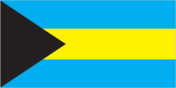
three equal horizontal bands of aquamarine (top), gold, and aquamarine with a black equilateral triangle based on the hoist side
Government type
commonwealth
Independence
10 July 1973 (from UK)
International organization participation
ACP, C, Caricom, CCC, CDB, ECLAC, FAO, G-77, IADB, IBRD, ICAO, ICFTU, ICRM, IFC, IFRCS, ILO, IMF, IMO, Inmarsat, Intelsat, Interpol, IOC, ITU, NAM, OAS, OPANAL, UN, UNCTAD, UNESCO, UNIDO, UPU, WHO, WIPO, WMO, WTrO (applicant)
Judicial branch
Supreme Court
Legal system
based on English common law
Legislative branch
bicameral Parliament consists of the Senate (16-member body appointed by the governor general upon the advice of the prime minister and the opposition leader for a five-year term) and the House of Assembly (40 seats; members elected by direct popular vote to serve five-year terms) elections: last held 14 March 1997 (next to be held by March 2002) election results: percent of vote by party - NA; seats by party - FNM 34, PLP 6
National capital
Nassau
National holiday
National Day, 10 July (1973)
Political parties and leaders
Progressive Liberal Party or PLP [Perry CHRISTIE]; Free National Movement or FNM [Hubert Alexander INGRAHAM]
Suffrage
18 years of age; universal
Economy
Agriculture - products
citrus, vegetables; poultry
Budget
revenues: $665 million expenditures: $725 million, including capital expenditures of $94 million (FY95/96 est.)
Currency
1 Bahamian dollar (B$) = 100 cents
Debt - external
$393 million (1995)
Economic aid
$NA
Economy - overview
The Bahamas is a stable, developing nation with an economy heavily dependent on tourism and offshore banking. Tourism alone accounts for more than 50% of GDP and directly or indirectly employs 40% of the archipelago's labor force. A slowdown in the expansion of the tourism sector - especially stopover travel from Europe - led to a reduction in the country's GDP growth rate in 1995, down to an estimated 2% from 3.5% in 1994. The construction sector benefited from hotel rehabilitation and the government's ongoing housing development program. Earnings from exports of vegetable and citrus production have been decreasing since 1993 but were expected to increase in 1996 due to storm damage to crops in Florida. Overall growth prospects in the short run will depend heavily on the fortunes of the tourism sector and continued income growth in the US, which accounts for the majority of tourist visits.
Electricity - capacity
267,000 kW (1993)
Electricity - consumption per capita
2,717 kWh (1993)
Electricity - production
874 million kWh (1993)
Exchange rates
Bahamian dollar (B$) per US$1 - 1.00 (February 1997; fixed rate)
Exports
total value: $267.5 million (f.o.b., 1995) commodities: pharmaceuticals, cement, rum, crawfish, refined petroleum products partners: US 24%, Spain 14%, UK 7%, Norway 7%, France 6%, Italy 5% (1995 est.)
Fiscal year
1 July - 30 June
GDP
purchasing power parity - $4.8 billion (1995 est.)
GDP - composition by sector
agriculture : 3% industry: 6% services: 91% (1994)
GDP - per capita
purchasing power parity - $18,700 (1995 est.)
GDP - real growth rate
2% (1995 est.)
Imports
total value : $1.17 billion (f.o.b., 1995) commodities: foodstuffs, manufactured goods, crude oil, vehicles, electronics partners : US 29%, Finland 10%, Iran 10%, Denmark 8%
Industrial production growth rate
NA%
Industries
tourism, banking, cement, oil refining and transshipment, salt production, rum, aragonite, pharmaceuticals, spiral-welded steel pipe
Inflation rate - consumer price index
2.1% (1995)
Labor force
total: 136,900 (1993) by occupation : government 30%, tourism 40%, business services 10%, agriculture 5% (1995 est.)
Unemployment rate
15% (1995 est.)
Communications
Radio broadcast stations
AM 3, FM 2, shortwave 0
Radios
200,000 (1993 est.)
Telephone system
domestic : totally automatic system; highly developed international: tropospheric scatter and submarine cable to Florida; 3 coaxial submarine cables; satellite earth station - 1 Intelsat (Atlantic Ocean)
Telephones
119,000 (1987 est.)
Television broadcast stations
1 (1986 est.)
Televisions
60,000 (1993 est.)
Transportation
Airports
54 (1996 est.)
Airports - with paved runways
total : 47 over 3,047 m: 2 2,438 to 3,047 m: 1 1,524 to 2,437 m: 15 914 to 1,523 m: 12 under 914 m: 17 (1996 est.)
Airports - with unpaved runways
total: 7 914 to 1,523 m: 7 (1996 est.)
Highways
total: 2,450 km paved: 1,406 km unpaved: 1,044 km (1995 est.)
Merchant marine
total: 988 ships (1,000 GRT or over) totaling 23,690,478 GRT/37,428,826 DWT ships by type: bulk 176, cargo 205, chemical tanker 41, combination bulk 7, combination ore/oil 23, container 56, liquefied gas tanker 21, oil tanker 184, passenger 47, refrigerated cargo 150, roll-on/roll-off cargo 53, short-sea passenger 11, vehicle carrier 14 note: a flag of convenience registry; includes ships from 46 countries among which are Norway 157, Greece 146, UK 128, US 69, Denmark 51, Sweden 34, Finland 32, Belgium 29, Japan 27, and Monaco 27; Bahamas owns 10 additional ships (1,000 GRT or over) totaling 256,379 DWT that operate under Panamanian and Cypriot registry (1996 est.)
Ports and harbors
Freeport, Matthew Town, Nassau
Railways
0 km
Military and Security
Military branches
Royal Bahamas Defense Force (Coast Guard only), Royal Bahamas Police Force
Military expenditures - dollar figure
$20 million (FY95/96)
Military expenditures - percent of GDP
3.8% (FY95/96)
Military manpower - availability
males age 15-49: NA
Military manpower - fit for military service
males : NA
Transnational Issues
Disputes - international
none
Illicit drugs
transshipment point for cocaine and marijuana bound for US and Europe; banking industry vulnerable to money-laundering ______________________________________________________________________ BAHRAIN