1991 Edition
CIA World Factbook 1991 (Project Gutenberg)
Geography
Climate
tropical marine; moderated by warm waters of Gulf Stream
Coastline
3,542 km
Comparative area
slightly larger than Connecticut
Environment
subject to hurricanes and other tropical storms that cause extensive flood damage
Land boundaries
none
Land use
arable land 1%; permanent crops NEGL%; meadows and pastures NEGL%; forest and woodland 32%; other 67%
Maritime claims
Continental shelf: 200 m (depth) or to depth of exploitation; Exclusive fishing zone: 200 nm; Territorial sea: 3 nm
Natural resources
salt, aragonite, timber
Note
strategic location adjacent to US and Cuba; extensive island chain
Terrain
long, flat coral formations with some low rounded hills
Total area
13,940 km2; land area: 10,070 km2
People and Society
Birth rate
19 births/1,000 population (1991)
Death rate
5 deaths/1,000 population (1991)
Ethnic divisions
black 85%, white 15%
Infant mortality rate
18 deaths/1,000 live births (1991)
Labor force
132,600; government 30%, hotels and restaurants 25%, business services 10%, agriculture 5% (1986)
Language
English; some Creole among Haitian immigrants
Life expectancy at birth
69 years male, 76 years female (1991)
Literacy
90% (male 90%, female 89%) age 15 and over but definition of literacy not available (1963 est.)
Nationality
noun--Bahamian(s); adjective--Bahamian
Net migration rate
0 migrants/1,000 population (1991)
Organized labor
25% of labor force
Population
252,110 (July 1991), growth rate 1.4% (1991)
Religion
Baptist 32%, Anglican 20%, Roman Catholic 19%, Methodist 6%, Church of God 6%, other Protestant 12%, none or unknown 3%, other 2% (1980)
Total fertility rate
2.2 children born/woman (1991)
Government
Administrative divisions
21 districts; Abaco, Acklins Island, Andros Island, Berry Islands, Biminis, Cat Island, Cay Lobos, Crooked Island, Eleuthera, Exuma, Grand Bahama, Harbour Island, Inagua, Long Cay, Long Island, Mayaguana, New Providence, Ragged Island, Rum Cay, San Salvador, Spanish Wells
Capital
Nassau
Communists
none known
Constitution
10 July 1973
Diplomatic representation
Ambassador Margaret E. McDONALD; Chancery at Suite 865, 600 New Hampshire Avenue NW, Washington DC 20037; telephone (202) 944-3390; there are Bahamian Consulates General in Miami and New York; US--Ambassador Chic HECHT; Embassy at Mosmar Building, Queen Street, Nassau (mailing address is P. O. Box N-8197, Nassau); telephone (809) 322-1181 or 328-2206
Elections
House of Assembly--last held 19 June 1987 (next to be held by June 1992); results--percent of vote by party NA; seats--(49 total) PLP 32, FNM 17
Executive branch
British monarch, governor general, prime minister, deputy prime minister, Cabinet
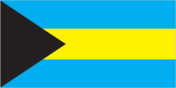
Flag
three equal horizontal bands of aquamarine (top), gold, and aquamarine with a black equilateral triangle based on the hoist side
Independence
10 July 1973 (from UK)
Judicial branch
Supreme Court
Leaders
Chief of State--Queen ELIZABETH II (since 6 February 1952), represented by Acting Governor General Sir Henry TAYLOR (since 26 June 1988); Head of Government--Prime Minister Sir Lynden Oscar PINDLING (since 16 January 1967)
Legal system
based on English common law
Legislative branch
bicameral Parliament consists of an upper house or Senate and a lower house or House of Assembly
Long-form name
The Commonwealth of The Bahamas
Member of
ACP, C, CCC, CARICOM, CDB, ECLAC, FAO, G-77, IADB, IBRD, ICAO, ICFTU, IFC, ILO, IMF, IMO, INTELSAT, INTERPOL, IOC, ITU, LORCS, NAM, OAS, OPANAL, UN, UNCTAD, UNESCO, UNIDO, UPU, WHO, WIPO, WMO
National holiday
Independence Day, 10 July (1973)
Other political or pressure groups
Vanguard Nationalist and Socialist Party (VNSP), a small leftist party headed by Lionel CAREY; Trade Union Congress (TUC), headed by Arlington MILLER
Political parties and leaders
Progressive Liberal Party (PLP), Sir Lynden O. PINDLING; Free National Movement (FNM), Hubert Alexander INGRAHAM
Suffrage
universal at age 18
Type
commonwealth
Economy
Agriculture
accounts for less than 5% of GDP; dominated by small-scale producers; principal products--citrus fruit, vegetables, poultry; large net importer of food
Budget
revenues $1.03 billion; expenditures $1.1 billion, including capital expenditures of $275 million (1990)
Currency
Bahamian dollar (plural--dollars); 1 Bahamian dollar (B$) = 100 cents
Economic aid
US commitments, including Ex-Im (FY85-88), $1.0 million; Western (non-US) countries, ODA and OOF bilateral commitments (1970-88), $345 million
Electricity
368,000 kW capacity; 857 million kWh produced, 3,480 kWh per capita (1990)
Exchange rates
Bahamian dollar (B$) per US$1--1.00 (fixed rate)
Exports
$300 million (f.o.b., 1990 est.); commodities--pharmaceuticals, cement, rum, crawfish; partners--US 41%, Norway 30%, Denmark 4%
External debt
$1.2 billion (December 1990)
Fiscal year
calendar year
GDP
$2.4 billion, per capita $9,800; real growth rate 2.0% (1989 est.)
Illicit drugs
transshipment point for cocaine
Imports
$1.23 billion (f.o.b., 1990 est.); commodities--foodstuffs, manufactured goods, mineral fuels; partners--US 35%, Nigeria 21%, Japan 13%, Angola 11%
Industrial production
growth rate NA%; accounts for 15% of GDP
Industries
tourism, banking, cement, oil refining and transshipment, salt production, rum, aragonite, pharmaceuticals, spiral weld, steel pipe
Inflation rate (consumer prices)
7.1% (1990 est.)
Overview
The Bahamas is a stable, middle-income developing nation whose economy is based primarily on tourism and offshore banking. Tourism alone provides about 50% of GDP and directly or indirectly employs about 50,000 people or 40% of the local work force. The economy has slackened in recent years, as the annual increase in the number of tourists slowed. Nonetheless, the per capita GDP of $9,800 is one of the highest in the region.
Unemployment
11.7% (1989)
Communications
Airports
59 total, 57 usable; 31 with permanent-surface runways; none with runways over 3,659 m; 3 with runways 2,440-3,659 m; 25 with runways 1,220-2,439 m
Civil air
9 major transport aircraft
Highways
2,400 km total; 1,350 km paved, 1,050 km gravel
Merchant marine
636 ships (1,000 GRT or over) totaling 14,266,066 GRT/23,585,465 DWT; includes 42 passenger, 16 short-sea passenger, 190 cargo, 41 roll-on/roll-off cargo, 23 container, 5 car carrier, 1 railroad carrier, 141 petroleum, oils, and lubricants (POL) tanker, 8 liquefied gas, 15 combination ore/oil, 33 chemical tanker, 1 specialized tanker, 112 bulk, 8 combination bulk; note--a flag of convenience registry
Ports
Freeport, Nassau
Telecommunications
highly developed; 99,000 telephones in totally automatic system; tropospheric scatter and submarine cable links to Florida; stations--3 AM, 2 FM, 1 TV; 3 coaxial submarine cables; 1 Atlantic Ocean INTELSAT earth station
Military and Security
Branches
Royal Bahamas Defense Force (a coast guard element only), Royal Bahamas Police Force
Defense expenditures
$65 million, 2.7% of GDP (1990) _%_
Manpower availability
males 15-49, 68,020; NA fit for military service