1999 Edition
CIA World Factbook 1999 (Internet Archive)
Geography
Area
total: 514,000 sq km land: 511,770 sq km water: 2,230 sq km
Area--comparative
slightly more than twice the size of Wyoming
Climate
tropical; rainy, warm, cloudy southwest monsoon (mid-May to September); dry, cool northeast monsoon (November to mid-March); southern isthmus always hot and humid
Coastline
3,219 km
Elevation extremes
lowest point: Gulf of Thailand 0 m highest point: Doi Inthanon 2,576 m
Environment--current issues
air pollution from vehicle emissions; water pollution from organic and factory wastes; deforestation; soil erosion; wildlife populations threatened by illegal hunting
Environment--international agreements
party to: Climate Change, Endangered Species, Hazardous Wastes, Marine Life Conservation, Nuclear Test Ban, Ozone Layer Protection, Tropical Timber 83, Tropical Timber 94 signed, but not ratified: Biodiversity, Climate Change-Kyoto Protocol, Law of the Sea
Geographic coordinates
15 00 N, 100 00 E
Geography--note
controls only land route from Asia to Malaysia and Singapore
Irrigated land
44,000 sq km (1993 est.)
Land boundaries
total: 4,863 km border countries: Burma 1,800 km, Cambodia 803 km, Laos 1,754 km, Malaysia 506 km
Land use
arable land: 34% permanent crops: 6% permanent pastures: 2% forests and woodland: 26% other: 32% (1993 est.)
Location
Southeastern Asia, bordering the Andaman Sea and the Gulf of Thailand, southeast of Burma
Map references
Southeast Asia
Maritime claims
continental shelf: 200-m depth or to the depth of exploitation exclusive economic zone: 200 nm territorial sea: 12 nm
Natural hazards
land subsidence in Bangkok area resulting from the depletion of the water table; droughts
Natural resources
tin, rubber, natural gas, tungsten, tantalum, timber, lead, fish, gypsum, lignite, fluorite
Terrain
central plain; Khorat Plateau in the east; mountains elsewhere
People and Society
Age structure
0-14 years: 24% (male 7,364,411; female 7,095,428) 15-64 years: 70% (male 20,878,602; female 21,493,735) 65 years and over: 6% (male 1,664,113; female 2,112,757) (1999 est.)
Birth rate
16.46 births/1,000 population (1999 est.)
Death rate
7.16 deaths/1,000 population (1999 est.)
Ethnic groups
Thai 75%, Chinese 14%, other 11%
Infant mortality rate
29.54 deaths/1,000 live births (1999 est.)
Languages
Thai, English (secondary language of the elite), ethnic and regional dialects
Life expectancy at birth
total population: 69.21 years male: 65.58 years female: 73.01 years (1999 est.)
Literacy
definition: age 15 and over can read and write total population: 93.8% male: 96% female: 91.6% (1995 est.)
Nationality
noun: Thai (singular and plural) adjective: Thai
Net migration rate
0 migrant(s)/1,000 population (1999 est.)
Population
60,609,046 (July 1999 est.)
Population growth rate
0.93% (1999 est.)
Religions
Buddhism 95%, Muslim 3.8%, Christianity 0.5%, Hinduism 0.1%, other 0.6% (1991)
Sex ratio
at birth: 1.05 male(s)/female under 15 years: 1.04 male(s)/female 15-64 years: 0.97 male(s)/female 65 years and over: 0.79 male(s)/female total population: 0.97 male(s)/female (1999 est.)
Total fertility rate
1.82 children born/woman (1999 est.)
Government
Administrative divisions
76 provinces (changwat, singular and plural); Amnat Charoen, Ang Thong, Buriram, Chachoengsao, Chai Nat, Chaiyaphum, Chanthaburi, Chiang Mai, Chiang Rai, Chon Buri, Chumphon, Kalasin, Kamphaeng Phet, Kanchanaburi, Khon Kaen, Krabi, Krung Thep Mahanakhon (Bangkok), Lampang, Lamphun, Loei, Lop Buri, Mae Hong Son, Maha Sarakham, Mukdahan, Nakhon Nayok, Nakhon Pathom, Nakhon Phanom, Nakhon Ratchasima, Nakhon Sawan, Nakhon Si Thammarat, Nan, Narathiwat, Nong Bua Lamphu, Nong Khai, Nonthaburi, Pathum Thani, Pattani, Phangnga, Phatthalung, Phayao, Phetchabun, Phetchaburi, Phichit, Phitsanulok, Phra Nakhon Si Ayutthaya, Phrae, Phuket, Prachin Buri, Prachuap Khiri Khan, Ranong, Ratchaburi, Rayong, Roi Et, Sa Kaeo, Sakon Nakhon, Samut Prakan, Samut Sakhon, Samut Songkhram, Sara Buri, Satun, Sing Buri, Sisaket, Songkhla, Sukhothai, Suphan Buri, Surat Thani, Surin, Tak, Trang, Trat, Ubon Ratchathani, Udon Thani, Uthai Thani, Uttaradit, Yala, Yasothon
Capital
Bangkok
Constitution
new constitution signed by King PHUMIPHON on 11 October 1997
Country name
conventional long form: Kingdom of Thailand conventional short form: Thailand
Data code
TH
Executive branch
chief of state: King PHUMIPHON Adunyadet (since 9 June 1946) head of government: Prime Minister CHUAN Likphai (since 15 November 1997) cabinet: Council of Ministers note: there is also a Privy Council elections: none; the monarch is hereditary; prime minister designated from among the members of the House of Representatives; following a national election for the House of Representatives, the leader of the party that can organize a majority coalition usually becomes prime minister
Flag description
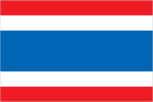
five horizontal bands of red (top), white, blue (double width), white, and red
Government type
constitutional monarchy
Independence
1238 (traditional founding date; never colonized)
International organization participation
APEC, AsDB, ASEAN, CCC, CP, ESCAP, FAO, G-77, IAEA, IBRD, ICAO, ICFTU, ICRM, IDA, IFAD, IFC, IFRCS, IHO, ILO, IMF, IMO, Inmarsat, Intelsat, Interpol, IOC, IOM, ISO, ITU, NAM, OPCW, PCA, UN, UNCTAD, UNESCO, UNHCR, UNIDO, UNIKOM, UNMIBH, UNU, UPU, WCL, WFTU, WHO, WIPO, WMO, WToO, WTrO Diplomatic representation in the US: chief of mission: Ambassador NIT Phibunsongkhram chancery: 1024 Wisconsin Avenue NW, Washington, DC 20007 consulate(s) general: Chicago, Los Angeles, and New York Diplomatic representation from the US: chief of mission: Ambassador Richard HECKLINGER embassy: 120 Wireless Road, Bangkok mailing address: APO AP 96546 consulate(s) general: Chiang Mai
Judicial branch
Supreme Court (Sandika), judges appointed by the monarch Political parties and leaders: Thai Nation Party or TNP (Chat Yoobamrung, SOPHON Petchsavang]
Legal system
based on civil law system, with influences of common law; has not accepted compulsory ICJ jurisdiction
Legislative branch
bicameral National Assembly or Rathasapha consists of the Senate or Wuthisapha (a 253-member appointed body which will be phased into a 200-member elected body starting in March 2000; members serve six-year terms) and the House of Representatives or Sapha Phuthaen Ratsadon (currently has 391 members, but will become a 500-member body after the next election; members elected by popular vote to serve four-year terms) elections: House of Representatives--last held 17 November 1996 (next scheduled to be held by 17 November 2000, but may be held earlier) election results: House of Representatives--percent of vote by party--NA; seats by party--NAP 125, DP 123, NDP 52, TNP 39, SAP 20, TCP 18, SP 8, LDP 4, MP 2
National holiday
Birthday of His Majesty the King, 5 December (1927)
Suffrage
18 years of age; universal and compulsory
Economy
Agriculture--products
rice, cassava (tapioca), rubber, corn, sugarcane, coconuts, soybeans
Budget
revenues: $24 billion expenditures: $25 billion, including capital expenditures of $8 billion (FY96/97)
Currency
1 baht (B) = 100 satang
Debt--external
$90 billion (1997)
Economic aid--recipient
$1.732 billion (1995)
Economy--overview
After months of speculative pressure on the Thai baht, the government decided to float the currency in July 1997, the symbolic beginning of the country's current economic crisis. The crisis--which began in the country's financial sector--has spread throughout the economy. After years of rapid economic growth averaging 9% earlier this decade, the Thai economy contracted 0.4% in 1997 and shrunk another 8.5% in 1998. In the years before the crisis, Thailand ran persistent current account deficits. With the depreciation of the Thai baht and the collapse of domestic demand, however, imports have fallen off sharply--by more than 33%--and Thailand posted a trade surplus of approximately $12 billion in 1998. Foreign investment for new projects, the long-time catalyst of Thailand's economic growth, has also slowed. The CHUAN government has closely adhered to the economic recovery program prescribed by the IMF. The cooperation afforded Thailand stability in the value of its currency in the second half of 1998 and helped replenish foreign reserves. Tough measures--including passage of adequate bankruptcy and foreclosure legislation as well as privatization of state-owned companies and recapitalization of the financial sector--remain undone. Bangkok is also trying to establish a social safety net for those displaced by the current economic crisis and is working to increase the quality of Thailand's labor force.
Electricity--consumption
82.561 billion kWh (1996)
Electricity--exports
79 million kWh (1996)
Electricity--imports
640 million kWh (1996)
Electricity--production
82 billion kWh (1996)
Electricity--production by source
fossil fuel: 91.46% hydro: 8.54% nuclear: 0% other: 0% (1996)
Exchange rates
baht (B) per US$1--36.624 (January 1999), 41.359 (1998), 31.364 (1997), 25.343 (1996), 24.915 (1995), 25.150 (1994)
Exports
$51.6 billion (f.o.b., 1997)
Exports--commodities
manufactures 82% (computers and parts 16%), agricultural products and fisheries 14% (1997)
Exports--partners
US 19.6%, Japan 14.9%, Singapore 11%, Hong Kong 5.7%, Malaysia 4.3%, UK 3.7% (1997)
Fiscal year
1 October--30 September
GDP
purchasing power parity--$369 billion (1998 est.)
GDP--composition by sector
agriculture: 12% industry: 39% services: 49% (1997 est.)
GDP--per capita
purchasing power parity?$6,100 (1998 est.)
GDP--real growth rate
-8.5% (1998 est.)
Household income or consumption by percentage share
lowest 10%: 2.5% highest 10%: 37.1% (1992)
Imports
$73.5 billion (c.i.f., 1996)
Imports--commodities
capital goods 50%, intermediate goods and raw materials 22%, consumer goods 10.2%, fuels 8.7% (1997)
Imports--partners
Japan 25.6%, US 13.9%, Singapore 5%, Taiwan 4.6%, Germany 4.5%, Malaysia 4.1% (1997)
Industrial production growth rate
-10% (1998)
Industries
tourism; textiles and garments, agricultural processing, beverages, tobacco, cement, light manufacturing, such as jewelry; electric appliances and components, computers and parts, integrated circuits, furniture, plastics; world's second-largest tungsten producer and third-largest tin producer
Inflation rate (consumer prices)
4.3% (1998 est.)
Labor force
32.6 million (1997 est.)
Labor force--by occupation
agriculture 54%, industry 15%, services (including government) 31% (1996 est.)
Population below poverty line
13.1% (1992 est.)
Unemployment rate
4.5% (1998 est.)
Communications
Radio broadcast stations
AM 200 (in government-controlled network), FM 100 (in government-controlled network), shortwave 0
Radios
10.75 million (1992 est.)
Telephone system
service to general public adequate, but investments in technological upgrades reduced by recession; bulk of service to government activities provided by multichannel cable and microwave radio relay network domestic: microwave radio relay and multichannel cable; domestic satellite system being developed international: satellite earth stations--2 Intelsat (1 Indian Ocean and 1 Pacific Ocean)
Telephones
1,553,200 (1994 est.)
Television broadcast stations
5 (all in Bangkok; in addition, there are 131 repeaters) (1997)
Televisions
3.3 million (1993 est.)
Transportation
Airports
107 (1998 est.) Airports--with paved runways: total: 56 over 3,047 m: 6 2,438 to 3,047 m: 9 1,524 to 2,437 m: 17 914 to 1,523 m: 20 under 914 m: 4 (1998 est.) Airports--with unpaved runways: total: 51 1,524 to 2,437 m: 1 914 to 1,523 m: 15 under 914 m: 35 (1998 est.)
Heliports
3 (1998 est.)
Highways
total: 64,600 km paved: 62,985 km unpaved: 1,615 km (1996 est.)
Merchant marine
total: 293 ships (1,000 GRT or over) totaling 1,848,626 GRT/2,989,382 DWT ships by type: bulk 41, cargo 135, chemical tanker 5, combination bulk 1, container 13, liquefied gas tanker 17, multifunction large-load carrier 3, oil tanker 61, passenger 1, refrigerated cargo 11, roll-on/roll-off cargo 2, short-sea passenger 1, specialized tanker 2 (1998 est.)
Pipelines
petroleum products 67 km; natural gas 350 km Ports and harbors: Bangkok, Laem Chabang, Pattani, Phuket, Sattahip, Si Racha, Songkhla
Railways
total: 4,623 km narrow gauge: 4,623 km 1.000-m gauge (99 km double track)
Waterways
3,999 km principal waterways; 3,701 km with navigable depths of 0.9 m or more throughout the year; numerous minor waterways navigable by shallow-draft native craft
Military and Security
Military branches
Royal Thai Army, Royal Thai Navy (includes Royal Thai Marine Corps), Royal Thai Air Force, Paramilitary Forces
Military expenditures--dollar figure
$1.95 billion (FY97/98)
Military expenditures--percent of GDP
2.5% (FY97/98)
Military manpower--availability
males age 15-49: 17,486,014 (1999 est.) Military manpower--fit for military service: males age 15-49: 10,536,417 (1999 est.)
Military manpower--military age
18 years of age
Military manpower--reaching military age annually
males: 585,562 (1999 est.)
Transnational Issues
Disputes--international
parts of the border with Laos are indefinite; maritime boundary with Vietnam resolved, August 1997; parts of border with Cambodia are indefinite; maritime boundary with Cambodia not clearly defined; sporadic conflict with Burma over alignment of border
Illicit drugs
a minor producer of opium, heroin, and marijuana; major illicit transit point for heroin en route to the international drug market from Burma and Laos; eradication efforts have reduced the area of cannabis cultivation and shifted some production to neighboring countries; opium poppy cultivation has been reduced by eradication efforts; also a drug money-laundering center; minor role in amphetamine production for regional consumption; increasing indigenous abuse of methamphetamines and heroin