2010 Edition
CIA World Factbook 2010 (Project Gutenberg)
Introduction
Background
The Tajik people came under Russian rule in the 1860s and 1870s, but Russia's hold on Central Asia weakened following the Revolution of 1917. Bolshevik control of the area was fiercely contested and not fully reestablished until 1925. Much of present-day Sughd province was transferred from the Uzbek SSR to the newly formed Tajik SSR in 1929. Ethnic Uzbeks form a substantial minority in Sughd province. Tajikistan became independent in 1991 following the breakup of the Soviet Union, and experienced a civil war between regional factions from 1992-97. There have been no major security incidents in recent years, although the country remains the poorest in the former Soviet sphere. Attention by the international community since the beginning of the NATO intervention in Afghanistan has brought increased economic development and security assistance, which could create jobs and strengthen stability in the long term. Tajikistan is in the early stages of seeking World Trade Organization membership and has joined NATO's Partnership for Peace.
Geography
Area
- land
- 141,510 sq km
- total
- 143,100 sq km
- water
- 2,590 sq km
Area - comparative
slightly smaller than Wisconsin
Climate
midlatitude continental, hot summers, mild winters; semiarid to polar in Pamir Mountains
Coastline
0 km (landlocked)
Elevation extremes
- highest point
- Qullai Ismoili Somoni (Pik Imeni Ismail Samani) 7,495 m
- lowest point
- Syr Darya (Sirdaryo) 300 m
Environment - current issues
inadequate sanitation facilities; increasing levels of soil salinity; industrial pollution; excessive pesticides
Environment - international agreements
- party to
- Biodiversity, Climate Change, Climate Change-Kyoto Protocol, Desertification, Environmental Modification, Ozone Layer Protection, Wetlands signed, but not ratified: none of the selected agreements
Freshwater withdrawal (domestic/industrial/agricultural)
- per capita
- 1,837 cu m/yr (2000)
- total
- 11.96 cu km/yr (4%/5%/92%)
Geographic coordinates
39 00 N, 71 00 E
Geography - note
landlocked; mountainous region dominated by the Trans-Alay Range in the north and the Pamirs in the southeast; highest point, Qullai Ismoili Somoni (formerly Communism Peak), was the tallest mountain in the former USSR
Irrigated land
7,220 sq km (2003)
Land boundaries
- border countries
- Afghanistan 1,206 km, China 414 km, Kyrgyzstan 870 km, Uzbekistan 1,161 km
- total
- 3,651 km
Land use
- arable land
- 6.52%
- other
- 92.59% (2005)
- permanent crops
- 0.89%
Location
Central Asia, west of China
Map references
Asia
Maritime claims
none (landlocked)
Natural hazards
earthquakes; floods
Natural resources
hydropower, some petroleum, uranium, mercury, brown coal, lead, zinc, antimony, tungsten, silver, gold
Terrain
Pamir and Alay Mountains dominate landscape; western Fergana Valley in north, Kofarnihon and Vakhsh Valleys in southwest
Total renewable water resources
99.7 cu km (1997)
People and Society
Age structure
0-14 years: 34.3% (male 1,282,681/female 1,238,607) 15-64 years: 62.1% (male 2,260,552/female 2,303,034) 65 years and over: 3.6% (male 112,334/female 151,937) (2010 est.)
Birth rate
26.49 births/1,000 population (2010 est.)
Death rate
6.72 deaths/1,000 population (July 2010 est.)
Education expenditures
3.5% of GDP (2008)
Ethnic groups
Tajik 79.9%, Uzbek 15.3%, Russian 1.1%, Kyrgyz 1.1%, other 2.6% (2000 census)
HIV/AIDS - adult prevalence rate
less than 0.3% (2007 est.)
HIV/AIDS - deaths
fewer than 500 (2007 est.)
HIV/AIDS - people living with HIV/AIDS
10,000 (2007 est.)
Infant mortality rate
- female
- 34.77 deaths/1,000 live births (2010 est.)
- male
- 44.55 deaths/1,000 live births
- total
- 39.78 deaths/1,000 live births
Languages
Tajik (official), Russian widely used in government and business
Life expectancy at birth
- female
- 68.88 years (2010 est.)
- male
- 62.63 years
- total population
- 65.68 years
Literacy
- definition: age 15 and over can read and write
- female
- 99.2% (2000 census)
- male
- 99.7%
- total population
- 99.5%
Major infectious diseases
- degree of risk
- high
- food or waterborne diseases
- bacterial diarrhea, hepatitis A, and typhoid fever
- vectorborne disease
- malaria (2009)
Median age
- female
- 22.7 years (2010 est.)
- male
- 21.7 years
- total
- 22.2 years
Nationality
- adjective
- Tajikistani
- noun
- Tajikistani(s)
Net migration rate
-1.26 migrant(s)/1,000 population (2010 est.)
Population
7,487,489 (July 2010 est.)
Population growth rate
1.852% (2010 est.)
Religions
Sunni Muslim 85%, Shia Muslim 5%, other 10% (2003 est.)
School life expectancy (primary to tertiary education)
- female
- 10 years (2008)
- male
- 12 years
- total
- 11 years
Sex ratio
- at birth
- 1.05 male(s)/female under 15 years: 1.04 male(s)/female 15-64 years: 0.98 male(s)/female 65 years and over: 0.74 male(s)/female
- total population
- 0.99 male(s)/female (2010 est.)
Total fertility rate
2.94 children born/woman (2010 est.)
Urbanization
- rate of urbanization
- 1.6% annual rate of change (2005-10 est.)
- urban population
- 26% of total population (2008)
Government
Administrative divisions
2 provinces (viloyatho, singular - viloyat) and 1 autonomous province* (viloyati mukhtor); Viloyati Khatlon (Qurghonteppa), Viloyati Mukhtori Kuhistoni Badakhshon [Gorno-Badakhshan]* (Khorugh), Viloyati Sughd (Khujand) note: the administrative center name follows in parentheses
Capital
- geographic coordinates
- 38 35 N, 68 48 E
- name
- Dushanbe
- time difference
- UTC+5 (10 hours ahead of Washington, DC during Standard Time)
Constitution
6 November 1994
Country name
- conventional long form
- Republic of Tajikistan
- conventional short form
- Tajikistan
- former
- Tajik Soviet Socialist Republic
- local long form
- Jumhurii Tojikiston
- local short form
- Tojikiston
Diplomatic representation from the US
- chief of mission
- Ambassador Kenneth GROSS
- embassy
- 109-A Ismoili Somoni Avenue, Dushanbe 734019
- FAX
- [992] (37) 229-20-50
- mailing address
- 7090 Dushanbe Place, Dulles, VA 20189
- telephone
- [992] (37) 229-20-00
Diplomatic representation in the US
- chancery
- 1005 New Hampshire Avenue NW, Washington, DC 20037
- chief of mission
- Ambassador Abdujabbor SHIRINOV
- FAX
- [1] (202) 223-6091
- telephone
- [1] (202) 223-6090
Executive branch
- cabinet
- Council of Ministers appointed by the president, approved by the Supreme Assembly (For more information visit the World Leaders website )
- chief of state
- President Emomali RAHMON (since 6 November 1994; head of state and Supreme Assembly chairman since 19 November 1992)
- election results
- Emomali RAHMON reelected president; percent of vote - Emomali RAHMON 79.3%, Olimjon BOBOEV 6.2%, other 14.5%
- elections
- president elected by popular vote for a seven-year term (eligible for a second term); election last held on 6 November 2006 (next to be held in November 2013); prime minister appointed by the president
- head of government
- Prime Minister Oqil OQILOV (since 20 January 1999)
Flag description
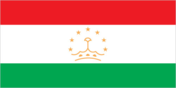
three horizontal stripes of red (top), a wider stripe of white, and green; a gold crown surmounted by seven gold, five-pointed stars is located in the center of the white stripe; red represents the sun, victory, and the unity of the nation, white stands for purity, cotton, and mountain snows, while green is the color of Islam and the bounty of nature; the crown symbolizes the Tajik people; the seven stars signify the Tajik magic word "seven" - a symbol of perfection and the embodiment of happiness
Government type
republic
Independence
9 September 1991 (from the Soviet Union)
International organization participation
ADB, CICA, CIS, CSTO, EAEC, EAPC, EBRD, ECO, FAO, G-77, GCTU, IAEA, IBRD, ICAO, ICCt, ICRM, IDA, IDB, IFAD, IFC, IFRCS, ILO, IMF, Interpol, IOC, IOM, IPU, ISO (correspondent), ITSO, ITU, MIGA, NAM (observer), OIC, OPCW, OSCE, PFP, SCO, UN, UNCTAD, UNESCO, UNIDO, UNWTO, UPU, WCO, WFTU, WHO, WIPO, WMO, WTO (observer)
Judicial branch
Supreme Court (judges are appointed by the president)
Legal system
based on civil law system; no judicial review of legislative acts; has not accepted compulsory ICJ jurisdiction
Legislative branch
- bicameral Supreme Assembly or Majlisi Oli consists of the National Assembly (upper chamber) or Majlisi Milliy (34 seats; 25 members selected by local deputies, 8 appointed by the president; 1 seat reserved for the former president; members serve five-year terms) and the Assembly of Representatives (lower chamber) or Majlisi Namoyandagon (63 seats; members elected by popular vote to serve five-year terms)
- election results
- National Assembly - percent of vote by party - NA; seats by party - NA; Assembly of Representatives - percent of vote by party - PDPT 71%, Islamic Revival Party 8.2%, CPT 7%, APT 5.1%, PER 5.1%, other 3.6%; seats by party - PDPT 55, Islamic Revival Party 2, CPT 2, APT 2, PER 2
- elections
- National Assembly - last held on 28 February 2010 (next to be held in February 2015); Assembly of Representatives - last held on 28 February 2010 (next to be held in February 2015)
National anthem
- lyrics/music
- Gulnazar KELDI/Suleiman YUDAKOV note: adopted 1991; after the fall of the Soviet Union, Tajikistan kept the music of the anthem from its time as a Soviet republic but adopted new lyrics
- name
- "Surudi milli" (National Anthem)
National holiday
Independence Day (or National Day), 9 September (1991)
Political parties and leaders
Agrarian Party of Tajikistan or APT [Amir QARAQULOV]; Democratic Party or DPT [Mahmadruzi ISKANDAROV (imprisoned October 2005); Rahmatullo VALIYEV, deputy]; Islamic Revival Party [Muhiddin KABIRI]; Party of Economic Reform or PER [Olimjon BOBOEV]; Party of Economic Reforms [Mahmadsharif NOZIMOV]; People's Democratic Party of Tajikistan or PDPT [Emomali RAHMON]; Social Democratic Party or SDPT [Rahmatullo ZOYIROV]; Socialist Party or SPT [Mirhuseyn NARZIEV]; Tajik Communist Party or CPT [Shodi SHABDOLOV]
Political pressure groups and leaders
- splinter parties recognized by the government but not by the base of
- the party
- Democratic Party or DPT [Masud SOBIROV] (splintered from ISKANDAROV's DPT); Socialist Party or SPT [Abduhalim GHAFFOROV] (splintered from NARZIEV's SPT)
- unregistered political parties
- Agrarian Party [Hikmatullo NASREDDINOV]; Progressive Party [Sulton QUVVATOV]; Unity Party [Hikmatullo SAIDOV]
Suffrage
18 years of age; universal
Economy
Agriculture - products
cotton, grain, fruits, grapes, vegetables; cattle, sheep, goats
Central bank discount rate
8% (31 December 2009) 13.5% (31 December 2008)
Commercial bank prime lending rate
22.91% (31 December 2009 est.) 23.7% (31 December 2008 est.)
Current account balance
-$330 million (2010 est.) -$179.9 million (2009 est.)
Debt - external
$1.997 billion (31 December 2010 est.) $1.771 billion (31 December 2009 est.)
Distribution of family income - Gini index
32.6 (2006) 34.7 (1998)
Economy - overview
Tajikistan has one of the lowest per capita GDPs among the 15 former Soviet republics. Because of a lack of employment opportunities in Tajikistan, nearly half of the labor force works abroad, primarily in Russia and Kazakhstan, supporting families in Tajikistan through remittances. The exact number of labor migrants is unknown, but estimated at around 1 million. Less than 7% of the land area is arable. Cotton is the most important crop, but this sector is burdened with debt and obsolete infrastructure; moreover, government has encouraged a gradual transition away from cotton and towards food cultivation due to its concerns about feeding the population. Mineral resources include silver, gold, uranium, and tungsten. Industry consists only of a large aluminum plant, hydropower facilities, and small obsolete factories mostly in light industry and food processing. The civil war (1992-97) severely damaged the already weak economic infrastructure and caused a sharp decline in industrial and agricultural production. Tajikistan's economic situation remains fragile due to uneven implementation of structural reforms, corruption, weak governance, seasonal power shortages, and the external debt burden. A debt restructuring agreement was reached with Russia in December 2002, including a $250 million write-off of Tajikistan's $300 million debt. Completion of the Sangtuda I hydropower dam - finished in 2009 with Russian investment - and the Sangtuda II and Rogun dams will add substantially to electricity output. If finished according to Tajik plans, Rogun will be the world's tallest dam. The World Bank, in 2010, agreed to fund safety and feasibility studies for the Rogun Dam. Favorable reports from these studies could increase investor interest in the project, which has been stalled due to lack of funding. Tajikistan has also received substantial infrastructure development loans from the Chinese government to improve roads and an electricity transmission network. To help increase north-south trade, the US funded a $36 million bridge which opened in August 2007 and links Tajikistan and Afghanistan. While Tajikistan has experienced steady economic growth since 1997, more than half of the population continues to live in poverty. Economic growth reached 10.6% in 2004, but dropped below 8% in 2005-08, as the effects of higher oil prices and then the international financial crisis began to register - mainly in the form of lower prices for key export commodities and lower remittances from Tajiks working abroad, due to the global economic downturn. In 2009 GDP growth dropped to 3.4% as a result of the world recession.
Electricity - consumption
16.7 billion kWh (2009)
Electricity - exports
1 billion kWh (2008 est.)
Electricity - imports
667.8 million kWh (2009 est.)
Electricity - production
16.1 billion kWh (2009 est.)
Exchange rates
Tajikistani somoni (TJS) per US dollar - 4.3788 (2010), 4.1428 (2009), 3.4563 (2008), 3.4418 (2007), 3.3 (2006)
Exports
$1.318 billion (2010 est.) $1.039 billion (2009 est.)
Exports - commodities
aluminum, electricity, cotton, fruits, vegetable oil, textiles
Exports - partners
Russia 19.16%, China 18.38%, Turkey 12.09%, Iran 11.11%, Uzbekistan 7.92%, Norway 6.17%, Greece 4.32% (2009)
GDP - composition by sector
- agriculture
- 19.2%
- industry
- 22.6%
- services
- 58.1% (2010 est.)
GDP - per capita (PPP)
$2,000 (2010 est.) $1,900 (2009 est.) $1,900 (2008 est.) note: data are in 2010 US dollars
GDP - real growth rate
5.5% (2010 est.) 3.4% (2009 est.) 7.9% (2008 est.)
GDP (official exchange rate)
$5.578 billion (2010 est.)
GDP (purchasing power parity)
$14.61 billion (2010 est.) $13.85 billion (2009 est.) $13.4 billion (2008 est.) note: data are in 2010 US dollars
Household income or consumption by percentage share
lowest 10%: 3.3% highest 10%: 25.6% (2007 est.)
Imports
$3.301 billion (2010 est.) $2.77 billion (2009 est.)
Imports - commodities
electricity, petroleum products, aluminum oxide, machinery and equipment, foodstuffs
Imports - partners
Russia 23.92%, China 23.74%, Kazakhstan 8.92%, Turkey 4.96%, Uzbekistan 4.73% (2009)
Industrial production growth rate
7.5% (2010 est.)
Industries
aluminum, zinc, lead; chemicals and fertilizers, cement, vegetable oil, metal-cutting machine tools, refrigerators and freezers
Inflation rate (consumer prices)
5.8% (2010 est.) 6.4% (2009 est.)
Investment (gross fixed)
20.9% of GDP (2010 est.)
Labor force
2.1 million (2009)
Labor force - by occupation
- agriculture
- 49.8%
- industry
- 12.8%
- services
- 37.4% (2009 est.)
Market value of publicly traded shares
$NA
Natural gas - consumption
266.1 million cu m (2009 est.)
Natural gas - exports
0 cu m (2009 est.)
Natural gas - imports
250 million cu m (2009 est.)
Natural gas - production
16.1 million cu m (2009 est.)
Natural gas - proved reserves
5.663 billion cu m (1 January 2010 est.)
Oil - consumption
38,000 bbl/day (2009 est.)
Oil - exports
349 bbl/day (2007 est.)
Oil - imports
10,100 bbl/day (2008)
Oil - production
221 bbl/day (2009 est.)
Oil - proved reserves
12 million bbl (1 January 2010 est.)
Population below poverty line
60% (2009 est.)
Reserves of foreign exchange and gold
$303 million (31 December 2010 est.) $227 million (31 December 2009 est.)
Stock of broad money
$1.095 billion (31 December 2010 est.) $851.4 million (31 December 2009 est.)
Stock of direct foreign investment - abroad
$18.5 billion (31 December 2010 est.) $16.3 billion (31 December 2009 est.)
Stock of direct foreign investment - at home
$100.3 billion (31 December 2009 est.) $93.05 billion (31 December 2008 est.)
Stock of domestic credit
$1.209 billion (31 December 2010 est.) $939.7 million (31 December 2009 est.)
Stock of narrow money
$863 million (31 December 2010 est) $712.3 million (31 December 2009 est)
Unemployment rate
2.2% (2009 est.) 2.3% (2008 est.) note: official rates; actual unemployment is higher
Communications
Broadcast media
state-run television broadcaster transmits nationally on 4 stations and regionally on 4 stations; about 10 independent TV stations broadcast locally and regionally; some households are able to receive Russian and other foreign stations via cable and satellite; state-run radio broadcaster operates Radio Tajikistan, Voice of Dushanbe, and several regional stations; a small number of independent radio stations also broadcast (2008)
Internet country code
.tj
Internet hosts
1,504 (2010)
Internet users
700,000 (2009)
Telephone system
- domestic
- fixed line availability has not changed significantly since 1998 while mobile cellular subscribership, aided by competition among multiple operators, has expanded rapidly; coverage now extends to all major cities and towns
- general assessment
- foreign investment in the telephone system has resulted in major improvements; conversion of the existing fixed network from analogue to digital more than 90% complete by 2009
- international
- country code - 992; linked by cable and microwave radio relay to other CIS republics and by leased connections to the Moscow international gateway switch; Dushanbe linked by Intelsat to international gateway switch in Ankara (Turkey); satellite earth stations - 3 (2 Intelsat and 1 Orbita) (2009)
Telephones - main lines in use
290,000 (2009)
Telephones - mobile cellular
4.9 million (2009)
Transportation
Airports
26 (2010)
Airports - with paved runways
- total
- 17 over 3,047 m: 2 2,438 to 3,047 m: 4 1,524 to 2,437 m: 5 914 to 1,523 m: 3 under 914 m: 3 (2010)
Airports - with unpaved runways
- total
- 9 1,524 to 2,437: 1 914 to 1,523 m: 1 under 914 m: 7 (2010)
Pipelines
gas 549 km; oil 38 km (2009)
Railways
- broad gauge
- 680 km 1.520-m gauge (2008)
- total
- 680 km
Roadways
- total
- 27,767 km (2000)
Waterways
200 km (along Vakhsh River) (2010)
Military and Security
Manpower available for military service
males age 16-49: 1,980,012 females age 16-49: 1,990,084 (2010 est.)
Manpower fit for military service
males age 16-49: 1,461,896 females age 16-49: 1,642,240 (2010 est.)
Manpower reaching militarily significant age annually
- female
- 75,201 (2010 est.)
- male
- 77,585
Military branches
Ground Forces, Air and Air Defense Forces, Mobile Forces (2010)
Military expenditures
1.5% of GDP (2010)
Military service age and obligation
18 years of age for compulsory military service; 2-year conscript service obligation (2009)
Transnational Issues
Disputes - international
in 2006, China and Tajikistan pledged to commence demarcation of the revised boundary agreed to in the delimitation of 2002; talks continue with Uzbekistan to delimit border and remove minefields; disputes in Isfara Valley delay delimitation with Kyrgyzstan
Illicit drugs
major transit country for Afghan narcotics bound for Russian and, to a lesser extent, Western European markets; limited illicit cultivation of opium poppy for domestic consumption; Tajikistan seizes roughly 80% of all drugs captured in Central Asia and stands third worldwide in seizures of opiates (heroin and raw opium); significant consumer of opiates page last updated on January 19, 2011 ======================================================================
Trafficking in persons
- current situation
- Tajikistan is a source country for women trafficked through Kyrgyzstan and Russia to the UAE, Turkey, and Russia for the purpose of commercial sexual exploitation; men are trafficked to Russia and Kazakhstan for the purpose of forced labor, primarily in the construction and agricultural industries; boys and girls are trafficked internally for various purposes, including forced labor and forced begging
- tier rating
- Tier 2 Watch List - Tajikistan is on the Tier 2 Watch List for its failure to provide evidence of increasing efforts to combat human trafficking, especially efforts to investigate, prosecute, convict, and sentence traffickers; despite evidence of low- and mid-level officials' complicity in trafficking, the government did not punish any public officials for trafficking complicity during 2007; lack of capacity and poor coordination between government institutions remained key obstacles to effective anti-trafficking efforts (2008)