1994 Edition
CIA World Factbook 1994 (Project Gutenberg)
Introduction
Administrative divisions
2 oblasts (viloyotho, singular - viloyat) and one autonomous oblast* (viloyati avtonomii); Viloyati Avtonomii Badakhshoni Kuni* (Khorugh - formerly Khorog), Viloyati Khatlon (Qurghonteppa - formerly Kurgan-Tyube), Viloyati Leninobad (Khujand - formerly Leninabad) note: the administrative center names are in parentheses
Agriculture
cotton, grain, fruits, grapes, vegetables; cattle, sheep and goats
Airports
total: 58 usable: 30 with permanent-surface runways: 12 with runways over 3,659 m: with runways 2,440-3,659 m: 4 with runways 1,060-2,439 m: 13 note: a C-130 can land on a 1,060-m airstrip
Area
total area: 143,100 sq km land area: 142,700 sq km comparative area: slightly smaller than Wisconsin
Birth rate
34.79 births/1,000 population (1994 est.)
Branches
Army (being formed), National Guard, Security Forces (internal and border troops)
Budget
revenues: $NA expenditures: $NA, including capital expenditures of $NA
Capital
Dushanbe
Climate
midlatitude continental, hot summers, mild winters; semiarid to polar in Pamir Mountains
Coastline
0 km (landlocked)
Constitution
a referendum on new constitution planned for June 1994
Currency
1 ruble (R) = 100 kopeks; acquiring new Russian rubles as currency under December 1993 agreement
Death rate
6.71 deaths/1,000 population (1994 est.)
Defense expenditures
$NA, NA% of GDP
Digraph
TI
Diplomatic representation in US
chief of mission: NA chancery: NA telephone: NA
Economic aid
recipient: Russia reportedly provided substantial general assistance throughout 1993 and continues to provide assistance in 1994; Western aid and credits promised through the end of 1993 were $700 million but disbursements were only $104 million; large scale development loans await IMF approval of a reform and stabilization plan
Electricity
capacity: 4,585,000 kW production: 16.8 billion kWh consumption per capita: 2,879 kWh (1992)
Environment
current issues: inadequate sanitation facilities; increasing levels of soil salinity; industrial pollution; excessive pesticides; Tajikistan is part of the basin of the shrinking Aral Sea which suffers from severe overutilization of available water for irrigation and associated pollution natural hazards: NA international agreements: NA
Ethnic divisions
Tajik 64.9%, Uzbek 25%, Russian 3.5% (declining because of emigration), other 6.6%
Exchange rates
NA
Executive branch
chief of state: Head of State and Assembly Chairman Emomili RAKHMONOV (since NA November 1992); election last held 27 October 1991 (next to be held NA September 1994); results - Rakhman NABIYEV, Communist Party 60%; Davlat KHUDONAZAROV, Democratic Party, Islamic Rebirth Party and Rastokhoz Party 30% head of government: Prime Minister Abdujalil SAMADOV (since 27 December 993) cabinet: Council of Ministers note: the presidency was abolished in November 1992, when RAKHMANOV became head of state; a referendum on presidential or parliamentary system is planned for June 1994
Exports
$263 million to outside the FSU countries (1993) commodities: cotton, aluminum, fruits, vegetable oil, textiles partners: Russia, Kazakhstan, Ukraine, Uzbekistan, Turkmenistan
External debt
$NA
Fiscal year
calendar year
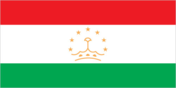
Flag
three horizontal stripes of red (top), a wider stripe of white, and green; a crown surmounted by seven five-pointed stars is located in the center of the white stripe
Highways
total: 29,900 km paved: 21,400 km unpaved: earth 8,500 km (1990)
Illicit drugs
illicit cultivation of cannabis and opium poppy; mostly for CIS consumption; limited government eradication programs; used as transshipment points for illicit drugs from Southwest Asia to Western Europe and North America
Imports
$371 million from outside the FSU countries (1993) commodities: fuel, chemicals, machinery and transport equipment, textiles, foodstuffs partners: Russia, Uzbekistan, Kazakhstan
Independence
9 September 1991 (from Soviet Union)
Industrial production
growth rate -20% (1993 est.)
Industries
aluminum, zinc, lead, chemicals and fertilizers, cement, vegetable oil, metal-cutting machine tools, refrigerators and freezers
Infant mortality rate
62 deaths/1,000 live births (1994 est.)
Inflation rate (consumer prices)
38% per month (1993 average)
International disputes
boundary with China in dispute; territorial dispute with Kyrgyzstan on northern boundary in Isfara Valley area; Afghanistan's and other foreign support to Tajik rebels based in northern Afghanistan
Irrigated land
6,940 sq km (1990)
Judicial branch
Prosecutor General
Labor force
1.95 million (1992) by occupation: agriculture and forestry 43%, government and services 24%, industry 14%, trade and communications 11%, construction 8% (1990)
Land boundaries
total 3,651 km, Afghanistan 1,206 km, China 414 km, Kyrgyzstan 870 km, Uzbekistan 1,161 km
Land use
arable land: 6% permanent crops: 0% meadows and pastures: 23% forest and woodland: 0% other: 71%
Languages
Tajik (official), Russian widely used in government and business
Legal system
based on civil law system; no judicial review of legislative acts
Legislative branch
unicameral
Life expectancy at birth
total population: 68.76 years male: 65.88 years female: 71.79 years (1994 est.)
Literacy
age 9-49 can read and write (1970) total population: 100% male: 100% female: 99%
Location
Central Asia, between Uzbekistan and China
Manpower availability
males age 15-49 1,361,143; fit for military service 1,116,246; reach military age (18) annually 57,681 (1994 est.)
Map references
Asia, Commonwealth of Independent States - Central Asian States, Standard Time Zones of the World
Maritime claims
none; landlocked
Member of
CIS, CSCE, EBRD, ECO, ESCAP, IBRD, IDA, IDB, IMF, INTELSAT (nonsignatory user), IOC, NACC, OIC, UN, UNCTAD, UNESCO, UNIDO, WHO, WMO
Names
conventional long form: Republic of Tajikistan conventional short form: Tajikistan local long form: Respublika i Tojikiston local short form: none former: Tajik Soviet Socialist Republic
National holiday
National Day, 9 September (1991)
National product
GDP - purchasing power equivalent - $6.9 billion (1993 estimate from the UN International Comparison Program, as extended to 1991 and published in the World Bank's World Development Report 1993; and as extrapolated to 1993 using official Tajik statistics, which are very uncertain because of major economic changes since 1990)
National product per capita
$1,180 (1993 est.)
National product real growth rate
-21% (1993 est.)
Nationality
noun: Tajik(s) adjective: Tajik
Natural resources
significant hydropower potential, some petroleum, uranium, mercury, brown coal, lead, zinc, antimony, tungsten
Net migration rate
-1.43 migrant(s)/1,000 population (1994 est.)
Note
landlocked
Other political or pressure groups
Tajikistan Opposition Movement based in northern Afghanistan
Overview
Tajikistan had the lowest per capita GDP in the former USSR, the highest rate of population growth, and the lowest standard of living. Its economy at the start of 1994 is producing at roughly the 1989 level and faces urgent reconstruction tasks from the 1992 civil war. Tajikistan's economy was severely disrupted by the breakup of the Soviet economy, which provided guaranteed trade relations and heavy subsidies and in which specialized tasks were assigned to each republic. Its economy is highly agricultural (43% of the work force); it has specialized in growing cotton for export and must import a large share of its food. Its industry (14% of the work force) produces aluminum, hydropower, machinery, and household appliances. Nearly all petroleum products must be imported. Constant political turmoil and continued dominance of former Communist officials have slowed the process of economic reform and brought near economic collapse while limiting foreign assistance. Tajikistan is in the midst of a prolonged monetary crisis in which it is attempting to continue to use the Russian ruble as its currency while its neighbors have switched to new independent currencies; Russia is unwilling to advance sufficient rubles without attaching stringent reform conditions.
Pipelines
natural gas 400 km (1992)
Political parties and leaders
Communist Party (Tajik Socialist Party - TSP), Shodi SHABDOLOV, chairman; Tajik Democratic Party (TDP), Shodmon YUSUF; Islamic Revival Party (IRP), Mohammed Sharif HIMOTZODA, Davat OUSMAN; Rastokhez Movement, Tohir ABDUJABBAR; Lali Badakhshan Society, Atobek AMIRBEK note: all the above-listed parties but the Communist Party were banned in June 1993
Population
5,995,469 (July 1994 est.)
Population growth rate
2.67% (1994 est.)
Ports
none; landlocked
Railroads
480 km; does not include industrial lines (1990)
Religions
Sunni Muslim 80%, Shi'a Muslim 5%
Suffrage
18 years of age; universal
Supreme Soviet
elections last held 25 February 1990 (next to be held NA September 1994); results - Communist Party 99%, other 1%; seats - (230 total) Communist Party 227, other 3
Telecommunications
poorly developed and not well maintained; many towns are not reached by the national network; 303,000 telephone circuits (December 1991); telephone density about 55 per 1000 persons(1951); linked by cable and microwave to other CIS republics, and by leased connections to the Moscow international gateway switch; Dushanbe linked by INTELSAT to international gateway switch in Ankara; satellite earth stations - 1 Orbita and 2 INTELSAT (one INTELSAT earth station provides TV receive-only service from Turkey)
Terrain
Pamir and Alay Mountains dominate landscape; western Fergana Valley in north, Kofarnihon and Vakhsh Valleys in southwest
Total fertility rate
4.62 children born/woman (1994 est.)
Type
republic
Unemployment rate
1.1% includes only officially registered unemployed; also large numbers of underemployed workers and unregistered unemployed people
US diplomatic representation
chief of mission: Ambassador Stanley T. ESCUDERO embassy: Hotel October, 105A Rudaki Prospect, Dushanbe mailing address: use embassy street address telephone: [7] (3772) 21-03-56 and 21-03-60