2010 Edition
CIA World Factbook 2010 (Project Gutenberg)
Introduction
Background
In 1895, military defeat forced China to cede Taiwan to Japan. Taiwan reverted to Chinese control after World War II. Following the Communist victory on the mainland in 1949, 2 million Nationalists fled to Taiwan and established a government using the 1947 constitution drawn up for all of China. Over the next five decades, the ruling authorities gradually democratized and incorporated the local population within the governing structure. In 2000, Taiwan underwent its first peaceful transfer of power from the Nationalist to the Democratic Progressive Party. Throughout this period, the island prospered and became one of East Asia's economic "Tigers." The dominant political issues continue to be the relationship between Taiwan and China - specifically the question of Taiwan's eventual status - as well as domestic political and economic reform.
Geography
Area
- land
- 32,260 sq km
- total
- 35,980 sq km
- water
- 3,720 sq km note: includes the Pescadores, Matsu, and Quemoy islands
Area - comparative
slightly smaller than Maryland and Delaware combined
Climate
tropical; marine; rainy season during southwest monsoon (June to August); cloudiness is persistent and extensive all year
Coastline
1,566.3 km
Elevation extremes
- highest point
- Yu Shan 3,952 m
- lowest point
- South China Sea 0 m
Environment - current issues
air pollution; water pollution from industrial emissions, raw sewage; contamination of drinking water supplies; trade in endangered species; low-level radioactive waste disposal
Environment - international agreements
- party to
- none of the selected agreements because of Taiwan's international status
Geographic coordinates
23 30 N, 121 00 E
Geography - note
strategic location adjacent to both the Taiwan Strait and the Luzon Strait
Irrigated land
NA
Land boundaries
0 km
Land use
- arable land
- 24%
- other
- 75% (2001)
- permanent crops
- 1%
Location
Eastern Asia, islands bordering the East China Sea, Philippine Sea, South China Sea, and Taiwan Strait, north of the Philippines, off the southeastern coast of China
Map references
Southeast Asia
Maritime claims
- exclusive economic zone
- 200 nm
- territorial sea
- 12 nm
Natural hazards
- earthquakes; typhoons
- volcanism
- Kueishantao Island (elev. 401 m, 1,316 ft), east of Taiwan, is its only historically active volcano, although it has not erupted in centuries
Natural resources
small deposits of coal, natural gas, limestone, marble, and asbestos
Terrain
eastern two-thirds mostly rugged mountains; flat to gently rolling plains in west
Total renewable water resources
67 cu km (2000)
People and Society
Age structure
0-14 years: 16.7% (male 1,996,905/female 1,844,611) 15-64 years: 72.6% (male 8,416,300/female 8,267,675) 65 years and over: 10.7% (male 1,183,382/female 1,265,474) (2010 est.)
Birth rate
8.97 births/1,000 population (2010 est.)
Death rate
6.87 deaths/1,000 population (July 2010 est.)
Education expenditures
NA
Ethnic groups
Taiwanese (including Hakka) 84%, mainland Chinese 14%, indigenous 2%
HIV/AIDS - adult prevalence rate
NA
HIV/AIDS - deaths
NA
HIV/AIDS - people living with HIV/AIDS
NA
Infant mortality rate
- female
- 4.96 deaths/1,000 live births (2010 est.)
- male
- 5.53 deaths/1,000 live births
- total
- 5.26 deaths/1,000 live births
Languages
Mandarin Chinese (official), Taiwanese (Min), Hakka dialects
Life expectancy at birth
- female
- 81.2 years (2010 est.)
- male
- 75.34 years
- total population
- 78.15 years
Literacy
- definition: age 15 and over can read and write
- female
- NA (2003)
- male
- NA
- total population
- 96.1%
Median age
- female
- 37.7 years (2010 est.)
- male
- 36.4 years
- total
- 37 years
Nationality
- adjective
- Taiwan
- noun
- Taiwan (singular and plural) note: example - he or she is from Taiwan; they are from Taiwan
Net migration rate
0.03 migrant(s)/1,000 population (2010 est.)
Population
23,024,956 (July 2010 est.)
Population growth rate
0.213% (2010 est.)
Religions
mixture of Buddhist and Taoist 93%, Christian 4.5%, other 2.5%
Sex ratio
- at birth
- 1.086 male(s)/female under 15 years: 1.08 male(s)/female 15-64 years: 1.02 male(s)/female 65 years and over: 0.92 male(s)/female
- total population
- 1.02 male(s)/female (2010 est.)
Total fertility rate
1.15 children born/woman (2010 est.)
Government
Administrative divisions
- includes main island of Taiwan plus smaller islands nearby and off coast of China's Fujian Province; Taiwan is divided into 18 counties (hsien, singular and plural), 5 municipalities (shih, singular and plural), and 2 special municipalities (chih-hsia-shih, singular and plural) note: Taiwan uses a variety of romanization systems; while a modified Wade-Giles system still dominates, the city of Taipei has adopted a Pinyin romanization for street and place names within its boundaries; other local authorities use different romanization systems; names for administrative divisions that follow are taken from the Taiwan Yearbook 2007 published by the Government Information Office in Taipei.
- counties
- Changhua, Chiayi (county), Hsinchu (county), Hualien, Kaohsiung (county), Kinmen, Lienchiang, Miaoli, Nantou, Penghu, Pingtung, Taichung (county), Tainan (county), Taipei (county), Taitung, Taoyuan, Yilan, and Yunlin
- municipalities
- Chiayi (city), Hsinchu (city), Keelung, Taichung (city), Tainan (city)
- special municipalities
- Kaohsiung (city), Taipei (city)
Capital
- geographic coordinates
- 25 03 N, 121 30 E
- name
- Taipei
- time difference
- UTC+8 (13 hours ahead of Washington, DC during Standard Time)
Constitution
adopted on 25 December 1946; promulgated on 1 January 1947; effective 25 December 1947; amended numerous times
Country name
- conventional long form
- none
- conventional short form
- Taiwan
- former
- Formosa
- local long form
- none
- local short form
- Taiwan
Diplomatic representation from the US
- none; commercial and cultural relations with the people on Taiwan are maintained through an unofficial instrumentality, the American Institute in Taiwan (AIT), a private nonprofit corporation that performs citizen and consular services similar to those at diplomatic posts
- director
- William A. STANTON
- FAX
- [1] [886] (07) 238-7744
- office
- #7 Lane 134, Hsin Yi Road, Section 3, Taipei, Taiwan
- other offices
- Kaohsiung
- telephone
- [1] [886] (02) 2162-2000
Diplomatic representation in the US
- none; commercial and cultural relations with the people in the United States are maintained through an unofficial instrumentality, the Taipei Economic and Cultural Representative Office in the United States (TECRO), a private nonprofit corporation that performs citizen and consular services similar to those at diplomatic posts
- office
- 4201 Wisconsin Avenue NW, Washington, DC 20016
- representative
- Jason C. YUAN
- Taipei Economic and Cultural Offices (branch offices)
- Atlanta, Boston, Chicago, Guam, Houston, Honolulu, Kansas City, Los Angeles, Miami, New York, San Francisco, Seattle
- telephone
- [1] 202 895-1800
Executive branch
- cabinet
- Executive Yuan - (ministers appointed by president on recommendation of premier) (For more information visit the World Leaders website )
- chief of state
- President MA Ying-jeou (since 20 May 2008); Vice President Vincent SIEW (since 20 May 2008)
- election results
- MA Ying-jeou elected president; percent of vote - MA Ying-jeou 58.45%, Frank HSIEH 41.55%
- elections
- president and vice president elected on the same ticket by popular vote for four-year terms (eligible for a second term); election last held on 22 March 2008 (next to be held in March 2012); premier appointed by the president; vice premiers appointed by the president on the recommendation of the premier
- head of government
- Premier (President of the Executive Yuan) WU Den-yih (since 10 September 2009); Vice Premier (Vice President of Executive Yuan) Sean CHEN (since 17 May 2010)
Flag description
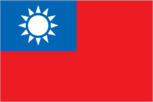
red field with a dark blue rectangle in the upper hoist-side corner bearing a white sun with 12 triangular rays; the blue and white design of the canton (symbolizing the sun of progress) dates to 1895; it was later adopted as the flag of the Kuomintang Party; blue signifies liberty, justice, and democracy; red stands for fraternity, sacrifice, and nationaliam, white represents equality, frankness, and the people's livelihood; the 12 rays of the sun are those of the months and the twelve traditional Chinese hours (each ray equals two hours) note: somewhat resembles the flag of Burma
Government type
multiparty democracy
International organization participation
ADB, APEC, BCIE, ICC, IOC, ITUC, WTO
Judicial branch
Judicial Yuan (justices appointed by the president with consent of the Legislative Yuan)
Legal system
based on civil law system; has not accepted compulsory ICJ jurisdiction
Legislative branch
- unicameral Legislative Yuan (113 seats - 73 district members elected by popular vote, 34 at-large members elected on basis of proportion of islandwide votes received by participating political parties, 6 elected by popular vote among aboriginal populations; members to serve four-year terms); parties must receive 5% of vote to qualify for at-large seats
- election results
- Legislative Yuan - percent of vote by party - KMT 53.5%, DPP 38.2%, NPSU 2.4%, PFP 0.3%, others 1.6%, independents 4%; seats by party - KMT 81, DPP 27, NPSU 3, PFP 1, independent 1; note - following the 2008 elections, several rounds of byelections were held to fill seats vacated as a result of corruption changes; seats by party as of December 2010 - KMT 74, DPP 33, NPSU 3, independent 2, vacant 1
- elections
- Legislative Yuan - last held on 12 January 2008 (next to be held in December 2011 or January 2012)
National anthem
- lyrics/music
- HU Han-min, TAI Chi-t'ao, and LIAO Chung-k'ai/CHENG Mao-Yun note: adopted 1930; the anthem is also the song of the Kuomintang Party; it is informally known as "San Min Cau I" (Three Principles of the People); because of political pressure from China, "Guo qi ee" (National Banner Song) is used at international events rather than the official anthem of Taiwan; the "National Banner Song" has gained popularity in Taiwan and is commonly used during flag raisings
- name
- "Zhonghua Minguo guoge" (National Anthem of the Republic of China)
National holiday
Republic Day (Anniversary of the Chinese Revolution), 10 October (1911)
Political parties and leaders
Democratic Progressive Party or DPP [TSAI Ing-wen]; Kuomintang or KMT (Nationalist Party) [MA Ying-jeou]; Non-Partisan Solidarity Union or NPSU [LIN Pin-kuan]; People First Party or PFP [James SOONG]
Political pressure groups and leaders
environmental groups; independence movement; various business groups note: debate on Taiwan independence has become acceptable within the mainstream of domestic politics on Taiwan; public opinion polls consistently show a substantial majority of Taiwan people supports maintaining Taiwan's status quo for the foreseeable future; advocates of Taiwan independence oppose the stand that the island will eventually unify with mainland China; advocates of eventual unification predicate their goal on the democratic transformation of the mainland
Suffrage
20 years of age; universal
Economy
Agriculture - products
rice, corn, vegetables, fruit, tea; pigs, poultry, beef, milk; fish
Central bank discount rate
1.25% (February 2009)
Commercial bank prime lending rate
2.56% (31 December 2009) 4.06% (31 December 2008 est.)
Current account balance
$39 billion (2010 est.) $42.92 billion (2009 est.)
Debt - external
$91.41 billion (31 December 2010 est.) $75.3 billion (31 December 2009 est.)
Economy - overview
Taiwan has a dynamic capitalist economy with gradually decreasing government guidance of investment and foreign trade. In keeping with this trend, some large, state-owned banks and industrial firms have been privatized. Exports, led by electronics and machinery, generate about 70% of Taiwan's GDP growth, and have provided the primary impetus for economic development. This heavy dependence on exports makes the economy vulnerable to downturns in world demand. In 2009, Taiwan's GDP fell by 1.9%, due primarily to a 20% year-on-year decline in exports. GDP grew more than 8% in 2010, as exports returned to the level of previous years. Taiwan's diplomatic isolation, low birth rate, and rapidly aging population are major long-term challenges. Free trade agreements have proliferated in East Asia over the past several years, but so far Taiwan has been excluded from this greater economic integration, largely for reasons of diplomacy. Taiwan's birth rate of only 1.2 child per woman is among the lowest in the world, raising the prospect of future labor shortages, falling domestic demand, and declining tax revenues. Taiwan's population is aging quickly, with the number of people over 65 accounting for 10.8% of the island's total population as of the end of 2009. The island runs a large trade surplus, and its foreign reserves are the world's fourth largest, behind China, Japan, and Russia. Since President MA Ying-jeou took office in May 2008, cross-Strait economic ties have increased significantly. Since 2005 China has overtaken the US to become Taiwan's second-largest source of imports after Japan. China is also the island's number one destination for foreign direct investment. Taipei has focused much of its economic recovery effort on improving cross-Strait economic integration. Three financial memorandums of understanding, covering banking, securities, and insurance, took effect in mid-January 2010, opening the island to greater investments from the Mainland's financial firms and institutional investors, and providing new opportunities for Taiwan financial firms to operate in China. Taiwan and the mainland in June 2010 signed the landmark Economic Cooperation Framework Agreement (ECFA), an agreement similar to a free-trade agreement deal that will increase cross-Strait economic ties by lowering tariffs on a number of goods. Taiwan's goverment has said that the ECFA will serve as a stepping stone toward trade pacts with other regional partners and announced the beginning of negotiations on such an agreement with Singapore in August.
Electricity - consumption
229.8 billion kWh (2008)
Electricity - exports
0 kWh (2009 est.)
Electricity - imports
0 kWh (2009 est.)
Electricity - production
238.3 billion kWh (2008)
Exchange rates
New Taiwan dollars (TWD) per US dollar - 31.864 (2010), 33.061 (2009), 31.53 (2008), 32.84 (2007), 32.534 (2006)
Exports
$277.6 billion (2010 est.) $203.4 billion (2009 est.)
Exports - commodities
electronics, flat panels, machinery; metals; textiles, plastics, chemicals; optical, photographic, measuring, and medical instruments
Exports - partners
China 26.6%, Hong Kong 14.4%, US 11.6%, Japan 7.2%, Singapore 4.2% (2009)
GDP - composition by sector
- agriculture
- 1.4%
- industry
- 31.1%
- services
- 67.5% (2010 est.)
GDP - per capita (PPP)
$35,100 (2010 est.) $32,400 (2009 est.) $33,100 (2008 est.) note: data are in 2010 US dollars
GDP - real growth rate
8.3% (2010 est.) -1.9% (2009 est.) 0.7% (2008 est.)
GDP (official exchange rate)
$427 billion (2010 est.)
GDP (purchasing power parity)
$807.2 billion (2010 est.) $745.4 billion (2009 est.) $759.8 billion (2008 est.) note: data are in 2010 US dollars
Household income or consumption by percentage share
lowest 10%: NA highest 10%: 41.1% (2002)
Imports
$250.2 billion (2010 est.) $172.8 billion (2009 est.)
Imports - commodities
electronics, machinery, crude petroleum, precision instruments, organic chemicals, metals
Imports - partners
Japan 20.7%, China 14%, US 10.3%, South Korea 6%, Saudi Arabia 4.8% (2009)
Industrial production growth rate
16% (2010 est.)
Industries
electronics, communications and information technology products, petroleum refining, armaments, chemicals, textiles, iron and steel, machinery, cement, food processing, vehicles, consumer products, pharmaceuticals
Inflation rate (consumer prices)
1.3% (2010 est.) 3.5% (2008)
Investment (gross fixed)
21.5% of GDP (2010 est.)
Labor force
11.03 million (2010 est.)
Labor force - by occupation
- agriculture
- 5.1%
- industry
- 36.8%
- services
- 58% (2008 est.)
Market value of publicly traded shares
$657.3 billion (31 December 2009) $354.7 billion (31 December 2008) $654 billion (28 December 2007)
Natural gas - consumption
12.44 billion cu m (2008 est.)
Natural gas - exports
0 cu m (2008 est.)
Natural gas - imports
12.08 billion cu m (2008 est.)
Natural gas - production
360 million cu m (2008 est.)
Natural gas - proved reserves
6.229 billion cu m (1 January 2010 est.)
Oil - consumption
910,000 bbl/day (2009 est.)
Oil - exports
359,800 bbl/day (2009 est.)
Oil - imports
931,300 bbl/day (2009 est.)
Oil - production
276,800 bbl/day (2009 est.)
Oil - proved reserves
2.8 million bbl (1 January 2010 est.)
Population below poverty line
1.08% (2008 est.)
Public debt
31.4% of GDP (2010 est.) 33% of GDP (2009 est.)
Reserves of foreign exchange and gold
$382.8 billion (31 December 2010 est.) $353 billion (31 December 2009 est.)
Stock of broad money
$952.2 billion (31 December 2010 est.) $891.2 billion (31 December 2009 est.)
Stock of direct foreign investment - abroad
$122.5 billion (31 December 2010 est.) $145.3 billion (31 December 2009 est.)
Stock of direct foreign investment - at home
$65.38 billion (31 December 2010 est.) $107.2 billion (31 December 2009 est.)
Stock of domestic credit
$661.4 billion (31 December 2010 est.) $630.8 billion (31 December 2009 est.)
Stock of narrow money
$331.7 billion (31 December 2010 est) $317.9 billion (31 December 2009 est)
Unemployment rate
5.2% (2010 est.) 5.9% (2009 est.)
Communications
Broadcast media
5 free-to-air nationwide television networks operating roughly 75 TV stations; about 85% of households utilize multi-channel cable TV; national and regional radio networks with about 170 radio stations broadcasting (2008)
Internet country code
.tw
Internet hosts
6.336 million (2010)
Internet users
16.147 million (2009)
Telephone system
- domestic
- thoroughly modern; completely digitalized
- general assessment
- provides telecommunications service for every business and private need
- international
- country code - 886; roughly 15 submarine fiber cables cables provide links throughout Asia, Australia, the Middle East, Europe, and the US; satellite earth stations - 2
Telephones - main lines in use
14.596 million (2009)
Telephones - mobile cellular
26.959 million (2009)
Transportation
Airports
41 (2010)
Airports - with paved runways
- total
- 38 over 3,047 m: 8 2,438 to 3,047 m: 8 1,524 to 2,437 m: 11 914 to 1,523 m: 7 under 914 m: 4 (2010)
Airports - with unpaved runways
- total
- 3 1,524 to 2,437 m: 2 under 914 m: 1 (2010)
Heliports
4 (2010)
Merchant marine
- by type
- bulk carrier 28, cargo 19, chemical tanker 2, container 27, passenger/cargo 4, petroleum tanker 12, refrigerated cargo 7, roll on/roll off 2
- foreign-owned
- 2 (France 1, Vietnam 1)
- registered in other countries
- 574 (Cambodia 1, Honduras 2, Hong Kong 26, Indonesia 1, Italy 11, Kiribati 5, Liberia 88, Marshall Islands 2, Panama 337, Philippines 1, Sierra Leone 1, Singapore 79, Thailand 1, UK 11, unknown 8) (2010)
- total
- 101
Pipelines
gas 405 km (2009)
Ports and terminals
Chilung (Keelung), Kaohsiung, Hualian, Taichung
Railways
- narrow gauge
- 1,091 km 1.067-m gauge; 146 km .762-m gauge note: the 146 km of .762 gauge track belongs primarily to Taiwan Sugar Corporation and Taiwan Forestry Bureau, some to other entities (2008)
- standard gauge
- 345 km 1.435-m gauge
- total
- 1,582 km
Roadways
- paved
- 40,843 km (includes 976 km of expressways)
- total
- 41,279 km
- unpaved
- 436 km (2008)
Military and Security
Manpower available for military service
males age 16-49: 6,218,009 females age 16-49: 6,038,964 (2010 est.)
Manpower fit for military service
males age 16-49: 5,094,111 females age 16-49: 4,980,454 (2010 est.)
Manpower reaching militarily significant age annually
- female
- 155,070 (2010 est.)
- male
- 166,141
Military branches
Army, Navy (includes Marine Corps), Air Force, Coast Guard Administration, Armed Forces Reserve Command, Combined Service Forces Command, Armed Forces Police Command
Military expenditures
2.2% of GDP (in 2009, the Taiwanese president pledged to maintain defense spending at 3.0% or higher; projected 2.73% for 2011) (2009)
Military service age and obligation
19-35 years of age for male compulsory military service; service obligation 2 years; women may enlist; women in Air Force service are restricted to noncombat roles; reserve obligation to age 30 (Army); the Ministry of Defense is in the process of implementing a voluntary enlistment system over the period 2010-2015, although nonvolunteers will still be required to perform alternative service or go through 4 months of military training (2010)
Transnational Issues
Disputes - international
involved in complex dispute with Brunei, China, Malaysia, the Philippines, and Vietnam over the Spratly Islands, and with China and the Philippines over Scarborough Reef; the 2002 "Declaration on the Conduct of Parties in the South China Sea" has eased tensions but falls short of a legally binding "code of conduct" desired by several of the disputants; Paracel Islands are occupied by China, but claimed by Taiwan and Vietnam; in 2003, China and Taiwan became more vocal in rejecting both Japan's claims to the uninhabited islands of the Senkaku-shoto (Diaoyu Tai) and Japan's unilaterally declared exclusive economic zone in the East China Sea where all parties engage in hydrocarbon prospecting
Illicit drugs
regional transit point for heroin, methamphetamine, and precursor chemicals; transshipment point for drugs to Japan; major problem with domestic consumption of methamphetamine and heroin; rising problems with use of ketamine and club drugs page last updated on January 24, 2011 ======================================================================