2000 Edition
CIA World Factbook 2000 (Project Gutenberg)
Introduction
Background
In 1895, military defeat forced China to cede Taiwan to Japan, however it reverted to Chinese control after World War II. Following the communist victory on the mainland in 1949, 2 million Nationalists fled to Taiwan and established a government that over five decades has gradually democratized and incorporated the native population within its structure. Throughout this period, the island has prospered to become one of East Asia's economic "Tigers." The dominant political issue continues to be the relationship between Taiwan and China and the question of eventual reunification.
Geography
Area
- land
- 32,260 sq km
- note
- includes the Pescadores, Matsu, and Quemoy
- total
- 35,980 sq km
- water
- 3,720 sq km
Area - comparative
slightly smaller than Maryland and Delaware combined
Climate
tropical; marine; rainy season during southwest monsoon (June to August); cloudiness is persistent and extensive all year
Coastline
1,566.3 km
Elevation extremes
- highest point
- Yu Shan 3,997 m
- lowest point
- South China Sea 0 m
Environment - current issues
air pollution; water pollution from industrial emissions, raw sewage; contamination of drinking water supplies; trade in endangered species; low-level radioactive waste disposal
Environment - international agreements
- party to
- none of the selected agreements signed, but not ratified: none of the selected agreements
Geographic coordinates
23 30 N, 121 00 E
Irrigated land
NA sq km
Land boundaries
0 km
Land use
- arable land
- 24%
- forests and woodland
- 55%
- other
- 15%
- permanent crops
- 1%
- permanent pastures
- 5%
Location
Eastern Asia, islands bordering the East China Sea, Philippine Sea, South China Sea, and Taiwan Strait, north of the Philippines, off the southeastern coast of China
Map references
Southeast Asia
Maritime claims
- exclusive economic zone
- 200 nm
- territorial sea
- 12 nm
Natural hazards
earthquakes and typhoons
Natural resources
small deposits of coal, natural gas, limestone, marble, and asbestos
Terrain
eastern two-thirds mostly rugged mountains; flat to gently rolling plains in west
People and Society
Age structure
0-14 years: 22% (male 2,485,421; female 2,292,901) 15-64 years: 70% (male 7,869,939; female 7,629,195) 65 years and over: 8% (male 1,013,074; female 900,557) (2000 est.)
Birth rate
14.42 births/1,000 population (2000 est.)
Death rate
5.91 deaths/1,000 population (2000 est.)
Ethnic groups
Taiwanese (including Hakka) 84%, mainland Chinese 14%, aborigine 2%
Infant mortality rate
7.06 deaths/1,000 live births (2000 est.)
Languages
Mandarin Chinese (official), Taiwanese (Min), Hakka dialects
Life expectancy at birth
- female
- 79.32 years (2000 est.)
- male
- 73.62 years
- total population
- 76.35 years
Literacy
- definition
- age 15 and over can read and write
- female
- 79% (1980 est.)
- male
- 93% (1980 est.)
- total population
- 86% (1980 est.); note - literacy for the total population has reportedly increased to 94% (1998 est.)
Nationality
- adjective
- Chinese
- noun
- Chinese (singular and plural)
Net migration rate
-0.38 migrant(s)/1,000 population (2000 est.)
Population
22,191,087 (July 2000 est.)
Population growth rate
0.81% (2000 est.)
Religions
mixture of Buddhist, Confucian, and Taoist 93%, Christian 4.5%, other 2.5%
Sex ratio
- at birth
- 1.08 male(s)/female under 15 years: 1.08 male(s)/female 15-64 years: 1.03 male(s)/female 65 years and over: 1.12 male(s)/female
- total population
- 1.05 male(s)/female (2000 est.)
Total fertility rate
1.76 children born/woman (2000 est.)
Government
Administrative divisions
- since in the past the authorities claimed to be the government of all China, the central administrative divisions include the provinces of Fu-chien (some 20 offshore islands of Fujian Province including Quemoy and Matsu) and Taiwan (the island of Taiwan and the Pescadores islands); note - the more commonly referenced administrative divisions are those of Taiwan Province - 16 counties (hsien, singular and plural), 5 municipalities* (shih, singular and plural), and 2 special municipalities** (chuan-shih, singular and plural); Chang-hua, Chia-i, Chia-i*, Chi-lung*, Hsin-chu, Hsin-chu*, Hua-lien, I-lan, Kao-hsiung, Kao-hsiung**, Miao-li, Nan-t'ou, P'eng-hu, P'ing-tung, T'ai-chung, T'ai-chung*, T'ai-nan, T'ai-nan*, T'ai-pei, T'ai-pei**, T'ai-tung, T'ao-yuan, and Yun-lin; the provincial capital is at Chung-hsing-hsin-ts'un
- note
- Taiwan uses the Wade-Giles system for romanization
Capital
Taipei
Constitution
1 January 1947, amended in 1992, 1994, and 1997
Country name
- conventional long form
- none
- conventional short form
- Taiwan
- local long form
- none
- local short form
- T'ai-wan
Data code
TW
Diplomatic representation from the US
- none; unofficial commercial and cultural relations with the people on Taiwan are maintained through a private corporation, the American Institute in Taiwan (AIT), which has its headquarters in Rosslyn, Virginia (telephone: (703) 525-8474
- and FAX
- (703) 841-1385) and offices in Taipei at #7 Lane 134, Hsin Yi Road, Section 3, telephone (2) 2709-2000, FAX (2) 2702-7675, and in Kao-hsiung at #2 Chung Cheng 3d Road, telephone (7) 224-0154 through 0157, FAX (7) 223-8237, and the American Trade Center at Room 3207 International Trade Building, Taipei World Trade Center, 333 Keelung Road Section 1, Taipei 10548, telephone (2) 2720-1550, FAX (2) 2757-7162
Diplomatic representation in the US
none; unofficial commercial and cultural relations with the people of the US are maintained through a private instrumentality, the Taipei Economic and Cultural Representative Office (TECRO) in the US with headquarters in Taipei and field offices in Washington and 12 other US cities
Executive branch
- cabinet
- Executive Yuan appointed by the president
- chief of state
- President LEE Teng-hui (succeeded to the presidency following the death of President CHIANG Ching-kuo 13 January 1988, elected by the National Assembly 21 March 1990, elected by popular vote in the first-ever direct elections for president 23 March 1996); Vice President LIEN Chan (since 20 May 1996)
- election results
- CHEN Shui-bian elected president; percent of vote - CHEN Shui-bian (DPP) 39.3%, James SOONG (independent) 36.84%, LIEN Chan (KMT) 23.1%, HSU Hsin-liang (independent) .63%, LEE Ao (CNP) .13%
- elections
- president and vice president elected on the same ticket by popular vote for four-year terms; election last held 18 March 2000 (next to be held NA March 2004); premier appointed by the president; vice premiers appointed by the president on the recommendation of the premier
- head of government
- Premier (President of the Executive Yuan) Vincent SIEW (since 1 September 1997) and Vice Premier (Vice President of the Executive Yuan) LIU Chao-shiuan (since 10 December 1997)
- note
- President-elect CHEN Shui-bian is scheduled to take office on 20 May 2000
Flag description
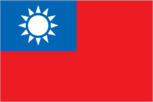
red with a dark blue rectangle in the upper hoist-side corner bearing a white sun with 12 triangular rays
Government type
multiparty democratic regime headed by popularly elected president
International organization participation
APEC, AsDB, BCIE, ICC, IOC, WCL, WTrO (applicant)
Judicial branch
Judicial Yuan, justices appointed by the president with the consent of the National Assembly
Legal system
based on civil law system; accepts compulsory ICJ jurisdiction, with reservations
Legislative branch
- unicameral Legislative Yuan (225 seats - 168 elected by popular vote, 41 elected on the basis of the proportion of nationwide votes received by participating political parties, eight elected from overseas Chinese constituencies on the basis of the proportion of nationwide votes received by participating political parties, eight elected by popular vote among the aboriginal populations; members serve three-year terms) and unicameral National Assembly (334 seats; members elected by popular vote to serve four-year terms)
- election results
- Legislative Yuan - percent of vote by party - KMT 46%, DPP 29%, CNP 7%, independents 10%, other parties 8%; seats by party - KMT 123, DPP 70, CNP 11, independents 15, other parties 6; National Assembly - percent of vote by party - KMT 55%, DPP 30%, CNP 14%, other 1%; seats by party - KMT 183, DPP 99, CNP 46, other 6
- elections
- Legislative Yuan - last held 5 December 1998 (next to be held NA December 2001); National Assembly - last held 23 March 1996 (next to be held NA 2000)
National holiday
National Day, 10 October (1911) (Anniversary of the Chinese Revolution)
Political parties and leaders
Chinese New Party or CNP [CHOU Yang-sun]; Democratic Progressive Party or DPP [LIN Yi-hsiung, chairman]; Kuomintang or KMT (Nationalist Party) [LIEN Chan, acting chairman]; Taiwan Independence Party or TAIP ; other minor parties
Political pressure groups and leaders
- Taiwan independence movement, various business and environmental groups
- note
- debate on Taiwan independence has become acceptable within the mainstream of domestic politics on Taiwan; political liberalization and the increased representation of opposition parties in Taiwan's legislature have opened public debate on the island's national identity; advocates of Taiwan independence oppose the ruling party's traditional stand that the island will eventually reunify with mainland China; goals of the Taiwan independence movement include establishing a sovereign nation on Taiwan and entering the UN; other organizations supporting Taiwan independence include the World United Formosans for Independence and the Organization for Taiwan Nation Building
Suffrage
20 years of age; universal
Economy
Agriculture - products
rice, corn, vegetables, fruit, tea; pigs, poultry, beef, milk; fish
Budget
- expenditures
- $40.53 billion, including capital expenditures of $NA (1999 est.)
- revenues
- $36.82 billion
Currency
1 New Taiwan dollar (NT$) = 100 cents
Debt - external
$35 billion (September 1999)
Economic aid - recipient
$NA
Economy - overview
Taiwan has a dynamic capitalist economy with gradually decreasing guidance of investment and foreign trade by government authorities. In keeping with this trend, some large government-owned banks and industrial firms are being privatized. Real growth in GDP has averaged about 8% during the past three decades. Exports have grown even faster and have provided the primary impetus for industrialization. Inflation and unemployment are low; the trade surplus is substantial; and foreign reserves are the world's third largest. Agriculture contributes 3% to GDP, down from 35% in 1952. Traditional labor-intensive industries are steadily being moved off-shore and replaced with more capital- and technology-intensive industries. Taiwan has become a major investor in China, Thailand, Indonesia, the Philippines, Malaysia, and Vietnam. The tightening of labor markets has led to an influx of foreign workers, both legal and illegal. Because of its conservative financial approach and its entrepreneurial strengths, Taiwan suffered little compared with many of its neighbors from the Asian financial crisis in 1998-99. Growth in 2000 should pick up a bit from 1999, backed by expansion in domestic consumption, exports, and private investment.
Electricity - consumption
124.235 billion kWh (1998)
Electricity - exports
0 kWh (1998)
Electricity - imports
0 kWh (1998)
Electricity - production
133.586 billion kWh (1998)
Electricity - production by source
- fossil fuel
- 65.91%
- hydro
- 7.84%
- nuclear
- 26.25%
- other
- 0% (1998)
Exchange rates
New Taiwan dollars per US$1 - 31.395 (yearend 1999), 32.216 (1998), 32.052 (1997), 27.5 (1996), 27.5 (1995)
Exports
$121.6 billion (f.o.b., 1999)
Exports - commodities
electronics, electric and machinery equipment 52%, metals, textiles, plastics, chemicals
Exports - partners
US 26%, Hong Kong 21%, Europe 18%, Japan 10%, Singapore 3% (1999)
Fiscal year
1 July - 30 June (up to FY98/99); 1 July 1999 - 31 December 2000 for FY00; calendar year (after FY00)
GDP
purchasing power parity - $357 billion (1999 est.)
GDP - composition by sector
- agriculture
- 3%
- industry
- 33%
- services
- 64% (1999 est.)
GDP - per capita
purchasing power parity - $16,100 (1999 est.)
GDP - real growth rate
5.5% (1999 est.)
Household income or consumption by percentage share
lowest 10%: NA% highest 10%: NA%
Imports
$101.7 billion (c.i.f., 1999)
Imports - commodities
electronics, electric and machinery equipment 45%, minerals, precision instruments
Imports - partners
Japan 27%, US 18%, Europe 16%, South Korea 6%, Malaysia 4% (1999)
Industrial production growth rate
7.5% (1999 est.)
Industries
electronics, petroleum refining, chemicals, textiles, iron and steel, machinery, cement, food processing
Inflation rate (consumer prices)
0.4% (1999 est.)
Labor force
9.7 million (1999 est.)
Labor force - by occupation
services 55%, industry 37%, agriculture 8% (1999 est.)
Population below poverty line
1% (1999 est.)
Unemployment rate
2.9% (1999 est.)
Communications
Internet Service Providers (ISPs)
15 (1999)
Radio broadcast stations
AM 218, FM 333, shortwave 50 (1999)
Radios
16 million (1994)
Telephone system
- domestic
- provides modern telecommunications service for every business and private need; completely digitalized
- international
- satellite earth stations - 2 Intelsat (1 Pacific Ocean and 1 Indian Ocean); submarine cables to Japan (Okinawa), Philippines, Guam, Singapore, Hong Kong, Indonesia, Australia, Middle East, and Western Europe (1999)
Telephones - main lines in use
12 million (October 1999)
Telephones - mobile cellular
10.2 million (October 1999)
Television broadcast stations
29 (plus two repeaters) (1997)
Televisions
8.8 million (1998)
Transportation
Airports
38 (1999 est.)
Airports - with paved runways
- total
- 35 over 3,047 m: 8 2,438 to 3,047 m: 9 1,524 to 2,437 m: 8 914 to 1,523 m: 7 under 914 m: 3 (1999 est.)
Airports - with unpaved runways
- total
- 3 1,524 to 2,437 m: 1 under 914 m: 2 (1999 est.)
Heliports
2 (1999 est.)
Highways
- paved
- 31,271 km (including 538 km of expressways)
- total
- 34,901 km
- unpaved
- 3,630 km (1998 est.)
Merchant marine
- ships by type
- bulk 45, cargo 33, combination bulk 1, container 69, petroleum tanker 17, refrigerated cargo 8, roll-on/roll-off 2 (1999 est.)
- total
- 175 ships (1,000 GRT or over) totaling 4,944,166 GRT/7,710,891 DWT
Pipelines
petroleum products 3,400 km; natural gas 1,800 km (1999)
Ports and harbors
Chi-lung (Keelung), Hua-lien, Kao-hsiung, Su-ao, T'ai-chung
Railways
- narrow gauge
- 2,481 km 1.067-m (1999)
- total
- 2,481 km (519 km electrified)
Military and Security
Military branches
Army, Navy (includes Marines), Air Force, Coastal Patrol and Defense Command, Armed Forces Reserve Command, Combined Service Forces
Military expenditures - dollar figure
$8.042 billion (FY98/99)
Military expenditures - percent of GDP
2.8% (FY98/99)
Military manpower - availability
males age 15-49: 6,554,373 (2000 est.)
Military manpower - fit for military service
males age 15-49: 5,017,643 (2000 est.)
Military manpower - military age
19 years of age
Military manpower - reaching military age annually
- males
- 201,413 (2000 est.)
Transnational Issues
Disputes - international
involved in complex dispute over the Spratly Islands with China, Malaysia, Philippines, Vietnam, and possibly Brunei; Paracel Islands occupied by China, but claimed by Vietnam and Taiwan; claims Japanese-administered Senkaku-shoto (Senkaku Islands/Diaoyu Tai), as does China
Illicit drugs
- considered an important heroin transit point; major problem with domestic consumption of methamphetamines and heroin
- TAJIKISTAN