1995 Edition
CIA World Factbook 1995 (Project Gutenberg)
Geography
Area
total area: 35,980 sq km land area: 32,260 sq km comparative area: slightly larger than Maryland and Delaware combined note: includes the Pescadores, Matsu, and Quemoy
Climate
tropical; marine; rainy season during southwest monsoon (June to August); cloudiness is persistent and extensive all year
Coastline
1,448 km
Environment
current issues: water pollution from industrial emissions, raw sewage; air pollution; contamination of drinking water supplies; trade in endangered species natural hazards: earthquakes and typhoons international agreements: signed, but not ratified - Marine Life Conservation
International disputes
involved in complex dispute over the Spratly Islands with China, Malaysia, Philippines, Vietnam, and possibly Brunei; Paracel Islands occupied by China, but claimed by Vietnam and Taiwan; Japanese-administered Senkaku-shoto (Senkaku Islands/Diaoyu Tai) claimed by China and Taiwan
Irrigated land
NA sq km
Land boundaries
0 km
Land use
arable land: 24% permanent crops: 1% meadows and pastures: 5% forest and woodland: 55% other: 15%
Location
Eastern Asia, islands bordering the East China Sea, Philippine Sea, South China Sea, and Taiwan Strait, north of the Philippines, off the southeastern coast of China
Map references
Southeast Asia
Maritime claims
exclusive economic zone: 200 nm territorial sea: 12 nm
Natural resources
small deposits of coal, natural gas, limestone, marble, and asbestos
Terrain
eastern two-thirds mostly rugged mountains; flat to gently rolling plains in west
People and Society
Age structure
0-14 years: 24% (female 2,543,134; male 2,665,878) 15-64 years: 68% (female 7,191,964; male 7,482,814) 65 years and over: 8% (female 734,535; male 882,258) (July 1995 est.)
Birth rate
15.33 births/1,000 population (1995 est.)
Death rate
5.71 deaths/1,000 population (1995 est.)
Ethnic divisions
Taiwanese 84%, mainland Chinese 14%, aborigine 2%
Infant mortality rate
5.6 deaths/1,000 live births (1995 est.)
Labor force
7.9 million by occupation: industry and commerce 53%, services 22%, agriculture 15.6%, civil administration 7% (1989)
Languages
Mandarin Chinese (official), Taiwanese (Min), Hakka dialects
Life expectancy at birth
total population: 75.47 years male: 72.17 years female: 78.93 years (1995 est.)
Literacy
age 15 and over can read and write (1980) total population: 86% male: 93% female: 79%
Nationality
noun: Chinese (singular and plural) adjective: Chinese
Net migration rate
-0.37 migrant(s)/1,000 population (1995 est.)
Population
21,500,583 (July 1995 est.)
Population growth rate
0.93% (1995 est.)
Religions
mixture of Buddhist, Confucian, and Taoist 93%, Christian 4.5%, other 2.5%
Total fertility rate
1.81 children born/woman (1995 est.)
Government
Administrative divisions
some of the ruling party in Taipei claim to be the government of all China; in keeping with that claim, the central administrative divisions include 2 provinces (sheng, singular and plural) and 2 municipalities* (shih, singular and plural) - Fu-chien (some 20 offshore islands of Fujian Province including Quemoy and Matsu), Kao-hsiung*, T'ai-pei*, and Taiwan (the island of Taiwan and the Pescadores islands); the more commonly referenced administrative divisions are those of Taiwan Province - 16 counties (hsien, singular and plural), 5 municipalities* (shih, singular and plural), and 2 special municipalities** (chuan-shih, singular and plural); Chang-hua, Chia-i, Chia-i*, Chi-lung*, Hsin-chu, Hsin-chu*, Hua-lien, I-lan, Kao-hsiung, Kao-hsiung**, Miao-li, Nan-t'ou, P'eng-hu, P'ing-tung, T'ai-chung, T'ai-chung*, T'ai-nan, T'ai-nan*, T'ai-pei, T'ai-pei**, T'ai-tung, T'ao-yuan, and Yun-lin; the provincial capital is at Chung-hsing-hsin-ts'un note: Taiwan uses the Wade-Giles system for romanization
Capital
Taipei
Constitution
1 January 1947, amended in 1992, presently undergoing revision
Digraph
TW
Diplomatic representation in US
none; unofficial commercial and cultural relations with the people of the US are maintained through a private instrumentality, the Taipei Economic and Cultural Representative Office (TECRO) with headquarters in Taipei and field offices in Washington and 10 other US cities
Executive branch
chief of state: President LI Teng-hui (since 13 January 1988); Vice President LI Yuan-zu (since 20 May 1990) head of government: Premier (President of the Executive Yuan) LIEN Chan (since 23 February 1993); Vice Premier (Vice President of the Executive Yuan) HSU Li-teh (since 23 February 1993); presidential election last held 21 March 1990 (next election will probably be a direct popular election and will be held NA March 1996); results - President LI Teng-hui was reelected by the National Assembly; vice presidential election last held 21 March 1990; results - LI Yuan-zu was elected by the National Assembly cabinet: Executive Yuan; appointed by the president
Flag
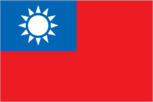
red with a dark blue rectangle in the upper hoist-side corner bearing a white sun with 12 triangular rays
Judicial branch
Judicial Yuan
Legal system
based on civil law system; accepts compulsory ICJ jurisdiction, with reservations
Legislative branch
unicameral Legislative Yuan and unicameral National Assembly
Legislative Yuan
elections last held 19 December 1992 (next to be held NA December 1995); results - KMT 60%, DPP 31%, independents 9%; seats - (304 total, 161 elected) KMT 96, DPP 50, independents 15
Member of
expelled from UN General Assembly and Security Council on 25 October 1971 and withdrew on same date from other charter-designated subsidiary organs; expelled from IMF/World Bank group April/May 1980; seeking to join GATT; attempting to retain membership in INTELSAT; suspended from IAEA in 1972, but still allows IAEA controls over extensive atomic development, APEC, AsDB, BCIE, ICC, IOC, WCL
Names
conventional long form: none conventional short form: Taiwan local long form: none local short form: T'ai-wan
National Assembly
first National Assembly elected in November 1946 with a supplementary election in December 1986; second and present National Assembly elected in December 1991; seats - (403 total) KMT 318, DPP 75, other 10; (next election to be held probably in 1996 and will be a direct popular election)
National holiday
National Day, 10 October (1911) (Anniversary of the Revolution)
Other political or pressure groups
Taiwan independence movement, various environmental groups note: debate on Taiwan independence has become acceptable within the mainstream of domestic politics on Taiwan; political liberalization and the increased representation of the opposition Democratic Progressive Party in Taiwan's legislature have opened public debate on the island's national identity; advocates of Taiwan independence, both within the DPP and the ruling Kuomintang, oppose the ruling party's traditional stand that the island will eventually unify with mainland China; the aims of the Taiwan independence movement include establishing a sovereign nation on Taiwan and entering the UN; other organizations supporting Taiwan independence include the World United Formosans for Independence and the Organization for Taiwan Nation Building
Political parties and leaders
Kuomintang (KMT, Nationalist Party), LI Teng-hui, chairman; Democratic Progressive Party (DPP), SHIH Ming-teh, chairman; Chinese New Party (CNP); Labor Party (LP)
Suffrage
20 years of age; universal
Type
multiparty democratic regime; opposition political parties legalized in March, 1989
US diplomatic representation
unofficial commercial and cultural relations with the people of Taiwan are maintained through a private institution, the American Institute in Taiwan (AIT), which has offices in Taipei at #7, Lane 134, Hsin Yi Road, Section 3, telephone [886] (2) 709-2000, and in Kao-hsiung at #2 Chung Cheng 3d Road, telephone [886] (7) 224-0154 through 0157, and the American Trade Center at Room 3207 International Trade Building, Taipei World Trade Center, 333 Keelung Road Section 1, Taipei 10548, telephone [886] (2) 720-1550
Economy
Agriculture
accounts for 4% of GDP and 16% of labor force (includes part-time farmers); heavily subsidized sector; major crops - vegetables, rice, fruit, tea; livestock - hogs, poultry, beef, milk; not self-sufficient in wheat, soybeans, corn; fish catch increasing, reached 1.4 million metric tons in 1988
Budget
revenues: $30.3 billion expenditures: $30.1 billion, including capital expenditures of $NA (1991 est.)
Currency
1 New Taiwan dollar (NT$) = 100 cents
Economic aid
recipient: US, including Ex-Im (FY46-82), $4.6 billion; Western (non-US) countries, ODA and OOF bilateral commitments (1970-89), $500 million
Electricity
capacity: 21,460,000 kW production: 108 billion kWh consumption per capita: 4,789 kWh (1993)
Exchange rates
New Taiwan dollars per US$1 - 26.2 (1994), 26.6 (1993), 25.4 (1992), 25.748 (1991), 27.108 (1990), 26.407 (1989)
Exports
$93 billion (f.o.b., 1994) commodities: electrical machinery 19.7%, electronic products 19.6%, textiles 10.9%, footwear 3.3%, foodstuffs 1.0%, plywood and wood products 0.9% (1993 est.) partners: US 27.6%, Hong Kong 21.7%, EC countries 15.2%, Japan 10.5% (1994 est.)
External debt
$620 million (1992 est.)
Fiscal year
1 July - 30 June
Illicit drugs
an important heroin transit point; also a major drug money laundering center
Imports
$85.1 billion (c.i.f., 1994) commodities: machinery and equipment 15.7%, electronic products 15.6%, chemicals 9.8%, iron and steel 8.5%, crude oil 3.9%, foodstuffs 2.1% (1993 est.) partners: Japan 30.1%, US 21.7%, EC countries 17.6% (1993 est.)
Industrial production
growth rate 4.5% (1994 est.); accounts for more than 40% of GDP
Industries
electronics, textiles, chemicals, clothing, food processing, plywood, sugar milling, cement, shipbuilding, petroleum refining
Inflation rate (consumer prices)
5.2% (1994 est.)
National product
GDP - purchasing power parity - $257 billion (1994 est.)
National product per capita
$12,070 (1994 est.)
National product real growth rate
6% (1994 est.)
Overview
Taiwan has a dynamic capitalist economy with considerable government guidance of investment and foreign trade and partial government ownership of some large banks and industrial firms. Real growth in GNP has averaged about 9% a year during the past three decades. Export growth has been even faster and has provided the impetus for industrialization. Inflation and unemployment are remarkably low. Agriculture contributes about 4% to GDP, down from 35% in 1952. Taiwan currently ranks as number 13 among major trading countries. Traditional labor-intensive industries are steadily being replaced with more capital- and technology-intensive industries. Taiwan has become a major investor in China, Thailand, Indonesia, the Philippines, Malaysia, and Vietnam. The tightening of labor markets has led to an influx of foreign workers, both legal and illegal.
Unemployment rate
1.6% (1994)
Communications
Radio
broadcast stations: AM 91, FM 23, shortwave 0 radios: 8.62 million
Telephone system
7,800,000 telephones; best developed system in Asia outside of Japan local: NA intercity: extensive microwave radio relay links on east and west coasts international: 2 INTELSAT (1 Pacific Ocean and 1 Indian Ocean) earth stations; submarine cable links to Japan (Okinawa), Philippines, Guam, Singapore, Hong Kong, Indonesia, Australia, Middle East, and Western Europe
Television
broadcast stations: 15 (repeaters 13) televisions: 6.386 million (color 5,680,000, monochrome 706,000)
Transportation
Airports
total: 41 with paved runways over 3,047 m: 8 with paved runways 2,438 to 3,047 m: 11 with paved runways 1,524 to 2,437 m: 6 with paved runways 914 to 1,523 m: 6 with paved runways under 914 m: 8 with unpaved runways 1,524 to 2,438 m: 2
Highways
total: 20,041 km paved: bituminous, concrete pavement 17,095 km unpaved: crushed stone, gravel 2,371 km; graded earth 575 km
Merchant marine
total: 198 ships (1,000 GRT or over) totaling 5,635,682 GRT/8,652,111 DWT ships by type: bulk 55, cargo 30, chemical tanker 1, combination bulk 2, combination ore/oil 1, container 78, oil tanker 17, passenger-cargo 1, refrigerated cargo 12, roll-on/roll-off cargo 1
Pipelines
petroleum products 615 km; natural gas 97 km
Ports
Chi-lung (Keelung), Hua-lien, Kao-hsiung, Su-ao, T'ai-chung
Railroads
total: 4,600 km; note - 1,075 km in common carrier service and about 3,525 km is dedicated to industrial use narrow gauge: 4,600 km 1.067-m
Military and Security
Branches
Army, Navy (includes Marines), Air Force, Coastal Patrol and Defense Command, Armed Forces Reserve Command, Military Police Command
Defense expenditures
exchange rate conversion - $9.8 billion, 3.4% of GDP (FY94/95); $9.77 billion proposed for FY95/96 budget ________________________________________________________________________ TAJIKISTAN Note--Tajikistan has experienced three changes of government since it gained independence in September 1991. The current president, Emomali RAKHMONOV, was elected to the presidency in November 1994, yet has been in power since 1992. The country is suffering through its third year of a civil war, with no clear end in sight. Underlying the conflict are deeply-rooted regional and clan-based animosities that pit a government consisting of people primarily from the Kulob (Kulyab), Khujand (Leninabad), and Hisor (Hissar) regions against a secular and Islamic-led opposition from the Gharm, Gorno-Badakhshan, and Qurghonteppa (Kurgan-Tyube) regions. Government and opposition representatives have held periodic rounds of UN-mediated peace talks and agreed in September 1994 to a cease-fire. Russian-led peacekeeping troops are deployed throughout the country, and Russian border guards are stationed along the Tajik-Afghan border.
Manpower availability
males age 15-49 6,293,884; males fit for military service 4,863,014; males reach military age (19) annually 201,191 (1995 est.)