2016 Edition
CIA World Factbook 2016 Archive (HTML)
Introduction
Background
Following World War I, France acquired a mandate over the northern portion of the former Ottoman Empire province of Syria. The French administered the area as Syria until granting it independence in 1946. The new country lacked political stability and experienced a series of military coups. Syria united with Egypt in February 1958 to form the United Arab Republic. In September 1961, the two entities separated, and the Syrian Arab Republic was reestablished. In the 1967 Arab-Israeli War, Syria lost the Golan Heights region to Israel. During the 1990s, Syria and Israel held occasional, albeit unsuccessful, peace talks over its return. In November 1970, Hafiz al-ASAD, a member of the socialist Ba'th Party and the minority Alawi sect, seized power in a bloodless coup and brought political stability to the country. Following the death of President Hafiz al-ASAD, his son, Bashar al-ASAD, was approved as president by popular referendum in July 2000. Syrian troops - stationed in Lebanon since 1976 in an ostensible peacekeeping role - were withdrawn in April 2005. During the July-August 2006 conflict between Israel and Hizballah, Syria placed its military forces on alert but did not intervene directly on behalf of its ally Hizballah. In May 2007, Bashar al-ASAD's second term as president was approved by popular referendum. Influenced by major uprisings that began elsewhere in the region, and compounded by additional social and economic factors, antigovernment protests broke out first in the southern province of Dar'a in March 2011 with protesters calling for the repeal of the restrictive Emergency Law allowing arrests without charge, the legalization of political parties, and the removal of corrupt local officials. Demonstrations and violent unrest spread across Syria with the size and intensity of protests fluctuating. The government responded to unrest with a mix of concessions - including the repeal of the Emergency Law, new laws permitting new political parties, and liberalizing local and national elections - and military force. However, the government's response has failed to meet opposition demands for ASAD's resignation, and the government's ongoing violence to quell unrest and widespread armed opposition activity has led to extended clashes between government forces and oppositionists. International pressure on the ASAD regime has intensified since late 2011, as the Arab League, EU, Turkey, and the US expanded economic sanctions against the regime. In December 2012, the Syrian National Coalition, was recognized by more than 130 countries as the sole legitimate representative of the Syrian people. Peace talks between the Coalition and Syrian regime at the UN-sponsored Geneva II conference in 2014 failed to produce a resolution of the conflict. Unrest continues in Syria, and according to an April 2016 UN estimate, the death toll among Syrian Government forces, opposition forces, and civilians had reached 400,000. As of January 2016, approximately 13.5 million people were in need of humanitarian assistance in Syria, with 6.5 million people displaced internally, and an additional 4.8 million Syrian refugees, making the Syrian situation the largest humanitarian crisis worldwide.
Geography
Area
- 185,180 sq km 183,630 sq km 1,550 sq km includes 1,295 sq km of Israeli-occupied territory
- land
- 183,630 sq km
- note
- includes 1,295 sq km of Israeli-occupied territory
- total
- 185,180 sq km
- water
- 1,550 sq km
Area - comparative
slightly more than 1.5 times the size of Pennsylvania
Climate
mostly desert; hot, dry, sunny summers (June to August) and mild, rainy winters (December to February) along coast; cold weather with snow or sleet periodically in Damascus
Coastline
193 km
Elevation
- 514 m lowest point: unnamed location near Lake Tiberias -200 m highest point: Mount Hermon 2,814 m
- elevation extremes
- lowest point: unnamed location near Lake Tiberias -200 m
- highest point
- Mount Hermon 2,814 m
- mean elevation
- 514 m
Environment - current issues
deforestation; overgrazing; soil erosion; desertification; water pollution from raw sewage and petroleum refining wastes; inadequate potable water
Environment - international agreements
- Biodiversity, Climate Change, Climate Change-Kyoto Protocol, Desertification, Endangered Species, Hazardous Wastes, Ozone Layer Protection, Ship Pollution, Wetlands Environmental Modification
- party to
- Biodiversity, Climate Change, Climate Change-Kyoto Protocol, Desertification, Endangered Species, Hazardous Wastes, Ozone Layer Protection, Ship Pollution, Wetlands
- signed, but not ratified
- Environmental Modification
Geographic coordinates
35 00 N, 38 00 E
Geography - note
the capital of Damascus - located at an oasis fed by the Barada River - is thought to be one of the world's oldest continuously inhabited cities; there are 42 Israeli settlements and civilian land use sites in the Israeli-occupied Golan Heights (2014 est.)
Irrigated land
14,280 sq km (2012)
Land boundaries
- 2,363 km Iraq 599 km, Israel 83 km, Jordan 379 km, Lebanon 403 km, Turkey 899 km
- border countries (5)
- Iraq 599 km, Israel 83 km, Jordan 379 km, Lebanon 403 km, Turkey 899 km
- total
- 2,363 km
Land use
- 75.8% arable land 25.4%; permanent crops 5.8%; permanent pasture 44.6% 2.7% 21.5% (2011 est.)
- agricultural land
- 75.8%
- forest
- 2.7%
- other
- 21.5% (2011 est.)
Location
Middle East, bordering the Mediterranean Sea, between Lebanon and Turkey
Map references
Middle East
Maritime claims
- 12 nm 24 nm
- contiguous zone
- 24 nm
- territorial sea
- 12 nm
Natural hazards
- dust storms, sandstorms Syria's two historically active volcanoes, Es Safa and an unnamed volcano near the Turkish border have not erupted in centuries
- volcanism
- Syria's two historically active volcanoes, Es Safa and an unnamed volcano near the Turkish border have not erupted in centuries
Natural resources
petroleum, phosphates, chrome and manganese ores, asphalt, iron ore, rock salt, marble, gypsum, hydropower
Population - distribution
significant population density along the Mediterranean coast; larger concentrations found in the major cities of Damascus, Aleppo (the country's largest city), and Hims (Homs); more than half of the population lives in the coastal plain, the province of Aleppo, and the Euphrates River valley
Terrain
primarily semiarid and desert plateau; narrow coastal plain; mountains in west
People and Society
Age structure
- 31.95% (male 2,815,140/female 2,675,166) 19.65% (male 1,711,847/female 1,664,814) 39.03% (male 3,342,264/female 3,364,406) 5.26% (male 447,205/female 457,525) 4.11% (male 318,691/female 388,112) (2016 est.)
- 0-14 years
- 31.95% (male 2,815,140/female 2,675,166)
- 15-24 years
- 19.65% (male 1,711,847/female 1,664,814)
- 25-54 years
- 39.03% (male 3,342,264/female 3,364,406)
- 55-64 years
- 5.26% (male 447,205/female 457,525)
- 65 years and over
- 4.11% (male 318,691/female 388,112) (2016 est.)
Birth rate
21.7 births/1,000 population (2016 est.)
Child labor - children ages 5-14
- 192,915 4% (2006 est.)
- percentage
- 4% (2006 est.)
- total number
- 192,915
Children under the age of 5 years underweight
10.1% (2009)
Contraceptive prevalence rate
53.9% (2009/10)
Death rate
4 deaths/1,000 population (2016 est.)
Dependency ratios
- 70% 63.1% 6.9% 14.5% (2015 est.)
- elderly dependency ratio
- 6.9%
- potential support ratio
- 14.5% (2015 est.)
- total dependency ratio
- 70%
- youth dependency ratio
- 63.1%
Drinking water source
- urban: 92.3% of population rural: 87.2% of population total: 90.1% of population urban: 7.7% of population rural: 12.8% of population total: 9.9% of population (2015 est.)
- rural
- 12.8% of population
- total
- 9.9% of population (2015 est.)
- urban
- 7.7% of population
Education expenditures
5.1% of GDP (2009)
Ethnic groups
Arab 90.3%, Kurds, Armenians, and other 9.7%
Health expenditures
3.3% of GDP (2014)
HIV/AIDS - adult prevalence rate
0.01% (2014 est.)
HIV/AIDS - deaths
less than 100 (2014 est.)
HIV/AIDS - people living with HIV/AIDS
900 (2014 est.)
Hospital bed density
1.5 beds/1,000 population (2012)
Infant mortality rate
- 15.2 deaths/1,000 live births 17.5 deaths/1,000 live births 12.8 deaths/1,000 live births (2016 est.)
- female
- 12.8 deaths/1,000 live births (2016 est.)
- male
- 17.5 deaths/1,000 live births
- total
- 15.2 deaths/1,000 live births
Languages
Arabic (official), Kurdish, Armenian, Aramaic, Circassian, French, English
Life expectancy at birth
- 74.9 years 72.5 years 77.4 years (2016 est.)
- female
- 77.4 years (2016 est.)
- male
- 72.5 years
- total population
- 74.9 years
Literacy
- age 15 and over can read and write 86.4% 91.7% 81% (2015 est.)
- definition
- age 15 and over can read and write
- female
- 81% (2015 est.)
- male
- 91.7%
- total population
- 86.4%
Major urban areas - population
Aleppo 3.562 million; DAMASCUS (capital) 2.566 million; Hims (Homs) 1.641 million; Hamah 1.237 million; Lattakia 781,000 (2015)
Maternal mortality rate
68 deaths/100,000 live births (2015 est.)
Median age
- 24.1 years 23.7 years 24.6 years (2016 est.)
- female
- 24.6 years (2016 est.)
- male
- 23.7 years
- total
- 24.1 years
Nationality
- Syrian(s) Syrian
- adjective
- Syrian
- noun
- Syrian(s)
Net migration rate
-2.1 migrant(s)/1,000 population (2016 est.)
Obesity - adult prevalence rate
21.6% (2014)
Physicians density
1.46 physicians/1,000 population (2010)
Population
- 17,185,170 (July 2016 est.) approximately 20,500 Israeli settlers live in the Golan Heights (2014)
- note
- approximately 20,500 Israeli settlers live in the Golan Heights (2014)
Population distribution
significant population density along the Mediterranean coast; larger concentrations found in the major cities of Damascus, Aleppo (the country's largest city), and Hims (Homs); more than half of the population lives in the coastal plain, the province of Aleppo, and the Euphrates River valley
Population growth rate
1.56% (2016 est.)
Religions
Muslim 87% (official; includes Sunni 74% and Alawi, Ismaili, and Shia 13%), Christian 10% (includes Orthodox, Uniate, and Nestorian), Druze 3%, Jewish (few remaining in Damascus and Aleppo)
Sanitation facility access
- urban: 96.2% of population rural: 95.1% of population total: 95.7% of population urban: 3.8% of population rural: 4.9% of population total: 4.3% of population (2015 est.)
- rural
- 4.9% of population
- total
- 4.3% of population (2015 est.)
- urban
- 3.8% of population
School life expectancy (primary to tertiary education)
- 9 years 9 years 9 years (2013)
- female
- 9 years (2013)
- male
- 9 years
- total
- 9 years
Sex ratio
- 1.06 male(s)/female 1.05 male(s)/female 1.03 male(s)/female 0.99 male(s)/female 0.98 male(s)/female 0.82 male(s)/female 1.01 male(s)/female (2016 est.)
- 0-14 years
- 1.05 male(s)/female
- 15-24 years
- 1.03 male(s)/female
- 25-54 years
- 0.99 male(s)/female
- 55-64 years
- 0.98 male(s)/female
- 65 years and over
- 0.82 male(s)/female
- at birth
- 1.06 male(s)/female
- total population
- 1.01 male(s)/female (2016 est.)
Total fertility rate
2.55 children born/woman (2016 est.)
Unemployment, youth ages 15-24
- 35.8% 26.6% 71.1% (2011 est.)
- female
- 71.1% (2011 est.)
- male
- 26.6%
- total
- 35.8%
Urbanization
- 57.7% of total population (2015) 1.37% annual rate of change (2010-15 est.)
- rate of urbanization
- 1.37% annual rate of change (2010-15 est.)
- urban population
- 57.7% of total population (2015)
Government
Administrative divisions
14 provinces (muhafazat, singular - muhafazah); Al Hasakah, Al Ladhiqiyah (Latakia), Al Qunaytirah, Ar Raqqah, As Suwayda', Dar'a, Dayr az Zawr, Dimashq (Damascus), Halab, Hamah, Hims (Homs), Idlib, Rif Dimashq (Damascus Countryside), Tartus
Capital
- Damascus 33 30 N, 36 18 E UTC+2 (7 hours ahead of Washington, DC, during Standard Time) +1hr, begins midnight on the last Friday in March; ends at midnight on the first Friday in November
- daylight saving time
- +1hr, begins midnight on the last Friday in March; ends at midnight on the first Friday in November
- geographic coordinates
- 33 30 N, 36 18 E
- name
- Damascus
- time difference
- UTC+2 (7 hours ahead of Washington, DC, during Standard Time)
Citizenship
- no the father must be a citizen of Syria; if the father is unknown or stateless, the mother must be a citizen of Syria yes 10 years
- citizenship by birth
- no
- citizenship by descent only
- the father must be a citizen of Syria; if the father is unknown or stateless, the mother must be a citizen of Syria
- dual citizenship recognized
- yes
- residency requirement for naturalization
- 10 years
Constitution
several previous; latest issued 15 February 2012, passed by referendum 26 February 2012 (2016)
Country name
- Syrian Arab Republic Syria Al Jumhuriyah al Arabiyah as Suriyah Suriyah United Arab Republic (with Egypt) name ultimately derived from the ancient Assyrians who dominated northern Mesopotamia, but whose reach also extended westward to the Levant; over time, the name came to be associated more with the western area
- conventional long form
- Syrian Arab Republic
- conventional short form
- Syria
- etymology
- name ultimately derived from the ancient Assyrians who dominated northern Mesopotamia, but whose reach also extended westward to the Levant; over time, the name came to be associated more with the western area
- former
- United Arab Republic (with Egypt)
- local long form
- Al Jumhuriyah al Arabiyah as Suriyah
- local short form
- Suriyah
Diplomatic representation from the US
- ambassador (vacant); Special Envoy for Syria Michael RATNEY (since 27 July 2015); note - on 6 February 2012, the US closed its embassy in Damascus Abou Roumaneh, Al-Mansour Street, No. 2, Damascus P. O. Box 29, Damascus [963] (11) 3391-4444 [963] (11) 3391-3999
- chief of mission
- ambassador (vacant); Special Envoy for Syria Michael RATNEY (since 27 July 2015); note - on 6 February 2012, the US closed its embassy in Damascus
- embassy
- Abou Roumaneh, Al-Mansour Street, No. 2, Damascus
- FAX
- [963] (11) 3391-3999
- mailing address
- P. O. Box 29, Damascus
- telephone
- [963] (11) 3391-4444
Diplomatic representation in the US
- Embassy ceased operation and closed on 18 March 2014 Ambassador (vacant); Charge d'Affaires Mounir KOUDMANI (since 1 June 2012) 2215 Wyoming Avenue NW, Washington, DC 20008 [1] (202) 232-6313 [1] (202) 234-9548
- chancery
- 2215 Wyoming Avenue NW, Washington, DC 20008
- chief of mission
- Ambassador (vacant); Charge d'Affaires Mounir KOUDMANI (since 1 June 2012)
- FAX
- [1] (202) 234-9548
- note
- Embassy ceased operation and closed on 18 March 2014
- telephone
- [1] (202) 232-6313
Executive branch
- President Bashar al-ASAD (since 17 July 2000); Vice President Najah al-ATTAR (since 23 March 2006) Prime Minister Imad Muhammad Dib KHAMIS (since 22 June 2016); Walid al-MUALEM (since 2006); Deputy Prime Minister Fahd Jasim al-FURAYJ, Lt. Gen. (since 2012) Council of Ministers appointed by the president president directly elected by simple majority popular vote for a 7-year term (eligible for a second term); election last held on 3 June 2014 (next to be held in June 2021); the president appoints the vice presidents, prime minister, and deputy prime ministers Bashar al-ASAD approved as president; percent of vote - Bashar al-ASAD (Ba'th Party) 88.7%, Hassan al-NOURI (independent) 4.3%, Maher HAJJER (independent) 3.2%, other/invalid 3.8%
- cabinet
- Council of Ministers appointed by the president
- chief of state
- President Bashar al-ASAD (since 17 July 2000); Vice President Najah al-ATTAR (since 23 March 2006)
- election results
- Bashar al-ASAD approved as president; percent of vote - Bashar al-ASAD (Ba'th Party) 88.7%, Hassan al-NOURI (independent) 4.3%, Maher HAJJER (independent) 3.2%, other/invalid 3.8%
- elections/appointments
- president directly elected by simple majority popular vote for a 7-year term (eligible for a second term); election last held on 3 June 2014 (next to be held in June 2021); the president appoints the vice presidents, prime minister, and deputy prime ministers
- head of government
- Prime Minister Imad Muhammad Dib KHAMIS (since 22 June 2016); Walid al-MUALEM (since 2006); Deputy Prime Minister Fahd Jasim al-FURAYJ, Lt. Gen. (since 2012)
Flag description
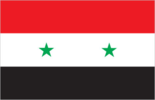
- three equal horizontal bands of red (top), white, and black; two small, green, five-pointed stars in a horizontal line centered in the white band; the band colors derive from the Arab Liberation flag and represent oppression (black), overcome through bloody struggle (red), to be replaced by a bright future (white); identical to the former flag of the United Arab Republic (1958-1961) where the two stars represented the constituent states of Syria and Egypt; the current design dates to 1980 similar to the flag of Yemen, which has a plain white band, Iraq, which has an Arabic inscription centered in the white band, and that of Egypt, which has a gold Eagle of Saladin centered in the white band
- note
- similar to the flag of Yemen, which has a plain white band, Iraq, which has an Arabic inscription centered in the white band, and that of Egypt, which has a gold Eagle of Saladin centered in the white band
Government type
presidential republic; highly authoritarian regime
Independence
17 April 1946 (from League of Nations mandate under French administration)
International law organization participation
has not submitted an ICJ jurisdiction declaration; non-party state to the ICCt
International organization participation
ABEDA, AFESD, AMF, CAEU, FAO, G-24, G-77, IAEA, IBRD, ICAO, ICC (national committees), ICRM, IDA, IDB, IFAD, IFC, IFRCS, IHO, ILO, IMF, IMO, Interpol, IOC, IPU, ISO, ITSO, ITU, LAS, MIGA, NAM, OAPEC, OIC, OPCW, UN, UNCTAD, UNESCO, UNIDO, UNRWA, UNWTO, UPU, WCO, WFTU (NGOs), WHO, WIPO, WMO, WTO (observer)
Judicial branch
- Court of Cassation (organized into civil, criminal, religious, and military divisions, each with 3 judges); Supreme Constitutional Court (consists of 7 members) Court of Cassation judges appointed by the Supreme Judicial Council or SJC, a judicial management body headed by the minister of justice with 7 members including the national president; judge tenure NA; Supreme Constitutional Court judges nominated by the president and appointed by the SJC; judges appointed for 4-year renewable terms courts of first instance; magistrates' courts; religious and military courts; Economic Security Court
- highest court(s)
- Court of Cassation (organized into civil, criminal, religious, and military divisions, each with 3 judges); Supreme Constitutional Court (consists of 7 members)
- judge selection and term of office
- Court of Cassation judges appointed by the Supreme Judicial Council or SJC, a judicial management body headed by the minister of justice with 7 members including the national president; judge tenure NA; Supreme Constitutional Court judges nominated by the president and appointed by the SJC; judges appointed for 4-year renewable terms
- subordinate courts
- courts of first instance; magistrates' courts; religious and military courts; Economic Security Court
Legal system
mixed legal system of civil and Islamic law (for family courts)
Legislative branch
- unicameral People's Assembly or Majlis al-Shaab (250 seats; members directly elected in multi-seat constituencies by proportional representation vote to serve 4-year terms) last held on 13 April 2016 (next to be held in 2020) percent of vote by party - NPF 80%, other 20%; seats by party - NPF 200, other 50
- description
- unicameral People's Assembly or Majlis al-Shaab (250 seats; members directly elected in multi-seat constituencies by proportional representation vote to serve 4-year terms)
- election results
- percent of vote by party - NPF 80%, other 20%; seats by party - NPF 200, other 50
- elections
- last held on 13 April 2016 (next to be held in 2020)
National anthem
- "Humat ad-Diyar" (Guardians of the Homeland) Khalil Mardam BEY/Mohammad Salim FLAYFEL and Ahmad Salim FLAYFEL adopted 1936, restored 1961; between 1958 and 1961, while Syria was a member of the United Arab Republic with Egypt, the country had a different anthem
- lyrics/music
- Khalil Mardam BEY/Mohammad Salim FLAYFEL and Ahmad Salim FLAYFEL
- name
- "Humat ad-Diyar" (Guardians of the Homeland)
- note
- adopted 1936, restored 1961; between 1958 and 1961, while Syria was a member of the United Arab Republic with Egypt, the country had a different anthem
National holiday
Independence Day, 17 April (1946)
National symbol(s)
- hawk; national colors: red, white, black, green
- hawk; national colors
- red, white, black, green
Political parties and leaders
- Arab Socialist Union of Syria or ASU [Safwan al-QUDSI] National Progressive Front or NPF [Bashar al-ASAD, Suleiman QADDAH] (alliance includes Arab Socialist Renaissance (Ba'th) Party [President Bashar al-ASAD], Socialist Unionist Democratic Party [Fadlallah Nasr al-DIN] Syrian Communist Party (two branches) [Wissal Farha BAKDASH, Yusuf Rashid FAYSAL] Syrian Social Nationalist Party or SSNP [As'ad HARDAN] Unionist Socialist Party [Fayez ISMAIL]) Kurdish Azadi Party Kurdish Democratic Accord Party (al Wifaq) Kurdish Democratic Party (al Parti-Ibrahim wing) Kurdish Democratic Party (al Parti-Mustafa wing) Kurdish Democratic Party in Syria or KDP-S Kurdish Democratic Patriotic/National Party Kurdish Democratic Progressive Party or KDPP-Darwish Kurdish Democratic Progressive Party or KDPP-Muhammad Kurdish Democratic Union Party or PYD [Salih Muslim MOHAMMAD] Kurdish Democratic Unity Party Kurdish Democratic Yekiti Party Kurdish Future Party [Rezan HASSAN] Kurdish Left Party Kurdish Yekiti (Union) Party Syrian Kurdish Democratic Party Syrian Democratic Party [Mustafa QALAAJI]
- Kurdish parties (considered illegal)
- Kurdish Azadi Party
- legal parties/alliances
- Arab Socialist Union of Syria or ASU [Safwan al-QUDSI]
- other
- Syrian Democratic Party [Mustafa QALAAJI]
Political pressure groups and leaders
- Free Syrian Army Syrian Muslim Brotherhood or SMB [Muhammad Riyad al-SHAQFAH] (operates in exile in London) Syrian Opposition Coalition or National Coalition of Syrian Revolutionary and Opposition Forces [Anas al-ABDAH] there are also hundreds of local and provincial political and armed opposition groups that organize protests, provide civilian services, and stage armed attacks
- note
- there are also hundreds of local and provincial political and armed opposition groups that organize protests, provide civilian services, and stage armed attacks
Suffrage
18 years of age; universal
Economy
Agriculture - products
wheat, barley, cotton, lentils, chickpeas, olives, sugar beets; beef, mutton, eggs, poultry, milk
Budget
- $3.9 billion $5.7 billion government projections for FY2016
- expenditures
- $5.7 billion
- note
- government projections for FY2016
- revenues
- $3.9 billion
Budget surplus (+) or deficit (-)
-7.3% of GDP (2016 est.)
Central bank discount rate
0.75% (31 December 2015) 5% (31 December 2014)
Commercial bank prime lending rate
27% (31 December 2015 est.) 18.5% (31 December 2014 est.)
Current account balance
-$3.148 billion (2015 est.) -$3.667 billion (2014 est.)
Debt - external
$5.3 billion (31 December 2015 est.) $4.597 billion (31 December 2014 est.)
Economy - overview
Syria's economy continues to deteriorate amid the ongoing conflict that began in 2011, declining by 62% from 2010 to 2014. The government has struggled to address the effects of international sanctions, widespread infrastructure damage, diminished domestic consumption and production, reduced subsidies, and high inflation, which have caused dwindling foreign exchange reserves, rising budget and trade deficits, a decreasing value of the Syrian pound, and falling household purchasing power. During 2014, the ongoing conflict and continued unrest and economic decline worsened the humanitarian crisis and elicited a greater need for international assistance, as the number of people in need inside Syria increased from 9.3 million to 12.2 million, and the number of Syrian refugees increased from 2.2 million to more than 3.3 million. Prior to the turmoil, Damascus had begun liberalizing economic policies, including cutting lending interest rates, opening private banks, consolidating multiple exchange rates, raising prices on some subsidized items, and establishing the Damascus Stock Exchange, but the economy remains highly regulated. Long-run economic constraints include foreign trade barriers, declining oil production, high unemployment, rising budget deficits, increasing pressure on water supplies caused by heavy use in agriculture, rapid population growth, industrial expansion, water pollution, and widespread infrastructure damage.
Exchange rates
Syrian pounds (SYP) per US dollar - 236.41 (2015 est.) 153.695 (2014 est.) 153.695 (2013 est.) 64.39 (2012 est.) 48.371 (2011 est.)
Exports
$2.14 billion (2015 est.) $3.015 billion (2014 est.)
Exports - commodities
crude oil, minerals, petroleum products, fruits and vegetables, cotton fiber, textiles, clothing, meat and live animals, wheat
Exports - partners
Iraq 64.7%, Saudi Arabia 11.2%, Kuwait 7.1%, UAE 6.1%, Libya 4.6% (2015)
Fiscal year
calendar year
GDP - composition, by end use
- 63.4% 22.5% 19.2% 10.9% 9.1% -25.1% (2015 est.)
- exports of goods and services
- 9.1%
- government consumption
- 22.5%
- household consumption
- 63.4%
- imports of goods and services
- -25.1% (2015 est.)
- investment in fixed capital
- 19.2%
- investment in inventories
- 10.9%
GDP - composition, by sector of origin
- 19.5% 18.9% 61.6% (2015 est.)
- agriculture
- 19.5%
- industry
- 18.9%
- services
- 61.6% (2015 est.)
GDP - per capita (PPP)
- $5,100 (2011 est.) $5,100 (2010 est.) $5,200 (2010 est.) data are in 2011 US dollars
- note
- data are in 2011 US dollars
GDP - real growth rate
-9.9% (2015 est.) -36.5% (2014 est.) -30.9% (2013 est.)
GDP (official exchange rate)
$24.6 billion (2014 est.)
GDP (purchasing power parity)
- $55.8 billion (2014 est.) $61.9 billion (2013 est.) $97.5 billion (2012 est.) data are in 2014 US dollars the war-driven deterioration of the economy resulted in a disappearance of quality national level statistics in the 2012-13 period
- note
- data are in 2014 US dollars
Gross national saving
20% of GDP (2015 est.) 18.5% of GDP (2014 est.) 14.9% of GDP (2013 est.)
Household income or consumption by percentage share
- NA% NA%
- highest 10%
- NA%
- lowest 10%
- NA%
Imports
$6.663 billion (2015 est.) $8.028 billion (2014 est.)
Imports - commodities
machinery and transport equipment, electric power machinery, food and livestock, metal and metal products, chemicals and chemical products, plastics, yarn, paper
Imports - partners
Saudi Arabia 28%, UAE 13.7%, Iran 10.1%, Turkey 9%, Iraq 8.3%, China 6.1% (2015)
Industrial production growth rate
-4.8% (2015 est.)
Industries
petroleum, textiles, food processing, beverages, tobacco, phosphate rock mining, cement, oil seeds crushing, automobile assembly
Inflation rate (consumer prices)
38.1% (2015 est.) 29.2% (2014 est.)
Labor force
3.577 million (2015 est.)
Labor force - by occupation
- 17% 16% 67% (2008 est.)
- agriculture
- 17%
- industry
- 16%
- services
- 67% (2008 est.)
Market value of publicly traded shares
$NA
Population below poverty line
82.5% (2014 est.)
Public debt
52% of GDP (2015 est.) 48.8% of GDP (2014 est.)
Reserves of foreign exchange and gold
$772.9 million (31 December 2015 est.) $1.428 billion (31 December 2014 est.)
Stock of broad money
$11.05 billion (31 December 2014 est.) $12.71 billion (31 December 2013 est.)
Stock of domestic credit
$5.285 billion (31 December 2015 est.) $8.6 billion (31 December 2014 est.)
Stock of narrow money
$5.254 billion (31 December 2015 est.) $6.718 billion (31 December 2014 est.)
Taxes and other revenues
15.9% of GDP (2016 est.)
Unemployment rate
50% (2015 est.) 57.7% (2014 est.)
Energy
Carbon dioxide emissions from consumption of energy
49 million Mt (2013 est.)
Crude oil - exports
0 bbl/day (2013 est.)
Crude oil - imports
58,260 bbl/day (2013 est.)
Crude oil - production
30,000 bbl/day (2015 est.)
Crude oil - proved reserves
2.5 billion bbl (1 January 2016 es)
Electricity - consumption
17 billion kWh (2014 est.)
Electricity - exports
100 million kWh (2014 est.)
Electricity - from fossil fuels
82.9% of total installed capacity (2012 est.)
Electricity - from hydroelectric plants
16.8% of total installed capacity (2012 est.)
Electricity - from nuclear fuels
0% of total installed capacity (2012 est.)
Electricity - from other renewable sources
0.3% of total installed capacity (2012 est.)
Electricity - imports
1.2 billion kWh (2012 est.)
Electricity - installed generating capacity
8.2 million kW (2014 est.)
Electricity - production
21 billion kWh (2014 est.)
Electricity access
- 1,600,000 96% 100% 81% (2013)
- electrification - rural areas
- 81% (2013)
- electrification - total population
- 96%
- electrification - urban areas
- 100%
- population without electricity
- 1,600,000
Natural gas - consumption
5.205 billion cu m (2014 est.)
Natural gas - exports
0 cu m (2013 est.)
Natural gas - imports
249.2 million cu m (2011 est.)
Natural gas - production
5.205 billion cu m (2014 est.)
Natural gas - proved reserves
240.7 billion cu m (1 January 2016 es)
Refined petroleum products - consumption
165,000 bbl/day (2014 est.)
Refined petroleum products - exports
12,150 bbl/day (2013 est.)
Refined petroleum products - imports
76,050 bbl/day (2013 est.)
Refined petroleum products - production
111,600 bbl/day (2013 est.)
Communications
Broadcast media
state-run TV and radio broadcast networks; state operates 2 TV networks and a satellite channel; roughly two-thirds of Syrian homes have a satellite dish providing access to foreign TV broadcasts; 3 state-run radio channels; first private radio station launched in 2005; private radio broadcasters prohibited from transmitting news or political content (2007)
Internet country code
.sy
Internet users
- 5.116 million 30% (July 2015 est.)
- percent of population
- 30% (July 2015 est.)
- total
- 5.116 million
Telephone system
- the armed insurgency that began in 2011 has led to major disruptions to the network and has caused telephone and Internet outages throughout the country the number of fixed-line connections increased markedly prior to the civil war in 2011; mobile-cellular service stands at about 80 per 100 persons country code - 963; submarine cable connection to Egypt, Lebanon, and Cyprus; satellite earth stations - 1 Intelsat (Indian Ocean) and 1 Intersputnik (Atlantic Ocean region); coaxial cable and microwave radio relay to Iraq, Jordan, Lebanon, and Turkey; participant in Medarabtel (2015)
- domestic
- the number of fixed-line connections increased markedly prior to the civil war in 2011; mobile-cellular service stands at about 80 per 100 persons
- general assessment
- the armed insurgency that began in 2011 has led to major disruptions to the network and has caused telephone and Internet outages throughout the country
- international
- country code - 963; submarine cable connection to Egypt, Lebanon, and Cyprus; satellite earth stations - 1 Intelsat (Indian Ocean) and 1 Intersputnik (Atlantic Ocean region); coaxial cable and microwave radio relay to Iraq, Jordan, Lebanon, and Turkey; participant in Medarabtel (2015)
Telephones - fixed lines
- 4.082 million 24 (July 2015 est.)
- subscriptions per 100 inhabitants
- 24 (July 2015 est.)
- total subscriptions
- 4.082 million
Telephones - mobile cellular
- 13.904 million 81 (July 2015 est.)
- subscriptions per 100 inhabitants
- 81 (July 2015 est.)
- total
- 13.904 million
Transportation
Airports
90 (2013)
Airports - with paved runways
- 5 (2013)
- 2,438 to 3,047 m
- 16
- 914 to 1,523 m
- 3
- over 3,047 m
- 5
- total
- 29
- under 914 m
- 5 (2013)
Airports - with unpaved runways
- 48 (2013)
- 1,524 to 2,437 m
- 1
- 914 to 1,523 m
- 12
- total
- 61
- under 914 m
- 48 (2013)
Civil aircraft registration country code prefix
YK (2016)
Heliports
6 (2013)
Merchant marine
- bulk carrier 4, cargo 14, carrier 1 166 (Barbados 1, Belize 4, Bolivia 4, Cambodia 22, Comoros 5, Dominica 4, Georgia 24, Lebanon 2, Liberia 1, Malta 4, Moldova 5, North Korea 4, Panama 34, Saint Vincent and the Grenadines 9, Sierra Leone 13, Tanzania 23, Togo 6, unknown 1) (2010)
- by type
- bulk carrier 4, cargo 14, carrier 1
- registered in other countries
- 166 (Barbados 1, Belize 4, Bolivia 4, Cambodia 22, Comoros 5, Dominica 4, Georgia 24, Lebanon 2, Liberia 1, Malta 4, Moldova 5, North Korea 4, Panama 34, Saint Vincent and the Grenadines 9, Sierra Leone 13, Tanzania 23, Togo 6, unknown 1) (2010)
- total
- 19
National air transport system
- 475,932 1,517,388 mt-km (2015)
- annual freight traffic on registered air carriers
- 1,517,388 mt-km (2015)
- annual passenger traffic on registered air carriers
- 475,932
- inventory of registered aircraft operated by air carriers
- 11
- number of registered air carriers
- 2
Pipelines
gas 3,170 km; oil 2,029 km (2013)
Ports and terminals
- Baniyas, Latakia, Tartus
- major seaport(s)
- Baniyas, Latakia, Tartus
Railways
- 2,052 km 1,801 km 1.435-m gauge 251 km 1.050-m gauge (2014)
- narrow gauge
- 251 km 1.050-m gauge (2014)
- standard gauge
- 1,801 km 1.435-m gauge
- total
- 2,052 km
Roadways
- 69,873 km 63,060 km 6,813 km (2010)
- paved
- 63,060 km
- total
- 69,873 km
- unpaved
- 6,813 km (2010)
Waterways
900 km (navigable but not economically significant) (2011)
Military and Security
Military branches
- Syrian Armed Forces: Land Forces, Naval Forces, Air Forces (includes Air Defense Forces) (2013)
- Syrian Armed Forces
- Land Forces, Naval Forces, Air Forces (includes Air Defense Forces) (2013)
Military service age and obligation
18 years of age for compulsory and voluntary military service; conscript service obligation is 18 months; women are not conscripted but may volunteer to serve; re-enlistment obligation 5 years, with retirement after 15 years or age 40 (enlisted) or 20 years or age 45 (NCOs) (2012)
Transnational Issues
Disputes - international
Golan Heights is Israeli-occupied with the almost 1,000-strong UN Disengagement Observer Force patrolling a buffer zone since 1964; lacking a treaty or other documentation describing the boundary, portions of the Lebanon-Syria boundary are unclear with several sections in dispute; since 2000, Lebanon has claimed Shab'a Farms in the Golan Heights; 2004 Agreement and pending demarcation would settle border dispute with Jordan
Illicit drugs
a transit point for opiates, hashish, and cocaine bound for regional and Western markets; weak anti-money-laundering controls and bank privatization may leave it vulnerable to money laundering
Refugees and internally displaced persons
- 528,616 (Palestinian Refugees); undetermined (Iraq) (2015) the ongoing civil war has created about 4.8 million Syrian refugees - dispersed in Egypt, Iraq, Jordan, Lebanon, and Turkey - as of November 2016 6,563,462 (ongoing civil war since 2011) (2015) 160,000 (2015); note - Syria's stateless population consists of Kurds and Palestinians; stateless persons are prevented from voting, owning land, holding certain jobs, receiving food subsidies or public healthcare, enrolling in public schools, or being legally married to Syrian citizens; in 1962, some 120,000 Syrian Kurds were stripped of their Syrian citizenship, rendering them and their descendants stateless; in 2011, the Syrian Government granted citizenship to thousands of Syrian Kurds as a means of appeasement; however, resolving the question of statelessness is not a priority given Syria's ongoing civil war
- IDPs
- 6,563,462 (ongoing civil war since 2011) (2015)
- note
- the ongoing civil war has created about 4.8 million Syrian refugees - dispersed in Egypt, Iraq, Jordan, Lebanon, and Turkey - as of November 2016
- refugees (country of origin)
- 528,616 (Palestinian Refugees); undetermined (Iraq) (2015)
- stateless persons
- 160,000 (2015); note - Syria's stateless population consists of Kurds and Palestinians; stateless persons are prevented from voting, owning land, holding certain jobs, receiving food subsidies or public healthcare, enrolling in public schools, or being legally married to Syrian citizens; in 1962, some 120,000 Syrian Kurds were stripped of their Syrian citizenship, rendering them and their descendants stateless; in 2011, the Syrian Government granted citizenship to thousands of Syrian Kurds as a means of appeasement; however, resolving the question of statelessness is not a priority given Syria's ongoing civil war
Trafficking in persons
- as conditions continue to deteriorate due to Syria’s civil war, human trafficking has increased; Syrians remaining in the country and those that are refugees abroad are vulnerable to trafficking; Syria is a source and destination country for men, women and children subjected to forced labor and sex trafficking; Syrian children continue to be forcibly recruited by government forces, pro-regime militias, armed opposition groups, and terrorist organizations to serve as soldiers, human shields, and executioners; ISIL forces Syrian women and girls and Yazidi women and girls taken from Iraq to marry its fighters, where they experience domestic servitude and sexual violence; Syrian refugee women and girls are forced into exploitive marriages or prostitution in neighboring countries, while displaced children are forced into street begging domestically and abroad Tier 3 - the government does not fully comply with the minimum standards for the elimination of trafficking and is not making significant efforts to do so; in 2014, Syria’s violent conditions enabled human trafficking to flourish; the government made no effort to investigate, prosecute, or convict trafficking offenders or complicit government officials, including those who forcibly recruited child soldiers; authorities did not identify victims and failed to ensure victims, including child soldiers, were protected from arrest, detention, and severe abuse as a result of being trafficked (2015)
- current situation
- as conditions continue to deteriorate due to Syria’s civil war, human trafficking has increased; Syrians remaining in the country and those that are refugees abroad are vulnerable to trafficking; Syria is a source and destination country for men, women and children subjected to forced labor and sex trafficking; Syrian children continue to be forcibly recruited by government forces, pro-regime militias, armed opposition groups, and terrorist organizations to serve as soldiers, human shields, and executioners; ISIL forces Syrian women and girls and Yazidi women and girls taken from Iraq to marry its fighters, where they experience domestic servitude and sexual violence; Syrian refugee women and girls are forced into exploitive marriages or prostitution in neighboring countries, while displaced children are forced into street begging domestically and abroad
- tier rating
- Tier 3 - the government does not fully comply with the minimum standards for the elimination of trafficking and is not making significant efforts to do so; in 2014, Syria’s violent conditions enabled human trafficking to flourish; the government made no effort to investigate, prosecute, or convict trafficking offenders or complicit government officials, including those who forcibly recruited child soldiers; authorities did not identify victims and failed to ensure victims, including child soldiers, were protected from arrest, detention, and severe abuse as a result of being trafficked (2015)