1993 Edition
CIA World Factbook 1993 (Project Gutenberg)
Geography
Area
total area: 185,180 km2 land area: 184,050 km2 comparative area: slightly larger than North Dakota note: includes 1,295 km2 of Israeli-occupied territory
Climate
mostly desert; hot, dry, sunny summers (June to August) and mild, rainy winters (December to February) along coast
Coastline
193 km
Environment
deforestation; overgrazing; soil erosion; desertification
International disputes
separated from Israel by the 1949 Armistice Line; Golan Heights is Israeli occupied; Hatay question with Turkey; periodic disputes with Iraq over Euphrates water rights; ongoing dispute over water development plans by Turkey for the Tigris and Euphrates Rivers; Syrian troops in northern Lebanon since October 1976
Irrigated land
6,700 km2 (1989)
Land boundaries
total 2,253 km, Iraq 605 km, Israel 76 km, Jordan 375 km, Lebanon 375 km, Turkey 822 km
Land use
arable land: 28% permanent crops: 3% meadows and pastures: 46% forest and woodland: 3% other: 20%
Location
Middle East, along the Mediterranean Sea, between Turkey and Lebanon
Map references
Africa, Middle East, Standard Time Zones of the World
Maritime claims
contiguous zone: 41 nm territorial sea: 35 nm
Natural resources
petroleum, phosphates, chrome and manganese ores, asphalt, iron ore, rock salt, marble, gypsum
Note
there are 38 Jewish settlements in the Israeli-occupied Golan Heights
Terrain
primarily semiarid and desert plateau; narrow coastal plain; mountains in west
People and Society
Birth rate
44.08 births/1,000 population (1993 est.)
Death rate
6.44 deaths/1,000 population (1993 est.)
Ethnic divisions
Arab 90.3%, Kurds, Armenians, and other 9.7%
Infant mortality rate
43.9 deaths/1,000 live births (1993 est.)
Labor force
2.951 million (1989) by occupation: miscellaneous and government services 36%, agriculture 32%, industry and construction 32%; note - shortage of skilled labor (1984)
Languages
Arabic (official), Kurdish, Armenian, Aramaic, Circassian, French widely understood
Life expectancy at birth
total population: 66.12 years male: 65.07 years female: 67.22 years (1993 est.)
Literacy
age 15 and over can read and write (1990) total population: 64% male: 78% female: 51%
Nationality
noun: Syrian(s) adjective: Syrian
Net migration rate
0 migrant(s)/1,000 population (1993 est.)
Population
14,338,527 (July 1993 est.) note: in addition, there are at least 14,500 Druze and 14,000 Jewish settlers in the Israeli-occupied Golan Heights (1993 est.)
Population growth rate
3.76% (1993 est.)
Religions
Sunni Muslim 74%, Alawite, Druze, and other Muslim sects 16%, Christian (various sects) 10%, Jewish (tiny communities in Damascus, Al Qamishli, and Aleppo)
Total fertility rate
6.75 children born/woman (1993 est.)
Government
Administrative divisions
14 provinces (muhafazat, singular - muhafazah); Al Hasakah, Al Ladhiqiyah, Al Qunaytirah, Ar Raqqah, As Suwayda', Dar'a, Dayr az Zawr, Dimashq, Halab, Hamah, Hims, Idlib, Rif Dimashq, Tartus
Capital
Damascus
Chief of State
President Hafiz al-ASAD (since 22 February 1971 see note); Vice Presidents 'Abd al-Halim KHADDAM, Rif'at al-ASAD, and Muhammad Zuhayr MASHARIQA (since 11 March 1984); note - President ASAD seized power in the November 1970 coup, assumed presidential powers 22 February 1971, and was confirmed as president in the 12 March 1971 national elections
Constitution
13 March 1973
Digraph
SY
Diplomatic representation in US
chief of mission: Ambassador Walid MOUALEM chancery: 2215 Wyoming Avenue NW, Washington, DC 20008 telephone: (202) 232-6313
Executive branch
president, three vice presidents, prime minister, three deputy prime ministers, Council of Ministers (cabinet)
FAX
[963] (11) 718687
Flag
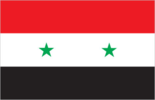
three equal horizontal bands of red (top), white, and black with two small green five-pointed stars in a horizontal line centered in the white band; similar to the flag of Yemen, which has a plain white band and of Iraq, which has three green stars (plus an Arabic inscription) in a horizontal line centered in the white band; also similar to the flag of Egypt, which has a symbolic eagle centered in the white band
Head of Government
Prime Minister Mahmud ZU'BI (since 1 November 1987); Deputy Prime Minister Lt. Gen. Mustafa TALAS (since 11 March 1984); Deputy Prime Minister Salim YASIN (since NA December 1981); Deputy Prime Minister Rashid AKHTARINI (since 4 July 1992)
Independence
17 April 1946 (from League of Nations mandate under French administration)
Judicial branch
Supreme Constitutional Court, High Judicial Council, Court of Cassation, State Security Courts
Legal system
based on Islamic law and civil law system; special religious courts; has not accepted compulsory ICJ jurisdiction
Legislative branch
unicameral People's Council (Majlis al-Chaab)
Member of
ABEDA, AFESD, AL, AMF, CAEU, CCC, ESCWA, FAO, G-24, G-77, IAEA, IBRD, ICAO, ICC, IDA, IDB, IFAD, IFC, ILO, IMF, IMO, INTELSAT, INTERPOL, IOC, ISO, ITU, LORCS, NAM, OAPEC, OIC, UN, UNCTAD, UNESCO, UNIDO, UNRWA, UPU, WFTU, WHO, WIPO, WMO, WTO
Names
conventional long form: Syrian Arab Republic conventional short form: Syria local long form: Al Jumhuriyah al Arabiyah as Suriyah local short form: Suriyah former: United Arab Republic (with Egypt)
National holiday
National Day, 17 April (1946)
Other political or pressure groups
non-Ba'th parties have little effective political influence; Communist party ineffective; conservative religious leaders; Muslim Brotherhood
People's Council
last held 22-23 May 1990 (next to be held NA May 1994); results - Ba'th 53.6%, ASU 3.2%, SCP 3.2%, Arab Socialist Unionist Movement 2.8%, ASP 2%, Democratic Socialist Union Party 1.6%, independents 33.6%; seats - (250 total) Ba'th 134, ASU 8, SCP 8, Arab Socialist Unionist Movement 7, ASP 5, Democratic Socialist Union Party 4, independents 84; note - the People's Council was expanded to 250 seats total prior to the May 1990 election
Political parties and leaders
ruling party is the Arab Socialist Resurrectionist (Ba'th) Party; the Progressive National is dominated by Ba'thists but includes independents and members of the Syrian Arab Socialist Party (ASP); Arab Socialist Union (ASU); Syrian Communist Party (SCP); Arab Socialist Unionist Movement; and Democratic Socialist Union Party
President
last held 2 December 1991 (next to be held December 1998); results - President Hafiz al-ASAD was reelected for a fourth seven-year term with 99.98% of the vote
Suffrage
18 years of age; universal
Type
republic under leftwing military regime since March 1963
US diplomatic representation
chief of mission: Ambassador Christopher W. S. ROSS embassy: Abu Rumaneh, Al Mansur Street No. 2, Damascus mailing address: P. O. Box 29, Damascus telephone: [963] (11) 333052 or 332557, 330416, 332814, 332315, 714108, 337178, 333232
Economy
Agriculture
accounts for 27% of GDP and one-third of labor force; all major crops (wheat, barley, cotton, lentils, chickpeas) grown mainly on rain-watered land causing wide swings in production; animal products - beef, lamb, eggs, poultry, milk; not self-sufficient in grain or livestock products
Budget
revenues $5.4 billion; expenditures $7.5 billion, including capital expenditures of $2.9 billion (1991 est.)
Currency
1 Syrian pound (#S) = 100 piasters
Economic aid
US commitments, including Ex-Im (FY70-81), $538 million; Western (non-US) ODA and OOF bilateral commitments (1970-89), $1.23 billion; OPEC bilateral aid (1979-89), $12.3 billion; former Communist countries (1970-89), $3.3 billion
Electricity
3,205,000 kW capacity; 11,900 million kWh produced, 830 kWh per capita (1992)
Exchange rates
Syrian pounds (#S) per US$1 - 22.0 (promotional rate since 1991), 22.0 (official rate since 1991), 42.0 (official parallel rate since 1991), 11.2250 (fixed rate 1987-90)
Exports
$3.5 billion (f.o.b., 1992 est.) commodities: petroleum 45%, farm products 11%, textiles, phosphates 5% (1990) partners: USSR and Eastern Europe 44%, EC 34%, Arab countries 17%, US/Canada 1% (1990)
External debt
$5.3 billion (1990 est.)
Fiscal year
calendar year
Illicit drugs
a transit country for Lebanese and Turkish refined cocaine going to Europe and heroin and hashish bound for the Persian Gulf area
Imports
$2.7 billion (f.o.b., 1992 est.) commodities: foodstuffs and beverages 21%, machinery 15%, metal and metal products 15%, textiles 7%, petroleum products (1990) partners: EC 42%, USSR and Eastern Europe 13%, other Europe 13%, US/Canada 11%, Arab countries 6% (1990)
Industrial production
growth rate 6% (1991 est.); accounts for 18% of GDP
Industries
textiles, food processing, beverages, tobacco, phosphate rock mining, petroleum
Inflation rate (consumer prices)
20% (1992 est.)
National product
GDP - exchange rate conversion - $30 billion (1991 est.)
National product per capita
$2,300 (1991 est.)
National product real growth rate
9% (1991 est.)
Overview
Syria's state-dominated Ba'thist economy has benefited from the Gulf war, increased oil production, good weather, and economic deregulation. Economic growth averaged nearly 12% annually in 1990-91, buoyed by increased oil production and improved agricultural performance. The Gulf war of early 1991 provided Syria an aid windfall of nearly $5 billion dollars from Arab, European, and Japanese donors. These inflows more than offset Damascus's war-related costs and will help Syria cover some of its debt arrears, restore suspended credit lines, and initiate selected military and civilian purchases. In 1992 the government spurred economic development by loosening controls on domestic and foreign investment while maintaining strict political controls. For the long run, Syria's economy is still saddled with a large number of poorly performing public sector firms and industrial and agricultural productivity is poor. A major long-term concern is the additional drain of upstream Euphrates water by Turkey when its vast dam and irrigation projects are completed by mid-decade.
Unemployment rate
5.7% (1989)
Communications
Airports
total: 104 usable: 100 with permanent-surface runways: 24 with runways over 3,659 m: with runways 2,440-3,659 m: 21 with runways 1,220-2,439 m: 3
Highways
29,000 km total; 670 km expressways; 5,000 km main or national roads; 23,330 km secondary or regional roads (not including municipal roads); 22,680 km of the total is paved (1988)
Inland waterways
870 km; minimal economic importance
Merchant marine
41 ships (1,000 GRT or over) totaling 117,247 GRT/183,607 DWT; includes 36 cargo, 2 vehicle carrier, 3 bulk
Pipelines
crude oil 1,304 km, petroleum products 515 km
Ports
Tartus, Latakia, Baniyas, Jablah
Railroads
1,998 km total; 1,766 km standard gauge, 232 km 1.050-meter (narrow) gauge
Telecommunications
fair system currently undergoing significant improvement and digital upgrades, including fiber optic technology; 512,600 telephones (37 telephones per 1,000 persons); broadcast stations - 9 AM, 1 FM, 17 TV; satellite earth stations - 1 Indian Ocean INTELSAT and 1 Intersputnik; 1 submarine cable; coaxial cable and microwave radio relay to Iraq, Jordan, Lebanon, and Turkey
Military and Security
Branches
Syrian Arab Army, Syrian Arab Navy, Syrian Arab Air Force, Syrian Arab Air Defense Forces
Defense expenditures
exchange rate conversion - $2.2 billion, 6% of GDP (1992)
Manpower availability
males age 15-49 3,168,429; fit for military service 1,777,413; reach military age (19) annually 151,102 (1993 est.)