1996 Edition
CIA World Factbook 1996 (Project Gutenberg)
Introduction
Description
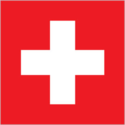
red square with a bold, equilateral white cross in the center that does not extend to the edges of the flag
Location
47 00 N, 8 00 E -- Central Europe, east of France Flag ----
Geography
Area
- comparative area
- slightly more than twice the size of New Jersey
- land area
- 39,770 sq km
- total area
- 41,290 sq km
Climate
temperate, but varies with altitude; cold, cloudy, rainy/snowy winters; cool to warm, cloudy, humid summers with occasional showers
Coastline
0 km (landlocked)
Environment
- current issues
- air pollution from vehicle emissions and open-air burning; acid rain; water pollution from increased use of agricultural fertilizers; loss of biodiversity
- international agreements
- party to - Air Pollution, Air Pollution-Nitrogen Oxides, Air Pollution-Sulphur 85, Air Pollution-Volatile Organic Compounds, Antarctic Treaty, Biodiversity, Climate Change, Endangered Species, Environmental Modification, Hazardous Wastes, Marine Dumping, Marine Life Conservation, Nuclear Test Ban, Ozone Layer Protection, Ship Pollution, Tropical Timber 83, Wetlands, Whaling; signed, but not ratified - Air Pollution-Sulphur 94, Antarctic-Environmental Protocol, Desertification, Law of the Sea, Tropical Timber 94
- natural hazards
- avalanches, landslides, flash floods
Geographic coordinates
47 00 N, 8 00 E
Geographic note
landlocked; crossroads of northern and southern Europe; along with southeastern France and northern Italy, contains the highest elevations in Europe
International disputes
none
Irrigated land
250 sq km (1989)
Land boundaries
- border countries
- Austria 164 km, France 573 km, Italy 740 km, Liechtenstein 41 km, Germany 334 km
- total
- 1,852 km
Land use
- arable land
- 10%
- forest and woodland
- 26%
- meadows and pastures
- 40%
- other
- 23%
- permanent crops
- 1%
Location
Central Europe, east of France
Map references
Europe
Maritime claims
none (landlocked)
Natural resources
hydropower potential, timber, salt
Terrain
- mostly mountains (Alps in south, Jura in northwest) with a central plateau of rolling hills, plains, and large lakes
- highest point
- Dufourspitze 4,634 m
- lowest point
- Lake Maggiore 195 m
People and Society
Age structure
0-14 years: 17% (male 638,728; female 610,546) 15-64 years: 68% (male 2,495,325; female 2,405,226) 65 years and over: 15% (male 424,394; female 632,841) (July 1996 est.)
Birth rate
11.35 births/1,000 population (1996 est.)
Death rate
9.64 deaths/1,000 population (1996 est.)
Ethnic divisions
- total population
- German 65%, French 18%, Italian 10%, Romansch 1%, other 6%
Infant mortality rate
5.4 deaths/1,000 live births (1996 est.)
Languages
- German 65%, French 18%, Italian 12%, Romansch 1%, other 4%
- note
- figures for Swiss nationals only: German 74%, French 20%, Italian 4%, Romansch 1%, other 1%
Life expectancy at birth
- female
- 80.82 years (1996 est.)
- male
- 74.58 years
- total population
- 77.62 years
Literacy
- age 15 and over can read and write (1980 est.)
- female
- NA%
- male
- NA%
- total population
- 99%
Nationality
- adjective
- Swiss
- noun
- Swiss (singular and plural)
Net migration rate
4.2 migrant(s)/1,000 population (1996 est.)
Population
7,207,060 (July 1996 est.)
Population growth rate
0.59% (1996 est.)
Religions
Roman Catholic 47.6%, Protestant 44.3%, other 8.1% (1980)
Sex ratio
- all ages
- 0.98 male(s)/female (1996 est.)
- at birth
- 1.05 male(s)/female
- under 15 years
- 1.05 male(s)/female 15-64 years: 1.04 male(s)/female 65 years and over: 0.67 male(s)/female
Swiss nationals
German 74%, French 20%, Italian 4%, Romansch 1%, other 1%
Total fertility rate
1.47 children born/woman (1996 est.)
Government
Administrative divisions
26 cantons (cantons, singular - canton in French; cantoni, singular - cantone in Italian; kantone, singular - kanton in German); Aargau, Ausser-Rhoden, Basel-Landschaft, Basel-Stadt, Bern, Fribourg, Geneve, Glarus, Graubunden, Inner-Rhoden, Jura, Luzern, Neuchatel, Nidwalden, Obwalden, Sankt Gallen, Schaffhausen, Schwyz, Solothurn, Thurgau, Ticino, Uri, Valais, Vaud, Zug, Zurich
Capital
Bern
Constitution
29 May 1874
Council of States
(German - Standerat, French - Conseil des Etats, Italian - Consiglio degli Stati); elections last held throughout 1995 (next to be held NA 1999); results - percent of vote by party NA; seats - (46 total) PRD 17, PDC 17, UDC 4, PSS 3, LPS 3, LdU 1, Ticino League 1
Data code
SZ
Diplomatic representation in US
- chancery
- 2900 Cathedral Avenue NW, Washington, DC 20008
- chief of mission
- Ambassador Carlo JAGMETTI
- telephone
- [1] (202) 745-7900
Executive branch
- cabinet
- Federal Council (German - Bundesrat, French - Censeil Federal, Italian - Consiglio Federale) was elected for a four-year term by the Federal Assembly from among its own members
- chief of state and head of government
- President Jean-Pascal DELAMURAZ (1996 calendar year; presidency rotates annually); Vice President Arnold KOLLER (term runs concurrently with that of president); the president is appointed each year from the Federal Council by the Federal Assembly
FAX
- [1] (202) 387-2564
- [41] (31) 357 73 44
- consulate(s) general
- Atlanta, Chicago, Houston, Los Angeles, New York, Pago Pago (American Samoa), and San Francisco
- consulate(s) general
- Zurich
Flag
red square with a bold, equilateral white cross in the center that does not extend to the edges of the flag
Independence
1 August 1291
International organization participation
AfDB, AG (observer), AsDB, Australia Group, BIS, CCC, CE, CERN, EBRD, ECE, EFTA, ESA, FAO, G- 8, G-10, IADB, IAEA, IBRD, ICAO, ICC, ICFTU, ICRM, IDA, IEA, IFAD, IFC, IFRCS, ILO, IMF, IMO, Inmarsat, Intelsat, Interpol, IOC, IOM, ISO, ITU, MTCR, NAM (guest), NEA, NSG, OAS (observer), OECD, OSCE, PCA, UN (observer), UNAMIR, UNCTAD, UNESCO, UNHCR, UNIDO, UNITAR, UNMOT, UNOMIG, UNPREDEP, UNPROFOR, UNTSO, UNU, UPU, WCL, WHO, WIPO, WMO, WToO, WTrO, ZC
Judicial branch
Federal Supreme Court, judges elected for six-year terms by the Federal Assembly
Legal system
civil law system influenced by customary law; judicial review of legislative acts, except with respect to federal decrees of general obligatory character; accepts compulsory ICJ jurisdiction, with reservations
Legislative branch
bicameral Federal Assembly (German - Bundesversammlung, French - Assemblee Federale, Italian - Assemblea Federale)
Name of country
- conventional long form
- Swiss Confederation
- conventional short form
- Switzerland
- local long form
- Schweizerische Eidgenossenschaft (German), Confederation Suisse (French), Confederazione Svizzera (Italian)
- local short form
- Schweiz (German), Suisse (French), Svizzera (Italian)
National Council
(German - Nationalrat, French - Conseil National, Italian - Consiglio Nazionale); elections last held 20 October 1995 (next to be held NA October 1999); results - percent of vote by party NA; seats - (200 total) PRD 45, PSS 54, PDC 34, UDC 30, GPS 8, LPS 7, FPS 6, LdU 6, SD 3, EVP 3, PdA 2, Ticino League 2
National holiday
Anniversary of the Founding of the Swiss Confederation, 1 August (1291)
Political parties and leaders
Radical Free Democratic Party (PRD), Franz STEINEGGER, president; Social Democratic Party (PSS), Peter BODENMANN, president; Christian Democratic People's Party (PDC), Anton COTTIER, president; Swiss People's Party (UDC), Hans UHLMANN, president; Green Party (GPS), Verena DIENER, president; Freedom Party (FPS), Roland BORER; Liberal Party (LPS), Christoph EYMANN, president; Alliance of Independents' Party (LdU), Monica WEBER, president; Ticino League, Giuliano BIGNASCA, president; and other minor parties including Swiss Democratic Party (SD), Workers' Party (PdA), and the Evangelical People's Party (EVP); note - see elections
Suffrage
18 years of age; universal
Type of government
federal republic
US diplomatic representation
- chief of mission
- Ambassador (vacant)
- embassy
- Jubilaeumstrasse 93, 3005 Bern
- mailing address
- use embassy street address
- telephone
- [41] (31) 357 70 11
Economy
Agriculture
grains, fruits, vegetables; meat, eggs
Budget
- expenditures
- $36.9 billion, including capital expenditures of $NA (1995)
- revenues
- $31 billion
Currency
1 Swiss franc, franken, or franco (SwF) = 100 centimes, rappen, or centesimi
Economic aid
- donor
- ODA, $793 million (1993)
Economic overview
Switzerland, a fundamentally prosperous and stable modern economy with a per capita GDP roughly 10% above that of the big West European economies, is experiencing short-term difficulties. After recovering slowly in 1994-95 from recession, the Swiss economy remains weak, mainly because of the strong Swiss franc and weak growth in Swiss export market, especially in other European countries. Over the near term, growth may average barely 1%, with more than one-half of this increase resulting from growth in inventories. Weak domestic consumer demand is the principal culprit; stagnation in real disposable income is combining with a reluctance to reduce saving rates in the face of an uncertain employment outlook. Switzerland's leading sectors, including financial services, biotechnology, pharmaceuticals, and special-purpose machines, will therefore be more reliant on export markets at the same time they are being squeezed by the strong franc. Consequently, growth in machinery and equipment investment, for example, is expected to taper off. On the other side, import growth has been fueled by the strong franc; there are growing indications that Swiss manufacturers are substituting imported inputs for domestic ones.
Electricity
- capacity
- 15,430,000 kW
- consumption per capita
- 6,699 kWh (1993)
- production
- 58 billion kWh
Exchange rates
Swiss francs, franken, or franchi (SwF) per US$1 - 1.1810 (January 1996), 1.1825 (1995), 1.3677 (1994), 1.4776 (1993), 1.4062 (1992), 1.4340 (1991)
Exports
- $69.6 billion (f.o.b., 1994 est.)
- commodities
- machinery and equipment, precision instruments, metal products, foodstuffs, textiles and clothing
- partners
- Western Europe 63.1% (EU countries 56%, other 7.1%), US 8.8%, Japan 3.4%
External debt
$NA
Fiscal year
calendar year
GDP
purchasing power parity - $158.5 billion (1995 est.)
GDP composition by sector
- agriculture
- 3%
- industry
- 33.5%
- services
- 63.5% (1991)
GDP per capita
$22,400 (1995 est.)
GDP real growth rate
1.2% (1995 est.)
Illicit drugs
money-laundering center; transit country for South American cocaine and Southwest Asian heroin
Imports
- $68.2 billion (c.i.f., 1994 est.)
- commodities
- agricultural products, machinery and transportation equipment, chemicals, textiles, construction materials
- partners
- Western Europe 79.2% (EU countries 72.3%, other 6.9%), US 6.4%
Industrial production growth rate
NA%
Industries
machinery, chemicals, watches, textiles, precision instruments
Inflation rate (consumer prices)
1.8% (1995 est.)
Labor force
- 3.48 million (900,000 foreign workers, mostly Italian)
- by occupation
- services 50%, industry and crafts 34%, government 10%, agriculture and forestry 6% (1992)
Unemployment rate
3.3% (1995)
Communications
Branches
Army, Air Force and Antiaircraft Command, Frontier Guards, Fortification Guards
Defense expenditures
exchange rate conversion - $3.74 billion, 1.4% of GDP (1995)
Manpower availability
- males age 15-49
- 1,893,587
- males fit for military service
- 1,623,414
- males reach military age (20) annually
- 41,425 (1996 est.)
Radio broadcast stations
AM 7, FM 265, shortwave 0
Radios
NA
Telephone system
- excellent domestic and international services
- domestic
- extensive cable and microwave radio relay networks
- international
- satellite earth stations - 2 Intelsat (Atlantic Ocean and Indian Ocean)
Telephones
5,622,976 (1986 est.)
Television broadcast stations
18 (repeaters 1,322)
Televisions
2.513 million (1994 est.) Defense
Transportation
Airports
- total
- 67
- with paved runways 1 524 to 2 437 m
- 13
- with paved runways 2 438 to 3 047 m
- 4
- with paved runways 914 to 1 523 m
- 5
- with paved runways over 3 047 m
- 4
- with paved runways under 914 m
- 40
- with unpaved runways 914 to 1 523 m
- 1 (1995 est.)
Highways
- paved
- 71,118 km (including 1,514 km of expressways)
- total
- 71,118 km
- unpaved
- 0 km (1992 est.)
Merchant marine
- ships by type
- bulk 14, cargo 1, chemical tanker 4, oil tanker 2, roll-on/roll-off cargo 1, specialized tanker 1 (1995 est.)
- total
- 23 ships (1,000 GRT or over) totaling 410,581 GRT/727,744 DWT
Pipelines
crude oil 314 km; natural gas 1,506 km
Ports
Basel
Railways
- narrow gauge
- 1,255 km 1.000-m gauge (99% electrified; 1,181 km nongovernment owned)
- other
- 1,181 km NA-m gauge (1995)
- standard gauge
- 3,283 km 1.435-m gauge (99% electrified; 310 km nongovernment owned)
- total
- 5,719 km (1,432 km double track)
Waterways
65 km; Rhine (Basel to Rheinfelden, Schaffhausen to Bodensee); 12 navigable lakes