1990 Edition
CIA World Factbook 1990 (Project Gutenberg)
Geography
Climate
temperate, but varies with altitude; cold, cloudy, rainy/snowy winters; cool to warm, cloudy, humid summers with occasional showers
Coastline
none--landlocked
Comparative area
slightly more than twice the size of New Jersey
Environment
dominated by Alps
Land boundaries
1,852 km total; Austria 164 km, France 573 km, Italy 740 km, Liechtenstein 41 km, FRG 334 km
Land use
10% arable land; 1% permanent crops; 40% meadows and pastures; 26% forest and woodland; 23% other; includes 1% irrigated
Maritime claims
none--landlocked
Natural resources
hydropower potential, timber, salt
Note
landlocked; crossroads of northern and southern Europe
Terrain
mostly mountains (Alps in south, Jura in northwest) with a central plateau of rolling hills, plains, and large lakes
Total area
41,290 km2; land area: 39,770 km2
People and Society
Birth rate
12 births/1,000 population (1990)
Death rate
9 deaths/1,000 population (1990)
Ethnic divisions
total population--65% German, 18% French, 10% Italian, 1% Romansch, 6% other; Swiss nationals--74% German, 20% French, 4% Italian, 1% Romansch, 1% other
Infant mortality rate
5 deaths/1,000 live births (1990)
Labor force
3,220,000; 841,000 foreign workers, mostly Italian; 42% services, 39% industry and crafts, 11% government, 7% agriculture and forestry, 1% other (1988)
Language
total population--65% German, 18% French, 12% Italian, 1% Romansch, 4% other; Swiss nationals--74% German, 20% French, 4% Italian, 1% Romansch, 1% other
Life expectancy at birth
75 years male, 83 years female (1990)
Literacy
99%
Nationality
noun--Swiss (sing. & pl.); adjective--Swiss
Net migration rate
3 migrants/1,000 population (1990)
Organized labor
20% of labor force
Population
6,742,461 (July 1990), growth rate 0.6% (1990)
Religion
49% Roman Catholic, 48% Protestant, 0.3% Jewish
Total fertility rate
1.6 children born/woman (1990)
Government
Administrative divisions
26 cantons (cantons, singular--canton in French; cantoni, singular--cantone in Italian; kantone, singular--kanton in German); Aargau, Ausser-Rhoden, Basel-Landschaft, Basel-Stadt, Bern, Fribourg, Geneve, Glarus, Graubunden, Inner-Rhoden, Jura, Luzern, Neuchatel, Nidwalden, Obwalden, Sankt Gallen, Schaffhausen, Schwyz, Solothurn, Thurgau, Ticino, Uri, Valais, Vaud, Zug, Zurich
Capital
Bern
Communists
4,500 members (est.)
Constitution
29 May 1874
Diplomatic representation
Ambassador Edouard BRUNNER; Chancery at 2900 Cathedral Avenue NW, Washington DC 20008; telephone (202) 745-7900; there are Swiss Consulates General in Atlanta, Chicago, Houston, Los Angeles, New York, and San Francisco; US--Ambassador Joseph B. GUILDENHORN; Embassy at Jubilaeumstrasse 93, 3005 Bern; telephone [41] (31) 437011; there is a Branch Office of the Embassy in Geneva and a Consulate General in Zurich
Elections
Council of State--last held throughout 1987 (next to be held NA); results--percent of vote by party NA; seats--(46 total) CVP 19, FDP 14, SPS 5, SVP 4, others 4; National Council--last held 18 October 1987 (next to be held October 1991); results--FDP 22.9%, CVP 20.0%, SPS 18.4%, SVP 11.0%, GP 4.8%, others 22.9%; seats--(200 total) FDP 51, CVP 42, SPS 41, SVP 25, GP 9, others 32
Executive branch
president, vice president, Federal Council
Flag
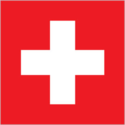
red square with a bold, equilateral white cross in the center that does not extend to the edges of the flag
Independence
1 August 1291
Judicial branch
Federal Supreme Court
Leaders
Chief of State and Head of Government--President Arnold KOLLER (1990 calendar year; presidency rotates annually); Vice President Flavio COTTI (term runs concurrently with that of president)
Legal system
civil law system influenced by customary law; judicial review of legislative acts, except with respect to federal decrees of general obligatory character; accepts compulsory ICJ jurisdiction, with reservations
Legislative branch
bicameral Federal Assembly (German--Bundesversammlung, French--Assemblee Federale) consists of an upper council or Council of States (German--Standerat, French--Conseil des Etats) and and a lower council or National Council (German--Nationalrat, French--Conseil National)
Long-form name
Swiss Confederation
Member of
ADB, CCC, Council of Europe, DAC, EFTA, ESA, FAO, GATT, IAEA, ICAC, ICAO, ICO, IDB--Inter-American Development Bank, IEA, IFAD, ILO, IMO, INTELSAT, INTERPOL, IPU, ITU, IWC--International Wheat Council, OECD, UNESCO, UPU, WCL, WFTU, WHO, WIPO, WMO, WSG, WTO; permanent observer status at the UN
National holiday
Anniversary of the Founding of the Swiss Confederation, 1 August (1291)
Political parties and leaders
Social Democratic Party (SPS), Helmut Hubacher, chairman; Radical Democratic Party (FDP), Bruno Hunziker, president; Christian Democratic People's Party (CVP), Eva Segmuller-Weber, president; Swiss People's Party (SVP), Hans Uhlmann, president; Workers' Party (PdA), Armand Magnin, secretary general; National Action Party (NA), Hans Zwicky, chairman; Independents' Party (LdU), Dr. Franz Jaeger, president; Republican Movement (Rep), Dr. James Schworzenboch, Franz Baumgartner, leaders; Liberal Party (LPS), Gilbert Coutau, president; Evangelical People's Party (EVP), Max Dunki, president; Progressive Organizations of Switzerland (POCH), Georg Degen, secretary; Federation of Ecology Parties (GP), Laurent Rebeaud, president; Autonomous Socialist Party (PSA), Werner Carobbio, secretary
Suffrage
universal at age 20
Type
federal republic
Economy
Agriculture
dairy farming predominates; less than 50% self-sufficient; food shortages--fish, refined sugar, fats and oils (other than butter), grains, eggs, fruits, vegetables, meat
Aid
donor--ODA and OOF commitments (1970-87), $2.5 billion
Budget
revenues $17.0 billion; expenditures $16.8 billion, including capital expenditures of $NA (1988)
Currency
Swiss franc, franken, or franco (plural--francs, franken, or franchi); 1 Swiss franc, franken, or franco (SwF) = 100 centimes, rappen, or centesimi
Electricity
17,710,000 kW capacity; 59,070 million kWh produced, 8,930 kWh per capita (1989)
Exchange rates
Swiss francs, franken, or franchi (SwF) per US$1--1.5150 (January 1990), 1.6359 (1989), 1.4633 (1988), 1.4912 (1987), 1.7989 (1986), 2.4571 (1985)
Exports
$51.2 billion (f.o.b., 1988); commodities--machinery and equipment, precision instruments, metal products, foodstuffs, textiles and clothing; partners--Europe 64% (EC 56%, other 8%), US 9%, Japan 4%
External debt
$NA
Fiscal year
calendar year
GDP
$119.5 billion, per capita $17,800; real growth rate 3.0%
Imports
$57.2 billion (c.i.f., 1988); commodities--agricultural products, machinery and transportation equipment, chemicals, textiles, construction materials; partners--Europe 79% (EC 72%, other 7%), US 5%
Industrial production
growth rate 7.0% (1988)
Industries
machinery, chemicals, watches, textiles, precision instruments
Inflation rate (consumer prices)
2.8% (1989 est.)
Overview
Switzerland's economic success is matched in few, if any, other nations. Per capita output, general living standards, education and science, health care, and diet are unsurpassed in Europe. Inflation remains low because of sound government policy and harmonious labor-management relations. Unemployment is negligible, a marked contrast to the larger economies of Western Europe. This economic stability helps promote the important banking and tourist sectors. Since World War II, Switzerland's economy has adjusted smoothly to the great changes in output and trade patterns in Europe and presumably can adjust to the challenges of the 1990s, in particular, the further economic integration of Western Europe and the amazingly rapid changes in East European political/economic prospects.
Unemployment rate
0.5% (1989 est.)
Communications
Airports
72 total, 70 usable; 42 with permanent-surface runways; 2 with runways over 3,659 m; 6 with runways 2,440-3,659 m; 17 with runways 1,220-2,439 m
Civil air
89 major transport aircraft
Highways
62,145 km total (all paved), of which 18,620 km are canton and 1,057 km are national highways (740 km autobahn); 42,468 km are communal roads
Inland waterways
65 km; Rhine (Basel to Rheinfelden, Schaffhausen to Bodensee); 12 navigable lakes
Merchant marine
20 ships (1,000 GRT or over) totaling 215,851 GRT/365,131 DWT; includes 4 cargo, 2 roll-on/roll-off cargo, 3 chemical tanker, 3 specialized liquid cargo, 8 bulk
Pipelines
314 km crude oil; 1,506 km natural gas
Ports
Basel (river port)
Railroads
5,174 km total; 2,971 km are government owned and 2,203 km are nongovernment owned; the government network consists of 2,897 km 1.435-meter standard gauge and 74 km 1.000-meter narrow gauge track; 1,432 km double track, 99% electrified; the nongovernment network consists of 710 km 1.435-meter standard gauge, 1,418 km 1.000-meter gauge, and 75 km 0.790-meter gauge track, 100% electrified
Telecommunications
excellent domestic, international, and broadcast services; 5,808,000 telephones; stations--6 AM, 36 (400 relays) FM, 145 (1,250 relays) TV; communications satellite earth stations operating in the INTELSAT (4 Atlantic Ocean and 1 Indian Ocean) and EUTELSAT systems
Military and Security
Branches
Army, Air Force
Defense expenditures
$1.2 billion (1989 est.)
Military manpower
males 15-49, 1,800,211; 1,550,662 fit for military service; 44,154 reach military age (20) annually