2016 Edition
CIA World Factbook 2016 Archive (HTML)
Introduction
Background
First explored by the Spaniards in the 16th century and then settled by the English in the mid-17th century, Suriname became a Dutch colony in 1667. With the abolition of African slavery in 1863, workers were brought in from India and Java. The Netherlands granted the colony independence in 1975. Five years later the civilian government was replaced by a military regime that soon declared a socialist republic. It continued to exert control through a succession of nominally civilian administrations until 1987, when international pressure finally forced a democratic election. In 1990, the military overthrew the civilian leadership, but a democratically elected government - a four-party coalition - returned to power in 1991. The coalition expanded to eight parties in 2005 and ruled until August 2010, when voters returned former military leader Desire BOUTERSE and his opposition coalition to power. President BOUTERSE was reelected unopposed in 2015.
Geography
Area
- 163,820 sq km 156,000 sq km 7,820 sq km
- land
- 156,000 sq km
- total
- 163,820 sq km
- water
- 7,820 sq km
Area - comparative
slightly larger than Georgia
Climate
tropical; moderated by trade winds
Coastline
386 km
Elevation
- 246 m lowest point: unnamed location in the coastal plain -2 m highest point: Juliana Top 1,230 m
- elevation extremes
- lowest point: unnamed location in the coastal plain -2 m
- highest point
- Juliana Top 1,230 m
- mean elevation
- 246 m
Environment - current issues
deforestation as timber is cut for export; pollution of inland waterways by small-scale mining activities
Environment - international agreements
- Biodiversity, Climate Change, Climate Change-Kyoto Protocol, Desertification, Endangered Species, Law of the Sea, Marine Dumping, Ozone Layer Protection, Ship Pollution, Tropical Timber 94, Wetlands, Whaling none of the selected agreements
- party to
- Biodiversity, Climate Change, Climate Change-Kyoto Protocol, Desertification, Endangered Species, Law of the Sea, Marine Dumping, Ozone Layer Protection, Ship Pollution, Tropical Timber 94, Wetlands, Whaling
- signed, but not ratified
- none of the selected agreements
Geographic coordinates
4 00 N, 56 00 W
Geography - note
smallest independent country on South American continent; mostly tropical rain forest; great diversity of flora and fauna that, for the most part, is increasingly threatened by new development; relatively small population, mostly along the coast
Irrigated land
570 sq km (2012)
Land boundaries
- 1,907 km Brazil 515 km, French Guiana 556 km, Guyana 836 km
- border countries (3)
- Brazil 515 km, French Guiana 556 km, Guyana 836 km
- total
- 1,907 km
Land use
- 0.5% arable land 0.4%; permanent crops 0%; permanent pasture 0.1% 94.6% 4.9% (2011 est.)
- agricultural land
- 0.5%
- forest
- 94.6%
- other
- 4.9% (2011 est.)
Location
Northern South America, bordering the North Atlantic Ocean, between French Guiana and Guyana
Map references
South America
Maritime claims
- 12 nm 200 nm
- exclusive economic zone
- 200 nm
- territorial sea
- 12 nm
Natural hazards
NA
Natural resources
timber, hydropower, fish, kaolin, shrimp, bauxite, gold, and small amounts of nickel, copper, platinum, iron ore
Population - distribution
population concentrated along the nothern coastal strip; the remainder of the country is sparsely populated
Terrain
mostly rolling hills; narrow coastal plain with swamps
People and Society
Age structure
- 25.15% (male 75,088/female 72,261) 17.46% (male 52,129/female 50,141) 44.36% (male 132,334/female 127,562) 7.16% (male 20,564/female 21,394) 5.86% (male 14,848/female 19,503) (2016 est.)
- 0-14 years
- 25.15% (male 75,088/female 72,261)
- 15-24 years
- 17.46% (male 52,129/female 50,141)
- 25-54 years
- 44.36% (male 132,334/female 127,562)
- 55-64 years
- 7.16% (male 20,564/female 21,394)
- 65 years and over
- 5.86% (male 14,848/female 19,503) (2016 est.)
Birth rate
16 births/1,000 population (2016 est.)
Child labor - children ages 5-14
- 6,094 6% (2006 est.)
- percentage
- 6% (2006 est.)
- total number
- 6,094
Children under the age of 5 years underweight
5.8% (2010)
Contraceptive prevalence rate
47.6% (2010)
Death rate
6.1 deaths/1,000 population (2016 est.)
Demographic profile
Suriname is a pluralistic society consisting primarily of Creoles (persons of mixed African and European heritage), the descendants of escaped African slaves known as Maroons, and the descendants of Indian and Javanese contract workers. The country overall is in full, post-industrial demographic transition, with a low fertility rate, a moderate mortality rate, and a rising life expectancy. However, the Maroon population of the rural interior lags behind because of lower educational attainment and contraceptive use, higher malnutrition, and significantly less access to electricity, potable water, sanitation, infrastructure, and health care. Some 350,000 people of Surinamese descent live in the Netherlands, Suriname's former colonial ruler. In the 19th century, better-educated, largely Dutch-speaking Surinamese began emigrating to the Netherlands. World War II interrupted the outflow, but it resumed after the war when Dutch labor demands grew - emigrants included all segments of the Creole population. Suriname still is strongly influenced by the Netherlands because most Surinamese have relatives living there and it is the largest supplier of development aid. Other emigration destinations include French Guiana and the United States. Suriname's immigration rules are flexible, and the country is easy to enter illegally because rainforests obscure its borders. Since the mid-1980s, Brazilians have settled in Suriname's capital, Paramaribo, or eastern Suriname, where they mine gold. This immigration is likely to slowly re-orient Suriname toward its Latin American roots.
Dependency ratios
- 50.8% 40.4% 10.4% 9.6% (2015 est.)
- elderly dependency ratio
- 10.4%
- potential support ratio
- 9.6% (2015 est.)
- total dependency ratio
- 50.8%
- youth dependency ratio
- 40.4%
Drinking water source
- urban: 98.1% of population rural: 88.4% of population total: 94.8% of population urban: 1.9% of population rural: 11.6% of population total: 5.2% of population (2015 est.)
- rural
- 11.6% of population
- total
- 5.2% of population (2015 est.)
- urban
- 1.9% of population
Education expenditures
NA
Ethnic groups
Hindustani (also known locally as "East Indians"; their ancestors emigrated from northern India in the latter part of the 19th century) 37%, Creole (mixed white and black) 31%, Javanese 15%, "Maroons" (their African ancestors were brought to the country in the 17th and 18th centuries as slaves and escaped to the interior) 10%, Amerindian 2%, Chinese 2%, white 1%, other 2%
Health expenditures
5.7% of GDP (2014)
HIV/AIDS - adult prevalence rate
1.08% (2015 est.)
HIV/AIDS - deaths
100 (2015 est.)
HIV/AIDS - people living with HIV/AIDS
3,800 (2015 est.)
Hospital bed density
3.1 beds/1,000 population (2010)
Infant mortality rate
- 25.3 deaths/1,000 live births 29.5 deaths/1,000 live births 20.9 deaths/1,000 live births (2016 est.)
- female
- 20.9 deaths/1,000 live births (2016 est.)
- male
- 29.5 deaths/1,000 live births
- total
- 25.3 deaths/1,000 live births
Languages
Dutch (official), English (widely spoken), Sranang Tongo (Surinamese, sometimes called Taki-Taki, is native language of Creoles and much of the younger population and is lingua franca among others), Caribbean Hindustani (a dialect of Hindi), Javanese
Life expectancy at birth
- 72.2 years 69.8 years 74.8 years (2016 est.)
- female
- 74.8 years (2016 est.)
- male
- 69.8 years
- total population
- 72.2 years
Literacy
- age 15 and over can read and write 95.6% 96.1% 95% (2015 est.)
- definition
- age 15 and over can read and write
- female
- 95% (2015 est.)
- male
- 96.1%
- total population
- 95.6%
Major infectious diseases
- very high bacterial and protozoal diarrhea, hepatitis A, and typhoid fever dengue fever and malaria active local transmission of Zika virus by Aedes species mosquitoes has been identified in this country (as of August 2016); it poses an important risk (a large number of cases possible) among US citizens if bitten by an infective mosquito; other less common ways to get Zika are through sex, via blood transfusion, or during pregnancy, in which the pregnant woman passes Zika virus to her fetus (2016)
- degree of risk
- very high
- food or waterborne diseases
- bacterial and protozoal diarrhea, hepatitis A, and typhoid fever
- note
- active local transmission of Zika virus by Aedes species mosquitoes has been identified in this country (as of August 2016); it poses an important risk (a large number of cases possible) among US citizens if bitten by an infective mosquito; other less common ways to get Zika are through sex, via blood transfusion, or during pregnancy, in which the pregnant woman passes Zika virus to her fetus (2016)
- vectorborne disease
- dengue fever and malaria
Major urban areas - population
PARAMARIBO (capital) 234,000 (2014)
Maternal mortality rate
155 deaths/100,000 live births (2015 est.)
Median age
- 29.5 years 29.1 years 29.9 years (2016 est.)
- female
- 29.9 years (2016 est.)
- male
- 29.1 years
- total
- 29.5 years
Nationality
- Surinamer(s) Surinamese
- adjective
- Surinamese
- noun
- Surinamer(s)
Net migration rate
0.6 migrant(s)/1,000 population (2016 est.)
Obesity - adult prevalence rate
26.1% (2014)
Population
585,824 (July 2016 est.)
Population distribution
population concentrated along the nothern coastal strip; the remainder of the country is sparsely populated
Population growth rate
1.05% (2016 est.)
Religions
Hindu 27.4%, Protestant 25.2% (predominantly Moravian), Roman Catholic 22.8%, Muslim 19.6%, indigenous beliefs 5%
Sanitation facility access
- urban: 88.4% of population rural: 61.4% of population total: 79.2% of population urban: 11.6% of population rural: 38.6% of population total: 20.8% of population (2015 est.)
- rural
- 38.6% of population
- total
- 20.8% of population (2015 est.)
- urban
- 11.6% of population
Sex ratio
- 1.05 male(s)/female 1.04 male(s)/female 1.04 male(s)/female 1.04 male(s)/female 0.96 male(s)/female 0.76 male(s)/female 1.01 male(s)/female (2016 est.)
- 0-14 years
- 1.04 male(s)/female
- 15-24 years
- 1.04 male(s)/female
- 25-54 years
- 1.04 male(s)/female
- 55-64 years
- 0.96 male(s)/female
- 65 years and over
- 0.76 male(s)/female
- at birth
- 1.05 male(s)/female
- total population
- 1.01 male(s)/female (2016 est.)
Total fertility rate
1.95 children born/woman (2016 est.)
Unemployment, youth ages 15-24
- 15.3% 11.6% 21.7% (2013 est.)
- female
- 21.7% (2013 est.)
- male
- 11.6%
- total
- 15.3%
Urbanization
- 66% of total population (2015) 0.78% annual rate of change (2010-15 est.)
- rate of urbanization
- 0.78% annual rate of change (2010-15 est.)
- urban population
- 66% of total population (2015)
Government
Administrative divisions
10 districts (distrikten, singular - distrikt); Brokopondo, Commewijne, Coronie, Marowijne, Nickerie, Para, Paramaribo, Saramacca, Sipaliwini, Wanica
Capital
- Paramaribo 5 50 N, 55 10 W UTC-3 (2 hours ahead of Washington, DC, during Standard Time)
- geographic coordinates
- 5 50 N, 55 10 W
- name
- Paramaribo
- time difference
- UTC-3 (2 hours ahead of Washington, DC, during Standard Time)
Citizenship
- no at least one parent must be a citizen of Suriname no 5 years
- citizenship by birth
- no
- citizenship by descent only
- at least one parent must be a citizen of Suriname
- dual citizenship recognized
- no
- residency requirement for naturalization
- 5 years
Constitution
previous 1975; latest ratified 30 September 1987, effective 30 October 1987; amended 1992 (2016)
Country name
- Republic of Suriname Suriname Republiek Suriname Suriname Netherlands Guiana, Dutch Guiana name may derive from the indigenous "Surinen" people who inhabited the area at the time of European contact
- conventional long form
- Republic of Suriname
- conventional short form
- Suriname
- etymology
- name may derive from the indigenous "Surinen" people who inhabited the area at the time of European contact
- former
- Netherlands Guiana, Dutch Guiana
- local long form
- Republiek Suriname
- local short form
- Suriname
Diplomatic representation from the US
- Ambassador Jay N. ANANIA (since 1 October 2012) Dr. Sophie Redmondstraat 129, Paramaribo US Department of State, PO Box 1821, Paramaribo [597] 472-900 [597] 410-972
- chief of mission
- Ambassador Jay N. ANANIA (since 1 October 2012)
- embassy
- Dr. Sophie Redmondstraat 129, Paramaribo
- FAX
- [597] 410-972
- mailing address
- US Department of State, PO Box 1821, Paramaribo
- telephone
- [597] 472-900
Diplomatic representation in the US
- Ambassador (vacant); Charge d'Affaires Sylvana Elvira SIMSON (since 1 September 2015) Suite 460, 4301 Connecticut Avenue NW, Washington, DC 20008 [1] (202) 244-7488 [1] (202) 244-5878 Miami
- chancery
- Suite 460, 4301 Connecticut Avenue NW, Washington, DC 20008
- chief of mission
- Ambassador (vacant); Charge d'Affaires Sylvana Elvira SIMSON (since 1 September 2015)
- consulate(s) general
- Miami
- FAX
- [1] (202) 244-5878
- telephone
- [1] (202) 244-7488
Executive branch
- President Desire Delano BOUTERSE (since 12 August 2010); Vice President Ashwin ADHIN (since 12 August 2015); note - the president is both chief of state and head of government President Desire Delano BOUTERSE (since 12 August 2010); Vice President Ashwin ADHIN (since 12 August 2015) Cabinet of Ministers appointed by the president president and vice president indirectly elected by the National Assembly; president and vice president serve a 5-year term (no term limits); election last held on 25 May 2015 (next to be held on 25 May 2020) Desire Delano BOUTERSE reelected president; National Assembly vote - NA
- cabinet
- Cabinet of Ministers appointed by the president
- chief of state
- President Desire Delano BOUTERSE (since 12 August 2010); Vice President Ashwin ADHIN (since 12 August 2015); note - the president is both chief of state and head of government
- election results
- Desire Delano BOUTERSE reelected president; National Assembly vote - NA
- elections/appointments
- president and vice president indirectly elected by the National Assembly; president and vice president serve a 5-year term (no term limits); election last held on 25 May 2015 (next to be held on 25 May 2020)
- head of government
- President Desire Delano BOUTERSE (since 12 August 2010); Vice President Ashwin ADHIN (since 12 August 2015)
Flag description
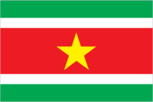
five horizontal bands of green (top, double width), white, red (quadruple width), white, and green (double width); a large, yellow, five-pointed star is centered in the red band; red stands for progress and love; green symbolizes hope and fertility; white signifies peace, justice, and freedom; the star represents the unity of all ethnic groups; from its yellow light the nation draws strength to bear sacrifices patiently while working toward a golden future
Government type
presidential republic
Independence
25 November 1975 (from the Netherlands)
International law organization participation
accepts compulsory ICJ jurisdiction with reservations; accepts ICCt jurisdiction
International organization participation
ACP, AOSIS, Caricom, CD, CDB, CELAC, FAO, G-77, IADB, IBRD, ICAO, ICCt, ICRM, IDA, IDB, IFAD, IFC, IFRCS, IHO, ILO, IMF, IMO, Interpol, IOC, IOM, IPU, ISO (correspondent), ITU, ITUC (NGOs), LAES, MIGA, NAM, OAS, OIC, OPANAL, OPCW, PCA, Petrocaribe, UN, UNASUR, UNCTAD, UNESCO, UNIDO, UPU, WHO, WIPO, WMO, WTO
Judicial branch
- High Court of Justice of Suriname (consists of the court president, vice president, and 4 judges); note - appeals beyond the High Court are referred to the Caribbean Court of Justice, with final appeal to the Judicial Committee of the Privy Council (in London) court judges appointed by the national president after consultation with the High Court; judges appointed for life cantonal courts
- highest resident court(s)
- High Court of Justice of Suriname (consists of the court president, vice president, and 4 judges); note - appeals beyond the High Court are referred to the Caribbean Court of Justice, with final appeal to the Judicial Committee of the Privy Council (in London)
- judge selection and term of office
- court judges appointed by the national president after consultation with the High Court; judges appointed for life
- subordinate courts
- cantonal courts
Legal system
civil law system influenced by Dutch civil law; note - the Commissie Nieuw Surinaamse Burgerlijk Wetboek completed drafting a new civil code in February 2009
Legislative branch
- unicameral National Assembly or Nationale Assemblee (51 seats; members directly elected in multi-seat constituencies by proportional representation vote to serve 5-year terms) last held on 25 May 2015 (next to be held in May 2020) percent of vote by party - NDP 45.5%, V7 37.2%, A-Com 10.5%, DOE 4.3%, PALU .7%, other 1.7%; seats by party - NDP 26, V7 18, A-Com 5, DOE 1, PALU 1
- description
- unicameral National Assembly or Nationale Assemblee (51 seats; members directly elected in multi-seat constituencies by proportional representation vote to serve 5-year terms)
- election results
- percent of vote by party - NDP 45.5%, V7 37.2%, A-Com 10.5%, DOE 4.3%, PALU .7%, other 1.7%; seats by party - NDP 26, V7 18, A-Com 5, DOE 1, PALU 1
- elections
- last held on 25 May 2015 (next to be held in May 2020)
National anthem
- "God zij met ons Suriname!" (God Be With Our Suriname) Cornelis Atses HOEKSTRA and Henry DE ZIEL/Johannes Corstianus DE PUY adopted 1959; originally adapted from a Sunday school song written in 1893 and contains lyrics in both Dutch and Sranang Tongo
- lyrics/music
- Cornelis Atses HOEKSTRA and Henry DE ZIEL/Johannes Corstianus DE PUY
- name
- "God zij met ons Suriname!" (God Be With Our Suriname)
- note
- adopted 1959; originally adapted from a Sunday school song written in 1893 and contains lyrics in both Dutch and Sranang Tongo
National holiday
Independence Day, 25 November (1975)
National symbol(s)
- royal palm, faya lobi (flower); national colors: green, white, red, yellow
- royal palm, faya lobi (flower); national colors
- green, white, red, yellow
Political parties and leaders
Alternative Combination or A-Com (a coalition that includes ABOP, KTPI, PDO) Brotherhood and Unity in Politics or BEP [Celsius WATERBERG] Democratic Alternative '91 or DA91 [Winston JESSURUN] General Liberation and Development Party or ABOP [Ronnie BRUNSWIJK} National Democratic Party or NDP [Desire Delano BOUTERSE] National Party of Suriname or NPS [Gregory RUSLAND] Party for Democracy and Development or PDO [Waldy NAIN] Party for Democracy and Development in Unity or DOE [Carl BREEVELD] Party for National Unity and Solidarity or KTPI [Willy SOEMITA] People's Alliance, Pertjaja Luhur or PL [Paul SOMOHARDJO] Progressive Worker and Farmer's Union or PALU [Jim HOK] Surinamese Labor Party or SPA [Guno CASTELEN] United Reform Party or VHP [Chandrikapersad SANTOKHI] Victory 7 or V7 (formerly the New Front for Democracy and Development or NF) (a coalition including NPS, VHP, DA91, PL, SPA) [Chandrikapresad SANTOKHI]
Political pressure groups and leaders
Association of Indigenous Village Chiefs [Ricardo PANE] Association of Saramaccan Authorities or Maroon [Head Captain WASE] Women's Parliament Forum or PVF [Iris GILLIAD]
Suffrage
18 years of age; universal
Economy
Agriculture - products
rice, bananas, palm kernels, coconuts, plantains, peanuts; beef, chickens; shrimp; forest products
Budget
- $878 million $1.259 billion (2015 est.)
- expenditures
- $1.259 billion (2015 est.)
- revenues
- $878 million
Budget surplus (+) or deficit (-)
-7.3% of GDP (2015 est.)
Central bank discount rate
10% (2013) 9% (2012)
Commercial bank prime lending rate
12.62% (31 December 2015 est.) 12.28% (31 December 2014 est.)
Current account balance
-$808 million (2015 est.) -$415 million (2014 est.)
Debt - external
$1.15 billion (31 December 2015 est.) $1.088 billion (31 December 2014 est.)
Economy - overview
The economy is dominated by the mining industry, with exports of oil, gold, and alumina accounting for about 85% of exports and 27% of government revenues, making the economy highly vulnerable to mineral price volatility. Economic growth has declined annually from just under 5% in 2012 to 1.5% in 2015. In January 2011, the government devalued the currency by 20% and raised taxes to reduce the budget deficit. As a result of these measures, inflation receded to less than 4% in 2015. Suriname's economic prospects for the medium term will depend on continued commitment to responsible monetary and fiscal policies and to the introduction of structural reforms to liberalize markets and promote competition. The government's reliance on revenue from extractive industries will temper Suriname's economic outlook, especially if gold prices continue their downward trend.
Exchange rates
Surinamese dollars (SRD) per US dollar - 3.4167 (2015 est.) 3.3 (2014 est.) 3.3 (2013 est.) 3.3 (2012 est.) 3.2683 (2011 est.)
Exports
$1.666 billion (2015 est.) $2.149 billion (2014 est.)
Exports - commodities
alumina, gold, crude oil, lumber, shrimp and fish, rice, bananas
Exports - partners
Switzerland 21.8%, UAE 14.5%, India 13.9%, Belgium 9.7%, US 8.9%, France 8.1%, Canada 6.6% (2015)
Fiscal year
calendar year
GDP - composition, by end use
- 75.8% 11.5% 12% 26.5% 25.6% -24.9% (2015 est.)
- exports of goods and services
- 25.6%
- government consumption
- 11.5%
- household consumption
- 75.8%
- imports of goods and services
- -24.9% (2015 est.)
- investment in fixed capital
- 12%
- investment in inventories
- 26.5%
GDP - composition, by sector of origin
- 6.4% 49.9% 43.7% (2015 est.)
- agriculture
- 6.4%
- industry
- 49.9%
- services
- 43.7% (2015 est.)
GDP - per capita (PPP)
- $16,300 (2015 est.) $16,200 (2014 est.) $16,200 (2013 est.) data are in 2015 US dollars
- note
- data are in 2015 US dollars
GDP - real growth rate
0.1% (2015 est.) 1.8% (2014 est.) 2.8% (2013 est.)
GDP (official exchange rate)
$5.192 billion (2015 est.)
GDP (purchasing power parity)
- $9.09 billion (2015 est.) $9.077 billion (2014 est.) $8.913 billion (2013 est.) data are in 2015 US dollars
- note
- data are in 2015 US dollars
Gross national saving
24.2% of GDP (2015 est.) 24.5% of GDP (2014 est.) 25.7% of GDP (2013 est.)
Household income or consumption by percentage share
- NA% NA%
- highest 10%
- NA%
- lowest 10%
- NA%
Imports
$1.973 billion (2015 est.) $1.966 billion (2014 est.)
Imports - commodities
capital equipment, petroleum, foodstuffs, cotton, consumer goods
Imports - partners
US 26.8%, Netherlands 14.3%, China 12.2%, Trinidad and Tobago 7.4%, Japan 4.8% (2015)
Industrial production growth rate
2% (2015 est.)
Industries
bauxite and gold mining, alumina production; oil, lumbering, food processing, fishing
Inflation rate (consumer prices)
3% (2015 est.) 3.4% (2014 est.)
Labor force
165,600 (2007 est.)
Labor force - by occupation
- 11.2% 19.5% 69.3% (2010)
- agriculture
- 11.2%
- industry
- 19.5%
- services
- 69.3% (2010)
Market value of publicly traded shares
$NA
Population below poverty line
70% (2002 est.)
Reserves of foreign exchange and gold
$330.2 million (31 December 2015 est.) $625.2 million (31 December 2014 est.)
Stock of broad money
$3.461 billion (31 December 2015 est.) $2.885 billion (31 December 2014 est.)
Stock of domestic credit
$2.224 billion (31 December 2015 est.) $2.029 billion (31 December 2014 est.)
Stock of narrow money
$1.231 billion (31 December 2015 est.) $1.409 billion (31 December 2014 est.)
Taxes and other revenues
16.9% of GDP (2015 est.)
Unemployment rate
8.9% (2014 est.) 8.5% (2013 est.)
Energy
Carbon dioxide emissions from consumption of energy
2.4 million Mt (2013 est.)
Crude oil - exports
0 bbl/day (2013 est.)
Crude oil - imports
0 bbl/day (2013 est.)
Crude oil - production
17,000 bbl/day (2015 est.)
Crude oil - proved reserves
88.97 million bbl (1 January 2016 es)
Electricity - consumption
1.9 billion kWh (2014 est.)
Electricity - exports
0 kWh (2013 est.)
Electricity - from fossil fuels
54.1% of total installed capacity (2012 est.)
Electricity - from hydroelectric plants
45.9% of total installed capacity (2012 est.)
Electricity - from nuclear fuels
0% of total installed capacity (2012 est.)
Electricity - from other renewable sources
0% of total installed capacity (2012 est.)
Electricity - imports
0 kWh (2013 est.)
Electricity - installed generating capacity
400,000 kW (2014 est.)
Electricity - production
2.1 billion kWh (2014 est.)
Electricity access
- 100% (2016)
- electrification - total population
- 100% (2016)
Natural gas - consumption
0 cu m (2013 est.)
Natural gas - exports
0 cu m (2013 est.)
Natural gas - imports
0 cu m (2013 est.)
Natural gas - production
0 cu m (2013 est.)
Natural gas - proved reserves
0 cu m (1 January 2011 es)
Refined petroleum products - consumption
17,000 bbl/day (2014 est.)
Refined petroleum products - exports
12,980 bbl/day (2013 est.)
Refined petroleum products - imports
10,260 bbl/day (2013 est.)
Refined petroleum products - production
19,120 bbl/day (2013 est.)
Communications
Broadcast media
2 state-owned TV stations; 1 state-owned radio station; multiple private radio and TV stations (2007)
Internet country code
.sr
Internet users
- 248,000 42.8% (July 2015 est.)
- percent of population
- 42.8% (July 2015 est.)
- total
- 248,000
Telephone system
- international facilities are good combined fixed-line and mobile-cellular teledensity 185 telephones per 100 persons; microwave radio relay network country code - 597; satellite earth stations - 2 Intelsat (Atlantic Ocean) (2015)
- domestic
- combined fixed-line and mobile-cellular teledensity 185 telephones per 100 persons; microwave radio relay network
- general assessment
- international facilities are good
- international
- country code - 597; satellite earth stations - 2 Intelsat (Atlantic Ocean) (2015)
Telephones - fixed lines
- 85,000 15 (July 2015 est.)
- subscriptions per 100 inhabitants
- 15 (July 2015 est.)
- total subscriptions
- 85,000
Telephones - mobile cellular
- 991,000 171 (July 2015 est.)
- subscriptions per 100 inhabitants
- 171 (July 2015 est.)
- total
- 991,000
Transportation
Airports
55 (2013)
Airports - with paved runways
- 5 (2013)
- over 3,047 m
- 1
- total
- 6
- under 914 m
- 5 (2013)
Airports - with unpaved runways
- 45 (2013)
- 914 to 1,523 m
- 4
- total
- 49
- under 914 m
- 45 (2013)
Civil aircraft registration country code prefix
PZ (2016)
National air transport system
- 259,682 29,324,319 mt-km (2015)
- annual freight traffic on registered air carriers
- 29,324,319 mt-km (2015)
- annual passenger traffic on registered air carriers
- 259,682
- inventory of registered aircraft operated by air carriers
- 5
- number of registered air carriers
- 2
Pipelines
oil 50 km (2013)
Ports and terminals
- Paramaribo, Wageningen
- major seaport(s)
- Paramaribo, Wageningen
Roadways
- 4,304 km 1,130 km 3,174 km (2003)
- paved
- 1,130 km
- total
- 4,304 km
- unpaved
- 3,174 km (2003)
Waterways
1,200 km (most navigable by ships with drafts up to 7 m) (2011)
Military and Security
Military branches
- Suriname Armed Forces: Ground Forces, Naval Forces, Air Forces (2010)
- Suriname Armed Forces
- Ground Forces, Naval Forces, Air Forces (2010)
Military service age and obligation
18 is the legal minimum age for voluntary military service; no conscription; personnel drawn almost exclusively from the Creole community (2012)
Transnational Issues
Disputes - international
area claimed by French Guiana between Riviere Litani and Riviere Marouini (both headwaters of the Lawa); Suriname claims a triangle of land between the New and Kutari/Koetari rivers in a historic dispute over the headwaters of the Courantyne; Guyana seeks UN Convention on the Law of the Sea arbitration to resolve the longstanding dispute with Suriname over the axis of the territorial sea boundary in potentially oil-rich waters
Illicit drugs
growing transshipment point for South American drugs destined for Europe via the Netherlands and Brazil; transshipment point for arms-for-drugs dealing
Trafficking in persons
- Suriname is a source, transit, and destination country for women and children subjected to sex trafficking and men, women, and children subjected to forced labor; women and girls from Suriname, Guyana, Brazil, and the Dominican Republic are subjected to sex trafficking in the country, sometimes in interior mining camps; migrant workers in agriculture and on fishing boats and children working in informal urban sectors and gold mines are vulnerable to forced labor; traffickers from Suriname exploit victims in the Netherlands Tier 2 Watch List – Suriname does not fully comply with the minimum standards for the elimination of trafficking; however, it is making significant efforts to do so; in 2014, Suriname was granted a waiver from an otherwise required downgrade to Tier 3 because its government has a written plan that, if implemented, would constitute making significant efforts to bring itself into compliance with the minimum standards for the elimination of trafficking; authorities increased the number of trafficking investigations, prosecutions, and convictions as compared to 2013, but resources were insufficient to conduct investigations in the country’s interior; more trafficking victims were identified in 2014 than in 2013, but protective services for adults and children were inadequate, with a proposed government shelter for women and child trafficking victims remaining unopened (2015)
- current situation
- Suriname is a source, transit, and destination country for women and children subjected to sex trafficking and men, women, and children subjected to forced labor; women and girls from Suriname, Guyana, Brazil, and the Dominican Republic are subjected to sex trafficking in the country, sometimes in interior mining camps; migrant workers in agriculture and on fishing boats and children working in informal urban sectors and gold mines are vulnerable to forced labor; traffickers from Suriname exploit victims in the Netherlands
- tier rating
- Tier 2 Watch List – Suriname does not fully comply with the minimum standards for the elimination of trafficking; however, it is making significant efforts to do so; in 2014, Suriname was granted a waiver from an otherwise required downgrade to Tier 3 because its government has a written plan that, if implemented, would constitute making significant efforts to bring itself into compliance with the minimum standards for the elimination of trafficking; authorities increased the number of trafficking investigations, prosecutions, and convictions as compared to 2013, but resources were insufficient to conduct investigations in the country’s interior; more trafficking victims were identified in 2014 than in 2013, but protective services for adults and children were inadequate, with a proposed government shelter for women and child trafficking victims remaining unopened (2015)