2008 Edition
CIA World Factbook 2008 (Project Gutenberg)
Introduction
Background
First explored by the Spaniards in the 16th century and then settled by the English in the mid-17th century, Suriname became a Dutch colony in 1667. With the abolition of slavery in 1863, workers were brought in from India and Java. Independence from the Netherlands was granted in 1975. Five years later the civilian government was replaced by a military regime that soon declared a socialist republic. It continued to exert control through a succession of nominally civilian administrations until 1987, when international pressure finally forced a democratic election. In 1990, the military overthrew the civilian leadership, but a democratically elected government - a four-party New Front coalition - returned to power in 1991 and has ruled since; the coalition expanded to eight parties in 2005.
Geography
Area
total: 163,270 sq km land: 161,470 sq km water: 1,800 sq km
Area - comparative
slightly larger than Georgia
Climate
tropical; moderated by trade winds
Coastline
386 km
Elevation extremes
lowest point: unnamed location in the coastal plain -2 m highest point: Juliana Top 1,230 m
Environment - current issues
deforestation as timber is cut for export; pollution of inland waterways by small-scale mining activities
Environment - international agreements
party to: Biodiversity, Climate Change, Climate Change-Kyoto Protocol, Desertification, Endangered Species, Law of the Sea, Marine Dumping, Ozone Layer Protection, Ship Pollution, Tropical Timber 94, Wetlands, Whaling signed, but not ratified: none of the selected agreements
Freshwater withdrawal (domestic/industrial/agricultural)
total: 0.67 cu km/yr (4%/3%/93%) per capita: 1,489 cu m/yr (2000)
Geographic coordinates
4 00 N, 56 00 W
Geography - note
smallest independent country on South American continent; mostly tropical rain forest; great diversity of flora and fauna that, for the most part, is increasingly threatened by new development; relatively small population, mostly along the coast
Irrigated land
510 sq km (2003)
Land boundaries
total: 1,703 km border countries: Brazil 593 km, French Guiana 510 km, Guyana 600 km
Land use
arable land: 0.36% permanent crops: 0.06% other: 99.58% (2005)
Location
Northern South America, bordering the North Atlantic Ocean, between French Guiana and Guyana
Map references
South America
Maritime claims
territorial sea: 12 nm exclusive economic zone: 200 nm
Natural hazards
NA
Natural resources
timber, hydropower, fish, kaolin, shrimp, bauxite, gold, and small amounts of nickel, copper, platinum, iron ore
Terrain
mostly rolling hills; narrow coastal plain with swamps
Total renewable water resources
122 cu km (2003)
People and Society
Age structure
0-14 years: 27.5% (male 66,695/female 64,356) 15-64 years: 66.2% (male 156,961/female 158,234) 65 years and over: 6.3% (male 12,868/female 16,882) (2008 est.)
Birth rate
17.02 births/1,000 population (2008 est.)
Death rate
5.51 deaths/1,000 population (2008 est.)
Education expenditures
NA
Ethnic groups
Hindustani (also known locally as "East Indians"; their ancestors emigrated from northern India in the latter part of the 19th century) 37%, Creole (mixed white and black) 31%, Javanese 15%, "Maroons" (their African ancestors were brought to the country in the 17th and 18th centuries as slaves and escaped to the interior) 10%, Amerindian 2%, Chinese 2%, white 1%, other 2%
HIV/AIDS - adult prevalence rate
1.7% (2001 est.)
HIV/AIDS - deaths
fewer than 500 (2003 est.)
HIV/AIDS - people living with HIV/AIDS
5,200 (2001 est.)
Infant mortality rate
total: 19.45 deaths/1,000 live births male: 22.96 deaths/1,000 live births female: 15.71 deaths/1,000 live births (2008 est.)
Languages
Dutch (official), English (widely spoken), Sranang Tongo (Surinamese, sometimes called Taki-Taki, is native language of Creoles and much of the younger population and is lingua franca among others), Caribbean Hindustani (a dialect of Hindi), Javanese
Life expectancy at birth
total population: 73.48 years male: 70.76 years female: 76.39 years (2008 est.)
Literacy
definition: age 15 and over can read and write total population: 89.6% male: 92% female: 87.2% (2004 census)
Major infectious diseases
degree of risk: high food or waterborne diseases: bacterial and protozoal diarrhea, hepatitis A, and typhoid fever vectorborne disease: dengue fever, Mayaro virus, and malaria water contact disease: leptospirosis (2008)
Median age
total: 27.5 years male: 27.1 years female: 27.9 years (2008 est.)
Nationality
noun: Surinamer(s) adjective: Surinamese
Net migration rate
-0.52 migrant(s)/1,000 population (2008 est.)
Population
475,996 (July 2008 est.)
Population growth rate
1.099% (2008 est.)
Religions
Hindu 27.4%, Protestant 25.2% (predominantly Moravian), Roman Catholic 22.8%, Muslim 19.6%, indigenous beliefs 5%
School life expectancy (primary to tertiary education)
total: 12 years male: 11 years female: 13 years (2002)
Sex ratio
at birth: 1.07 male(s)/female under 15 years: 1.04 male(s)/female 15-64 years: 0.99 male(s)/female 65 years and over: 0.76 male(s)/female total population: 0.99 male(s)/female (2008 est.)
Total fertility rate
2.01 children born/woman (2008 est.)
Government
Administrative divisions
10 districts (distrikten, singular - distrikt); Brokopondo, Commewijne, Coronie, Marowijne, Nickerie, Para, Paramaribo, Saramacca, Sipaliwini, Wanica
Capital
name: Paramaribo geographic coordinates: 5 50 N, 55 10 W time difference: UTC-3 (2 hours ahead of Washington, DC during Standard Time)
Constitution
ratified 30 September 1987; effective 30 October 1987
Country name
conventional long form: Republic of Suriname conventional short form: Suriname local long form: Republiek Suriname local short form: Suriname former: Netherlands Guiana, Dutch Guiana
Diplomatic representation from the US
chief of mission: Ambassador Lisa Bobbie SCHREIBER HUGHES embassy: Dr. Sophie Redmondstraat 129, Paramaribo mailing address: US Department of State, PO Box 1821, Paramaribo telephone: [597] 472-900
Diplomatic representation in the US
chief of mission: Ambassador Jacques Ruben Constantijn KROSS chancery: Suite 460, 4301 Connecticut Avenue NW, Washington, DC 20008 telephone: [1] (202) 244-7488
Executive branch
chief of state: President Runaldo Ronald VENETIAAN (since 12 August 2000); Vice President Ramdien SARDJOE (since 3 August 2005); note - the president is both the chief of state and head of government head of government: President Runaldo Ronald VENETIAAN (since 12 August 2000); Vice President Ram SARDJOE (since 3 August 2005) cabinet: Cabinet of Ministers appointed by the president elections: president and vice president elected by the National Assembly or, if no presidential or vice presidential candidate receives a two-thirds constitutional majority in the National Assembly after two votes, by a simple majority in the larger United People's Assembly (893 representatives from the national, local, and regional councils), for five-year terms (no term limits); election last held on 25 May 2005 (next to be held in 2010) election results: Runaldo Ronald VENETIAAN reelected president; percent of vote - Runaldo Ronald VENETIAAN 62.9%, Rabin PARMESSAR 35.4%, other 1.7%; note - after two votes in the parliament failed to secure a two-thirds majority for a candidate, the vote then went to a special session of the United People's Assembly on 3 August 2005
FAX
- [1] (202) 244-5878 consulate(s) general: Miami
- [597] 410-025
Flag description
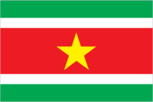
five horizontal bands of green (top, double width), white, red (quadruple width), white, and green (double width); there is a large, yellow, five-pointed star centered in the red band
Government type
constitutional democracy
Independence
25 November 1975 (from the Netherlands)
International organization participation
ACP, Caricom, FAO, G-77, IADB, IBRD, ICAO, ICCt, ICRM, IDB, IFAD, IFRCS, IHO (suspended), ILO, IMF, IMO, Interpol, IOC, IPU, ISO (subscriber), ITU, ITUC, LAES, MIGA, NAM, OAS, OIC, OPANAL, OPCW, PCA, UN, UNASUR, UNCTAD, UNESCO, UNIDO, UPU, WCL, WFTU, WHO, WIPO, WMO, WTO
Judicial branch
Cantonal Courts and a Court of Justice as an appellate court (justices are nominated for life)
Legal system
based on Dutch legal system incorporating French penal theory; accepts compulsory ICJ jurisdiction with reservations
Legislative branch
unicameral National Assembly or Nationale Assemblee (51 seats; members are elected by popular vote to serve five-year terms) elections: last held on 25 May 2005 (next to be held in 2010) election results: percent of vote by party - NF 39.7%, NDP 22.2%, VVV 13.8%, A-Com 7.2%, A-1 5.9%, other 11.2%; seats by party - NF 23, NDP 15, VVV 5, A-Com 5, A-1 3
National holiday
Independence Day, 25 November (1975)
Political parties and leaders
Alternative-1 or A-1 (a coalition of Amazone Party of Suriname or APS [Kenneth VAN GENDEREN], Democrats of the 21st Century or D-21 [Soewarto MOESTADJA], Nieuw Suriname or NS [Radjen Nanan PANDAY], Political Wing of the FAL or PVF [Jiwan SITAL], Trefpunt 2000 or T-2000 [Arti JESSURUN]); General Interior Development Party or ABOP [Ronnie BRUNSWIJK]; National Democratic Party or NDP [Desire BOUTERSE]; New Front for Democracy and Development or NF (a coalition that includes A-Combination or A-Com, Democratic Alternative 1991 or DA-91, an independent, business-oriented party [Winston JESSURUN], National Party Suriname or NPS [Ronald VENETIAAN], United Reform Party or VHP [Ramdien SARDJOE], Pertjaja Luhur or PL [Salam Paul SOMOHARDJO], Surinamese Labor Party or SPA [Siegfried GILDS]); Party for Democracy and Development in Unity or DOE [Marten SCHALKWIJK]; People's Alliance for Progress or VVV (a coalition of Democratic National Platform 2000 or DNP-2000 [Jules WIJDENBOSCH], Grassroots Party for Renewal and Democracy or BVD [Tjan GOBARDHAN], Party for National Unity and Solidarity of the Highest Order or KTPI [Willy SOEMITA], Party for Progression, Justice, and Perseverance or PPRS [Renee KAIMAN], Pendawalima or PL [Raymond SAPOEN]); Progressive Laborers and Farmers Union or PALU [Jim HOK]; Progressive Political Party or PPP [Surinder MUNGRA]; Seeka [Paul ABENA]; Union of Progressive Surinamers or UPS [Sheoradj PANDAY]
Political pressure groups and leaders
Association of Indigenous Village Chiefs [Ricardo PANE]; Association of Saramaccan Authorities or Maroon [Head Captain WASE]; Women's Parliament Forum or PVF [Iris GILLIAD]
Suffrage
18 years of age; universal
Economy
Agriculture - products
paddy rice, bananas, palm kernels, coconuts, plantains, peanuts; beef, chickens; shrimp; forest products
Budget
revenues: $392.6 million expenditures: $425.9 million (2004)
Commercial bank prime lending rate
13.77% (31 December 2007)
Currency (code)
Surinam dollar (SRD)
Currency code
SRG
Current account balance
$24 million (2007 est.)
Debt - external
$504.3 million (2005 est.)
Economic aid - recipient
$43.97 million (2005)
Economy - overview
The economy is dominated by the mining industry, with exports of alumina, gold, and oil accounting for about 85% of exports and 25% of government revenues, making the economy highly vulnerable to mineral price volatility. The short-term economic outlook depends on the government's ability to control inflation and on the development of projects in the bauxite and gold mining sectors. Suriname has received aid for these projects from Netherlands, Belgium, and the European Development Fund. Suriname's economic prospects for the medium term will depend on continued commitment to responsible monetary and fiscal policies and to the introduction of structural reforms to liberalize markets and promote competition. In 2000, the government of Ronald VENETIAAN, returned to office and inherited an economy with inflation of over 100% and a growing fiscal deficit. He quickly implemented an austerity program, raised taxes, attempted to control spending, and tamed inflation. These economic policies are likely to remain in effect during VENETIAAN's third term. Prospects for local onshore oil production are good as a drilling program is underway. Offshore oil drilling was given a boost in 2004 when the State Oil Company (Staatsolie) signed exploration agreements with Repsol, Maersk, and Occidental. Bidding on these new offshore blocks was completed in July 2006.
Electricity - consumption
1.457 billion kWh (2006 est.)
Electricity - exports
0 kWh (2007 est.)
Electricity - imports
0 kWh (2007 est.)
Electricity - production
1.595 billion kWh (2006 est.)
Electricity - production by source
fossil fuel: 25.2% hydro: 74.8% nuclear: 0% other: 0% (2001)
Exchange rates
Surinamese dollars (SRD) per US dollar - 2.745 (2007), 2.745 (2006), 2.7317 (2005), 2.7336 (2004), 2.6013 (2003) note: in January 2004, the government replaced the guilder with the Surinamese dollar, tied to a US dollar-dominated currency basket
Exports
$1.391 billion f.o.b. (2006 est.)
Exports - commodities
alumina, gold, crude oil, lumber, shrimp and fish, rice, bananas
Exports - partners
Canada 26.8%, Norway 20.2%, Belgium 9.2%, US 8.9%, UAE 7.9%, France 7.2% (2007)
Fiscal year
calendar year
GDP - composition by sector
agriculture: 10.8% industry: 24.4% services: 64.8% (2005 est.)
GDP - per capita (PPP)
$8,700 (2007 est.)
GDP - real growth rate
5.1% (2007 est.)
GDP (official exchange rate)
$2.404 billion (2007 est.)
GDP (purchasing power parity)
$3.846 billion (2007 est.)
Household income or consumption by percentage share
lowest 10%: NA% highest 10%: NA%
Imports
$1.297 billion f.o.b. (2006 est.)
Imports - commodities
capital equipment, petroleum, foodstuffs, cotton, consumer goods
Imports - partners
US 27%, Netherlands 17.3%, Trinidad and Tobago 14.3%, China 5.9%, Japan 5.1% (2007)
Industrial production growth rate
6.5% (1994 est.)
Industries
bauxite and gold mining, alumina production; oil, lumbering, food processing, fishing
Inflation rate (consumer prices)
6.4% (2007 est.)
Labor force
156,700 (2004)
Labor force - by occupation
agriculture: 8% industry: 14% services: 78% (2004)
Market value of publicly traded shares
$NA
Natural gas - consumption
0 cu m (2007 est.)
Natural gas - exports
0 cu m (2007 est.)
Natural gas - imports
0 cu m (2007 est.)
Natural gas - production
0 cu m (2007 est.)
Natural gas - proved reserves
0 cu m (1 January 2006 est.)
Oil - consumption
12,370 bbl/day (2006 est.)
Oil - exports
2,899 bbl/day (2005)
Oil - imports
6,369 bbl/day (2005)
Oil - production
13,000 bbl/day (2007 est.)
Oil - proved reserves
88 million bbl (1 January 2008 est.)
Population below poverty line
70% (2002 est.)
Reserves of foreign exchange and gold
$263.3 million (2006)
Stock of domestic credit
$651 million (31 December 2007)
Stock of money
$416.6 million (31 December 2007)
Stock of quasi money
$824.4 million (31 December 2007)
Unemployment rate
9.5% (2004)
Communications
Internet country code
.sr
Internet hosts
33 (2008)
Internet Service Providers (ISPs)
2 (2000)
Internet users
44,000 (2007)
Radio broadcast stations
AM 4, FM 13, shortwave 1 (1998)
Radios
300,000 (1997)
Telephone system
general assessment: international facilities are good domestic: combined fixed-line and mobile-cellular teledensity about 90 telephones per 100 persons; microwave radio relay network international: country code - 597; satellite earth stations - 2 Intelsat (Atlantic Ocean)
Telephones - main lines in use
81,500 (2006)
Telephones - mobile cellular
320,000 (2006)
Television broadcast stations
3 (plus 7 repeaters) (2000)
Televisions
63,000 (1997)
Transportation
Airports
50 (2007)
Airports - with paved runways
total: 5 over 3,047 m: 1 under 914 m: 4 (2007)
Airports - with unpaved runways
total: 45 914 to 1,523 m: 5 under 914 m: 40 (2007)
Merchant marine
total: 1 by type: cargo 1 (2008)
Pipelines
oil 50 km (2007)
Ports and terminals
Paramaribo, Wageningen
Roadways
total: 4,304 km paved: 1,130 km unpaved: 3,174 km (2003)
Waterways
1,200 km (most navigable by ships with drafts up to 7 m) (2005)
Military and Security
Manpower available for military service
males age 16-49: 130,534 females age 16-49: 130,243 (2008 est.)
Manpower fit for military service
males age 16-49: 105,770 females age 16-49: 109,666 (2008 est.)
Manpower reaching militarily significant age annually
male: 4,329 female: 4,350 (2008 est.)
Military branches
National Army (Nationaal Leger, NL; includes Naval Wing, Air Wing) (2007)
Military expenditures
0.6% of GDP (2006 est.)
Military service age and obligation
18 years of age (est.); recruitment is voluntary, with personnel drawn almost exclusively from the Creole community (2007)
Transnational Issues
Disputes - international
area claimed by French Guiana between Riviere Litani and Riviere Marouini (both headwaters of the Lawa); Suriname claims a triangle of land between the New and Kutari/Koetari rivers in a historic dispute over the headwaters of the Courantyne; Guyana seeks United Nations Convention on the Law of the Sea (UNCLOS) arbitration to resolve the long-standing dispute with Suriname over the axis of the territorial sea boundary in potentially oil-rich waters
Illicit drugs
growing transshipment point for South American drugs destined for Europe via the Netherlands and Brazil; transshipment point for arms-for-drugs dealing This page was last updated on 18 December, 2008