1992 Edition
CIA World Factbook 1992 (Project Gutenberg)
Geography
Climate
tropical; moderated by trade winds
Coastline
386 km
Comparative area
slightly larger than Georgia
Disputes
claims area in French Guiana between Litani Rivier and Riviere Marouini (both headwaters of the Lawa); claims area in Guyana between New (Upper Courantyne) and Courantyne/Kutari Rivers (all headwaters of the Courantyne)
Environment
mostly tropical rain forest
Exclusive economic zone
200 nm
Land area
161,470 km2
Land boundaries
1,707 km total; Brazil 597 km, French Guiana 510 km, Guyana 600 km
Land use
arable land NEGL%; permanent crops NEGL%; meadows and pastures NEGL%; forest and woodland 97%; other 3%; includes irrigated NEGL%
Natural resources
timber, hydropower potential, fish, shrimp, bauxite, iron ore, and small amounts of nickel, copper, platinum, gold
Terrain
mostly rolling hills; narrow coastal plain with swamps
Territorial sea
12 nm
Total area
163,270 km2
People and Society
Birth rate
26 births/1,000 population (1992)
Death rate
6 deaths/1,000 population (1992)
Ethnic divisions
Hindustani (East Indian) 37.0%, Creole (black and mixed) 31.0%, Javanese 15.3%, Bush black 10.3%, Amerindian 2.6%, Chinese 1.7%, Europeans 1.0%, other 1.1%
Infant mortality rate
34 deaths/1,000 live births (1992)
Labor force
104,000 (1984)
Languages
Dutch (official); English widely spoken; Sranan Tongo (Surinamese, sometimes called Taki-Taki) is native language of Creoles and much of the younger population and is lingua franca among others; also Hindi Suriname Hindustani (a variant of Bhoqpuri) and Javanese
Life expectancy at birth
66 years male, 71 years female (1992)
Literacy
95% (male 95%, female 95%) age 15 and over can read and write (1990 est.)
Nationality
noun - Surinamer(s); adjective - Surinamese
Net migration rate
-5 migrants/1,000 population (1992)
Organized labor
49,000 members of labor force
Population
410,016 (July 1992), growth rate 1.5% (1992)
Religions
Hindu 27.4%, Muslim 19.6%, Roman Catholic 22.8%, Protestant (predominantly Moravian) 25.2%, indigenous beliefs about 5%
Total fertility rate
2.9 children born/woman (1992)
Government
Administrative divisions
10 districts (distrikten, singular - distrikt); Brokopondo, Commewijne, Coronie, Marowijne, Nickerie, Para, Paramaribo, Saramacca, Sipaliwini, Wanica
Capital
Paramaribo
Chief of State and Head of Government
President Ronald VENETIAAN (since 16 September 1991); Vice President and Prime Minister Jules AJODHIA (since 16 September 1991)
Constitution
ratified 30 September 1987
Diplomatic representation
Ambassador Willem A. UDENHOUT; Chancery at Suite 108, 4301 Connecticut Avenue NW, Washington, DC 20008; telephone (202) 244-7488 or 7490 through 7492; there is a Surinamese Consulate General in Miami US: Ambassador John (Jack) P. LEONARD; Embassy at Dr. Sophie Redmonstraat 129, Paramaribo (mailing address is P. O. Box 1821, Paramaribo); telephone [597] 472900, 477881, or 476459; FAX [597] 410025
Executive branch
president, vice president and prime minister, Cabinet of Ministers, Council of State; note - Commander in Chief of the National Army maintains significant power
Flag
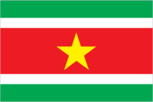
five horizontal bands of green (top, double width), white, red (quadruple width), white, and green (double width); there is a large yellow five-pointed star centered in the red band
Independence
25 November 1975 (from Netherlands; formerly Netherlands Guiana or Dutch Guiana)
Judicial branch
Supreme Court
Legal system
NA
Legislative branch
unicameral National Assembly (Assemblee Nationale)
Long-form name
Republic of Suriname
Member of
ACP, CARICOM (observer), ECLAC, FAO, GATT, G-77, IADB, IBRD, ICAO, ICFTU, IFAD, ILO, IMF, IMO, INTERPOL, IOC, ITU, LAES, LORCS, NAM, OAS, OPANAL, UN, UNCTAD, UNESCO, UNIDO, UPU, WCL, WHO, WIPO, WMO
National Assembly
last held 25 May 1991 (next to be held NA May 1996); results - percent of vote NA; seats - (51 total) NF 30, NDP 12, DA '91 9
National holiday
Independence Day, 25 November (1975)
Political parties and leaders
traditional ethnic-based parties: The New Front (NF), a coalition formed of four parties following the 24 December 1990 military coup - Progressive Reform Party (VHP), Jaggernath LACHMON; National Party of Suriname (NPS), Henck ARRON; Indonesian Peasants Party (KTPI), Willie SOEMITA; and Suriname Labor Party (SPA) Fred DERBY; promilitary: National Democratic Party (NDP), Orlando VAN AMSON; Democratic Alternative '91 (DA '91), Winston JESSURUN, a coalition of five parties formed in January 1991 - Alternative Forum (AF), Gerard BRUNINGS, Winston JESSURUN; Reformed Progressive Party (HPP), Panalal PARMESSAR; Party for Brotherhood and Unity in Politics (BEP), Cipriano ALLENDY; Pendawalima, Marsha JAMIN; and Independent Progressive Group, Karam RAMSUNDERSINGH; leftists: Revolutionary People's Party (RVP), Michael NAARENDORP; Progressive Workers and Farmers (PALU), Iwan KROLIS
President
last held 6 September 1991 (next to be held NA May 1996); results - elected by the National Assembly - Ronald VENETIAAN (NF) 80% (645 votes), Jules WIJDENBOSCH (NDP) 14% (115 votes), Hans PRADE (DA '91) 6% (49 votes)
Suffrage
universal at age 18
Type
republic
Economy
Agriculture
accounts for 11% of GDP; paddy rice planted on 85% of arable land and represents 60% of total farm output; other products - bananas, palm kernels, coconuts, plantains, peanuts, beef, chicken; shrimp and forestry products of increasing importance; self-sufficient in most foods
Budget
revenues $466 million; expenditures $716 million, including capital expenditures of $123 million (1989 est.)
Currency
Surinamese guilder, gulden, or florin (plural - guilders, gulden, or florins); 1 Surinamese guilder, gulden, or florin (Sf.) = 100 cents
Economic aid
US commitments, including Ex-Im (FY70-83), $2.5 million; Western (non-US) countries, ODA and OOF bilateral commitments (1970-89), $1.5 billion
Electricity
458,000 kW capacity; 2,018 million kWh produced, 5,015 kWh per capita (1991)
Exchange rates
Surinamese guilders, gulden, or florins (Sf.) per US$1 - 1.7850 (fixed rate)
Exports
$549 million (f.o.b., 1989 est.) commodities: alumina, bauxite, aluminum, rice, wood and wood products, shrimp and fish, bananas partners: Norway 33%, Netherlands 20%, US 15%, FRG 9%, Brazil 5%, UK 5%, Japan 3%, other 10%
External debt
$138 million (1990 est.)
Fiscal year
calendar year
GDP
exchange rate conversion - $1.4 billion, per capita $3,400; real growth rate 0% (1989 est.)
Imports
$331 million (f.o.b., 1989 est.) commodities: capital equipment, petroleum, foodstuffs, cotton, consumer goods partners: US 37%, Netherlands 15%, Netherlands Antilles 11%, Trinidad and Tobago 9%, Brazil 5%, UK 3%, other 20%
Industrial production
growth rate NA; accounts for 22% of GDP
Industries
bauxite mining, alumina and aluminum production, lumbering, food processing, fishing
Inflation rate (consumer prices)
50% (1989 est.)
Overview
The economy is dominated by the bauxite industry, which accounts for about 70% of export earnings and 40% of tax revenues. The economy has been in trouble since the Dutch ended development aid in 1982. A drop in world bauxite prices which started in the late 1970s and continued until late 1986 was followed by the outbreak of a guerrilla insurgency in the interior that crippled the important bauxite sector. Although the insurgency has since ebbed and the bauxite sector recovered, a military coup in December 1990 reflected continued political instability and deterred investment and economic reform. High inflation, high unemployment, widespread black market activity, and hard currency shortfalls continue to mark the economy.
Unemployment rate
33% (1990)
Communications
Airports
46 total, 40 usable; 6 with permanent-surface runways; none with runways over 3,659 m; 1 with runways 2,440-3,659 m; 2 with runways 1,220-2,439 m
Civil air
1 major transport aircraft
Highways
8,300 km total; 500 km paved; 5,400 km bauxite gravel, crushed stone, or improved earth; 2,400 km sand or clay
Inland waterways
1,200 km; most important means of transport; oceangoing vessels with drafts ranging up to 7 m can navigate many of the principal waterways
Merchant marine
3 ships (1,000 GRT or over) totaling 6,472 GRT/8,914 DWT; includes 2 cargo, 1 container
Ports
Paramaribo, Moengo
Railroads
166 km total; 86 km 1.000-meter gauge, government owned, and 80 km 1.435-meter standard gauge; all single track
Telecommunications
international facilities good; domestic microwave system; 27,500 telephones; broadcast stations - 5 AM, 14 FM, 6 TV, 1 shortwave; 2 Atlantic Ocean INTELSAT earth stations
Military and Security
Branches
National Army (including Navy which is company-size, small Air Force element), Civil Police, People's Militia
Defense expenditures
$NA, NA% of GDP
Manpower availability
males 15-49, 109,551; 65,250 fit for military service