1981 Edition
CIA World Factbook 1981 (Internet Archive)
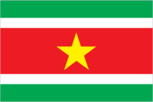
Geography
Area
142,709 km2; negligible amount of arable land, meadows and pastures, 76% forest, 8% unused but potentially productive, 16% built-on area, wasteland, and other
Coastline
386 km
Land boundaries
1,561 km
Limits of territorial waters (claimed)
12 nm (economic including fishing 200 nm)
People and Society
Ethnic divisions
37% Hindustani (East Indian), 31% Creole (Negro and mixed), 15.3% Javanese, 10.3% Bush Negro, 2.6% Amerindian, 1.7% Chinese, 1.0% Europeans, 1.7% other and unknown
Labor force
129,000; unemployment 2.6% (1978)
Language
Dutch official; English widely spoken; Sranan Tongo (Surinamese, sometimes called Taki-Taki) is native language of Creoles and much of the younger population, and is lingua franca among others; Hindi; Javanese
Literacy
80%
Nationality
noun — Surinamer(s); adjective — Surinamese
Organized labor
approx. 33% of labor force
Population
356,000 (July 1982), average annual growth rate -1.5%
Religion
Hindu, Muslim, Roman Catholic, Moravian, other
Government
Branches
new government announced on 1 April 1982 — Policy Center makes policy and decisions; Council of Ministers implements decisions; President is a ceremonial figurehead
Capital
Paramaribo
Communists
(all small groups) Democratic Peoples Front; Communist Party of Suriname (KPS); People's Party (VP), Ruben Lie Pauw Sam; Revolutionary People's Party (RVP), Edward Narrendorp
Elections
no elections planned Political parties and leaders: Revolutionary Front (December 1981) official party established by Lt. Col. Daysi Bouterse; regular party activity officially suspended, although some continue low-Jevel functioning; National Party of Suriname (NPS), Henck Arron; Nationalist Republic Party (PNR), Edward Bruma (principal leftist party); Progressive Reform Party (VHP), J. Lachmon; Pendawa Lima, S. Somohardjo; Javanese Farmers' Party (KTPI), Willy Soemita; Progressive Suriname People's Party (PSV), Emile Wijntuin; Reformed Progressive Party (HPP), Pannalal Parmessar Voting strength (1977): NPK 22 seats, Opposition United Democratic Parties Combination (VDP) 17 seats
Government leaders
Lt. Col. Daysi BOUTERSE, Army Commander and strongman; Acting President Lachmipersad Frederick RAMDAT-MISIER
Legal system
transitional constitution in effect
Member of
EC (associate), ECLA, FAO, GATT, IBA, IBRD, ICAO, ILO, IMCO, IMF, ITU, NAM, OAS, UN, UNESCO, UPU, WHO, WIPO, WMO
National holiday
Independence Day, 25 November
Official name
Republic of Suriname
Political subdivisions
9 districts before 1980 coup, each headed by District Commissioner responsible to Minister of District Government and Decentralization except for Paramaribo, whose commissioner is responsible to Minister of Home Affairs, not functioning at present; 100 "People's Committees" installed at local level
Suffrage
suspended
Type
military-civilian rule
Economy
Agriculture
main crops — rice, sugarcane, bananas; selfsufficient in major staple (rice)
Aid
economic — bilateral commitments including Ex-Im (FY70-80) from US, $1.9 million, (1970-79) from other Western countries, $945.0 million; no military aid
Budget
revenue, $273 million; expenditure, $319 million (1980 est.) SUR1NAME (Continued)
Electric power
410,000 kW capacity (1981); 1.6 billion kWh produced (1981), 3,500 kWh per capita
Exports
$514 million (f.o.b., 1980 est); alumina, bauxite, aluminum, rice, wood and wood products
GDP
$822 million (1978); $2,370 per capita (1979); real growth rate 4% (1978)
Imports
$501 million (c.i.f., 1980 est.); capital equipment, petroleum, iron and steel, cotton, flour, meat, dairy products
Major industries
bauxite mining, alumina and aluminum production, lumbering, food processing
Major trade partners
exports— 41% US, 33% EC, 12% other European countries; imports— 31% US, 33% EC, 16% Caribbean countries (1977)