2008 Edition
CIA World Factbook 2008 (Project Gutenberg)
Introduction
Background
The first Sinhalese arrived in Sri Lanka late in the 6th century B.C. probably from northern India. Buddhism was introduced in about the mid-third century B.C., and a great civilization developed at the cities of Anuradhapura (kingdom from circa 200 B.C. to circa A.D. 1000) and Polonnaruwa (from about 1070 to 1200). In the 14th century, a south Indian dynasty established a Tamil kingdom in northern Sri Lanka. The coastal areas of the island were controlled by the Portuguese in the 16th century and by the Dutch in the 17th century. The island was ceded to the British in 1796, became a crown colony in 1802, and was united under British rule by 1815. As Ceylon, it became independent in 1948; its name was changed to Sri Lanka in 1972. Tensions between the Sinhalese majority and Tamil separatists erupted into war in 1983. Tens of thousands have died in the ethnic conflict that continues to fester. After two decades of fighting, the government and Liberation Tigers of Tamil Eelam (LTTE) formalized a cease-fire in February 2002 with Norway brokering peace negotiations. Violence between the LTTE and government forces intensified in 2006 and the government regained control of the Eastern Province in 2007. In January 2008, the government officially withdrew from the ceasefire, and has begun engaging the LTTE in the northern portion of the country.
Geography
Area
total: 65,610 sq km land: 64,740 sq km water: 870 sq km
Area - comparative
slightly larger than West Virginia
Climate
tropical monsoon; northeast monsoon (December to March); southwest monsoon (June to October)
Coastline
1,340 km
Elevation extremes
lowest point: Indian Ocean 0 m highest point: Pidurutalagala 2,524 m
Environment - current issues
deforestation; soil erosion; wildlife populations threatened by poaching and urbanization; coastal degradation from mining activities and increased pollution; freshwater resources being polluted by industrial wastes and sewage runoff; waste disposal; air pollution in Colombo
Environment - international agreements
party to: Biodiversity, Climate Change, Climate Change-Kyoto Protocol, Desertification, Endangered Species, Environmental Modification, Hazardous Wastes, Law of the Sea, Ozone Layer Protection, Ship Pollution, Wetlands signed, but not ratified: Marine Life Conservation
Freshwater withdrawal (domestic/industrial/agricultural)
total: 12.61 cu km/yr (2%/2%/95%) per capita: 608 cu m/yr (2000)
Geographic coordinates
7 00 N, 81 00 E
Geography - note
strategic location near major Indian Ocean sea lanes
Irrigated land
7,430 sq km (2003)
Land boundaries
0 km
Land use
arable land: 13.96% permanent crops: 15.24% other: 70.8% (2005)
Location
Southern Asia, island in the Indian Ocean, south of India
Map references
Asia
Maritime claims
territorial sea: 12 nm contiguous zone: 24 nm exclusive economic zone: 200 nm continental shelf: 200 nm or to the edge of the continental margin
Natural hazards
occasional cyclones and tornadoes
Natural resources
limestone, graphite, mineral sands, gems, phosphates, clay, hydropower
Terrain
mostly low, flat to rolling plain; mountains in south-central interior
Total renewable water resources
50 cu km (1999)
People and Society
Age structure
0-14 years: 24.1% (male 2,596,463/female 2,495,136) 15-64 years: 68% (male 7,019,446/female 7,340,809) 65 years and over: 7.9% (male 783,823/female 893,096) (2008 est.)
Birth rate
16.63 births/1,000 population (2008 est.)
Death rate
6.07 deaths/1,000 population (2008 est.)
Education expenditures
NA
Ethnic groups
Sinhalese 73.8%, Sri Lankan Moors 7.2%, Indian Tamil 4.6%, Sri Lankan Tamil 3.9%, other 0.5%, unspecified 10% (2001 census provisional data)
HIV/AIDS - adult prevalence rate
less than 0.1% (2001 est.)
HIV/AIDS - deaths
fewer than 200 (2003 est.)
HIV/AIDS - people living with HIV/AIDS
3,500 (2001 est.)
Infant mortality rate
total: 19.01 deaths/1,000 live births male: 20.76 deaths/1,000 live births female: 17.17 deaths/1,000 live births (2008 est.)
Languages
Sinhala (official and national language) 74%, Tamil (national language) 18%, other 8% note: English is commonly used in government and is spoken competently by about 10% of the population
Life expectancy at birth
total population: 74.97 years male: 72.95 years female: 77.08 years (2008 est.)
Literacy
definition: age 15 and over can read and write total population: 90.7% male: 92.3% female: 89.1% (2001 census)
Major infectious diseases
degree of risk: high food or waterborne diseases: bacterial diarrhea and hepatitis A vectorborne disease: dengue fever and malaria water contact disease: leptospirosis (2008)
Median age
total: 30.4 years male: 29.5 years female: 31.4 years (2008 est.)
Nationality
noun: Sri Lankan(s) adjective: Sri Lankan
Net migration rate
-1.12 migrant(s)/1,000 population (2008 est.)
Population
21,128,772 note: since the outbreak of hostilities between the government and armed Tamil separatists in the mid-1980s, several hundred thousand Tamil civilians have fled the island and more than 200,000 Tamils have sought refuge in the West (July 2008 est.)
Population growth rate
0.943% (2008 est.)
Religions
Buddhist 69.1%, Muslim 7.6%, Hindu 7.1%, Christian 6.2%, unspecified 10% (2001 census provisional data)
Sex ratio
at birth: 1.04 male(s)/female under 15 years: 1.04 male(s)/female 15-64 years: 0.96 male(s)/female 65 years and over: 0.88 male(s)/female total population: 0.97 male(s)/female (2008 est.)
Total fertility rate
2.02 children born/woman (2008 est.)
Government
Administrative divisions
8 provinces; Central, North Central, North Eastern, North Western, Sabaragamuwa, Southern, Uva, Western note: in October 2006, a Sri Lankan Supreme Court ruling voided a presidential directive merging the North and Eastern Provinces; many have defended the merger as a prerequisite for a negotiated settlement to the ethnic conflict; a parliamentary decision on the issue is pending
Capital
name: Colombo geographic coordinates: 6 56 N, 79 51 E time difference: UTC+5.5 (10.5 hours ahead of Washington, DC during Standard Time) note: Sri Jayewardenepura Kotte (legislative capital)
Constitution
adopted 16 August 1978, certified 31 August 1978
Country name
conventional long form: Democratic Socialist Republic of Sri Lanka conventional short form: Sri Lanka local long form: Shri Lamka Prajatantrika Samajaya di Janarajaya/Ilankai Jananayaka Choshalichak Kutiyarachu local short form: Shri Lamka/Ilankai former: Serendib, Ceylon
Diplomatic representation from the US
chief of mission: Ambassador Robert O. BLAKE, Jr. embassy: 210 Galle Road, Colombo 3 mailing address: P. O. Box 106, Colombo telephone: [94] (11) 249-8500
Diplomatic representation in the US
chief of mission: Ambassador Jaliya WICKRAMASURIYA chancery: 2148 Wyoming Avenue NW, Washington, DC 20008 telephone: [1] (202) 483-4025 (through 4028)
Executive branch
chief of state: President Mahinda RAJAPAKSA (since 19 November 2005); note - the president is both the chief of state and head of government; Ratnasiri WICKREMANAYAKE (since 21 November 2005) holds the largely ceremonial title of prime minister head of government: President Mahinda RAJAPAKSA (since 19 November 2005) cabinet: Cabinet appointed by the president in consultation with the prime minister elections: president elected by popular vote for a six-year term (eligible for a second term); election last held on 17 November 2005 (next to be held in 2011) election results: Mahinda RAJAPAKSA elected president; percent of vote - Mahinda RAJAPAKSA 50.3%, Ranil WICKREMESINGHE 48.4%, other 1.3%
FAX
- [1] (202) 232-7181 consulate(s) general: Los Angeles consulate(s): New York
- [94] (11) 243-7345
Flag description
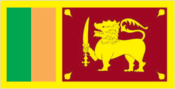
yellow with two panels; the smaller hoist-side panel has two equal vertical bands of green (hoist side) and orange; the other panel is a large dark red rectangle with a yellow lion holding a sword, and there is a yellow bo leaf in each corner; the yellow field appears as a border around the entire flag and extends between the two panels
Government type
republic
Independence
4 February 1948 (from UK)
International organization participation
ADB, BIMSTEC, C, CP, FAO, G-15, G-24, G-77, IAEA, IBRD, ICAO, ICC, ICRM, IDA, IFAD, IFC, IFRCS, IHO, ILO, IMF, IMO, IMSO, Interpol, IOC, IOM, IPU, ISO, ITSO, ITU, ITUC, MIGA, MINURSO, MINUSTAH, MONUC, NAM, OAS (observer), OPCW, PCA, SAARC, SACEP, UN, UNCTAD, UNESCO, UNIDO, UNMIS, UNWTO, UPU, WCL, WCO, WFTU, WHO, WIPO, WMO, WTO
Judicial branch
Supreme Court; Court of Appeals; judges for both courts are appointed by the president
Legal system
a highly complex mixture of English common law, Roman-Dutch, Kandyan, and Jaffna Tamil law; has not accepted compulsory ICJ jurisdiction
Legislative branch
unicameral Parliament (225 seats; members elected by popular vote on the basis of an open-list, proportional representation system by electoral district to serve six-year terms) elections: last held on 2 April 2004 (next to be held by 2010) election results: percent of vote by party or electoral alliance - SLFP and JVP (no longer in formal UPFA alliance) 45.6%, UNP 37.8%, TNA 6.8%, JHU 6%, SLMC 2%, UPF 0.5%, EPDP 0.3%, other 1%; seats by party - UNP 68, SLFP 57, JVP 39, TNA 22, CWC 8, JHU 7, SLMC 6, SLMC dissidents 4, Communist Party 2, JHU dissidents 2, LSSP 2, MEP 2, NUA 2, UPF 2, EPDP 1, UNP dissident 1
National holiday
Independence Day, 4 February (1948)
Political parties and leaders
All Ceylon Tamil Congress or ACTC [G.PONNAMBALAM]; Ceylon Workers Congress or CWC [Arumugam THONDAMAN]; Communist Party or CP [D. GUNASEKERA]; Eelam People's Democratic Party or EPDP [Douglas DEVANANDA]; Eelam People's Revolutionary Liberation Front or EPRLF [Suresh PREMACHANDRAN]; Janatha Vimukthi Peramuna or JVP [Somawansa AMARASINGHE]; Lanka Sama Samaja Party or LSSP [Tissa VITHARANA]; Mahajana Eksath Peramuna (People's United Front) or MEP [D. GUNAWARDENE]; National Heritage Party or JHU [Ellawala METHANANDA]; National Unity Alliance or NUA [Ferial ASHRAFF]; People's Liberation Organization of Tamil Eelam or PLOTE [D. SIDHARTHAN]; Sri Lanka Freedom Party or SLFP [Mahinda RAJAPAKSA]; Sri Lanka Muslim Congress or SLMC [Rauff HAKEEM]; Tamil Eelam Liberation Organization or TELO [Selvam ADAIKALANATHAN]; Tamil National Alliance or TNA [R. SAMPANTHAN]; Tamil United Liberation Front or TULF [V. ANANDASANGAREE]; United National Party or UNP [Ranil WICKREMASINGHE]; Up-country People's Front or UPF [P. CHANDRASEKARAN]
Political pressure groups and leaders
Liberation Tigers of Tamil Eelam or LTTE [Velupillai PRABHAKARAN](insurgent group fighting for a separate state); Tamil Makkal Viduthalai Pulikal (TMVP) or Karuna Faction [Vinayagamurthi MURALITHARAN] (paramilitary breakaway from LTTE and fighting LTTE) other: Buddhist clergy; labor unions; radical chauvinist Sinhalese groups such as the National Movement Against Terrorism; Sinhalese Buddhist lay groups
Suffrage
18 years of age; universal
Economy
Agriculture - products
rice, sugarcane, grains, pulses, oilseed, spices, tea, rubber, coconuts; milk, eggs, hides, beef; fish
Budget
revenues: $5.384 billion expenditures: $7.608 billion (2007 est.)
Central bank discount rate
15% (31 December 2007)
Commercial bank prime lending rate
17.08% (31 December 2007)
Currency (code)
Sri Lankan rupee (LKR)
Currency code
LKR
Current account balance
-$1.019 billion (2007 est.)
Debt - external
$12.2 billion (31 December 2007 est.)
Distribution of family income - Gini index
50 (FY03/04)
Economic aid - recipient
$1.189 billion (2005)
Economy - overview
In 1977, Colombo abandoned statist economic policies and its import substitution trade policy for more market-oriented policies, export-oriented trade, and encouragement of foreign investment. Recent changes in government, however, have brought some policy reversals. Currently, the ruling Sri Lanka Freedom Party has a more statist economic approach, which seeks to reduce poverty by steering investment to disadvantaged areas, developing small and medium enterprises, promoting agriculture, and expanding the already enormous civil service. The government has halted privatizations. Although suffering a brutal civil war that began in 1983, Sri Lanka saw GDP growth average 4.5% in the last 10 years with the exception of a recession in 2001. In late December 2004, a major tsunami took about 31,000 lives, left more than 6,300 missing and 443,000 displaced, and destroyed an estimated $1.5 billion worth of property. Government spending and reconstruction drove growth to more than 7% in 2006 but reduced agriculture output probably slowed growth to about 6 percent in 2007. Government spending and loose monetary policy drove inflation to nearly 16% in 2007. Sri Lanka's most dynamic sectors now are food processing, textiles and apparel, food and beverages, port construction, telecommunications, and insurance and banking. In 2006, plantation crops made up only about 15% of exports (compared with more than 90% in 1970), while textiles and garments accounted for more than 60%. About 800,000 Sri Lankans work abroad, 90% of them in the Middle East. They send home more than $1 billion a year. The struggle by the Tamil Tigers of the north and east for an independent homeland continues to cast a shadow over the economy.
Electricity - consumption
6.884 billion kWh (2006 est.)
Electricity - exports
0 kWh (2007 est.)
Electricity - imports
0 kWh (2007 est.)
Electricity - production
8.317 billion kWh (2006 est.)
Electricity - production by source
fossil fuel: 51.7% hydro: 48.3% nuclear: 0% other: 0% (2001)
Exchange rates
Sri Lankan rupees (LKR) per US dollar - 110.78 (2007), 103.99 (2006), 100.498 (2005), 101.194 (2004), 96.521 (2003)
Exports
$8.135 billion f.o.b. (2007 est.)
Exports - commodities
textiles and apparel, tea and spices; diamonds, emeralds, rubies; coconut products, rubber manufactures, fish
Exports - partners
US 25.5%, UK 13.2%, India 6.7%, Germany 5.7%, Italy 5.1% (2007)
Fiscal year
calendar year
GDP - composition by sector
agriculture: 11.7% industry: 29.9% services: 58.4% (2007 est.)
GDP - per capita (PPP)
$4,000 (2007 est.)
GDP - real growth rate
6.8% (2007 est.)
GDP (official exchange rate)
$30.01 billion (2007 est.)
GDP (purchasing power parity)
$82.02 billion (2007 est.)
Household income or consumption by percentage share
lowest 10%: 1.1% highest 10%: 39.7% (FY03/04)
Imports
$10.36 billion f.o.b. (2007 est.)
Imports - commodities
textile fabrics, mineral products, petroleum, foodstuffs, machinery and transportation equipment
Imports - partners
India 23.1%, Singapore 9.9%, China 8.2%, Iran 7.5%, Hong Kong 6.4% (2007)
Industrial production growth rate
7.6% (2007 est.)
Industries
processing of rubber, tea, coconuts, tobacco and other agricultural commodities; telecommunications, insurance, banking; clothing, textiles; cement, petroleum refining
Inflation rate (consumer prices)
15.8% (2007 est.)
Investment (gross fixed)
24.7% of GDP (2007 est.)
Labor force
7.489 million (2007 est.)
Labor force - by occupation
agriculture: 34.3% industry: 25.3% services: 40.4% (30 June 2006 est.)
Market value of publicly traded shares
$7.769 billion (2006)
Natural gas - consumption
0 cu m (2007 est.)
Natural gas - exports
0 cu m (2007 est.)
Natural gas - production
0 cu m (2007 est.)
Natural gas - proved reserves
0 cu m (1 January 2006 est.)
Oil - consumption
86,030 bbl/day (2006 est.)
Oil - exports
291.9 bbl/day (2005)
Oil - imports
87,090 bbl/day (2005)
Oil - production
0 bbl/day (2005 est.)
Oil - proved reserves
0 bbl (1 January 2006 est.)
Population below poverty line
22% (2002 est.)
Public debt
85.8% of GDP (2007 est.)
Reserves of foreign exchange and gold
$3.644 billion (31 December 2007 est.)
Stock of direct foreign investment - abroad
$NA
Stock of direct foreign investment - at home
$NA
Stock of domestic credit
$14.82 billion (31 December 2007)
Stock of money
$2.465 billion (31 December 2007)
Stock of quasi money
$10.46 billion (31 December 2007)
Unemployment rate
6% (2007 est.)
Communications
Internet country code
.lk
Internet hosts
4,940 (2008)
Internet Service Providers (ISPs)
5 (2000)
Internet users
771,700 (2007)
Radio broadcast stations
AM 15, FM 52, shortwave 4 (2007)
Radios
3.85 million (1997)
Telephone system
general assessment: telephone services have improved significantly and are available in most parts of the country domestic: national trunk network consists mostly of digital microwave radio relay; fiber-optic links now in use in Colombo area and fixed wireless local loops have been installed; competition is strong in mobile cellular systems and mobile cellular subscribership is increasing; combined fixed-line and mobile-cellular teledensity is about 50 per 100 persons international: country code - 94; the SEA-ME-WE-3 and SEA-ME-WE-4 submarine cables provide connectivity to Asia, Australia, Middle East, Europe, US; satellite earth stations - 2 Intelsat (Indian Ocean)
Telephones - main lines in use
2.742 million (2007)
Telephones - mobile cellular
7.983 million (2007)
Television broadcast stations
14 (2006)
Televisions
1.53 million (1997)
Transportation
Airports
18 (2007)
Airports - with paved runways
total: 14 over 3,047 m: 1 1,524 to 2,437 m: 6 914 to 1,523 m: 7 (2007)
Airports - with unpaved runways
total: 4 914 to 1,523 m: 1 under 914 m: 3 (2007)
Merchant marine
total: 26 by type: bulk carrier 4, cargo 18, chemical tanker 1, container 1, petroleum tanker 2 foreign-owned: 5 (Germany 5) registered in other countries: 1 (Panama 1) (2008)
Ports and terminals
Colombo
Railways
total: 1,449 km broad gauge: 1,449 km 1.676-m gauge (2006)
Roadways
total: 97,286 km paved: 78,802 km unpaved: 18,484 km (2003)
Waterways
160 km (primarily on rivers in southwest) (2006)
Military and Security
Manpower available for military service
males age 16-49: 5,458,720 females age 16-49: 5,594,006 (2008 est.)
Manpower fit for military service
males age 16-49: 4,477,437 females age 16-49: 4,683,716 (2008 est.)
Manpower reaching militarily significant age annually
male: 174,065 female: 168,593 (2008 est.)
Military branches
Sri Lanka Army, Sri Lanka Navy, Sri Lanka Air Force (2008)
Military expenditures
2.6% of GDP (2006)
Military service age and obligation
18 years of age for voluntary military service (2007)
Transnational Issues
Disputes - international
none
IDPs
460,000 (both Tamils and non-Tamils displaced due to long-term civil war between the government and the separatist Liberation Tigers of Tamil Eelam (LTTE)) (2007)
Trafficking in persons
current situation: Sri Lanka is a source and destination country for men and women trafficked for the purposes of involuntary servitude and commercial sexual exploitation; Sri Lankan men and women migrate willingly to the Persian Gulf, Middle East, and East Asia to work as construction workers, domestic servants, or garment factory workers, where some find themselves in situations of involuntary servitude when faced with restrictions on movement, withholding of passports, threats, physical or sexual abuse, and debt bondage; children are trafficked internally for commercial sexual exploitation and, less frequently, for forced labor tier rating: Tier 2 Watch List - for a second consecutive year, Sri Lanka is on the Tier 2 Watch List for failing to provide evidence of increasing efforts to combat severe forms of human trafficking, particularly in the area of law enforcement; the government failed to arrest, prosecute, or convict any person for trafficking offenses and continued to punish some victims of trafficking for crimes committed as a result of being trafficked; Sri Lanka has not ratified the 2000 UN TIP Protocol (2008) This page was last updated on 18 December, 2008