1996 Edition
CIA World Factbook 1996 (Project Gutenberg)
Introduction
Description
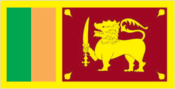
yellow with two panels; the smaller hoist-side panel has two equal vertical bands of green (hoist side) and orange; the other panel is a large dark red rectangle with a yellow lion holding a sword, and there is a yellow bo leaf in each corner; the yellow field appears as a border that goes around the entire flag and extends between the two panels
Location
7 00 N, 81 00 E -- Southern Asia, island in the Indian Ocean, south of India Flag ----
Geography
Area
- comparative area
- slightly larger than West Virginia
- land area
- 64,740 sq km
- total area
- 65,610 sq km
Climate
tropical monsoon; northeast monsoon (December to March); southwest monsoon (June to October)
Coastline
1,340 km
Environment
- current issues
- deforestation; soil erosion; wildlife populations threatened by poaching; coastal degradation from mining activities and increased pollution; freshwater resources being polluted by industrial wastes and sewage runoff
- international agreements
- party to - Biodiversity, Climate Change, Endangered Species, Environmental Modification, Hazardous Wastes, Law of the Sea, Nuclear Test Ban, Ozone Layer Protection, Wetlands, Whaling; signed, but not ratified - Marine Life Conservation
- natural hazards
- occasional cyclones and tornadoes
Geographic coordinates
7 00 N, 81 00 E
Geographic note
strategic location near major Indian Ocean sea lanes
International disputes
none
Irrigated land
5,600 sq km (1989 est.)
Land boundaries
0 km
Land use
- arable land
- 16%
- forest and woodland
- 37%
- meadows and pastures
- 7%
- other
- 23%
- permanent crops
- 17%
Location
Southern Asia, island in the Indian Ocean, south of India
Map references
Asia
Maritime claims
- contiguous zone
- 24 nm
- continental shelf
- 200 nm or to the edge of the continental margin
- exclusive economic zone
- 200 nm
- territorial sea
- 12 nm
Natural resources
limestone, graphite, mineral sands, gems, phosphates, clay
Terrain
- mostly low, flat to rolling plain; mountains in south-central interior
- highest point
- Pidurutalagala 2,524 m
- lowest point
- Indian Ocean 0 m
People and Society
Age structure
0-14 years: 28% (male 2,673,943; female 2,559,569) 15-64 years: 66% (male 6,023,759; female 6,171,964) 65 years and over: 6% (male 553,940; female 569,899) (July 1996 est.)
Birth rate
17.89 births/1,000 population (1996 est.)
Death rate
5.8 deaths/1,000 population (1996 est.)
Ethnic divisions
Sinhalese 74%, Tamil 18%, Moor 7%, Burgher, Malay, and Vedda 1%
Infant mortality rate
20.8 deaths/1,000 live births (1996 est.)
Languages
- Sinhala (official and national language) 74%, Tamil (national language) 18%
- note
- English is commonly used in government and is spoken by about 10% of the population
Life expectancy at birth
- female
- 75.06 years (1996 est.)
- male
- 69.77 years
- total population
- 72.35 years
Literacy
- age 15 and over can read and write (1995 est.)
- female
- 87.2%
- male
- 93.4%
- total population
- 90.2%
Nationality
- adjective
- Sri Lankan
- noun
- Sri Lankan(s)
Net migration rate
-0.78 migrant(s)/1,000 population (1996 est.)
Population
- 18,553,074 (July 1996 est.)
- note
- since the outbreak of hostilities between the government and armed Tamil separatists in the mid-1980s, several hundred thousand Tamil civilians have fled the island; as of late 1992, nearly 115,000 were housed in refugee camps in south India, another 95,000 lived outside the Indian camps, and more than 200,000 Tamils have sought political asylum in the West
Population growth rate
1.13% (1996 est.)
Religions
Buddhist 69%, Hindu 15%, Christian 8%, Muslim 8%
Sex ratio
- all ages
- 1 male(s)/female (1996 est.)
- at birth
- 1.05 male(s)/female
- under 15 years
- 1.04 male(s)/female 15-64 years: 0.98 male(s)/female 65 years and over: 0.97 male(s)/female
Total fertility rate
2.05 children born/woman (1996 est.)
Government
Administrative divisions
8 provinces; Central, North Central, North Eastern, North Western, Sabaragamuwa, Southern, Uva, Western
Capital
Colombo
Constitution
adopted 16 August 1978
Data code
CE
Diplomatic representation in US
- chancery
- 2148 Wyoming Avenue NW, Washington, DC 20008
- chief of mission
- Ambassador Jayantha Cudah Bandara DHANAPALA
- telephone
- [1] (202) 483-4025 through 4028
Executive branch
- cabinet
- Cabinet was appointed by the president in consultation with the prime minister
- chief of state and head of government
- President Chandrika Bandaranaike KUMARATUNGA (since 12 November 1994) was elected for a six-year term by popular vote; note - Sirimavo BANDARANAIKE is the prime minister; in Sri Lanka the president is considered to be both the chief of state and the head of the government, this is in contrast to the more common practice of dividing the roles between the president and the prime minister when both offices exist; election last held 9 November 1994 (next to be held NA November 2000); results - Chandrika Bandaranaike KUMARATUNGA (People's Alliance) 62%, Srima DISSANAYAKE (United National Party) 37%, other 1%
FAX
- [1] (202) 232-7181
- [94] (1) 437345
- consulate(s)
- New York
Flag
yellow with two panels; the smaller hoist-side panel has two equal vertical bands of green (hoist side) and orange; the other panel is a large dark red rectangle with a yellow lion holding a sword, and there is a yellow bo leaf in each corner; the yellow field appears as a border that goes around the entire flag and extends between the two panels
Independence
4 February 1948 (from UK)
International organization participation
AsDB, C, CCC, CP, ESCAP, FAO, G-24, G-77, IAEA, IBRD, ICAO, ICC, ICFTU, ICRM, IDA, IFAD, IFC, IFRCS, ILO, IMF, IMO, Inmarsat, Intelsat, Interpol, IOC, IOM, ISO, ITU, NAM, PCA, SAARC, UN, UNCTAD, UNESCO, UNIDO, UNU, UPU, WCL, WFTU, WHO, WIPO, WMO, WToO, WTrO
Judicial branch
Supreme Court, judges are appointed by the Judicial Service Commission
Legal system
a highly complex mixture of English common law, Roman-Dutch, Muslim, Sinhalese, and customary law; has not accepted compulsory ICJ jurisdiction
Legislative branch
unicameral
Name of country
- conventional long form
- Democratic Socialist Republic of Sri Lanka
- conventional short form
- Sri Lanka
- former
- Ceylon
National holiday
Independence and National Day, 4 February (1948)
Other political or pressure groups
Liberation Tigers of Tamil Eelam (LTTE) and other smaller Tamil separatist groups; other radical chauvinist Sinhalese groups; Buddhist clergy; Sinhalese Buddhist lay groups; labor unions
Parliament
elections last held 16 August 1994 (next to be held by August 2000); results - PA 49.0%, UNP 44.0%, SLMC 1.8%, TULF 1.7%, SLPF 1.1%, EPDP 0.3%, UPF 0.3%, PLOTE 0.1%, other 1.7%; seats - (225 total) PA 105, UNP 94, EPDP 9, SLMC 7, TULF 5, PLOTE 3, SLPF 1, UPF 1
Political parties and leaders
- All Ceylon Tamil Congress (ACTC), C. G. Kumar PONNAMBALAM; Ceylon Workers Congress (CLDC), S. THONDAMAN; Communist Party, K. P. SILVA; Communist Party/Beijing (CP/B), N. SHANMUGATHASAN; Democratic People's Liberation Front (DPLF), leader NA; Democratic United National Front (DUNF), G. M. PREMACHANDRA; Eelam People's Democratic Party (EPDP), Douglas DEVANANDA; Eelam People's Revolutionary Liberation Front (EPRL), Suresh PREMACHANDRAN; Eelam Revolutionary Organization of Students (EROS), Shankar RAJI; Lanka Socialist Party/Trotskyite (LSSP, or Lanka Sama Samaja Party), Colin R. DE SILVA; Liberal Party (LP), Chanaka AMARATUNGA; New Socialist Party (NSSP, or Nava Sama Samaja Party), Vasudeva NANAYAKKARA; People's Alliance (PA), Chandrika Bandaranaike KUMARATUNGA; People's Liberation Organization of Tamil Eelam (PLOTE), Dharmalingam SIDARTHAN; People's United Front (MEP, or Mahajana Eksath Peramuna), Dinesh GUNAWARDENE; Sri Lanka Freedom Party (SLFP), Sirimavo BANDARANAIKE; Sri Lanka Muslim Congress (SLMC), M. H. M. ASHRAFF; Sri Lanka People's Party (SLMP, or Sri Lanka Mahajana Party), Ossie ABEYGUNASEKERA; Sri Lanka Progressive Front (SLPF), leader NA; Tamil Eelam Liberation Organization (TELO), leader NA; Tamil United Liberation Front (TULF), M. SIVASITHAMBARAM; United National Party (UNP), Dingiri Banda WIJETUNGA; Upcountry People's Front (UPF), leader NA; several ethnic Tamil and Muslim parties, represented in either parliament or provincial councils
- note
- the United Socialist Alliance (USA), which was formed in 1987 and included the NSSP, LSSP, SLMP, CP/M, and CP/B, was defunct as of 1993, following the formation of the People's Alliance Party (PA)
Suffrage
18 years of age; universal
Type of government
republic
US diplomatic representation
- chief of mission
- Ambassador A. Peter BURLEIGH
- embassy
- 210 Galle Road, Colombo 3
- mailing address
- P. O. Box 106, Colombo
- telephone
- [94] (1) 448007
Economy
Agriculture
rice, sugarcane, grains, pulses, oilseed, roots, spices, tea, rubber, coconuts; milk, eggs, hides, meat
Budget
- expenditures
- $3.7 billion, including capital expenditures of $851 million (1995)
- revenues
- $2.7 billion
Currency
1 Sri Lankan rupee (SLRe) = 100 cents
Economic aid
- recipient
- ODA, $423 million (1993)
Economic overview
Industry - dominated by the fast-growing apparel industry - has surpassed agriculture as the main source of export earnings. The economy has been plagued by high rates of unemployment since the late 1970s. Economic growth accelerated in 1991-94 as domestic conditions began to improve and conditions for foreign investment brightened. In 1995, however, the government's emphasis on populist measures and its preoccupation with the stepped-up Tamil insurgency have clouded Sri Lanka's economic prospects and discouraged foreign investors. A further problem for 1996 is the need to curb government overspending.
Electricity
- capacity
- 1,410,000 kW
- consumption per capita
- 168 kWh (1993)
- production
- 3.2 billion kWh
Exchange rates
Sri Lankan rupees (SLRes) per US$1 - 54.158 (January 1996), 51.252 (1995), 49.415 (1994), 48.322 (1993), 43.830 (1992), 41.372 (1991)
Exports
- $3.2 billion (f.o.b., 1994)
- commodities
- garments and textiles, teas, diamonds, other gems, petroleum products, rubber products, other agricultural products, marine products, graphite
- partners
- US 34.7%, UK, Germany, Japan, Netherlands, France (1994)
External debt
$8.8 billion (1994 est.)
Fiscal year
calendar year
GDP
purchasing power parity - $65.6 billion (1995 est.)
GDP composition by sector
- agriculture
- 24%
- industry
- 24%
- services
- 52% (1994 est.)
GDP per capita
$3,600 (1995 est.)
GDP real growth rate
5% (1995 est.)
Imports
- $4.8 billion (c.i.f., 1994)
- commodities
- textiles and textile materials, machinery and equipment, transport equipment, food, petroleum, building materials
- partners
- Japan, India, UK, Hong Kong, South Korea, Taiwan, Singapore, China (1994)
Industrial production growth rate
9% (1994 est.)
Industries
processing of rubber, tea, coconuts, and other agricultural commodities; clothing, cement, petroleum refining, textiles, tobacco
Inflation rate (consumer prices)
8.4% (1994 est.)
Labor force
- 6.1 million
- by occupation
- agriculture 45%, services 37%, industry 18% (1993 est.)
Unemployment rate
13% (1994 est.)
Communications
Branches
Army, Navy, Air Force, Police Force
Defense expenditures
exchange rate conversion - $640 million, 4.4% of GDP (1996)
Manpower availability
- males age 15-49
- 5,085,306
- males fit for military service
- 3,960,070
- males reach military age (18) annually
- 180,825 (1996 est.)
Radio broadcast stations
AM 12, FM 5, shortwave 0
Radios
3.525 million (1992 est.)
Telephone system
- very inadequate domestic service, good international service
- domestic
- NA
- international
- submarine cables to Indonesia and Djibouti; satellite earth stations - 2 Intelsat (Indian Ocean)
Telephones
175,000 (1991 est.)
Television broadcast stations
5
Televisions
865,000 (1992 est.) Defense
Transportation
Airports
- total
- 13
- with paved runways 1 524 to 2 437 m
- 6
- with paved runways 914 to 1 523 m
- 6 (1995 est.)
- with paved runways over 3 047 m
- 1
Highways
- paved
- 25,749 km
- total
- 94,651 km
- unpaved
- 68,902 km (1990)
Merchant marine
- ships by type
- bulk 2, cargo 13, container 1, oil tanker 2, refrigerated cargo 8 (1995 est.)
- total
- 26 ships (1,000 GRT or over) totaling 220,508 GRT/329,410 DWT
Pipelines
crude oil and petroleum products 62 km (1987)
Ports
Colombo, Galle, Jaffna, Trincomalee
Railways
- broad gauge
- 1,459 km 1.676-m gauge
- narrow gauge
- 25 km .762-m gauge (1995)
- total
- 1,484 km
Waterways
430 km; navigable by shallow-draft craft