2018 Edition
CIA World Factbook 2018 Archive (Wayback Machine)
Introduction
Background
Spain's powerful world empire of the 16th and 17th centuries ultimately yielded command of the seas to England. Subsequent failure to embrace the mercantile and industrial revolutions caused the country to fall behind Britain, France, and Germany in economic and political power. Spain remained neutral in World War I and II but suffered through a devastating civil war (1936-39). A peaceful transition to democracy following the death of dictator Francisco FRANCO in 1975, and rapid economic modernization (Spain joined the EU in 1986) gave Spain a dynamic and rapidly growing economy and made it a global champion of freedom and human rights. More recently Spain has emerged from a severe economic recession that began in mid-2008, posting three straight years of GDP growth above the EU average. Unemployment has fallen, but remains high especially among youth. Spain is the Eurozone's fourth largest economy. In October 2017, the Catalan regional government conducted an illegal independence referendum and declared independence from Madrid. The international community has not recognized Catalonia's unilateral declaration of independence.
Geography
Area
- land
- 498,980 sq km
- note
- there are two autonomous cities - Ceuta and Melilla - and 17 autonomous communities including Balearic Islands and Canary Islands, and three small Spanish possessions off the coast of Morocco - Islas Chafarinas, Penon de Alhucemas, and Penon de Velez de la Gomera
- total
- 505,370 sq km
- water
- 6,390 sq km
Area Comparative
almost five times the size of Kentucky; slightly more than twice the size of Oregon
Climate
temperate; clear, hot summers in interior, more moderate and cloudy along coast; cloudy, cold winters in interior, partly cloudy and cool along coast
Coastline
4,964 km
Elevation
- elevation extremes
- 0 m lowest point: Atlantic Ocean
- mean elevation
- 660 m
- note
- 3718 highest point: Pico de Teide (Tenerife) on Canary Islands
Environment Current Issues
pollution of the Mediterranean Sea from raw sewage and effluents from the offshore production of oil and gas; water quality and quantity nationwide; air pollution; deforestation; desertification
Environment International Agreements
- party to
- Air Pollution, Air Pollution-Nitrogen Oxides, Air Pollution-Sulfur 94, Air Pollution-Volatile Organic Compounds, Antarctic-Environmental Protocol, Antarctic-Marine Living Resources, Antarctic Treaty, Biodiversity, Climate Change, Climate Change-Kyoto Protocol, Desertification, Endangered Species, Environmental Modification, Hazardous Wastes, Law of the Sea, Marine Dumping, Marine Life Conservation, Ozone Layer Protection, Ship Pollution, Tropical Timber 83, Tropical Timber 94, Wetlands, Whaling
- signed, but not ratified
- Air Pollution-Persistent Organic Pollutants
Geographic Coordinates
40 00 N, 4 00 W
Geography Note
strategic location along approaches to Strait of Gibraltar; Spain controls a number of territories in northern Morocco including the enclaves of Ceuta and Melilla, and the islands of Penon de Velez de la Gomera, Penon de Alhucemas, and Islas Chafarinas
Irrigated Land
38,000 sq km (2012)
Land Boundaries
- border countries (6)
- Andorra 63 km, France 646 km, Gibraltar 1.2 km, Portugal 1224 km, Morocco (Ceuta) 8 km, Morocco (Melilla) 10.5 km
- note
- an additional 75-meter border segment exists between Morocco and the Spanish exclave of Penon de Velez de la Gomera
- total
- 1,952.7 km
Land Use
- arable land: 24.9% (2011 est.) / permanent crops: 9.1% (2011 est.) / permanent pasture: 20.1% (2011 est.)
- agricultural land
- 54.1% (2011 est.)
- forest
- 36.8% (2011 est.)
- other
- 9.1% (2011 est.)
Location
Southwestern Europe, bordering the Mediterranean Sea, North Atlantic Ocean, Bay of Biscay, and Pyrenees Mountains; southwest of France
Map References
Europe
Maritime Claims
- contiguous zone
- 24 nm
- exclusive economic zone
- 200 nm (applies only to the Atlantic Ocean)
- territorial sea
- 12 nm
Natural Hazards
periodic droughts, occasional floodingvolcanism: volcanic activity in the Canary Islands, located off Africa's northwest coast; Teide (3,715 m) has been deemed a Decade Volcano by the International Association of Volcanology and Chemistry of the Earth's Interior, worthy of study due to its explosive history and close proximity to human populations; La Palma (2,426 m), which last erupted in 1971, is the most active of the Canary Islands volcanoes; Lanzarote is the only other historically active volcano
Natural Resources
coal, lignite, iron ore, copper, lead, zinc, uranium, tungsten, mercury, pyrites, magnesite, fluorspar, gypsum, sepiolite, kaolin, potash, hydropower, arable land
Population Distribution
with the notable exception of Madrid, Sevilla, and Zaragoza, the largest urban agglomerations are found along the Mediterranean and Atlantic coasts; numerous smaller cities are spread throughout the interior reflecting Spain's agrarian heritage; dense settlement is found around the capital of Madrid, as well as the port city of Barcelona
Terrain
large, flat to dissected plateau surrounded by rugged hills; Pyrenees Mountains in north
People and Society
Age Structure
- 0-14 years
- 15.29% (male 3,879,229 /female 3,664,016)
- 15-24 years
- 9.65% (male 2,458,486 /female 2,299,523)
- 25-54 years
- 44.54% (male 11,208,598 /female 10,762,651)
- 55-64 years
- 12.38% (male 2,980,206 /female 3,125,949)
- 65 years and over
- 18.15% (male 3,833,601 /female 5,118,817) (2018 est.)
Birth Rate
9 births/1,000 population (2018 est.)
Contraceptive Prevalence Rate
70.9% (2016)
Death Rate
9.2 deaths/1,000 population (2018 est.)
Dependency Ratios
- elderly dependency ratio
- 28.5 (2015 est.)
- potential support ratio
- 3.5 (2015 est.)
- total dependency ratio
- 51 (2015 est.)
- youth dependency ratio
- 22.5 (2015 est.)
Drinking Water Source
- improved: urban: 100% of population
- rural: 100% of population
- total: 100% of population
- unimproved: urban: 0% of population
- rural: 0% of population
- total: 0% of population (2015 est.)
Education Expenditures
4.3% of GDP (2014)
Ethnic Groups
- Spanish 86.4%, Morocco 1.8%, Romania 1.3%, other 10.5% (2018 est.)
- note
- data represent population by country of birth
Health Expenditures
9% of GDP (2014)
Hiv Aids Adult Prevalence Rate
0.4% (2017 est.)
Hiv Aids Deaths
NA
Hiv Aids People Living With Hiv Aids
150,000 (2017 est.)
Hospital Bed Density
3 beds/1,000 population (2013)
Infant Mortality Rate
- female
- 2.9 deaths/1,000 live births (2018 est.)
- male
- 3.6 deaths/1,000 live births (2018 est.)
- total
- 3.3 deaths/1,000 live births (2018 est.)
Languages
- Castilian Spanish (official nationwide) 74%, Catalan (official in Catalonia, the Balearic Islands, and the Valencian Community (where it is known as Valencian)) 17%, Galician (official in Galicia) 7%, Basque (official in the Basque Country and in the Basque-speaking area of Navarre) 2%, Aranese (official in the northwest corner of Catalonia (Vall d'Aran) along with Catalan, <5,000 speakers)
- note
- Aragonese, Aranese Asturian, Basque, Calo, Catalan, Galician, and Valencian are recognized as regional languages under the European Charter for Regional or Minority Languages
Life Expectancy At Birth
- female
- 85 years (2018 est.)
- male
- 78.8 years (2018 est.)
- total population
- 81.8 years (2018 est.)
Literacy
- definition
- age 15 and over can read and write (2016 est.)
- female
- 97.7% (2016 est.)
- male
- 98.8% (2016 est.)
- total population
- 98.3% (2016 est.)
Major Urban Areas Population
6.497 million MADRID (capital), 5.494 million Barcelona, 830,000 Valencia (2018)
Maternal Mortality Rate
5 deaths/100,000 live births (2015 est.)
Median Age
- female
- 44.3 years (2018 est.)
- male
- 41.9 years
- total
- 43.1 years
Mother S Mean Age At First Birth
30.7 years (2015 est.)
Nationality
- adjective
- Spanish
- noun
- Spaniard(s)
Net Migration Rate
7.8 migrant(s)/1,000 population (2017 est.)
Obesity Adult Prevalence Rate
23.8% (2016)
Physicians Density
3.87 physicians/1,000 population (2015)
Population
49,331,076 (July 2018 est.)
Population Growth Rate
0.73% (2018 est.)
Religions
Roman Catholic 70.2%, atheist 9.9%, other 2.6%, non-believer 15.1%, unspecified 2.1% (2016 est.)
Sanitation Facility Access
- improved: urban: 99.8% of population (2015 est.)
- rural: 100% of population (2015 est.)
- total: 99.9% of population (2015 est.)
- unimproved: urban: 0.2% of population (2015 est.)
- rural: 0% of population (2015 est.)
- total: 0.1% of population (2015 est.)
School Life Expectancy Primary To Tertiary Education
- female
- 18 years (2015)
- male
- 18 years (2015)
- total
- 18 years (2015)
Sex Ratio
- 0-14 years
- 1.06 male(s)/female (2017 est.)
- 15-24 years
- 1.07 male(s)/female (2017 est.)
- 25-54 years
- 1.04 male(s)/female (2017 est.)
- 55-64 years
- 0.95 male(s)/female (2017 est.)
- 65 years and over
- 0.74 male(s)/female (2017 est.)
- at birth
- 1.06 male(s)/female (2017 est.)
- total population
- 0.98 male(s)/female (2017 est.)
Total Fertility Rate
1.5 children born/woman (2018 est.)
Unemployment Youth Ages 15 24
- female
- 37.4% (2017 est.)
- male
- 39.5% (2017 est.)
- total
- 38.6% (2017 est.)
Urbanization
- note
- data include Canary Islands, Ceuta, and Melilla
- rate of urbanization
- 0.33% annual rate of change (2015-20 est.)
- urban population
- 80.3% of total population (2018)
Government
Administrative Divisions
- 17 autonomous communities (comunidades autonomas, singular - comunidad autonoma) and 2 autonomous cities* (ciudades autonomas, singular - ciudad autonoma); Andalucia; Aragon; Asturias; Canarias (Canary Islands); Cantabria; Castilla-La Mancha; Castilla-Leon; Cataluna (Castilian), Catalunya (Catalan), Catalonha (Aranese) [Catalonia]; Ceuta*; Comunidad Valenciana (Castilian), Comunitat Valenciana (Valencian) [Valencian Community]; Extremadura; Galicia; Illes Baleares (Balearic Islands); La Rioja; Madrid; Melilla*; Murcia; Navarra (Castilian), Nafarroa (Basque) [Navarre]; Pais Vasco (Castilian), Euskadi (Basque) [Basque Country]
- note
- the autonomous cities of Ceuta and Melilla plus three small islands of Islas Chafarinas, Penon de Alhucemas, and Penon de Velez de la Gomera, administered directly by the Spanish central government, are all along the coast of Morocco and are collectively referred to as Places of Sovereignty (Plazas de Soberania)
Capital
- daylight saving time
- +1hr, begins last Sunday in March; ends last Sunday in October
- geographic coordinates
- 40 24 N, 3 41 W
- name
- Madrid
- note
- Spain has two time zones, including the Canary Islands (UTC 0)
- time difference
- UTC+1 (6 hours ahead of Washington, DC, during Standard Time)
Citizenship
- citizenship by birth
- no
- citizenship by descent only
- at least one parent must be a citizen of Spain
- dual citizenship recognized
- only with select Latin American countries
- residency requirement for naturalization
- 10 years for persons with no ties to Spain
Constitution
- amendments
- proposed by the government, by the General Courts (the Congress or the Senate), or by the self-governing communities submitted through the government; passage requires three-fifths majority vote by both houses and passage by referendum if requested by one-tenth of members of either house; proposals disapproved by both houses are submitted to a joint committee, which submits an agreed upon text for another vote; passage requires two-thirds vote in Congress and simple majority vote in the Senate; amended 1992, 2007, 2011 (2016)
- history
- previous 1812; latest approved by the General Courts 31 October 1978, passed by referendum 6 December 1978, signed by the king 27 December 1978, effective 29 December 1978 (2016)
Country Name
- conventional long form
- Kingdom of Spain
- conventional short form
- Spain
- etymology
- derivation of the name "Espana" is uncertain, but may come from the Phoenician term "span," related to the word "spy," meaning "to forge metals," so, "i-spn-ya" would mean "place where metals are forged"; the ancient Phoenicians long exploited the Iberian Peninsula for its mineral wealth
- local long form
- Reino de Espana
- local short form
- Espana
Diplomatic Representation From The Us
- chief of mission
- Ambassador Richard BUCHAN (since December 2017) note - also accredited to Andorra
- consulate(s) general
- Barcelona
- embassy
- Serrano 75, 28006 Madrid
- FAX
- [34] (91) 587-2303
- mailing address
- PSC 61, APO AE 09642
- telephone
- [34] (91) 587-2200
Diplomatic Representation In The Us
- chancery
- 2375 Pennsylvania Avenue NW, Washington, DC 20037
- chief of mission
- Ambassador Santiago CABANAS Ansorena (since 17 September 2018)
- consulate(s)
- Kansas City (MO)
- consulate(s) general
- Boston, Chicago, Houston, Los Angeles, Miami, New York, San Francisco, San Juan (Puerto Rico)
- FAX
- [1] (202) 833-5670
- telephone
- [1] (202) 452-0100, 728-2340
Executive Branch
- cabinet
- Council of Ministers designated by the president
- chief of state
- King FELIPE VI (since 19 June 2014); Heir Apparent Princess LEONOR, Princess of Asturias (daughter of the monarch, born 31 October 2005)
- election results
- percent of National Assembly vote - NA
- elections/appointments
- the monarchy is hereditary; following legislative elections, the monarch usually proposes as president the leader of the party or coalition with the largest majority of seats, who is then indirectly elected by the Congress of Deputies; election last held on 26 June 2016 (next to be held in June 2020); vice president and Council of Ministers appointed by the president
- head of government
- President of the Government (Prime Minister-equivalent) Pedro SANCHEZ Perez-Castejon (since 2 June 2018); Vice President (and Minister of the President's Office) Maria del Carmen CALVO Poyato (since 7 June 2018); note - Prime Minister RAJOY was ousted in a non-confidence vote on 1 June 2018
- note
- there is also a Council of State that is the supreme consultative organ of the government, but its recommendations are non-binding
Flag Description
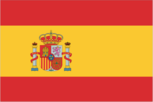
- three horizontal bands of red (top), yellow (double width), and red with the national coat of arms on the hoist side of the yellow band; the coat of arms is quartered to display the emblems of the traditional kingdoms of Spain (clockwise from upper left, Castile, Leon, Navarre, and Aragon) while Granada is represented by the stylized pomegranate at the bottom of the shield; the arms are framed by two columns representing the Pillars of Hercules, which are the two promontories (Gibraltar and Ceuta) on either side of the eastern end of the Strait of Gibraltar; the red scroll across the two columns bears the imperial motto of "Plus Ultra" (further beyond) referring to Spanish lands beyond Europe; the triband arrangement with the center stripe twice the width of the outer dates to the 18th century
- note
- the red and yellow colors are related to those of the oldest Spanish kingdoms: Aragon, Castile, Leon, and Navarre
Government Type
parliamentary constitutional monarchy
Independence
1492; the Iberian peninsula was characterized by a variety of independent kingdoms prior to the Muslim occupation that began in the early 8th century A.D. and lasted nearly seven centuries; the small Christian redoubts of the north began the reconquest almost immediately, culminating in the seizure of Granada in 1492; this event completed the unification of several kingdoms and is traditionally considered the forging of present-day Spain
International Law Organization Participation
accepts compulsory ICJ jurisdiction with reservations; accepts ICCt jurisdiction
International Organization Participation
ADB (nonregional member), AfDB (nonregional member), Arctic Council (observer), Australia Group, BCIE, BIS, CAN (observer), CBSS (observer), CD, CE, CERN, EAPC, EBRD, ECB, EIB, EITI (implementing country), EMU, ESA, EU, FAO, FATF, IADB, IAEA, IBRD, ICAO, ICC (national committees), ICCt, ICRM, IDA, IEA, IFAD, IFC, IFRCS, IHO, ILO, IMF, IMO, IMSO, Interpol, IOC, IOM, IPU, ISO, ITSO, ITU, ITUC (NGOs), LAIA (observer), MIGA, NATO, NEA, NSG, OAS (observer), OECD, OPCW, OSCE, Pacific Alliance (observer), Paris Club, PCA, PIF (partner), Schengen Convention, SELEC (observer), SICA (observer), UN, UNCTAD, UNESCO, UNHCR, UNIDO, UNIFIL, Union Latina, UNOCI, UNRWA, UNWTO, UPU, WCO, WHO, WIPO, WMO, WTO, ZC
Judicial Branch
- highest courts
- Supreme Court or Tribunal Supremo (consists of the court president and organized into the Civil Room, with a president and 9 judges; the Penal Room, with a president and 14 judges; the Administrative Room, with a president and 32 judges; the Social Room, with a president and 12 judges; and the Military Room, with a president and 7 judges); Constitutional Court or Tribunal Constitucional de Espana (consists of 12 judges)
- judge selection and term of office
- Supreme Court judges appointed by the monarch from candidates proposed by the General Council of the Judiciary Power, a 20-member governing board chaired by the monarch that includes presidential appointees, lawyers, and jurists confirmed by the National Assembly; judges can serve until age 70; Constitutional Court judges nominated by the National Assembly, executive branch, and the General Council of the Judiciary, and appointed by the monarch for 9-year terms
- subordinate courts
- National High Court; High Courts of Justice (in each of the autonomous communities); provincial courts; courts of first instance
Legal System
civil law system with regional variations
Legislative Branch
- description
- bicameral General Courts or Las Cortes Generales consists of:Senate or Senado (266 seats; 208 members directly elected in multi-seat constituencies by simple majority vote and 58 members indirectly elected by the legislatures of the autonomouse communities; members serve 4-year terms) Congress of Deputies or Congreso de los Diputados (350 seats; 348 members directly elected in 50 multi-seat constituencies by proportional representation vote and 2 directly elected from the North African Ceuta and Melilla enclaves by simple majority vote; members serve 4-year terms or until the government is dissolved)
- election results
- Senate - percent of vote by party - NA; seats by party - PP 149, PSOE 62, Unidos Podemos 20, ERC 12, EAJ/PNV 6, other 17; composition - men 165, women 101, percent of women 38% Congress of Deputies - percent of vote by party - PP 33%, PSOE 22.7%, Podemos 21.1%, C's 13%, ERC-CatSi 2.6%, EAJ/PNV 1.2%, other 6.4%; seats by party - PP 134, PSOE 84, Podemos 67, C's 32, ERC-CatSi 9, EAJ/PNV 5, other 19; composition - men 213, women 137, percent of women 38.6%
- elections
- Senate - last held on 26 June 2016 (next to be held no later than June 2020) Congress of Deputies - last held on 26 June 2016 (next to be held no later than June 2020)
National Anthem
- lyrics/music
- no lyrics/unknown
- name
- "Himno Nacional Espanol" (National Anthem of Spain)
- note
- officially in use between 1770 and 1931, restored in 1939; the Spanish anthem is the first anthem to be officially adopted, but it has no lyrics; in the years prior to 1931 it became known as "Marcha Real" (The Royal March); it first appeared in a 1761 military bugle call book and was replaced by "Himno de Riego" in the years between 1931 and 1939; the long version of the anthem is used for the king, while the short version is used for the prince, prime minister, and occasions such as sporting events
National Holiday
National Day (Hispanic Day), 12 October (1492); note - commemorates the arrival of COLUMBUS in the Americas
National Symbol S
Pillars of Hercules; national colors: red, yellow
Political Parties And Leaders
Asturias Forum or FAC [Cristina COTO]Basque Country Unite (Euskal Herria Bildu) or EH Bildu [Arnaldo OTEGI Mondragon] (coalition of 4 Basque pro-independence parties)Basque Nationalist Party or PNV or EAJ [Andoni ORTUZAR]Canarian Coalition or CC [Claudina MORALES Rodriguez] (coalition of 5 parties)Canarian Nationalist Party or PNC [Juan Manuel GARCIA Ramos]Catalan European Democratic Party or PDeCat [Artur MAS] (formerly Democratic Convergence of Catalonia)Ciudadanos Party or C's [Albert RIVERA]Compromis [Eric MORERA i Catala]Galician Nationalist Bloc or BNG [Ana PONTON Mondelo]Gomera Socialist Group or ASG [Casimiro CURBELO]Initiative for Catalonia Greens or ICV [Joan HERRERA i Torres and Dolors CAMATS]Unidos Podemos [Pablo IGLESIAS Turrion] (formerly Podemos IU; electoral coalition formed for May 2016 election)Popular Party or PP [Pablo CASADO]Republican Left of Catalonia or ERC [Oriol JUNQUERAS i Vies]Spanish Socialist Workers Party or PSOE [Pedro SANCHEZ]Union of People of Navarra or UPN [Javier ESPARZA]Union, Progress and Democracy or UPyD [Cristiano BROWN]United Left or IU [Alberto GARZON] (coalition includes Communist Party of Spain or PCE and other small parties; ran as Popular Unity or UP in 2016 election)Yes to the Future or Geroa Bai [Uxue BARKOS] (coalition include 4 Navarran parties)
Suffrage
18 years of age; universal
Economy
Agriculture Products
grain, vegetables, olives, wine grapes, sugar beets, citrus; beef, pork, poultry, dairy products; fish
Budget
- expenditures
- 539 billion (2017 est.)
- revenues
- 498.1 billion (2017 est.)
Budget Surplus Or Deficit
-3.1% (of GDP) (2017 est.)
Central Bank Discount Rate
- 0.05% (10 September 2014)
- 0.25% (13 November 2013)
- note
- this is the European Central Bank's rate on the marginal lending facility, which offers overnight credit to banks in the euro area
Commercial Bank Prime Lending Rate
- 2.03% (31 December 2017 est.)
- 2.19% (31 December 2016 est.)
Current Account Balance
- $24.74 billion (2017 est.)
- $23.77 billion (2016 est.)
Debt External
- $2.094 trillion (31 December 2017 est.)
- $1.963 trillion (31 March 2015 est.)
Distribution Of Family Income Gini Index
- 35.9 (2012)
- 32 (2005)
Economy Overview
After a prolonged recession that began in 2008 in the wake of the global financial crisis, Spain marked the fourth full year of positive economic growth in 2017, with economic activity surpassing its pre-crisis peak, largely because of increased private consumption. The financial crisis of 2008 broke 16 consecutive years of economic growth for Spain, leading to an economic contraction that lasted until late 2013. In that year, the government successfully shored up its struggling banking sector - heavily exposed to the collapse of Spain’s real estate boom - with the help of an EU-funded restructuring and recapitalization program.Until 2014, contraction in bank lending, fiscal austerity, and high unemployment constrained domestic consumption and investment. The unemployment rate rose from a low of about 8% in 2007 to more than 26% in 2013, but labor reforms prompted a modest reduction to 16.4% in 2017. High unemployment strained Spain's public finances, as spending on social benefits increased while tax revenues fell. Spain’s budget deficit peaked at 11.4% of GDP in 2010, but Spain gradually reduced the deficit to about 3.3% of GDP in 2017. Public debt has increased substantially – from 60.1% of GDP in 2010 to nearly 96.7% in 2017.Strong export growth helped bring Spain's current account into surplus in 2013 for the first time since 1986 and sustain Spain’s economic growth. Increasing labor productivity and an internal devaluation resulting from moderating labor costs and lower inflation have improved Spain’s export competitiveness and generated foreign investor interest in the economy, restoring FDI flows.In 2017, the Spanish Government’s minority status constrained its ability to implement controversial labor, pension, health care, tax, and education reforms. The European Commission expects the government to meet its 2017 budget deficit target and anticipates that expected economic growth in 2018 will help the government meet its deficit target. Spain’s borrowing costs are dramatically lower since their peak in mid-2012, and increased economic activity has generated a modest level of inflation, at 2% in 2017.
Exchange Rates
- euros (EUR) per US dollar -
- 0.885 (2017 est.)
- 0.903 (2016 est.)
- 0.9214 (2015 est.)
- 0.7525 (2014 est.)
- 0.7634 (2013 est.)
Exports
- $313.7 billion (2017 est.)
- $280.5 billion (2016 est.)
Exports Commodities
machinery, motor vehicles; foodstuffs, pharmaceuticals, medicines, other consumer goods
Exports Partners
France 15.1%, Germany 11.3%, Italy 7.8%, Portugal 7.1%, UK 6.9%, US 4.4% (2017)
Fiscal Year
calendar year
Gdp Composition By End Use
- exports of goods and services
- 34.1% (2017 est.)
- government consumption
- 18.5% (2017 est.)
- household consumption
- 57.7% (2017 est.)
- imports of goods and services
- -31.4% (2017 est.)
- investment in fixed capital
- 20.6% (2017 est.)
- investment in inventories
- 0.6% (2017 est.)
Gdp Composition By Sector Of Origin
- agriculture
- 2.6% (2017 est.)
- industry
- 23.2% (2017 est.)
- services
- 74.2% (2017 est.)
Gdp Official Exchange Rate
$1.314 trillion (2017 est.) (2017 est.)
Gdp Per Capita Ppp
- $38,400 (2017 est.)
- $37,200 (2016 est.)
- $36,100 (2015 est.)
- note
- data are in 2017 dollars
Gdp Purchasing Power Parity
- $1.778 trillion (2017 est.)
- $1.727 trillion (2016 est.)
- $1.674 trillion (2015 est.)
- note
- data are in 2017 dollars
Gdp Real Growth Rate
- 3% (2017 est.)
- 3.2% (2016 est.)
- 3.6% (2015 est.)
Gross National Saving
- 23% of GDP (2017 est.)
- 22.4% of GDP (2016 est.)
- 21.5% of GDP (2015 est.)
Household Income Or Consumption By Percentage Share
- highest 10%
- 24% (2011)
- lowest 10%
- 24% (2011)
Imports
- $338.6 billion (2017 est.)
- $300.2 billion (2016 est.)
Imports Commodities
machinery and equipment, fuels, chemicals, semi-finished goods, foodstuffs, consumer goods, measuring and medical control instruments
Imports Partners
Germany 14.2%, France 11.9%, China 6.9%, Italy 6.8%, Netherlands 5.1%, UK 4% (2017)
Industrial Production Growth Rate
4% (2017 est.)
Industries
textiles and apparel (including footwear), food and beverages, metals and metal manufactures, chemicals, shipbuilding, automobiles, machine tools, tourism, clay and refractory products, footwear, pharmaceuticals, medical equipment
Inflation Rate Consumer Prices
- 2% (2017 est.)
- -0.2% (2016 est.)
Labor Force
22.75 million (2017 est.)
Labor Force By Occupation
- agriculture
- 4.2%
- industry
- 24%
- services
- 71.7% (2009)
Market Value Of Publicly Traded Shares
- $787.2 billion (31 December 2015 est.)
- $992.9 billion (31 December 2014 est.)
- $1.117 trillion (31 December 2013 est.)
Population Below Poverty Line
21.1% (2012 est.)
Public Debt
- 98.4% of GDP (2017 est.)
- 99% of GDP (2016 est.)
Reserves Of Foreign Exchange And Gold
- $69.41 billion (31 December 2017 est.)
- $63.14 billion (31 December 2016 est.)
Stock Of Broad Money
- $1.088 trillion (31 December 2017 est.)
- $841.6 billion (31 December 2016 est.)
Stock Of Direct Foreign Investment Abroad
- $776.8 billion (31 December 2017 est.)
- $696.9 billion (31 December 2016 est.)
Stock Of Direct Foreign Investment At Home
- $824.8 billion (31 December 2017 est.)
- $739.7 billion (31 December 2016 est.)
Stock Of Domestic Credit
- $2.491 trillion (31 December 2017 est.)
- $2.21 trillion (31 December 2016 est.)
Stock Of Narrow Money
- $1.088 trillion (31 December 2017 est.)
- $841.6 billion (31 December 2016 est.)
- note
- see entry for the European Union for money supply for the entire euro area; the European Central Bank (ECB) controls monetary policy for the 18 members of the Economic and Monetary Union (EMU); individual members of the EMU do not control the quantity of money circulating within their own borders
Taxes And Other Revenues
37.9% (of GDP) (2017 est.)
Unemployment Rate
- 17.2% (2017 est.)
- 19.6% (2016 est.)
Energy
Carbon Dioxide Emissions From Consumption Of Energy
286.7 million Mt (2017 est.)
Crude Oil Exports
0 bbl/day (2017 est.)
Crude Oil Imports
1.325 million bbl/day (2017 est.)
Crude Oil Production
2,252 bbl/day (2017 est.)
Crude Oil Proved Reserves
150 million bbl (1 January 2018 est.)
Electricity Access
- electrification - total population
- 100% (2016)
Electricity Consumption
239.5 billion kWh (2016 est.)
Electricity Exports
14.18 billion kWh (2016 est.)
Electricity From Fossil Fuels
47% of total installed capacity (2016 est.)
Electricity From Hydroelectric Plants
14% of total installed capacity (2017 est.)
Electricity From Nuclear Fuels
7% of total installed capacity (2017 est.)
Electricity From Other Renewable Sources
32% of total installed capacity (2017 est.)
Electricity Imports
21.85 billion kWh (2016 est.)
Electricity Installed Generating Capacity
105.9 million kW (2016 est.)
Electricity Production
258.6 billion kWh (2016 est.)
Natural Gas Consumption
31.27 billion cu m (2017 est.)
Natural Gas Exports
2.888 billion cu m (2017 est.)
Natural Gas Imports
34.63 billion cu m (2017 est.)
Natural Gas Production
36.81 million cu m (2017 est.)
Natural Gas Proved Reserves
2.548 billion cu m (1 January 2018 est.)
Refined Petroleum Products Consumption
1.296 million bbl/day (2017 est.)
Refined Petroleum Products Exports
562,400 bbl/day (2017 est.)
Refined Petroleum Products Imports
464,800 bbl/day (2017 est.)
Refined Petroleum Products Production
1.361 million bbl/day (2017 est.)
Communications
Broadband Fixed Subscriptions
- subscriptions per 100 inhabitants
- 30 (2017 est.)
- total
- 14,473,888 (2017 est.)
Broadcast Media
a mixture of both publicly operated and privately owned TV and radio stations; overall, hundreds of TV channels are available including national, regional, local, public, and international channels; satellite and cable TV systems available; multiple national radio networks, a large number of regional radio networks, and a larger number of local radio stations; overall, hundreds of radio stations (2008)
Internet Country Code
.es
Internet Users
- percent of population
- 80.6% (July 2016 est.)
- total
- 39,123,384 (July 2016 est.)
Telephone System
- domestic
- combined fixed-line and mobile-cellular teledensity exceeds 145 telephones per 100 persons (2016)
- general assessment
- well-developed, modern facilities (2016)
- international
- country code - 34; submarine cables provide connectivity to Europe, Middle East, Asia, and US; satellite earth stations - 2 Intelsat (1 Atlantic Ocean and 1 Indian Ocean), NA Eutelsat; tropospheric scatter to adjacent countries (2016)
Telephones Fixed Lines
- subscriptions per 100 inhabitants
- 40 (2017 est.)
- total subscriptions
- 19,680,973 (2017 est.)
Telephones Mobile Cellular
- subscriptions per 100 inhabitants
- 107 (2017 est.)
- total subscriptions
- 52,484,655 (2017 est.)
Transportation
Airports
150 (2013)
Airports With Paved Runways
- 1,524 to 2,437 m
- 19 (2013)
- 2,438 to 3,047 m
- 14 (2013)
- 914 to 1,523 m
- 24 (2013)
- over 3,047 m
- 18 (2013)
- total
- 99 (2013)
- under 914 m
- 24 (2013)
Airports With Unpaved Runways
- 1,524 to 2,437 m
- 2 (2013)
- 914 to 1,523 m
- 13 (2013)
- total
- 51 (2013)
- under 914 m
- 36 (2013)
Civil Aircraft Registration Country Code Prefix
EC (2016)
Heliports
10 (2013)
Merchant Marine
- by type
- bulk carrier 1, general cargo 44, oil tanker 28, other 399 (2017)
- total
- 472 (2017)
National Air Transport System
- annual freight traffic on registered air carriers
- 1,040,913,279 mt-km (2015)
- annual passenger traffic on registered air carriers
- 60,809,228 (2015)
- inventory of registered aircraft operated by air carriers
- 414 (2015)
- number of registered air carriers
- 20 (2015)
Pipelines
10481 km gas, 616 km oil, 3461 km refined products (2013)
Ports And Terminals
- container port(s) (TEUs)
- Algeciras (4,761,428), Barcelona (2,236,960), Valencia (4,722,000) (2016)
- LNG terminal(s) (import)
- Barcelona, Bilbao, Cartagena, Huelva, Mugardos, Sagunto
- major seaport(s)
- Algeciras, Barcelona, Bilbao, Cartagena, Huelva, Tarragona, Valencia (all in Spain); Las Palmas, Santa Cruz de Tenerife (in the Canary Islands)
Railways
- broad gauge
- 11,873 km 1.668-m gauge (6,488 km electrified) (2014)
- narrow gauge
- 1,884.9 km 1.000-m gauge (807 km electrified) (2014)
- note
- 28 0.914-m gauge (28 km electrified) 3.6 0.600-m gauge
- standard gauge
- 2,312 km 1.435-m gauge (2,312 km electrified) (2014)
- total
- 16,102 km (2014)
Roadways
- paved
- 683,175 km (includes 16,205 km of expressways) (2011)
- total
- 683,175 km (2011)
Waterways
1,000 km (2012)
Military and Security
Military Branches
Spanish Armed Forces: Army (Ejercito de Tierra), Spanish Navy (Armada Espanola, AE, includes Marine Corps), Spanish Air Force (Ejercito del Aire Espanola, EdA) (2013)
Military Expenditures
- 0.93% of GDP (2018)
- 0.91% of GDP (2017)
- 1.21% of GDP (2016)
- 1.18% of GDP (2015)
- 1.23% of GDP (2014)
Military Service Age And Obligation
18-26 years of age for voluntary military service by a Spanish citizen or legal immigrant, 2-3 year obligation; women allowed to serve in all SAF branches, including combat units; no conscription, but Spanish Government retains right to mobilize citizens 19-25 years of age in a national emergency; mandatory retirement of non-NCO enlisted personnel at age 45 or 58, depending on service length (2013)
Transnational Issues
Disputes International
in 2002, Gibraltar residents voted overwhelmingly by referendum to reject any "shared sovereignty" arrangement; the Government of Gibraltar insists on equal participation in talks between the UK and Spain; Spain disapproves of UK plans to grant Gibraltar greater autonomyafter voters in the UK chose to leave the EU in a June 2016 referendum, Spain again proposed shared sovereignty of Gibraltar; UK officials rejected Spain’s joint sovereignty proposalMorocco protests Spain's control over the coastal enclaves of Ceuta, Melilla, and the islands of Penon de Velez de la Gomera, Penon de Alhucemas, and Islas Chafarinas, and surrounding waters; both countries claim Isla Perejil (Leila Island)Morocco serves as the primary launching site of illegal migration into Spain from North AfricaPortugal does not recognize Spanish sovereignty over the territory of Olivenza based on a difference of interpretation of the 1815 Congress of Vienna and the 1801 Treaty of Badajoz
Illicit Drugs
despite rigorous law enforcement efforts, North African, Latin American, Galician, and other European traffickers take advantage of Spain's long coastline to land large shipments of cocaine and hashish for distribution to the European market; consumer for Latin American cocaine and North African hashish; destination and minor transshipment point for Southwest Asian heroin; money-laundering site for Colombian narcotics trafficking organizations and organized crime
Refugees And Internally Displaced Persons
- note
- 123,310 estimated refugee and migrant arrivals (January 2015-December 2018); 28,707 migrant arrivals in 2017
- refugees (country of origin)
- 11,752 (Syria) (2017), 29,603 (Venezuela) (economic and political crisis; includes Venezuelans who have claimed asylum or have received alternative legal stay), 9,260 (Ukraine) (2018) note - estimate represents asylum applicants since the beginning of the Ukraine crisis in 2014 to September 2017
- stateless persons
- 1,596 (2017)
Terrorism
Terrorist Groups Home Based
- Basque Fatherland and Liberty (ETA)
- aim(s): establish an independent Basque homeland in northern Spain and southwestern France based on Marxist principlesarea(s) of operation: headquartered in northern Spain, reportedly disarmed in 2017 (April 2018)