1999 Edition
CIA World Factbook 1999 (Internet Archive)
Introduction
Background
A powerful world empire in the 16th and 17th centuries, Spain ultimately yielded command of the seas to England, beginning with the defeat of the Armada in 1588. Spain subsequently failed to embrace the mercantile and industrial revolutions and fell behind Britain, France, and Germany in economic and political power. Spain remained neutral in World Wars I and II. In the second half of the 20th century Spain played a catch-up role in the western international community. Continuing problems are large-scale unemployment and the Basque separatist movement.
Geography
Area
total: 504,750 sq km land: 499,400 sq km water: 5,350 sq km note: includes Balearic Islands, Canary Islands, and five places of sovereignty (plazas de soberania) on and off the coast of Morocco--Ceuta, Melilla, Islas Chafarinas, Penon de Alhucemas, and Penon de Velez de la Gomera
Area--comparative
slightly more than twice the size of Oregon
Climate
temperate; clear, hot summers in interior, more moderate and cloudy along coast; cloudy, cold winters in interior, partly cloudy and cool along coast
Coastline
4,964 km
Elevation extremes
lowest point: Atlantic Ocean 0 m highest point: Pico de Teide (Tenerife) on Canary Islands 3,718 m
Environment--current issues
pollution of the Mediterranean Sea from raw sewage and effluents from the offshore production of oil and gas; water quality and quantity nationwide; air pollution; deforestation; desertification
Environment--international agreements
party to: Air Pollution, Air Pollution-Nitrogen Oxides, Air Pollution-Sulphur 94, Air Pollution-Volatile Organic Compounds, Antarctic-Environmental Protocol, Antarctic Treaty, Biodiversity, Climate Change, Endangered Species, Environmental Modification, Hazardous Wastes, Law of the Sea, Marine Dumping, Marine Life Conservation, Nuclear Test Ban, Ozone Layer Protection, Ship Pollution, Tropical Timber 83, Tropical Timber 94, Wetlands, Whaling signed, but not ratified: Air Pollution-Persistent Organic Pollutants, Climate Change-Kyoto Protocol, Desertification
Geographic coordinates
40 00 N, 4 00 W
Geography--note
strategic location along approaches to Strait of Gibraltar
Irrigated land
34,530 sq km (1993 est.)
Land boundaries
total: 1,919.1 km border countries: Andorra 65 km, France 623 km, Gibraltar 1.2 km, Portugal 1,214 km, Morocco (Ceuta) 6.3 km, Morocco (Melilla) 9.6 km
Land use
arable land: 30% permanent crops: 9% permanent pastures: 21% forests and woodland: 32% other: 8% (1993 est.)
Location
Southwestern Europe, bordering the Bay of Biscay, Mediterranean Sea, North Atlantic Ocean, and Pyrenees Mountains, southwest of France
Map references
Europe
Maritime claims
exclusive economic zone: 200 nm (applies only to the Atlantic Ocean) territorial sea: 12 nm
Natural hazards
periodic droughts
Natural resources
coal, lignite, iron ore, uranium, mercury, pyrites, fluorspar, gypsum, zinc, lead, tungsten, copper, kaolin, potash, hydropower
Terrain
large, flat to dissected plateau surrounded by rugged hills; Pyrenees in north
People and Society
Age structure
0-14 years: 15% (male 3,012,907; female 2,835,455) 15-64 years: 68% (male 13,411,046; female 13,406,214) 65 years and over: 17% (male 2,702,654; female 3,799,468) (1999 est.)
Birth rate
9.99 births/1,000 population (1999 est.)
Death rate
9.69 deaths/1,000 population (1999 est.)
Ethnic groups
composite of Mediterranean and Nordic types
Infant mortality rate
6.41 deaths/1,000 live births (1999 est.)
Languages
Castilian Spanish 74%, Catalan 17%, Galician 7%, Basque 2%
Life expectancy at birth
total population: 77.71 years male: 73.97 years female: 81.71 years (1999 est.)
Literacy
definition: age 15 and over can read and write total population: 96% male: 98% female: 94% (1986 est.)
Nationality
noun: Spaniard(s) adjective: Spanish
Net migration rate
0.66 migrant(s)/1,000 population (1999 est.)
Population
39,167,744 (July 1999 est.)
Population growth rate
0.1% (1999 est.)
Religions
Roman Catholic 99%, other 1%
Sex ratio
at birth: 1.07 male(s)/female under 15 years: 1.06 male(s)/female 15-64 years: 1 male(s)/female 65 years and over: 0.71 male(s)/female total population: 0.95 male(s)/female (1999 est.)
Total fertility rate
1.24 children born/woman (1999 est.)
Government
Administrative divisions
17 autonomous communities (comunidades autonomas, singular--comunidad autonoma); Andalucia, Aragon, Asturias, Baleares (Balearic Islands), Canarias (Canary Islands), Cantabria, Castilla-La Mancha, Castilla y Leon, Cataluna, Communidad Valencian, Extremadura, Galicia, La Rioja, Madrid, Murcia, Navarra, Pais Vasco (Basque Country) note: there are five places of sovereignty on and off the coast of
Capital
Madrid
Constitution
6 December 1978, effective 29 December 1978
Country name
conventional long form: Kingdom of Spain conventional short form: Spain local short form: Espana
Data code
SP
Executive branch
chief of state: King JUAN CARLOS I (since 22 November 1975); Heir Apparent Prince FELIPE, son of the monarch, born 30 January 1968 head of government: President of the Government Jose Maria AZNAR Lopez (since 5 May 1996); First Vice President Francisco ALVAREZ CASCOS Fernandez (since 5 May 1996) and Second Vice President (and Minister of Economy and Finance) Rodrigo RATO Figaredo (since 5 May 1996) cabinet: Council of Ministers designated by the president note: there is also a Council of State that is the supreme consultative organ of the government elections: the monarch is hereditary; president proposed by the monarch and elected by the National Assembly following legislative elections; election last held 3 March 1996 (next to be held by NA April 2000); vice presidents appointed by the monarch on proposal of the president election results: Jose Maria AZNAR elected president; percent of National Assembly vote--NA
Flag description
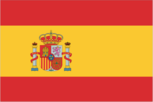
three horizontal bands of red (top), yellow (double width), and red with the national coat of arms on the hoist side of the yellow band; the coat of arms includes the royal seal framed by the Pillars of Hercules, which are the two promontories (Gibraltar and Ceuta) on either side of the eastern end of the Strait of Gibraltar
Government type
parliamentary monarchy
Independence
1492 (expulsion of the Moors and unification)
International organization participation
AfDB, AsDB, Australia Group, BIS, CCC, CE, CERN, EAPC, EBRD, ECE, ECLAC, EIB, EMU, ESA, EU, FAO, IADB, IAEA, IBRD, ICAO, ICC, ICFTU, ICRM, IDA, IEA, IFAD, IFC, IFRCS, IHO, ILO, IMF, IMO, Inmarsat, Intelsat, Interpol, IOC, IOM (observer), ISO, ITU, LAIA (observer), MTCR, NAM (guest), NATO, NEA, NSG, OAS (observer), OECD, OPCW, OSCE, PCA, UN, UNCTAD, UNESCO, UNHCR, UNIDO, UNMIBH, UNU, UPU, WCL, WEU, WHO, WIPO, WMO, WToO, WTrO, ZC Diplomatic representation in the US: chief of mission: Ambassador Antonio OYARZABAL MARCHESI chancery: 2375 Pennsylvania Avenue NW, Washington, DC 20037 consulate(s) general: Boston, Chicago, Houston, Los Angeles, Miami, New Orleans, New York, San Francisco, and San Juan (Puerto Rico) Diplomatic representation from the US: chief of mission: Ambassador Edward L. ROMERO embassy: Serrano 75, 28006 Madrid mailing address: APO AE 09642 consulate(s) general: Barcelona
Judicial branch
Supreme Court or Tribunal Supremo Political parties and leaders: principal national parties, from right to left: Popular Party or PP Gonzalez] Soley, secretary general] (a coalition of the Democratic Convergence Political pressure groups and leaders: on the extreme left, the Basque Fatherland and Liberty or ETA and the First of October Antifascist Resistance Group or GRAPO use terrorism to oppose the unions (authorized in April 1977); Workers Confederation or CC.OO; the Socialist General Union of Workers or UGT and the smaller independent Workers Syndical Union or USO; business and landowning interests; the Catholic Church; Opus Dei; university students
Legal system
civil law system, with regional applications; does not accept compulsory ICJ jurisdiction
Legislative branch
bicameral; the General Courts or National Assembly or Las Cortes Generales consists of the Senate or Senado (256 seats--208 members directly elected by popular vote and the other 48 appointed by the regional legislatures to serve four-year terms) and the Congress of Deputies or Congreso de los Diputados (350 seats; members are elected by popular vote on block lists by proportional representation to serve four-year terms) elections: Senate--last held 3 March 1996 (next to be held by April 2000); Congress of Deputies--last held 3 March 1996 (next to be held by April 2000) election results: Senate--percent of vote by party--NA; seats by party--PP 132, PSOE 96, CiU 11, PNV 6, IU 2, others 9; Congress of Deputies--percent of vote by party--PP 38.9%, PSOE 37.5%, IU 10.7%, CiU 4.6%; seats by party--PP 156, PSOE 141, IU 21, CiU 16, other 16
Morocco
Ceuta and Melilla are administered as autonomous communities; Islas Chafarinas, Penon de Alhucemas, and Penon de Velez de la Gomera are under direct Spanish administration
National holiday
National Day, 12 October
Suffrage
18 years of age; universal
Economy
Agriculture--products
grain, vegetables, olives, wine grapes, sugar beets, citrus; beef, pork, poultry, dairy products; fish
Budget
revenues: $113 billion expenditures: $139 billion, including capital expenditures of $15 billion (1995)
Currency
1 peseta (Pta) = 100 centimos
Debt--external
$90 billion (1993 est.)
Economic aid--donor
ODA, $1.3 billion (1995)
Economy--overview
Spain's mixed capitalist economy supports a GDP that on a per capita basis is three-fourths that of the four leading West European economies. Its center-right government successfully worked to gain admission to the first group of countries launching the European single currency on 1 January 1999. The deficit-to-GDP ratio is 2.1%, the debt-to-GDP ratio is around 68%, and inflation is approximately 2%. Moreover, the AZNAR administration has continued to advocate liberalization, privatization, and deregulation of the economy and has introduced some tax reforms to that end. Unemployment, nonetheless, remains the highest in the EU at 20%. The government, for political reasons, has made only limited progress in changing labor laws or reforming pension schemes, which are key to the sustainability of both Spain's internal economic advances and its competitiveness in a single currency area. Adjustment to the monetary and other economic policies of an integrated Europe will pose difficult challenges to Spain in the next few years.
Electricity--consumption
164.568 billion kWh (1996)
Electricity--exports
5.7 billion kWh (1996)
Electricity--imports
6.8 billion kWh (1996)
Electricity--production
163.468 billion kWh (1996)
Electricity--production by source
fossil fuel: 43.17% hydro: 23.92% nuclear: 32.74% other: 0.17% (1996)
Exchange rates
pesetas (Ptas) per US$1--143.39 (January 1999), 149.40 (1998), 146.41 (1997), 126.66 (1996), 124.69 (1995), 133.96 (1994) note: on 1 January 1999, the European Union introduced a common currency that is now being used by financial institutions in some member countries at the rate of 0.8597 euros per US$ and a fixed rate of 166.386 pesetas per euro; the euro will replace the local currency in consenting countries for all transactions in 2002
Exports
$111.1 billion (f.o.b., 1998 est.)
Exports--commodities
cars and trucks, other machinery and manufactured goods, foodstuffs, and other consumer goods
Exports--partners
EU 70% (France 20%, Germany 18%, Italy 10%, Portugal 9%, UK 8%), US 4.4% (1997)
Fiscal year
calendar year
GDP
purchasing power parity--$645.6 billion (1998 est.)
GDP--composition by sector
agriculture: 3.4% industry: 33.3% services: 63.3% (1997 est.)
GDP--per capita
purchasing power parity?$16,500 (1998 est.)
GDP--real growth rate
3.5% (1998 est.)
Household income or consumption by percentage share
lowest 10%: 2.8% highest 10%: 25.2% (1990)
Imports
$132.3 billion (f.o.b., 1998 est.)
Imports--commodities
machinery, transport equipment, fuels, semifinished goods, foodstuffs, consumer goods, chemicals (1997)
Imports--partners
EU 65% (France 17%, Germany 15%, Italy 9%, UK 8%, Benelux 7%), US 6%, Japan 3% (1997)
Industrial production growth rate
5.8% (1998)
Industries
textiles and apparel (including footwear), food and beverages, metals and metal manufactures, chemicals, shipbuilding, automobiles, machine tools, tourism
Inflation rate (consumer prices)
2% (1998 est.)
Labor force
16.2 million
Labor force--by occupation
services 64%, manufacturing, mining, and construction 28%, agriculture 8% (1997 est.)
Population below poverty line
NA%
Unemployment rate
20% (1998 est.)
Communications
Radio broadcast stations
AM 190, FM 406 (repeaters 134), shortwave 0
Radios
12 million (1992 est.)
Telephone system
generally adequate, modern facilities domestic: NA international: 22 coaxial submarine cables; satellite earth stations--2 Intelsat (1 Atlantic Ocean and 1 Indian Ocean), NA Eutelsat, NA Inmarsat, and NA Marecs; tropospheric scatter to adjacent countries
Telephones
12.6 million (1990 est.)
Television broadcast stations
542 (382 network stations, 160 low-power stations, and one US Air Force Europe station) (1997)
Televisions
15.7 million (1992 est.)
Transportation
Airports
99 (1998 est.) Airports--with paved runways: total: 66 over 3,047 m: 15 2,438 to 3,047 m: 11 1,524 to 2,437 m: 16 914 to 1,523 m: 15 under 914 m: 9 (1998 est.) Airports--with unpaved runways: total: 33 1,524 to 2,437 m: 1 914 to 1,523 m: 11 under 914 m: 21 (1998 est.)
Heliports
2 (1998 est.)
Highways
total: 346,858 km paved: 343,389 km (including 9,063 km of expressways) unpaved: 3,469 km (1997 est.)
Merchant marine
total: 137 ships (1,000 GRT or over) totaling 1,094,408 GRT/1,695,708 DWT ships by type: bulk 11, cargo 29, chemical tanker 10, container 10, liquefied gas tanker 3, oil tanker 25, passenger 1, refrigerated cargo 6, roll-on/roll-off cargo 35, short-sea passenger 6, specialized tanker 1 (1998 est.)
Pipelines
crude oil 265 km; petroleum products 1,794 km; natural gas 1,666 km Ports and harbors: Aviles, Barcelona, Bilbao, Cadiz, Cartagena, Castellon de la Plana, Ceuta, Huelva, La Coruna, Las Palmas (Canary Islands), Malaga, Melilla, Pasajes, Gijon, Santa Cruz de Tenerife (Canary Islands), Santander, Tarragona, Valencia, Vigo
Railways
total: 15,079 km broad gauge: 12,781 km 1.668-m gauge (6,355 km electrified; 2,295 km double track) standard gauge: 525 km 1.435-m gauge (480 km electrified) narrow gauge: 1,773 km 1.000-m gauge (594 km electrified) (1996)
Waterways
1,045 km, but of minor economic importance
Military and Security
Military branches
Army, Navy, Air Force, Marines, Civil Guard, National Police, Coastal Civil Guard
Military expenditures--dollar figure
$6.3 billion (1995)
Military expenditures--percent of GDP
1.4% (1995)
Military manpower--availability
males age 15-49: 10,374,314 (1999 est.) Military manpower--fit for military service: males age 15-49: 8,346,155 (1999 est.)
Military manpower--military age
20 years of age
Military manpower--reaching military age annually
males: 311,350 (1999 est.)
Transnational Issues
Disputes--international
Gibraltar issue with UK; Spain controls five places of sovereignty (plazas de soberania) on and off the coast of Morocco--the coastal enclaves of Ceuta and Melilla, which Morocco contests, as well as the islands of Penon de Alhucemas, Penon de Velez de la Gomera, and Islas Chafarinas
Illicit drugs
key European gateway country for Latin American cocaine and North African hashish entering the European market; transshipment point for and consumer of Southwest Asian heroin