1993 Edition
CIA World Factbook 1993 (Project Gutenberg)
Geography
Area
total area: 504,750 km2 land area: 499,400 km2 comparative area: slightly more than twice the size of Oregon note: includes Balearic Islands, Canary Islands, and five places of sovereignty (plazas de soberania) on and off the coast of Morocco - Ceuta, Mellila, Islas Chafarinas, Penon de Alhucemas, and Penon de Velez de la Gomera
Climate
temperate; clear, hot summers in interior, more moderate and cloudy along coast; cloudy, cold winters in interior, partly cloudy and cool along coast
Coastline
4,964 km
Environment
deforestation; air pollution
International disputes
Gibraltar question with UK; Spain controls five places of sovereignty (plazas de soberania) on and off the coast of Morocco - the coastal enclaves of Ceuta and Melilla, which Morocco contests, as well as the islands of Penon de Alhucemas, Penon de Velez de la Gomera, and Islas Chafarinas
Irrigated land
33,600 km2 (1989 est.)
Land boundaries
total 1,903.2 km, Andorra 65 km, France 623 km, Gibraltar 1.2 km, Portugal 1,214 km
Land use
arable land: 31% permanent crops: 10% meadows and pastures: 21% forest and woodland: 31% other: 7%
Location
Southwestern Europe, bordering the North Atlantic Ocean and the Mediterranean Sea, between Portugal and France
Map references
Africa, Europe, Standard Time Zones of the World
Maritime claims
exclusive economic zone: 200 nm territorial sea: 12 nm
Natural resources
coal, lignite, iron ore, uranium, mercury, pyrites, fluorspar, gypsum, zinc, lead, tungsten, copper, kaolin, potash, hydropower
Note
strategic location along approaches to Strait of Gibraltar
Terrain
large, flat to dissected plateau surrounded by rugged hills; Pyrenees in north
People and Society
Birth rate
10.88 births/1,000 population (1993 est.)
Death rate
8.76 deaths/1,000 population (1993 est.)
Ethnic divisions
composite of Mediterranean and Nordic types
Infant mortality rate
7 deaths/1,000 live births (1993 est.)
Labor force
14.621 million by occupation: services 53%, industry 24%, agriculture 14%, construction 9% (1988)
Languages
Castilian Spanish, Catalan 17%, Galician 7%, Basque 2%
Life expectancy at birth
total population: 77.51 years male: 74.22 years female: 81.04 years (1993 est.)
Literacy
age 15 and over can read and write (1990) total population: 95% male: 97% female: 93%
Nationality
noun: Spaniard(s) adjective: Spanish
Net migration rate
0.24 migrant(s)/1,000 population (1993 est.)
Population
39,207,159 (July 1993 est.)
Population growth rate
0.24% (1993 est.)
Religions
Roman Catholic 99%, other sects 1%
Total fertility rate
1.38 children born/woman (1993 est.)
Government
Administrative divisions
17 autonomous communities (comunidades autonomas, singular - comunidad autonoma); Andalucia, Aragon, Asturias, Canarias, Cantabria, Castilla-La Mancha, Castilla y Leon, Cataluna, Communidad Valencia, Extremadura, Galicia, Islas Baleares, La Rioja, Madrid, Murcia, Navarra, Pais Vasco note: there are five places of sovereignty on and off the coast of Morocco (Ceuta, Mellila, Islas Chafarinas, Penon de Alhucemas, and Penon de Velez de la Gomera) with administrative status unknown
Capital
Madrid
Chief of State
King JUAN CARLOS I (since 22 November 1975)
Congress of Deputies
last held 29 October 1989 (next to be held NA October 1993); results - PSOE 39.6%, PP 25.8%, CDS 9%, IU 9%, CiU 5%, PNV 1.2%, HB 1%, PA 1%, other 8.4%; seats - (350 total) PSOE 175, PP 106, CiU 18, IU 17, CDS 14, PNV 5, HB 4, other 11
Constitution
6 December 1978, effective 29 December 1978
Digraph
SP
Diplomatic representation in US
chief of mission: Ambassador Jaime De OJEDA y Eiseley chancery: 2700 15th Street NW, Washington, DC 20009 telephone: (202) 265-0190 or 0191 consulates general: Boston, Chicago, Houston, Los Angeles, Miami, New Orleans, New York, San Francisco, and San Juan (Puerto Rico)
Executive branch
monarch, president of the government (prime minister), deputy prime minister, Council of Ministers (cabinet), Council of State
FAX
[34] (1) 577-5735 consulate general: Barcelona consulate: Bilbao
Flag
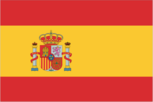
three horizontal bands of red (top), yellow (double width), and red with the national coat of arms on the hoist side of the yellow band; the coat of arms includes the royal seal framed by the Pillars of Hercules, which are the two promontories (Gibraltar and Ceuta) on either side of the eastern end of the Strait of Gibraltar
Head of Government
Prime Minister Felipe GONZALEZ Marquez (since 2 December 1982); Deputy Prime Minister Narcis SERRA y Serra (since 13 March 1991)
Independence
1492 (expulsion of the Moors and unification)
Judicial branch
Supreme Court (Tribunal Supremo)
Legal system
civil law system, with regional applications; does not accept compulsory ICJ jurisdiction
Legislative branch
bicameral The General Courts or National Assembly (Las Cortes Generales) consists of an upper house or Senate (Senado) and a lower house or Congress of Deputies (Congreso de los Diputados)
Member of
AG (observer), AsDB, Australian Group, BIS, CCC, CE, CERN, COCOM, CSCE, EBRD, AfDB, EC, ECE, ECLAC, EIB, ESA, FAO, G-8, GATT, IADB, IAEA, IBRD, ICAO, ICC, ICFTU, IDA, IEA, IFAD, IFC, ILO, IMF, IMO, INMARSAT, INTELSAT, INTERPOL, IOC, IOM (observer), ISO, ITU, LAIA (observer), LORCS, MTRC, NACC, NAM (guest), NATO, NEA, NSG, OAS (observer), OECD, ONUSAL, PCA, UN, UNAVEM II, UNCTAD, UNESCO, UNIDO, UNOMOZ, UPU, WCL, WEU, WHO, WIPO, WMO, WTO, ZC
Names
conventional long form: Kingdom of Spain conventional short form: Spain local short form: Espana
National holiday
National Day, 12 October
Other political or pressure groups
on the extreme left, the Basque Fatherland and Liberty (ETA) and the First of October Antifascist Resistance Group (GRAPO) use terrorism to oppose the government; free labor unions (authorized in April 1977) include the Communist-dominated Workers Commissions (CCOO); the Socialist General Union of Workers (UGT), and the smaller independent Workers Syndical Union (USO); the Catholic Church; business and landowning interests; Opus Dei; university students
Political parties and leaders
principal national parties, from right to left: Popular Party (PP), Jose Maria AZNAR; Social Democratic Center (CDS), Rafael Calvo ORTEGA; Spanish Socialist Workers Party (PSOE), Felipe GONZALEZ Marquez, secretary general; Socialist Democracy Party (DS), Ricardo Garcia DAMBORENEA; Spanish Communist Party (PCE), Julio ANGUITA; United Left (IU) a coalition of parties including the PCE, a branch of the PSOE, and other small parties, leader NA chief regional parties: Convergence and Unity (CiU), Jordi PUJOL Saley, in Catalonia; Basque Nationalist Party (PNV), Xabier ARZALLUS; Basque Solidarity (EA), Carlos GARAICOETXEA Urizza; Basque Popular Unity (HB), Jon IDIGORAS; Basque Left (EE), Juan Maria BANDRES; Basque Socialist Party (PSE); coalition of the PSE, EE, and PSOE, Jose Maria BANEGAS; Euskal Ezkerra (EUE), Xabier GURRUTXAGA; Andalusian Party (PA), Pedro PACHECO; Independent Canary Group (AIC), leader NA; Aragon Regional Party (PAR), leader NA; Valencian Union (UV), leader NA
Senate
last held 29 October 1989 (next to be held NA October 1993); results - percent of vote by party NA; seats - (208 total) PSOE 106, PP 79, CiU 10, PNV 4, HB 3, AIC 1, other 5
Suffrage
18 years of age; universal
Type
parliamentary monarchy
US diplomatic representation
chief of mission: Ambassador Richard G. CAPEN, Jr. embassy: Serrano 75, 28006 Madrid mailing address: PSC 61, APO AE 09642 telephone: [34] (1) 577-4000
Economy
Agriculture
accounts for about 5% of GDP and 14% of labor force; major products - grain, vegetables, olives, wine grapes, sugar beets, citrus fruit, beef, pork, poultry, dairy; largely self-sufficient in food; fish catch of 1.4 million metric tons is among top 20 nations
Budget
revenues $122.9 billion; expenditures $140.2 billion, including capital expenditures of $NA (1992 est.)
Currency
1 peseta (Pta) = 100 centimos
Economic aid
US commitments, including Ex-Im (FY70-87), $1.9 billion; Western (non-US) countries, ODA and OOF bilateral commitments (1970-79), $545.0 million; not currently a recipient
Electricity
46,600,000 kW capacity; 157,000 million kWh produced, 4,000 kWh per capita (1992)
Exchange rates
pesetas (Ptas) per US$1 - 114.59 (January 1993), 102.38 (1992), 103.91 (1991), 101.93 (1990), 118.38 (1989), 116.49 (1988)
Exports
$62 billion (f.o.b., 1992 est.) commodities: cars and trucks, semifinished manufactured goods, foodstuffs, machinery partners: EC 71.0%, US 4.9%, other developed countries 7.9% (1991)
External debt
$67.5 billion (1992 est.)
Fiscal year
calendar year
Illicit drugs
key European gateway country for Latin American cocaine entering the European market
Imports
$100 billion (c.i.f., 1992 est.) commodities: machinery, transport equipment, fuels, semifinished goods, foodstuffs, consumer goods, chemicals partners: EC 60.0%, US 8.0%, other developed countries 11.5%, Middle East 2.6% (1991)
Industrial production
growth rate 0.6% (1992 est.)
Industries
textiles and apparel (including footwear), food and beverages, metals and metal manufactures, chemicals, shipbuilding, automobiles, machine tools, tourism
Inflation rate (consumer prices)
6% (1992 est.)
National product
GDP - purchasing power equivalent - $514.9 billion (1992)
National product per capita
$13,200 (1992)
National product real growth rate
1% (1992)
Overview
Spain has done well since joining the EC in 1986. Foreign and domestic investments have spurred GDP growth at an annual average of more than 4% in 1986-91. As of 1 January 1993, Spain has wholly liberalized its trade and capital markets to EC standards, including integrating agriculture two years ahead of schedule. Beginning in 1989, Madrid implemented a tight monetary policy to fight 7% inflation. As a result of this action and the worldwide decline in economic growth, Spain's growth rate declined to 1% in 1992. Spain faces a likely recession in first half 1993. The government expects a recovery in the second half, but this depends on stepped-up growth in Germany and France. The slowdown in growth - along with displacements caused by structural adjustments in preparation for the EC single market - has pushed an already high unemployment rate up to 19%. However, many people listed as unemployed work in the underground economy. If the government can stick to its tough economic policies and push further structural reforms, the economy will emerge stronger at the end of the 1990s.
Unemployment rate
19% (yearend 1992)
Communications
Airports
total: 105 usable: 99 with permanent-surface runways: 60 with runways over 3,659 m: 4 with runways 2,440-3,659 m: 22 with runways 1,220-2,439 m: 26
Highways
150,839 km total; 82,513 km national (includes 2,433 km limited-access divided highway, 63,042 km bituminous treated, 17,038 km intermediate bituminous, concrete, or stone block) and 68,326 km provincial or local roads (bituminous treated, intermediate bituminous, or stone block)
Inland waterways
1,045 km, but of minor economic importance
Merchant marine
242 ships (1,000 GRT or over) totaling 2,394,175 GRT/4,262,868 DWT; includes 2 passenger, 8 short-sea passenger, 71 cargo, 12 refrigerated cargo, 12 container, 32 roll-on/roll-off cargo, 4 vehicle carrier, 41 oil tanker, 14 chemical tanker, 7 liquefied gas, 3 specialized tanker, 36 bulk
Pipelines
crude oil 265 km, petroleum products 1,794 km, natural gas 1,666 km
Ports
Algeciras, Alicante, Almeria, Barcelona, Bilbao, Cadiz, Cartagena, Castellon de la Plana, Ceuta, El Ferrol del Caudillo, Puerto de Gijon, Huelva, La Coruna, Las Palmas (Canary Islands), Mahon, Malaga, Melilla, Rota, Santa Cruz de Tenerife, Sagunto, Tarragona, Valencia, Vigo, and 175 minor ports
Railroads
15,430 km total; Spanish National Railways (RENFE) operates 12,691 km (all 1.668-meter gauge, 6,184 km electrified, and 2,295 km double track); FEVE (government-owned narrow-gauge railways) operates 1,821 km (predominantly 1.000-meter gauge, 441 km electrified); privately owned railways operate 918 km (predominantly 1.000-meter gauge, 512 km electrified, and 56 km double track)
Telecommunications
generally adequate, modern facilities; 15,350,464 telephones; broadcast stations - 190 AM, 406 (134 repeaters) FM, 100 (1,297 repeaters) TV; 22 coaxial submarine cables; 2 communications satellite earth stations operating in INTELSAT (Atlantic Ocean and Indian Ocean); MARECS, INMARSAT, and EUTELSAT systems; tropospheric links
Military and Security
Branches
Army, Navy, Air Force, Marines, Civil Guard, National Police, Coastal Civil Guard
Defense expenditures
exchange rate conversion - $9.6 billion, 1.6% of GDP (1992)
Manpower availability
males age 15-49 10,299,960; fit for military service 8,341,046; reach military age (20) annually 338,231 (1993 est.)