2018 Edition
CIA World Factbook 2018 Archive (Wayback Machine)
Introduction
Background
An independent kingdom for much of its long history, Korea was occupied by Japan beginning in 1905 following the Russo-Japanese War. In 1910, Tokyo formally annexed the entire Peninsula. Korea regained its independence following Japan's surrender to the US in 1945. After World War II, a democratic-based government (Republic of Korea, ROK) was set up in the southern half of the Korean Peninsula while a communist-style government was installed in the north (Democratic People's Republic of Korea, DPRK). During the Korean War (1950-53), US troops and UN forces fought alongside ROK soldiers to defend South Korea from a DPRK invasion supported by China and the Soviet Union. A 1953 armistice split the Peninsula along a demilitarized zone at about the 38th parallel. PARK Chung-hee took over leadership of the country in a 1961 coup. During his regime, from 1961 to 1979, South Korea achieved rapid economic growth, with per capita income rising to roughly 17 times the level of North Korea.South Korea held its first free presidential election under a revised democratic constitution in 1987, with former ROK Army general ROH Tae-woo winning a close race. In 1993, KIM Young-sam (1993-98) became the first civilian president of South Korea's new democratic era. President KIM Dae-jung (1998-2003) won the Nobel Peace Prize in 2000 for his contributions to South Korean democracy and his "Sunshine" policy of engagement with North Korea. President PARK Geun-hye, daughter of former ROK President PARK Chung-hee, took office in February 2013 as South Korea's first female leader. In December 2016, the National Assembly passed an impeachment motion against President PARK over her alleged involvement in a corruption and influence-peddling scandal, immediately suspending her presidential authorities. The impeachment was upheld in March 2017, triggering an early presidential election in May 2017 won by MOON Jae-in. South Korea hosted the Winter Olympic and Paralympic Games in February 2018, in which North Korea also participated. Discord with North Korea has permeated inter-Korean relations for much of the past decade, highlighted by the North's attacks on a South Korean ship and island in 2010, the exchange of artillery fire across the DMZ in 2015, and multiple nuclear and missile tests in 2016 and 2017. North Korea’s participation in the Winter Olympics, dispatch of a senior delegation to Seoul, and the planned April 27 inter-Korean summit at Panmunjom – the first in 11 years and the first-ever to be held at the inter-Korean border – appear to have ushered in a temporary period of respite.
Geography
Area
- land
- 96,920 sq km
- total
- 99,720 sq km
- water
- 2,800 sq km
Area Comparative
slightly smaller than Pennsylvania; slightly larger than Indiana
Climate
temperate, with rainfall heavier in summer than winter; cold winters
Coastline
2,413 km
Elevation
- elevation extremes
- 0 m lowest point: Sea of Japan
- mean elevation
- 282 m
- note
- 1950 highest point: Halla-san
Environment Current Issues
air pollution in large cities; acid rain; water pollution from the discharge of sewage and industrial effluents; drift net fishing; solid waste disposal; transboundary pollution
Environment International Agreements
- party to
- Antarctic-Environmental Protocol, Antarctic-Marine Living Resources, Antarctic Treaty, Biodiversity, Climate Change, Climate Change-Kyoto Protocol, Desertification, Endangered Species, Environmental Modification, Hazardous Wastes, Law of the Sea, Marine Dumping, Ozone Layer Protection, Ship Pollution, Tropical Timber 83, Tropical Timber 94, Wetlands, Whaling
- signed, but not ratified
- none of the selected agreements
Geographic Coordinates
37 00 N, 127 30 E
Geography Note
strategic location on Korea Strait; about 3,000 mostly small and uninhabited islands lie off the western and southern coasts
Irrigated Land
7,780 sq km (2012)
Land Boundaries
- border countries (1)
- North Korea 237 km
- total
- 237 km
Land Use
- arable land: 15.3% (2011 est.) / permanent crops: 2.2% (2011 est.) / permanent pasture: 0.6% (2011 est.)
- agricultural land
- 18.1% (2011 est.)
- forest
- 63.9% (2011 est.)
- other
- 18% (2011 est.)
Location
Eastern Asia, southern half of the Korean Peninsula bordering the Sea of Japan and the Yellow Sea
Map References
Asia
Maritime Claims
- contiguous zone
- 24 nm
- continental shelf
- not specified
- exclusive economic zone
- 200 nm
- territorial sea
- 12 nm; between 3 nm and 12 nm in the Korea Strait
Natural Hazards
occasional typhoons bring high winds and floods; low-level seismic activity common in southwestvolcanism: Halla (1,950 m) is considered historically active although it has not erupted in many centuries
Natural Resources
coal, tungsten, graphite, molybdenum, lead, hydropower potential
Population Distribution
with approximately 70% of the country considered mountainous, the country's population is primarily concentrated in the lowland areas, where density is quite high; Gyeonggi Province in the northwest, which surrounds the capital of Seoul and contains the port of Incheon, is the most densely populated province; Gangwon in the northeast is the least populated
Terrain
mostly hills and mountains; wide coastal plains in west and south
People and Society
Age Structure
- 0-14 years
- 13.03% (male 3,448,627 /female 3,251,786)
- 15-24 years
- 12.19% (male 3,295,814 /female 2,970,439)
- 25-54 years
- 45.13% (male 11,986,760 /female 11,220,268)
- 55-64 years
- 15.09% (male 3,825,127 /female 3,935,700)
- 65 years and over
- 14.55% (male 3,202,232 /female 4,281,344) (2018 est.)
Birth Rate
8.3 births/1,000 population (2018 est.)
Children Under The Age Of 5 Years Underweight
0.7% (2010)
Contraceptive Prevalence Rate
- 79.6% (2015)
- note
- percent of women aged 20-49
Death Rate
6.3 deaths/1,000 population (2018 est.)
Dependency Ratios
- elderly dependency ratio
- 17.7 (2015 est.)
- potential support ratio
- 5.6 (2015 est.)
- total dependency ratio
- 36.7 (2015 est.)
- youth dependency ratio
- 19 (2015 est.)
Drinking Water Source
- improved: urban: 99.7% of population
- rural: 87.9% of population
- total: 97.8% of population
- unimproved: urban: 0.3% of population
- rural: 12.1% of population
- total: 2.2% of population (2012 est.)
Education Expenditures
5.1% of GDP (2015)
Ethnic Groups
homogeneous
Health Expenditures
7.4% of GDP (2014)
Hiv Aids Adult Prevalence Rate
NA
Hiv Aids Deaths
NA
Hiv Aids People Living With Hiv Aids
NA
Hospital Bed Density
11.5 beds/1,000 population (2015)
Infant Mortality Rate
- female
- 2.8 deaths/1,000 live births (2018 est.)
- male
- 3.2 deaths/1,000 live births (2018 est.)
- total
- 3 deaths/1,000 live births (2018 est.)
Languages
Korean, English (widely taught in elementary, junior high, and high school)
Life Expectancy At Birth
- female
- 85.8 years (2018 est.)
- male
- 79.4 years (2018 est.)
- total population
- 82.5 years (2018 est.)
Major Urban Areas Population
9.963 million SEOUL (capital), 3.467 million Busan, 2.763 million Incheon, 2.221 million Daegu (Taegu), 1.558 million Daejon (Taejon), 1.518 million Gwangju (Kwangju) (2018)
Maternal Mortality Rate
11 deaths/100,000 live births (2015 est.)
Median Age
- female
- 44 years (2018 est.)
- male
- 40.6 years
- total
- 42.3 years
Mother S Mean Age At First Birth
31 years (2014 est.)
Nationality
- adjective
- Korean
- noun
- Korean(s)
Net Migration Rate
2.5 migrant(s)/1,000 population (2017 est.)
Obesity Adult Prevalence Rate
4.7% (2016)
Physicians Density
2.33 physicians/1,000 population (2016)
Population
51,418,097 (July 2018 est.)
Population Growth Rate
0.44% (2018 est.)
Religions
- Protestant 19.7%, Buddhist 15.5%, Catholic 7.9%, none 56.9% (2015 est.)
- note
- many people practice Confucianism, regardless of their religion or not having a religious affiliation
Sanitation Facility Access
- improved: urban: 100% of population (2015 est.)
- rural: 100% of population (2015 est.)
- total: 100% of population (2015 est.)
- unimproved: urban: 0% of population (2015 est.)
- rural: 0% of population (2015 est.)
- total: 0% of population (2015 est.)
School Life Expectancy Primary To Tertiary Education
- female
- 16 years (2013)
- male
- 17 years (2013)
- total
- 17 years (2013)
Sex Ratio
- 0-14 years
- 1.07 male(s)/female (2017 est.)
- 15-24 years
- 1.12 male(s)/female (2017 est.)
- 25-54 years
- 1.06 male(s)/female (2017 est.)
- 55-64 years
- 0.98 male(s)/female (2017 est.)
- 65 years and over
- 0.71 male(s)/female (2017 est.)
- at birth
- 1.05 male(s)/female (2017 est.)
- total population
- 1 male(s)/female (2017 est.)
Total Fertility Rate
1.27 children born/woman (2018 est.)
Unemployment Youth Ages 15 24
- female
- 9.7% (2017 est.)
- male
- 11.3% (2017 est.)
- total
- 10.4% (2017 est.)
Urbanization
- rate of urbanization
- 0.3% annual rate of change (2015-20 est.)
- urban population
- 81.5% of total population (2018)
Government
Administrative Divisions
9 provinces (do, singular and plural), 6 metropolitan cities (gwangyeoksi, singular and plural), 1 special city (teugbyeolsi), and 1 special self-governing city (teukbyeoljachisi)provinces: Chungbuk (North Chungcheong), Chungnam (South Chungcheong), Gangwon, Gyeongbuk (North Gyeongsang), Gyeonggi, Gyeongnam (South Gyeongsang), Jeju, Jeonbuk (North Jeolla), Jeonnam (South Jeolla); metropolitan cities: Busan (Pusan), Daegu (Taegu), Daejeon (Taejon), Gwangju (Kwangju), Incheon (Inch'on), Ulsan; special city: Seoul; special self-governing city: Sejong
Capital
- geographic coordinates
- 37 33 N, 126 59 E
- name
- Seoul; note - Sejong, located some 120 km (75 mi) south of Seoul, is being developed as a new capital
- time difference
- UTC+9 (14 hours ahead of Washington, DC, during Standard Time)
Citizenship
- citizenship by birth
- no
- citizenship by descent only
- at least one parent must be a citizen of South Korea
- dual citizenship recognized
- no
- residency requirement for naturalization
- 5 years
Constitution
- amendments
- proposed by the president or by majority support of the National Assembly membership; passage requires at least two-thirds majority vote by the Assembly membership, approval in a referendum by more than one-half of the votes by more than one-half of eligible voters, and promulgation by the president; amended several times, last in 1987; note - an amendment proposed in March 2018 that would change the presidential term to 4 years and increase the term limit to 2 failed in the National Assembly vote in June 2018 (2018)
- history
- several previous; latest passed by National Assembly 12 October 1987, approved in referendum 28 October 1987, effective 25 February 1988 (2018)
Country Name
- abbreviation
- ROK
- conventional long form
- Republic of Korea
- conventional short form
- South Korea
- etymology
- derived from the Chinese name for Goryeo, which was the Korean dynasty that united the peninsula in the 10th century A.D.; the South Korean name "Han'guk" derives from the long form, "Taehan-min'guk," which is itself a derivation from "Daehan-je'guk," which means "the Great Empire of the Han"; "Han" refers to the "Sam'han" or the "Three Han Kingdoms" (Goguryeo, Baekje, and Silla from the Three Kingdoms Era, 1st-7th centuries A.D.)
- local long form
- Taehan-min'guk
- local short form
- Han'guk
Diplomatic Representation From The Us
- chief of mission
- Ambassador Harry HARRIS (since 10 July 2018)
- embassy
- 188 Sejong-daero, Jongno-gu, Seoul 110-710
- FAX
- [82] (2) 725-0152
- mailing address
- US Embassy Seoul, 9600 Seoul Place Washington, D.C., 20521-9600
- telephone
- [82] (2) 397-4114
Diplomatic Representation In The Us
- chancery
- 2450 Massachusetts Avenue NW, Washington, DC 20008
- chief of mission
- Ambassador CHO Yoon-je (since 29 November 2017)
- consulate(s) general
- Agana (Guam), Anchorage (AK), Atlanta, Boston, Chicago, Honolulu, Houston, Los Angeles, New York, San Francisco, Seattle
- FAX
- [1] (202) 797-0595
- telephone
- [1] (202) 939-5600
Executive Branch
- cabinet
- State Council appointed by the president on the prime minister's recommendation
- chief of state
- President MOON Jae-in (since 10 May 2017); note - President PARK Geun-hye (since 25 February 2013) was impeached by the National Assembly on 9 December 2016; PARK's impeachment was upheld by the Constitutional Court and she was removed from office on 9 March 2017
- election results
- MOON Jae-in elected president; percent of vote - MOON Jae-in (DP) 41.1%, HONG Joon-pyo (LKP) 25.5%, AHN Cheol-soo (PP) 21.4%, other 12%
- elections/appointments
- president directly elected by simple majority popular vote for a single 5-year term; election last held on 9 May 2017 (next to be held in 2022); prime minister appointed by president with consent of National Assembly
- head of government
- Prime Minister LEE Nak-yon (since 1 June 2017); Deputy Prime Ministers KIM Dong-yeon (since 9 June 2017), KIM Sang-kon (since 4 July 2017)
Flag Description
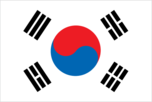
white with a red (top) and blue yin-yang symbol in the center; there is a different black trigram from the ancient I Ching (Book of Changes) in each corner of the white field; the South Korean national flag is called Taegukki; white is a traditional Korean color and represents peace and purity; the blue section represents the negative cosmic forces of the yin, while the red symbolizes the opposite positive forces of the yang; each trigram (kwae) denotes one of the four universal elements, which together express the principle of movement and harmony
Government Type
presidential republic
Independence
15 August 1945 (from Japan)
International Law Organization Participation
has not submitted an ICJ jurisdiction declaration; accepts ICCt jurisdiction
International Organization Participation
ADB, AfDB (nonregional member), APEC, Arctic Council (observer), ARF, ASEAN (dialogue partner), Australia Group, BIS, CD, CICA, CP, EAS, EBRD, FAO, FATF, G-20, IADB, IAEA, IBRD, ICAO, ICC (national committees), ICCt, ICRM, IDA, IEA, IFAD, IFC, IFRCS, IHO, ILO, IMF, IMO, IMSO, Interpol, IOC, IOM, IPU, ISO, ITSO, ITU, ITUC (NGOs), LAIA (observer), MIGA, MINURSO, MINUSTAH, NEA, NSG, OAS (observer), OECD, OPCW, OSCE (partner), Pacific Alliance (observer), Paris Club (associate), PCA, PIF (partner), SAARC (observer), SICA (observer), UN, UNAMID, UNCTAD, UNESCO, UNHCR, UNIDO, UNIFIL, UNMIL, UNMISS, UNMOGIP, UNOCI, UNWTO, UPU, WCO, WHO, WIPO, WMO, WTO, ZC
Judicial Branch
- highest courts
- Supreme Court of South Korea (consists of a chief justice and 13 justices); Constitutional Court (consists of a court head and 8 justices)
- judge selection and term of office
- Supreme Court chief justice appointed by the president with the consent of the National Assembly; other justices appointed by the president upon the recommendation of the chief justice and consent of the National Assembly; position of the chief justice is a 6-year nonrenewable term; other justices serve 6-year renewable terms; Constitutional Court justices appointed - 3 by the president, 3 by the National Assembly, and 3 by the Supreme Court chief justice; court head serves until retirement at age 70, while other justices serve 6-year renewable terms with mandatory retirement at age 65
- subordinate courts
- High Courts; District Courts; Branch Courts (organized under the District Courts); specialized courts for family and administrative issues
Legal System
mixed legal system combining European civil law, Anglo-American law, and Chinese classical thought
Legislative Branch
- description
- unicameral National Assembly or Kuk Hoe (300 seats statutory, 299 current); 253 members directly elected in single-seat constituencies by simple majority vote and 47 directly elected in a single national constituency by proportional representation vote; members serve 4-year terms)
- election results
- percent of vote by party - NFP 33.5%, PP 26.7%, MPK 25.5%, JP 7.2%, other 7.1%; seats by party - MPK 123, NFP 122, PP 38, JP 6, independent 11
- elections
- last held on 13 April 2016 (next to be held on 15 April 2020)
- note
- as of December 2018, seats by party - DP 129, LKP 112, BFP 29, PDP 14, JP 5, KPP 1, MP 1, independent 7
National Anthem
- lyrics/music
- YUN Ch'i-Ho or AN Ch'ang-Ho/AHN Eaktay
- name
- "Aegukga" (Patriotic Song)
- note
- adopted 1948, well-known by 1910; both North Korea's and South Korea's anthems share the same name and have a vaguely similar melody but have different lyrics
National Holiday
Liberation Day, 15 August (1945)
National Symbol S
taegeuk (yin yang symbol), Hibiscus syriacus (Rose of Sharon), Siberian tiger; national colors: red, white, blue, black
Political Parties And Leaders
Bareun Future Party or BFP [PARK Joo-sun] (merger of Bareun Party and People's Party)Democratic Party or DP [CHOO Mi-ae] (renamed from Minjoo Party of Korea or MPK in October 2016; formerly New Politics Alliance for Democracy or NPAD, which was a merger of the Democratic Party or DP (formerly DUP) [KIM Han-gil] and the New Political Vision Party or NPVP [AHN Cheol-soo] in March 2014)Justice Party or JP [LEE Jeong-mi]Liberty Korea Party or LKP (formerly the New Frontier Party (NFP) or Saenuri, previously the Grand National Party [HONG Jueen-Pyo])Minjung Party or MP (formed from the merger of the New People's Party (formerly the New People's Political Party or NPP) and the People's United Party or PUP)Korean Patriots' Party or KPP [CHO Won-jin]Parliamentary Group for Peace and Justice [ROH Hoe-chan] (parliamentary group made up of PDP and JP)Party for Democracy and Peace or PDP [CHO Bae-sook]People's Party or PP [AHN Cheol-soo]
Suffrage
19 years of age; universal
Economy
Agriculture Products
rice, root crops, barley, vegetables, fruit, cattle, pigs, chickens, milk, eggs, fish
Budget
- expenditures
- 335.8 billion (2017 est.)
- revenues
- 357.1 billion (2017 est.)
Budget Surplus Or Deficit
1.4% (of GDP) (2017 est.)
Central Bank Discount Rate
- 1.5% (31 December 2017 est.)
- 1.25% (31 December 2016 est.)
Commercial Bank Prime Lending Rate
- 3.48% (31 December 2017 est.)
- 3.37% (31 December 2016 est.)
Current Account Balance
- $78.46 billion (2017 est.)
- $99.24 billion (2016 est.)
Debt External
- $384.6 billion (31 December 2017 est.)
- $384.1 billion (31 December 2016 est.)
Distribution Of Family Income Gini Index
- 35.7 (2016 est.)
- 35.4 (2015 est.)
Economy Overview
After emerging from the 1950-53 war with North Korea, South Korea emerged as one of the 20th century’s most remarkable economic success stories, becoming a developed, globally connected, high-technology society within decades. In the 1960s, GDP per capita was comparable with levels in the poorest countries in the world. In 2004, South Korea's GDP surpassed one trillion dollars.Beginning in the 1960s under President PARK Chung-hee, the government promoted the import of raw materials and technology, encouraged saving and investment over consumption, kept wages low, and directed resources to export-oriented industries that remain important to the economy to this day. Growth surged under these policies, and frequently reached double-digits in the 1960s and 1970s. Growth gradually moderated in the 1990s as the economy matured, but remained strong enough to propel South Korea into the ranks of the advanced economies of the OECD by 1997. These policies also led to the emergence of family-owned chaebol conglomerates such as Daewoo, Hyundai, and Samsung, which retained their dominant positions even as the government loosened its grip on the economy amid the political changes of the 1980s and 1990s.The Asian financial crisis of 1997-98 hit South Korea’s companies hard because of their excessive reliance on short-term borrowing, and GDP ultimately plunged by 7% in 1998. South Korea tackled difficult economic reforms following the crisis, including restructuring some chaebols, increasing labor market flexibility, and opening up to more foreign investment and imports. These steps lead to a relatively rapid economic recovery. South Korea also began expanding its network of free trade agreements to help bolster exports, and has since implemented 16 free trade agreements covering 58 countries—including the United State and China—that collectively cover more than three-quarters of global GDP.In 2017, the election of President MOON Jae-in brought a surge in consumer confidence, in part, because of his successful efforts to increase wages and government spending. These factors combined with an uptick in export growth to drive real GDP growth to more than 3%, despite disruptions in South Korea’s trade with China over the deployment of a US missile defense system in South Korea.In 2018 and beyond, South Korea will contend with gradually slowing economic growth - in the 2-3% range - not uncommon for advanced economies. This could be partially offset by efforts to address challenges arising from its rapidly aging population, inflexible labor market, continued dominance of the chaebols, and heavy reliance on exports rather than domestic consumption. Socioeconomic problems also persist, and include rising inequality, poverty among the elderly, high youth unemployment, long working hours, low worker productivity, and corruption.
Exchange Rates
- South Korean won (KRW) per US dollar -
- 1,130.48 (2017 est.)
- 1,160.41 (2016 est.)
- 1,160.77 (2015 est.)
- 1,130.95 (2014 est.)
- 1,052.96 (2013 est.)
Exports
- $577.4 billion (2017 est.)
- $512 billion (2016 est.)
Exports Commodities
semiconductors, petrochemicals, automobile/auto parts, ships, wireless communication equipment, flat displays, steel, electronics, plastics, computers
Exports Partners
China 25.1%, US 12.2%, Vietnam 8.2%, Hong Kong 6.9%, Japan 4.7% (2017)
Fiscal Year
calendar year
Gdp Composition By End Use
- exports of goods and services
- 43.1% (2017 est.)
- government consumption
- 15.3% (2017 est.)
- household consumption
- 48.1% (2017 est.)
- imports of goods and services
- -37.7% (2017 est.)
- investment in fixed capital
- 31.1% (2017 est.)
- investment in inventories
- 0% (2017 est.)
Gdp Composition By Sector Of Origin
- agriculture
- 2.2% (2017 est.)
- industry
- 39.3% (2017 est.)
- services
- 58.3% (2017 est.)
Gdp Official Exchange Rate
$1.54 trillion (2017 est.) (2017 est.)
Gdp Per Capita Ppp
- $39,500 (2017 est.)
- $38,500 (2016 est.)
- $37,600 (2015 est.)
- note
- data are in 2017 dollars
Gdp Purchasing Power Parity
- $2.035 trillion (2017 est.)
- $1.974 trillion (2016 est.)
- $1.918 trillion (2015 est.)
- note
- data are in 2017 dollars
Gdp Real Growth Rate
- 3.1% (2017 est.)
- 2.9% (2016 est.)
- 2.8% (2015 est.)
Gross National Saving
- 36.6% of GDP (2017 est.)
- 36.3% of GDP (2016 est.)
- 36.6% of GDP (2015 est.)
Household Income Or Consumption By Percentage Share
- highest 10%
- 48.5% (2015 est.)
- lowest 10%
- 48.5% (2015 est.)
Imports
- $457.5 billion (2017 est.)
- $393.1 billion (2016 est.)
Imports Commodities
crude oil/petroleum products, semiconductors, natural gas, coal, steel, computers, wireless communication equipment, automobiles, fine chemicals, textiles
Imports Partners
China 20.5%, Japan 11.5%, US 10.5%, Germany 4.2%, Saudi Arabia 4.1% (2017)
Industrial Production Growth Rate
4.6% (2017 est.)
Industries
electronics, telecommunications, automobile production, chemicals, shipbuilding, steel
Inflation Rate Consumer Prices
- 1.9% (2017 est.)
- 1% (2016 est.)
Labor Force
27.75 million (2017 est.)
Labor Force By Occupation
- agriculture
- 4.8%
- industry
- 24.6%
- services
- 70.6% (2017 est.)
Market Value Of Publicly Traded Shares
- $1.305 trillion (31 December 2016 est.)
- $1.28 trillion (31 December 2015 est.)
- $1.269 trillion (31 December 2014 est.)
Population Below Poverty Line
14.4% (2016 est.)
Public Debt
- 39.5% of GDP (2017 est.)
- 39.9% of GDP (2016 est.)
Reserves Of Foreign Exchange And Gold
- $389.2 billion (31 December 2017 est.)
- $371.1 billion (31 December 2016 est.)
Stock Of Broad Money
- $793.9 billion (31 December 2017 est.)
- $658.7 billion (31 December 2016 est.)
Stock Of Direct Foreign Investment Abroad
- $344.7 billion (31 December 2017 est.)
- $358 billion (31 December 2016 est.)
Stock Of Direct Foreign Investment At Home
- $230.6 billion (31 December 2017 est.)
- $180.1 billion (31 December 2016 est.)
Stock Of Domestic Credit
- $2.986 trillion (31 December 2017 est.)
- $2.515 trillion (31 December 2016 est.)
Stock Of Narrow Money
- $793.9 billion (31 December 2017 est.)
- $658.7 billion (31 December 2016 est.)
Taxes And Other Revenues
23.2% (of GDP) (2017 est.)
Unemployment Rate
- 3.7% (2017 est.)
- 3.7% (2016 est.)
Energy
Carbon Dioxide Emissions From Consumption Of Energy
778.4 million Mt (2017 est.)
Crude Oil Exports
0 bbl/day (2017 est.)
Crude Oil Imports
3.057 million bbl/day (2017 est.)
Crude Oil Production
0 bbl/day (2017 est.)
Crude Oil Proved Reserves
NA (1 January 2017 est.)
Electricity Access
- electrification - total population
- 100% (2016)
Electricity Consumption
507.6 billion kWh (2016 est.)
Electricity Exports
0 kWh (2016 est.)
Electricity From Fossil Fuels
70% of total installed capacity (2016 est.)
Electricity From Hydroelectric Plants
2% of total installed capacity (2017 est.)
Electricity From Nuclear Fuels
21% of total installed capacity (2017 est.)
Electricity From Other Renewable Sources
8% of total installed capacity (2017 est.)
Electricity Imports
0 kWh (2016 est.)
Electricity Installed Generating Capacity
111.2 million kW (2016 est.)
Electricity Production
526 billion kWh (2016 est.)
Natural Gas Consumption
45.28 billion cu m (2017 est.)
Natural Gas Exports
0 cu m (2017 est.)
Natural Gas Imports
48.65 billion cu m (2017 est.)
Natural Gas Production
339.8 million cu m (2017 est.)
Natural Gas Proved Reserves
7.079 billion cu m (1 January 2018 est.)
Refined Petroleum Products Consumption
2.584 million bbl/day (2017 est.)
Refined Petroleum Products Exports
1.396 million bbl/day (2017 est.)
Refined Petroleum Products Imports
908,800 bbl/day (2017 est.)
Refined Petroleum Products Production
3.302 million bbl/day (2017 est.)
Communications
Broadband Fixed Subscriptions
- subscriptions per 100 inhabitants
- 41 (2017 est.)
- total
- 21,195,918 (2017 est.)
Broadcast Media
multiple national TV networks with 2 of the 3 largest networks publicly operated; the largest privately owned network, Seoul Broadcasting Service (SBS), has ties with other commercial TV networks; cable and satellite TV subscription services available; publicly operated radio broadcast networks and many privately owned radio broadcasting networks, each with multiple affiliates, and independent local stations (2017)
Internet Country Code
.kr
Internet Users
- percent of population
- 89.9% (July 2016 est.)
- total
- 44.153 million (July 2016 est.)
Telephone System
- domestic
- fixed-line 52 per 100 and mobile-cellular services 124 per 100 persons widely available; rapid assimilation of a full range of telecommunications technologies leading to a boom in e-commerce (2017)
- general assessment
- excellent domestic and international services featuring rapid incorporation of new technologies; ranked 1st out of 34 Asian telecoms; exceedingly high mobile and mobile broadband penetration and very high fixed broadband penetration; strong support from govt, savvy population has catapulted the nation into one of the world's most active telecommunication markets; 5G services to go live for enterprise customers in 2019; slower growth predicted over the next five years to 2023; Chinese telecommunications company Huawei has partnered with other MNOs in South Korea (2017)
- international
- country code - 82; numerous submarine cables provide links throughout Asia, Australia, the Middle East, Europe, and US; satellite earth stations - 66 (2016)
Telephones Fixed Lines
- subscriptions per 100 inhabitants
- 52 (2017 est.)
- total subscriptions
- 26,842,952 (2017 est.)
Telephones Mobile Cellular
- subscriptions per 100 inhabitants
- 124 (2017 est.)
- total subscriptions
- 63,658,688 (2017 est.)
Transportation
Airports
111 (2013)
Airports With Paved Runways
- 1,524 to 2,437 m
- 12 (2017)
- 2,438 to 3,047 m
- 19 (2017)
- 914 to 1,523 m
- 13 (2017)
- over 3,047 m
- 4 (2017)
- total
- 71 (2017)
- under 914 m
- 23 (2017)
Airports With Unpaved Runways
- 914 to 1,523 m
- 2 (2013)
- total
- 40 (2013)
- under 914 m
- 38 (2013)
Civil Aircraft Registration Country Code Prefix
HL (2016)
Heliports
466 (2013)
Merchant Marine
- by type
- bulk carrier 100, container ship 89, general cargo 394, oil tanker 201, other 1123 (2017)
- total
- 1,907 (2017)
National Air Transport System
- annual freight traffic on registered air carriers
- 11.297 billion mt-km (2015)
- annual passenger traffic on registered air carriers
- 65,482,307 (2015)
- inventory of registered aircraft operated by air carriers
- 348 (2015)
- number of registered air carriers
- 12 (2015)
Pipelines
3790 km gas, 16 km oil, 889 km refined products (2017)
Ports And Terminals
- container port(s) (TEUs)
- Busan (19,850,000), Kwangyang (2,249,558), Incheon (2,679,504) (2016)
- LNG terminal(s) (import)
- Incheon, Kwangyang, Pyeongtaek, Samcheok, Tongyeong, Yeosu
- major seaport(s)
- Busan, Incheon, Gunsan, Kwangyang, Mokpo, Pohang, Ulsan, Yeosu
Railways
- standard gauge
- 3,979 km 1.435-m gauge (2,727 km electrified) (2016)
- total
- 3,979 km (2016)
Roadways
- paved
- 92,795 km (includes 4,193 km of expressways) (2016)
- total
- 100,428 km (2016)
- unpaved
- 7,633 km (2016)
Waterways
1,600 km (most navigable only by small craft) (2011)
Military and Security
Military Branches
Republic of Korea Army, Navy (includes Marine Corps), Air Force (2011)
Military Expenditures
- 2.7% of GDP (2017)
- 2.3% of GDP (2016)
- 2.3% of GDP (2015)
- 2.64% of GDP (2014)
- 2.63% of GDP (2013)
Military Service Age And Obligation
18-35 years of age for compulsory military service, with middle school education required; minimum conscript service obligation - 21 months (Army, Marines), 23 months (Navy), 24 months (Air Force); 18-26 years of age for voluntary military service; women, in service since 1950, admitted to 7 service branches, including infantry, but excluded from artillery, armor, anti-air, and chaplaincy corps; HIV-positive individuals are exempt from military service (2017)
Transnational Issues
Disputes International
Military Demarcation Line within the 4-km-wide Demilitarized Zone has separated North from South Korea since 1953periodic incidents with North Korea in the Yellow Sea over the Northern Limit Line, which South Korea claims as a maritime boundarySouth Korea and Japan claim Liancourt Rocks (Tok-do/Take-shima), occupied by South Korea since 1954
Refugees And Internally Displaced Persons
- stateless persons
- 197 (2017)