2009 Edition
CIA World Factbook 2009 (Project Gutenberg)
Introduction
Background
An independent Korean state or collection of states has existed almost continuously for several millennia. Between its initial unification in the 7th century - from three predecessor Korean states - until the 20th century, Korea existed as a single independent country. In 1905, following the Russo-Japanese War, Korea became a protectorate of imperial Japan, and in 1910 it was annexed as a colony. Korea regained its independence following Japan's surrender to the United States in 1945. After World War II, a Republic of Korea (ROK) was set up in the southern half of the Korean Peninsula while a Communist-style government was installed in the north (the DPRK). During the Korean War (1950-53), US troops and UN forces fought alongside soldiers from the ROK to defend South Korea from DPRK attacks supported by China and the Soviet Union. An armistice was signed in 1953, splitting the peninsula along a demilitarized zone at about the 38th parallel. Thereafter, South Korea achieved rapid economic growth with per capita income rising to roughly 14 times the level of North Korea. In 1993, KIM Young-sam became South Korea's first civilian president following 32 years of military rule. South Korea today is a fully functioning modern democracy. In June 2000, a historic first North-South summit took place between the South's President KIM Dae-jung and the North's leader KIM Jong Il. In October 2007, a second North-South summit took place between the South's President ROH Moo-hyun and the North Korean leader. Harsh rhetoric and unwillingness by North Korea to engage with President LEE Myung-bak following his February 2008 inauguration has strained inter-Korean relations.
Geography
Area
total: 99,720 sq km country comparison to the world: 108 land: 96,920 sq km water: 2,800 sq km
Area - comparative
slightly larger than Indiana
Climate
temperate, with rainfall heavier in summer than winter
Coastline
2,413 km
Elevation extremes
lowest point: Sea of Japan 0 m highest point: Halla-san 1,950 m
Environment - current issues
air pollution in large cities; acid rain; water pollution from the discharge of sewage and industrial effluents; drift net fishing
Environment - international agreements
party to: Antarctic-Environmental Protocol, Antarctic-Marine Living Resources, Antarctic Treaty, Biodiversity, Climate Change, Climate Change-Kyoto Protocol, Desertification, Endangered Species, Environmental Modification, Hazardous Wastes, Law of the Sea, Marine Dumping, Ozone Layer Protection, Ship Pollution, Tropical Timber 83, Tropical Timber 94, Wetlands, Whaling signed, but not ratified: none of the selected agreements
Freshwater withdrawal (domestic/industrial/agricultural)
total: 18.59 cu km/yr (36%/16%/48%) per capita: 389 cu m/yr (2000)
Geographic coordinates
37 00 N, 127 30 E
Geography - note
strategic location on Korea Strait
Irrigated land
8,780 sq km (2003)
Land boundaries
total: 238 km border countries: North Korea 238 km
Land use
arable land: 16.58% permanent crops: 2.01% other: 81.41% (2005)
Location
Eastern Asia, southern half of the Korean Peninsula bordering the Sea of Japan and the Yellow Sea
Map references
Asia
Maritime claims
territorial sea: 12 nm; between 3 nm and 12 nm in the Korea Strait contiguous zone: 24 nm exclusive economic zone: 200 nm continental shelf: not specified
Natural hazards
occasional typhoons bring high winds and floods; low-level seismic activity common in southwest
Natural resources
coal, tungsten, graphite, molybdenum, lead, hydropower potential
Terrain
mostly hills and mountains; wide coastal plains in west and south
Total renewable water resources
69.7 cu km (1999)
People and Society
Age structure
0-14 years: 16.8% (male 4,278,581/female 3,887,516) 15-64 years: 72.3% (male 17,897,053/female 17,196,840) 65 years and over: 10.8% (male 2,104,589/female 3,144,393) (2009 est.)
Birth rate
8.93 births/1,000 population (2009 est.) country comparison to the world: 212
Death rate
5.94 deaths/1,000 population (July 2009 est.) country comparison to the world: 165
Education expenditures
4.6% of GDP (2004) country comparison to the world: 85
Ethnic groups
homogeneous (except for about 20,000 Chinese)
HIV/AIDS - adult prevalence rate
less than 0.1% (2007 est.) country comparison to the world: 151
HIV/AIDS - deaths
fewer than 500 (2007 est.) country comparison to the world: 94
HIV/AIDS - people living with HIV/AIDS
13,000 (2007 est.) country comparison to the world: 93
Infant mortality rate
total: 4.26 deaths/1,000 live births country comparison to the world: 204 male: 4.49 deaths/1,000 live births female: 4.02 deaths/1,000 live births (2009 est.)
Languages
Korean, English widely taught in junior high and high school
Life expectancy at birth
total population: 78.72 years country comparison to the world: 40 male: 75.45 years female: 82.22 years (2009 est.)
Literacy
definition: age 15 and over can read and write total population: 97.9% male: 99.2% female: 96.6% (2002)
Median age
total: 37.3 years male: 36 years female: 38.5 years (2009 est.)
Nationality
noun: Korean(s) adjective: Korean
Net migration rate
-0.33 migrant(s)/1,000 population (2009 est.) country comparison to the world: 102
Population
48,508,972 (July 2009 est.) country comparison to the world: 25
Population growth rate
0.266% (2009 est.) country comparison to the world: 178
Religions
Christian 26.3% (Protestant 19.7%, Roman Catholic 6.6%), Buddhist 23.2%, other or unknown 1.3%, none 49.3% (1995 census)
School life expectancy (primary to tertiary education)
total: 17 years male: 18 years female: 15 years (2007)
Sex ratio
at birth: 1.07 male(s)/female under 15 years: 1.1 male(s)/female 15-64 years: 1.04 male(s)/female 65 years and over: 0.67 male(s)/female total population: 1 male(s)/female (2009 est.)
Total fertility rate
1.21 children born/woman (2009 est.) country comparison to the world: 218
Urbanization
urban population: 81% of total population (2008) rate of urbanization: 0.6% annual rate of change (2005-10 est.)
Government
Administrative divisions
9 provinces (do, singular and plural) and 7 metropolitan cities (gwangyoksi, singular and plural) provinces: Cheju-do, Cholla-bukto (North Cholla), Cholla-namdo (South Cholla), Ch'ungch'ong-bukto (North Ch'ungch'ong), Ch'ungch'ong-namdo (South Ch'ungch'ong), Kangwon-do, Kyonggi-do, Kyongsang-bukto (North Kyongsang), Kyongsang-namdo (South Kyongsang) metropolitan cities: Inch'on-gwangyoksi, Kwangju-gwangyoksi, Pusan-gwangyoksi, Soul-t'ukpyolsi, Taegu-gwangyoksi, Taejon-gwangyoksi, Ulsan-gwangyoksi
Capital
name: Seoul geographic coordinates: 37 33 N, 126 59 E time difference: UTC+9 (14 hours ahead of Washington, DC during Standard Time)
Constitution
17 July 1948; note - amended or rewritten nine times; current constitution approved on 29 October 1987
Country name
conventional long form: Republic of Korea conventional short form: South Korea local long form: Taehan-min'guk local short form: Han'guk abbreviation: ROK
Diplomatic representation from the US
chief of mission: Ambassador Kathleen STEPHENS embassy: 32 Sejongno, Jongno-gu, Seoul 110-710 mailing address: US Embassy Seoul, APO AP 96205-5550 telephone: [82] (2) 397-4114
Diplomatic representation in the US
chief of mission: Ambassador HAN Duck-soo chancery: 2450 Massachusetts Avenue NW, Washington, DC 20008 telephone: [1] (202) 939-5600
Executive branch
chief of state: President LEE Myung-bak (since 25 February 2008) head of government: Prime Minister CHUNG Un-chan (since 30 September 2009) cabinet: State Council appointed by the president on the prime minister's recommendation elections: president elected by popular vote for a single five-year term; election last held 19 December 2007 (next to be held in December 2012); prime minister appointed by president with consent of National Assembly election results: LEE Myung-bak elected president on 19 December 2007; percent of vote - LEE Myung-bak (GNP) 48.7%; CHUNG Dong-young (UNDP) 26.1%); LEE Hoi-chang (independent) 15.1; others 10.1%
FAX
- [1] (202) 387-0205 consulate(s) general: Agana (Guam), Atlanta, Boston, Chicago, Honolulu, Houston, Los Angeles, New York, San Francisco, Seattle
- [82] (2) 738-8845
Flag description
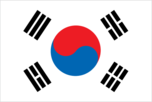
white with a red (top) and blue yin-yang symbol in the center; there is a different black trigram from the ancient I Ching (Book of Changes) in each corner of the white field
Government type
republic
Independence
15 August 1945 (from Japan)
International organization participation
ADB, AfDB (nonregional member), APEC, APT, ARF, ASEAN (dialogue partner), Australia Group, BIS, CP, EAS, EBRD, FAO, G-20, IADB, IAEA, IBRD, ICAO, ICC, ICCt, ICRM, IDA, IEA, IFAD, IFC, IFRCS, IHO, ILO, IMF, IMO, IMSO, Interpol, IOC, IOM, IPU, ISO, ITSO, ITU, ITUC, LAIA, MIGA, NEA, NSG, OAS (observer), OECD, OPCW, OSCE (partner), PCA, PIF (partner), SAARC (observer), UN, UNCTAD, UNESCO, UNHCR, UNIDO, UNIFIL, UNMIL, UNMIS, UNMOGIP, UNOMIG, UNWTO, UPU, WCL, WCO, WFTU, WHO, WIPO, WMO, WTO, ZC
Judicial branch
Supreme Court (justices appointed by the president with consent of National Assembly); Constitutional Court (justices appointed by the president based partly on nominations by National Assembly and Chief Justice of the court)
Legal system
combines elements of continental European civil law systems, Anglo-American law, and Chinese classical thought; has not accepted compulsory ICJ jurisdiction
Legislative branch
unicameral National Assembly or Kukhoe (299 seats; 243 members elected in single-seat constituencies, 56 elected by proportional representation; to serve four-year terms) elections: last held 9 April 2008 (next to be held in April 2012) election results: percent of vote by party - NA; seats by party - GNP 172, UDP 83, LFP 20, Pro-Park Alliance 8, DLP 5, CKP 1, independents 9
National holiday
Liberation Day, 15 August (1945)
Political parties and leaders
Democratic Party or DP [CHUNG Sye-kyun] (formerly the United Democratic Party or UDP); Democratic Labor Party or DLP [KANG Ki-kabi]; Grand National Party or GNP [CHUNG Mong-joon]; Liberty Forward Party or LFP [LEE Hoi-chang]; Pro-Park Alliance or PPA [SUH Choung-won]; Renewal Korea Party or RKP [MOON Kook-hyun]
Political pressure groups and leaders
Federation of Korean Industries; Federation of Korean Trade Unions; Korean Confederation of Trade Unions; Korean National Council of Churches; Korean Traders Association; Korean Veterans' Association; National Council of Labor Unions; National Democratic Alliance of Korea; National Federation of Farmers' Associations; National Federation of Student Associations
Suffrage
19 years of age; universal
Economy
Agriculture - products
rice, root crops, barley, vegetables, fruit; cattle, pigs, chickens, milk, eggs; fish
Budget
revenues: $227.5 billion expenditures: $216.7 billion (2008 est.)
Central bank discount rate
1.75% (31 December 2008) country comparison to the world: 131 3.25% (31 December 2007)
Commercial bank prime lending rate
7.17% (31 December 2008)
Current account balance
-$6.349 billion (2008 est.) country comparison to the world: 161 $5.954 billion (2007 est.)
Distribution of family income - Gini index
31.3 (2007) country comparison to the world: 105 35.8 (2000)
Economy - overview
Since the 1960s, South Korea has achieved an incredible record of growth and integration into the high-tech modern world economy. Four decades ago, GDP per capita was comparable with levels in the poorer countries of Africa and Asia. In 2004, South Korea joined the trillion dollar club of world economies. In 2008, its GDP per capita was roughly the same as that of the Czech Republic and New Zealand. Initially, this success was achieved by a system of close government/business ties including directed credit, import restrictions, sponsorship of specific industries, and a strong labor effort. The government promoted the import of raw materials and technology at the expense of consumer goods and encouraged savings and investment over consumption. The Asian financial crisis of 1997-98 exposed longstanding weaknesses in South Korea's development model including high debt/equity ratios, massive foreign borrowing, and an undisciplined financial sector. GDP plunged by 6.9% in 1998, then recovered by 9% in 1999-2000. Korea adopted numerous economic reforms following the crisis, including greater openness to foreign investment and imports. Growth fell back to 3.3% in 2001 because of the slowing global economy, falling exports, and the perception that much-needed corporate and financial reforms had stalled. Led by consumer spending and exports, growth in 2002 was an impressive 7% despite anemic global growth. Between 2003 and 2007, growth moderated to about 4-5% annually. A downturn in consumer spending was offset by rapid export growth. In 2008, inflation increased in the face of rising oil and food prices before easing in the fourth quarter. Korea was hit hard by the global financial turmoil that began in September 2008. Stock prices fell by more than 40% for the year and the value of the won fell by approximately 26%. Korean GDP shrank in the fourth quarter and GDP growth for the year was just 2.2%. The Korean government adopted several measures to combat the credit crunch and stimulate the economy.
Electricity - consumption
385.1 billion kWh (2008 est.) country comparison to the world: 11
Electricity - exports
0 kWh (2008 est.)
Electricity - imports
0 kWh (2008 est.)
Electricity - production
440 billion kWh (2008 est.) country comparison to the world: 10
Exports
$433.5 billion (2008 est.) country comparison to the world: 12 $379 billion (2007 est.)
Exports - commodities
semiconductors, wireless telecommunications eq
GDP - composition by sector
agriculture: 3% industry: 39.5% services: 57.6% (2008 est.)
GDP - per capita (PPP)
$27,700 (2008 est.) country comparison to the world: 50 $27,100 (2007 est.) $25,900 (2006 est.) note: data are in 2008 US dollars
GDP - real growth rate
2.2% (2008 est.) country comparison to the world: 155 5.1% (2007 est.) 5.2% (2006 est.)
GDP (official exchange rate)
$929.1 billion (2008 est.)
GDP (purchasing power parity)
$1.338 trillion (2008 est.) country comparison to the world: 14 $1.309 trillion (2007 est.) $1.245 trillion (2006 est.) note: data are in 2008 US dollars
Household income or consumption by percentage share
lowest 10%: 2.7% highest 10%: 24.2% (2007)
Industrial production growth rate
2.2% (2008 est.) country comparison to the world: 101
Industries
electronics, telecommunications, automobile production, chemicals, shipbuilding, steel
Inflation rate (consumer prices)
4.7% (2008 est.) country comparison to the world: 82 2.5% (2007 est.)
Investment (gross fixed)
27.1% of GDP (2008 est.) country comparison to the world: 38
Labor force
24.35 million (2008 est.) country comparison to the world: 24
Labor force - by occupation
agriculture: 7.2% industry: 25.1% services: 67.7% (2007)
Market value of publicly traded shares
$494.6 billion (31 December 2008) country comparison to the world: 16 $1.124 trillion (31 December 2007) $835.2 billion (31 December 2006)
Natural gas - consumption
34.76 billion cu m (2008 est.) country comparison to the world: 25
Natural gas - exports
0 cu m (2008) country comparison to the world: 80
Natural gas - imports
36.21 billion cu m (2008 est.) country comparison to the world: 11
Natural gas - production
443 million cu m (2008 est.) country comparison to the world: 68
Natural gas - proved reserves
50 billion cu m (1 January 2008 est.) country comparison to the world: 64
Oil - consumption
2.175 million bbl/day (2008 est.) country comparison to the world: 11
Oil - exports
800,000 bbl/day country comparison to the world: 22 note: exports consist of oil derivatives (gasoline, light oil, and diesel), not crude oil (2008 est.)
Oil - imports
2.982 million bbl/day (2008 est.) country comparison to the world: 5
Oil - production
30,440 bbl/day (2008 est.) country comparison to the world: 69
Oil - proved reserves
0 bbl country comparison to the world: 190
Population below poverty line
15% (2003 est.)
Public debt
24.4% of GDP (2008 est.) country comparison to the world: 84 21.3% of GDP (2004 est.)
Stock of domestic credit
$937 billion (31 December 2008) country comparison to the world: 12 $1.061 trillion (31 December 2007)
Stock of money
$80.66 billion (31 December 2008) country comparison to the world: 15 $92.59 billion (31 December 2007)
Stock of quasi money
$478 billion (31 December 2008) country comparison to the world: 8 $541.7 billion (31 December 2007)
Unemployment rate
3.2% (2008 est.) country comparison to the world: 37 3.3% (2007 est.)