1999 Edition
CIA World Factbook 1999 (Internet Archive)
Introduction
Background
At the end of World War II, the US and the Soviet Union agreed that US troops would accept the surrender of Japanese forces south of the 38th parallel and the Soviet Union would do so in the north. In 1948, the UN proposed nationwide elections; after P'yongyang's refusal to allow UN inspectors in the north, elections were held in the south and the Republic of Korea was established. The Democratic People's Republic of Korea was established the following month in the north. Communist North Korean forces invaded South Korea in 1950. US and other UN forces intervened to defend the South and Chinese forces intervened on behalf of the North. After a bitter three-year war, an armistice was signed in 1953, establishing a military demarcation line near the 38th parallel. Thereafter, South Korea achieved amazing economic growth, with per capita output rising to 13 times the level in the North. Since late 1997, however, the nation has suffered widespread financial and organizational difficulties. Continuing tensions between North and South have raised concerns of provocative military actions by the North.
Geography
Area
total: 98,480 sq km land: 98,190 sq km water: 290 sq km
Area--comparative
slightly larger than Indiana
Climate
temperate, with rainfall heavier in summer than winter
Coastline
2,413 km
Elevation extremes
lowest point: Sea of Japan 0 m highest point: Halla-san 1,950 m
Environment--current issues
air pollution in large cities; water pollution from the discharge of sewage and industrial effluents; driftnet fishing
Environment--international agreements
party to: Antarctic-Environmental Protocol, Antarctic Treaty, Biodiversity, Climate Change, Endangered Species, Environmental Modification, Hazardous Wastes, Law of the Sea, Nuclear Test Ban, Ozone Layer Protection, Ship Pollution, Tropical Timber 83, Tropical Timber 94, Wetlands, Whaling signed, but not ratified: Climate Change-Kyoto Protocol, Desertification
Geographic coordinates
37 00 N, 127 30 E
Irrigated land
13,350 sq km (1993 est.)
Land boundaries
total: 238 km border countries: North Korea 238 km
Land use
arable land: 19% permanent crops: 2% permanent pastures: 1% forests and woodland: 65% other: 13% (1993 est.)
Location
Eastern Asia, southern half of the Korean Peninsula bordering the Sea of Japan and the Yellow Sea
Map references
Asia
Maritime claims
contiguous zone: 24 nm continental shelf: not specified exclusive economic zone: 200 nm territorial sea: 12 nm; between 3 nm and 12 nm in the Korea Strait
Natural hazards
occasional typhoons bring high winds and floods; low-level seismic activity common in southwest
Natural resources
coal, tungsten, graphite, molybdenum, lead, hydropower
Terrain
mostly hills and mountains; wide coastal plains in west and south
People and Society
Age structure
0-14 years: 22% (male 5,504,333; female 4,874,974) 15-64 years: 71% (male 16,949,807; female 16,432,951) 65 years and over: 7% (male 1,192,688; female 1,930,047) (1999 est.)
Birth rate
15.95 births/1,000 population (1999 est.)
Death rate
5.68 deaths/1,000 population (1999 est.)
Ethnic groups
homogeneous (except for about 20,000 Chinese)
Infant mortality rate
7.57 deaths/1,000 live births (1999 est.)
Languages
Korean, English widely taught in junior high and high school
Life expectancy at birth
total population: 74.3 years male: 70.75 years female: 78.32 years (1999 est.)
Literacy
definition: age 15 and over can read and write total population: 98% male: 99.3% female: 96.7% (1995 est.)
Nationality
noun: Korean(s) adjective: Korean
Net migration rate
-0.3 migrant(s)/1,000 population (1999 est.)
Population
46,884,800 (July 1999 est.)
Population growth rate
1% (1999 est.)
Religions
Christianity 49%, Buddhism 47%, Confucianism 3%, pervasive folk religion (shamanism), Chondogyo (Religion of the Heavenly Way), and other 1%
Sex ratio
at birth: 1.13 male(s)/female under 15 years: 1.13 male(s)/female 15-64 years: 1.03 male(s)/female 65 years and over: 0.62 male(s)/female total population: 1.02 male(s)/female (1999 est.)
Total fertility rate
1.79 children born/woman (1999 est.)
Government
Administrative divisions
9 provinces (do, singular and plural) and 6 special cities* (gwangyoksi, singular and plural); Cheju-do, Cholla-bukto, Cholla-namdo, Ch'ungch'ong-bukto, Ch'ungch'ong-namdo, Inch'on-gwangyoksi*, Kangwon-do, Kwangju-gwangyoksi*, Kyonggi-do, Kyongsang-bukto, Kyongsang-namdo, Pusan-gwangyoksi*, Soul-t'ukpyolsi*, Taegu-gwangyoksi*, Taejon-gwangyoksi*
Capital
Seoul
Constitution
25 February 1988
Country name
conventional long form: Republic of Korea conventional short form: South Korea local long form: Taehan-min'guk local short form: none note: the South Koreans generally use the term "Han-guk" to refer to their country abbreviation: ROK
Data code
KS
Executive branch
chief of state: President KIM Dae-jung (since 25 February 1998) head of government: Prime Minister KIM Chong-p'il (since 3 March 1998) cabinet: State Council appointed by the president on the prime minister's recommendation elections: president elected by popular vote for a single five-year term; election last held 18 December 1997 (next to be held by 18 December 2002); prime minister appointed by the president; deputy prime ministers appointed by the president on the prime minister's recommendation election results: KIM Dae-jung elected president; percent of vote--KIM Dae-jung (NCNP) 40.3%, YI Hoe-chang (GNP) 38.7%, YI In-che (NPP) 19.2%
Flag description
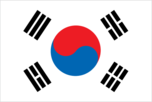
white with a red (top) and blue yin-yang symbol in the center; there is a different black trigram from the ancient I Ching (Book of Changes) in each corner of the white field
Government type
republic
Independence
15 August 1945, date of liberation from Japanese colonial rule
International organization participation
AfDB, APEC, AsDB, BIS, CCC, CP, EBRD, ESCAP, FAO, G-77, IAEA, IBRD, ICAO, ICC, ICFTU, ICRM, IDA, IEA (observer), IFAD, IFC, IFRCS, IHO, ILO, IMF, IMO, Inmarsat, Intelsat, Interpol, IOC, IOM, ISO, ITU, MINURSO, NEA, NSG, OAS (observer), OECD, OPCW, OSCE (partner), UN, UNCTAD, UNESCO, UNIDO, UNMOGIP, UNOMIG, UNU, UPU, WHO, WIPO, WMO, WToO, WTrO Diplomatic representation in the US: chief of mission: Ambassador YI Hong-ku chancery: 2450 Massachusetts Avenue NW, Washington, DC 20008 consulate(s) general: Agana (Guam), Anchorage, Atlanta, Boston, Chicago, Honolulu, Houston, Los Angeles, Miami, New York, San Francisco, and Seattle Diplomatic representation from the US: chief of mission: Ambassador Stephen W. BOSWORTH embassy: 82 Sejong-Ro, Chongro-ku, Seoul mailing address: American Embassy, Unit 15550, APO AP 96205-0001
Judicial branch
Supreme Court, justices are appointed by the president subject to the consent of the National Assembly Political parties and leaders: Grand National Party or GNP [CHO president] note: subsequent to the legislative election of April 1996 the following parties disbanded--New Korea Party or NKP and Democratic Party or DP; New People's Party or NPP merged with the NCNP in August 1998 Political pressure groups and leaders: Korean National Council of Churches; National Democratic Alliance of Korea; National Federation of Student Associations; National Federation of Farmers' Associations; National Council of Labor Unions; Federation of Korean Trade Unions; Korean Veterans' Association; Federation of Korean Industries; Korean Traders Association; Korean Confederation of Trade Unions
Legal system
combines elements of continental European civil law systems, Anglo-American law, and Chinese classical thought
Legislative branch
unicameral National Assembly or Kukhoe (299 seats; members elected by popular vote to serve four-year terms) elections: last held 11 April 1996 (next to be held NA 2000) election results: percent of vote by party--NA; seats by party--NKP 139, NCNP 79, ULD 50, DP 15, independents 16; note--the distribution of seats as of February 1999 was GNP 137, NCNP 105, ULD 53, independents 4
National holiday
Liberation Day, 15 August (1945)
Suffrage
20 years of age; universal
Economy
Agriculture--products
rice, root crops, barley, vegetables, fruit; cattle, pigs, chickens, milk, eggs; fish
Budget
revenues: $100.4 billion expenditures: $100.5 billion, including capital expenditures of $NA (1997 est.)
Currency
1 South Korean won (W) = 100 chun (theoretical)
Debt--external
$154 billion (1998 est.)
Economic aid--recipient
$NA
Economy--overview
As one of the Four Dragons of East Asia, South Korea has achieved an incredible record of growth. Three decades ago its GDP per capita was comparable with levels in the poorer countries of Africa and Asia. Today its GDP per capita is seven times India's, 13 times North Korea's, and already near the lesser economies of the European Union. This success through the late 1980s was achieved by a system of close government business ties, including directed credit, import restrictions, sponsorship of specific industries, and a strong labor effort. The government promoted the import of raw materials and technology at the expense of consumer goods and encouraged savings and investment over consumption. The Asian financial crisis of 1997-98 exposed certain longstanding weaknesses in South Korea's development model, including high debt/equity ratios, massive foreign borrowing, and an undisciplined financial sector. By the end of 1998 it had recovered financial stability, rebuilding foreign exchange reserves to record levels by running a current account surplus of $40 billion. As of December 1998, the first tentative signs of a rebound in the economy emerged, and most forecasters expect GDP growth to turn positive at least in the second half of 1999. Seoul has also made a positive start on a program to get the country's largest business groups to swap subsidiaries to promote specialization, and the administration has directed many of the mid-sized conglomerates into debt-workout programs with creditor banks. Challenges for the future include cutting redundant staff, which reaches 20%-30% at most firms and maintaining the impetus for structural reform.
Electricity--consumption
194.163 billion kWh (1996)
Electricity--exports
0 kWh (1996)
Electricity--imports
0 kWh (1996)
Electricity--production
194.163 billion kWh (1996)
Electricity--production by source
fossil fuel: 61.18% hydro: 2.65% nuclear: 36.17% other: 0% (1996)
Exchange rates
South Korean won (W) per US$1--1,174.00 (January 1999), 1,401.44 (1998), 951.29 (1997), 804.45 (1996), 771.27 (1995), 803.45 (1994)
Exports
$133 billion (f.o.b., 1998)
Exports--commodities
electronic and electrical equipment, machinery, steel, automobiles, ships; textiles, clothing, footwear; fish
Exports--partners
US 17%, EU 13%, Japan 12% (1995)
Fiscal year
calendar year
GDP
purchasing power parity--$584.7 billion (1998 est.)
GDP--composition by sector
agriculture: 6% industry: 43% services: 51% (1997 est.)
GDP--per capita
purchasing power parity?$12,600 (1998 est.)
GDP--real growth rate
-6.8% (1998 est.)
Household income or consumption by percentage share
lowest 10%: NA% highest 10%: NA%
Imports
$94 billion (c.i.f., 1998)
Imports--commodities
machinery, electronics and electronic equipment, oil, steel, transport equipment, textiles, organic chemicals, grains
Imports--partners
US 22%, Japan 21%, EU 13% (1995)
Industrial production growth rate
3.1% (1997 est.)
Industries
electronics, automobile production, chemicals, shipbuilding, steel, textiles, clothing, footwear, food processing
Inflation rate (consumer prices)
7.5% (1998)
Labor force
20 million
Labor force--by occupation
services and other 52%, mining and manufacturing 27%, agriculture, fishing, forestry 21% (1991)
Population below poverty line
NA%
Unemployment rate
7.9% (1998)
Communications
Radio broadcast stations
AM 79, FM 46, shortwave 0
Radios
42 million (1993 est.)
Telephone system
excellent domestic and international services domestic: NA international: fiber-optic submarine cable to China; satellite earth stations--3 Intelsat (2 Pacific Ocean and 1 Indian Ocean) and 1 Inmarsat (Pacific Ocean region)
Telephones
16.6 million (1993)
Television broadcast stations
121 (in addition, there are 850 relay stations and eight-channel American Forces Korea Network) (1997)
Televisions
9.3 million (1992 est.)
Transportation
Airports
103 (1998 est.) Airports--with paved runways: total: 68 over 3,047 m: 1 2,438 to 3,047 m: 18 1,524 to 2,437 m: 15 914 to 1,523 m: 13 under 914 m: 21 (1998 est.) Airports--with unpaved runways: total: 35 914 to 1,523 m: 3 under 914 m: 32 (1998 est.)
Heliports
200 (1998 est.)
Highways
total: 63,500 km paved: 46,800 km (including 1,720 km of expressways) unpaved: 16,700 km (1998 est.)
Merchant marine
total: 442 ships (1,000 GRT or over) totaling 5,212,089 GRT/8,161,845 DWT ships by type: bulk 106, cargo 133, chemical tanker 36, combination bulk 5, container 52, liquefied gas tanker 13, multifunction large-load carrier 1, oil tanker 56, passenger 3, refrigerated cargo 22, roll-on/roll-off cargo 2, short-sea passenger 1, specialized tanker 3, vehicle carrier 9 (1998 est.)
Pipelines
petroleum products 455 km; note--additionally, there is a parallel petroleum, oils, and lubricants (POL) pipeline being completed Ports and harbors: Chinhae, Inch'on, Kunsan, Masan, Mokp'o, P'ohang, Pusan, Tonghae-hang, Ulsan, Yosu
Railways
total: 6,240 km standard gauge: 6,240 km 1.435-m gauge (525 km electrified) (1998 est.)
Waterways
1,609 km; use restricted to small native craft
Military and Security
Military branches
Army, Navy, Air Force, Marine Corps, National Maritime Police (Coast Guard)
Military expenditures--dollar figure
$9.9 billion (FY98/99)
Military expenditures--percent of GDP
3.2% (FY98/99)
Military manpower--availability
males age 15-49: 13,954,916 (1999 est.) Military manpower--fit for military service: males age 15-49: 8,890,144 (1999 est.)
Military manpower--military age
18 years of age
Military manpower--reaching military age annually
males: 400,468 (1999 est.)
Transnational Issues
Disputes--international
Demarcation Line with North Korea; Liancourt Rocks (Takeshima/Tokdo) claimed by Japan