1992 Edition
CIA World Factbook 1992 (Project Gutenberg)
Geography
Climate
temperate, with rainfall heavier in summer than winter
Coastline
2,413 km
Comparative area
slightly larger than Indiana
Continental shelf
not specific
Disputes
Demarcation Line with North Korea; Liancourt Rocks claimed by Japan
Environment
occasional typhoons bring high winds and floods; earthquakes in southwest; air pollution in large cities
Land area
98,190 km2
Land boundaries
238 km; North Korea 238 km
Land use
arable land 21%; permanent crops 1%; meadows and pastures 1%; forest and woodland 67%; other 10%; includes irrigated 12%
Natural resources
coal, tungsten, graphite, molybdenum, lead, hydropower
Terrain
mostly hills and mountains; wide coastal plains in west and south
Territorial sea
12 nm (3 nm in the Korea Strait)
Total area
98,480 km2
People and Society
Birth rate
16 births/1,000 population (1992)
Death rate
6 deaths/1,000 population (1992)
Ethnic divisions
homogeneous; small Chinese minority (about 20,000)
Infant mortality rate
23 deaths/1,000 live births (1992)
Labor force
16,900,000; 52% services and other; 27% mining and manufacturing; 21% agriculture, fishing, forestry (1987)
Languages
Korean; English widely taught in high school
Life expectancy at birth
67 years male, 73 years female (1992)
Literacy
96% (male 99%, female 94%) age 15 and over can read and write (1990 est.)
Nationality
noun - Korean(s);adjective - Korean
Net migration rate
1 migrant/1,000 population (1992)
Organized labor
23.4% (1989) of labor force in government-sanctioned unions
Population
44,149,199 (July 1992), growth rate 1.1% (1992)
Religions
strong Confucian tradition; vigorous Christian minority (24.3% of the total population); Buddhism; pervasive folk religion (Shamanism); Chondogyo (religion of the heavenly way), eclectic religion with nationalist overtones founded in 19th century, about 0.1% of population
Total fertility rate
1.6 children born/woman (1992)
Government
Administrative divisions
9 provinces (do, singular and plural) and 6 special cities* (jikhalsi, singular and plural); Cheju-do, Cholla-bukto, Cholla-namdo, Ch'ungch'ong-bukto, Ch'ungch'ong-namdo, Inch'on-jikhalsi*, Kangwon-do, Kwangju-jikhalsi*, Kyonggi-do, Kyongsang-bukto, Kyongsang-namdo, Pusan-jikhalsi*, Soul-t'ukpyolsi*, Taegu-jikhalsi*, Taejon-jikhalsi*
Capital
Seoul
Chief of State
President ROH Tae Woo (since 25 February 1988)
Constitution
25 February 1988
Diplomatic representation
Ambassador HYUN Hong Joo; Chancery at 2370 Massachusetts Avenue NW, Washington, DC 20008; telephone (202) 939-5600; there are Korean Consulates General in Agana (Guam), Anchorage, Atlanta, Chicago, Honolulu, Houston, Los Angeles, New York, San Francisco, and Seattle US: Ambassador Donald P. GREGG; Embassy at 82 Sejong-Ro, Chongro-ku, Seoul, AMEMB, Unit 15550 (mailing address is APO AP 96205-0001); telephone [82] (2) 732-2601 through 2618; FAX [82] (2) 738-8845; there is a US Consulate in Pusan
Executive branch
president, prime minister, two deputy prime ministers, State Council (cabinet)
Flag
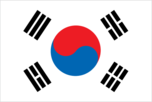
white with a red (top) and blue yin-yang symbol in the center; there is a different black trigram from the ancient I Ching (Book of Changes) in each corner of the white field
Head of Government
Prime Minister CHUNG Won Shik (since 24 May 1991); Deputy Prime Minister CHOI Gak Kyu (since 19 February 1991)
Independence
15 August 1948
Judicial branch
Supreme Court
Legal system
combines elements of continental European civil law systems, Anglo-American law, and Chinese classical thought
Legislative branch
unicameral National Assembly (Kuk Hoe)
Long-form name
Republic of Korea; abbreviated ROK
Member of
AfDB, APEC, AsDB, CCC, COCOM, CP, EBRD, ESCAP, FAO, G-77, GATT, IAEA, IBRD, ICAO, ICC, ICFTU, IDA, IFAD, IFC, IMF, ILO, IMF, INMARSAT, INTELSAT, INTERPOL, IOC, IOM, ISO, ITU, LORCS, OAS, UN, UNCTAD, UNESCO, UNIDO, UPU, WHO, WIPO, WMO, WTO
National Assembly
last held on 26 April 1988 (next to be held around March 1992); results - DJP 34%, RDP 24%, PPD 19%, NDRP 15%, other 8%; seats - (296 total) DJP 125, PPD 70, RDP 59, NDRP 35, other 10; note - on 9 February 1990 the DJP, RDP, and NDRP merged to form the DLP; also the PPD, later renamed the NDP, merged with another party to form the DP in September 1991. The distribution of seats as of December 1991 was DLP 214, DP 72, independent 9, vacant 1
National holiday
Independence Day, 15 August (1948)
Other political or pressure groups
Korean National Council of Churches; National Democratic Alliance of Korea; National Council of College Student Representatives; National Federation of Farmers' Associations; National Council of Labor Unions; Federation of Korean Trade Unions; Korean Veterans' Association; Federation of Korean Industries; Korean Traders Association
Political parties and leaders
ruling party: Democratic Liberal Party (DLP), ROH Tae Woo, president, KIM Young Sam, chairman; KIM Chong Pil and PAK Tae Chun, co-chairmen; note - the DLP resulted from a merger of the Democratic Justice Party (DJP), Reunification Democratic Party (RDP), and New Democratic Republican Party (NDRP) on 9 February 1990 opposition: Democratic Party (DP), result of a merger of the New Democratic Party and the Democratic Party formalized 16 September 1991; KIM Dae Jung, executive chairman; LEE Ki Taek, executive chairman; several smaller parties
President
last held on 16 December 1987 (next to be held December 1992); results - ROH Tae Woo (DJP) 35.9%, KIM Young Sam (RDP) 27.5%, KIM Dae Jung (PPD) 26.5%, other 10.1%
Suffrage
universal at age 20
Type
republic
Economy
Agriculture
accounts for 8% of GNP and employs 21% of work force (including fishing and forestry); principal crops - rice, root crops, barley, vegetables, fruit; livestock and livestock products - cattle, hogs, chickens, milk, eggs; self-sufficient in food, except for wheat; fish catch of 2.9 million metric tons, seventh-largest in world
Budget
revenues $44 billion; expenditures $44 billion, including capital expenditures of $NA (1992)
Currency
South Korean won (plural - won); 1 South Korean won (W) = 100 chon (theoretical)
Economic aid
US commitments, including Ex-Im (FY70-89), $3.9 billion; non-US countries (1970-89), $3.0 billion
Electricity
24,000,000 kW capacity; 106,000 million kWh produced, 2,460 kWh per capita (1991)
Exchange rates
South Korean won (W) per US$1 - 766.66 (January 1992), 733.35 (1991), 707.76 (1990), 671.46 (1989), 731.47 (1988), 822.57 (1987)
Exports
$71.9 billion (f.o.b., 1991) commodities: textiles, clothing, electronic and electrical equipment, footwear, machinery, steel, automobiles, ships, fish partners: US 26%, Japan 18% (1991)
External debt
$38.2 billion (1991)
Fiscal year
calendar year
GNP
purchasing power equivalent - $273 billion, per capita $6,300; real growth rate 8.7% (1991 est.)
Imports
$81.6 billion (c.i.f., 1991) commodities: machinery, electronics and electronic equipment, oil, steel, transport equipment, textiles, organic chemicals, grains partners: Japan 26%, US 23% (1991)
Industrial production
growth rate 7.5% (1991 est.); accounts for about 45% of GNP
Industries
textiles, clothing, footwear, food processing, chemicals, steel, electronics, automobile production, shipbuilding
Inflation rate (consumer prices)
9.7% (1991)
Overview
The driving force behind the economy's dynamic growth has been the planned development of an export-oriented economy in a vigorously entrepreneurial society. Real GNP has increased more than 10% annually over the past six years. This growth has led to an overheated situation characterized by a tight labor market, strong inflationary pressures, and a rapidly rising current account deficit. Policymakers have stated they will focus attention on slowing inflation. In any event, the economy will remain the envy of the great majority of the world's peoples.
Unemployment rate
2.4% (1991)
Communications
Airports
105 total, 97 usable; 60 with permanent-surface runways; none with runways over 3,659 m; 23 with runways 2,440-3,659 m; 16 with runways 1,220-2,439 m
Civil air
93 major transport aircraft
Highways
62,936 km total (1982); 13,476 km national highway, 49,460 km provincial and local roads
Inland waterways
1,609 km; use restricted to small native craft
Merchant marine
435 ships (1,000 GRT or over) totaling 6,924,818 GRT/11,389,397 DWT; includes 2 short-sea passenger, 140 cargo, 53 container, 11 refrigerated cargo, 9 vehicle carrier, 42 petroleum tanker, 10 chemical tanker, 14 liquefied gas, 5 combination ore/oil, 145 bulk, 3 combination bulk, 1 multifunction large-load carrier
Pipelines
petroleum products 455 km
Ports
Pusan, Inchon, Kunsan, Mokpo, Ulsan
Railroads
3,106 km operating in 1983; 3,059 km 1.435-meter standard gauge, 47 km 0.610-meter narrow gauge, 712 km double track, 418 km electrified; government owned
Telecommunications
adequate domestic and international services; 4,800,000 telephones; broadcast stations - 79 AM, 46 FM, 256 TV (57 of 1 kW or greater); satellite earth stations - 2 Pacific Ocean INTELSAT and 1 Indian Ocean INTELSAT
Military and Security
Branches
Army, Navy, Marines Corps, Air Force
Defense expenditures
exchange rate conversion - $12.6 billion, 4.5% of GNP (1992 budget)
Manpower availability
males 15-49, 13,131,113; 8,456,428 fit for military service; 448,450 reach military age (18) annually