2023 Edition
CIA World Factbook 2023 (factbook.json @ 0d4fa4984ecb)
Introduction
Background
The islands, with large bird and seal populations, lie approximately 1,000 km east of the Falkland Islands and have been under British administration since 1908 - except for a brief period in 1982 when Argentina occupied them. Grytviken, on South Georgia, was a 19th and early 20th century whaling station. Famed explorer Ernest SHACKLETON stopped there in 1914 en route to his ill-fated attempt to cross Antarctica on foot. He returned some 20 months later with a few companions in a small boat and arranged a successful rescue for the rest of his crew, stranded off the Antarctic Peninsula. He died in 1922 on a subsequent expedition and is buried in Grytviken. Today, the station houses scientists from the British Antarctic Survey. Recognizing the importance of preserving the marine stocks in adjacent waters, the UK, in 1993, extended the exclusive fishing zone from 12 nm to 200 nm around each island.
Geography
Area
- land
- 3,903 sq km
- note
- note: includes Shag Rocks, Black Rock, Clerke Rocks, South Georgia Island, Bird Island, and the South Sandwich Islands, which consist of 11 islands
- total
- 3,903 sq km
- water
- 0 sq km
Area - comparative
slightly larger than Rhode Island
Climate
variable, with mostly westerly winds throughout the year interspersed with periods of calm; nearly all precipitation falls as snow
Coastline
NA
Elevation
- highest point
- Mount Paget (South Georgia) 2,934 m
- lowest point
- Atlantic Ocean 0 m
Geographic coordinates
54 30 S, 37 00 W
Geography - note
the north coast of South Georgia has several large bays, which provide good anchorage
Irrigated land
0 sq km (2022)
Land boundaries
- total
- 0 km
Land use
- other
- 100% (2018 est.)
Location
Southern South America, islands in the South Atlantic Ocean, east of the tip of South America
Map references
Antarctic Region
Maritime claims
- exclusive fishing zone
- 200 nm
- territorial sea
- 12 nm
Natural hazards
the South Sandwich Islands have prevailing weather conditions that generally make them difficult to approach by ship; they are also subject to active volcanism
Natural resources
fish
Terrain
most of the islands are rugged and mountainous rising steeply from the sea; South Georgia is largely barren with steep, glacier-covered mountains; the South Sandwich Islands are of volcanic origin with some active volcanoes
People and Society
Age structure
- 0-14 years
- NA
- 15-64 years
- NA
- 65 years and over
- NA
Birth rate
NA
Children under the age of 5 years underweight
NA
Contraceptive prevalence rate
NA
Current health expenditure
NA
Death rate
NA
Dependency ratios
- elderly dependency ratio
- NA
- potential support ratio
- NA
- total dependency ratio
- NA
- youth dependency ratio
- NA
Drinking water source
- improved: rural
- rural: NA
- improved: total
- total: NA
- improved: urban
- urban: NA
- unimproved: rural
- rural: NA
- unimproved: total
- total: NA
- unimproved: urban
- urban: NA
Education expenditures
NA
Net migration rate
5.9 migrant(s)/1,000 population
Population
- (July 2021 est.) no indigenous inhabitants
- note
- note: the small military garrison on South Georgia withdrew in March 2001, replaced by a permanent group of scientists of the British Antarctic Survey, which also has a biological station on Bird Island; the South Sandwich Islands are uninhabited
Population growth rate
NA
Sex ratio
- 0-14 years
- NA
- 15-64 years
- NA
- 65 years and over
- NA
- at birth
- NA
Government
Country name
- abbreviation
- SGSSI
- conventional long form
- South Georgia and the South Sandwich Islands
- conventional short form
- South Georgia and South Sandwich Islands
- etymology
- South Georgia was named "the Isle of Georgia" in 1775 by Captain James COOK in honor of British King GEORGE III; the explorer also discovered the Sandwich Islands Group that year, which he named "Sandwich Land" after John MONTAGU, the Earl of Sandwich and First Lord of the Admiralty; the word "South" was later added to distinguish these islands from the other Sandwich Islands, now known as the Hawaiian Islands
Dependency status
overseas territory of the UK, also claimed by Argentina; administered from the Falkland Islands by a commissioner, who is concurrently governor of the Falkland Islands, representing King CHARLES III
Diplomatic representation from the US
none (overseas territory of the UK, also claimed by Argentina)
Diplomatic representation in the US
none (overseas territory of the UK, also claimed by Argentina)
Flag description
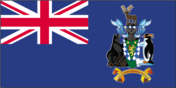
blue with the flag of the UK in the upper hoist-side quadrant and the South Georgia and South Sandwich Islands coat of arms centered on the outer half of the flag; the coat of arms features a shield with a golden lion rampant, holding a torch; the shield is supported by a fur seal on the left and a Macaroni penguin on the right; a reindeer appears above the crest, and below the shield on a scroll is the motto LEO TERRAM PROPRIAM PROTEGAT (Let the Lion Protect its Own Land); the lion with the torch represents the UK and discovery; the background of the shield, blue and white estoiles, are found in the coat of arms of James Cook, discoverer of the islands; all the outer supporting animals represented are native to the islands
International organization participation
UPU
Legal system
the laws of the UK, where applicable, apply
Transportation
Ports and terminals
- major seaport(s)
- Grytviken
Military and Security
Military - note
defense is the responsibility of the UK
Transnational Issues
Disputes - international
South Georgia and South Sandwich Islands (UK)-Argentina: Argentina, which claims the islands in its constitution and briefly occupied them by force in 1982, agreed in 1995 to no longer seek settlement by force
Environment
Climate
variable, with mostly westerly winds throughout the year interspersed with periods of calm; nearly all precipitation falls as snow
Environment - current issues
reindeer - introduced to the islands in the 20th century - devastated the native flora and bird species; some reindeer were translocated to the Falkland Islands in 2001, the rest were exterminated (2013-14); a parallel effort (2010-15) eradicated rats and mice that came to the islands as stowaways on ships as early as the late 18th century
Land use
- other
- 100% (2018 est.)