1998 Edition
CIA World Factbook 1998 (Internet Archive)
Geography
Area
total: 1,219,912 sq km land: 1,219,912 sq km water: 0 sq km note: includes Prince Edward Islands (Marion Island and Prince Edward Island)
Area-comparative
slightly less than twice the size of Texas
Climate
mostly semiarid; subtropical along east coast; sunny days, cool nights
Coastline
2,798 km
Elevation extremes
lowest point: Atlantic Ocean 0 m highest point: Njesuthi 3,408 m
Environment-current issues
lack of important arterial rivers or lakes requires extensive water conservation and control measures; growth in water usage threatens to outpace supply; pollution of rivers from agricultural runoff and urban discharge; air pollution resulting in acid rain; soil erosion; desertification
Environment-international agreements
party to: Antarctic-Environmental Protocol, Antarctic Treaty, Biodiversity, Climate Change, Desertification, Endangered Species, Hazardous Wastes, Law of the Sea, Marine Dumping, Marine Life Conservation, Nuclear Test Ban, Ozone Layer Protection, Ship Pollution, Wetlands, Whaling signed, but not ratified: none of the selected agreements
Geographic coordinates
29 00 S, 24 00 E
Geography-note
South Africa completely surrounds Lesotho and almost completely surrounds Swaziland
Irrigated land
12,700 sq km (1993 est.)
Land boundaries
total: 4,750 km border countries: Botswana 1,840 km, Lesotho 909 km, Mozambique 491 km, Namibia 855 km, Swaziland 430 km, Zimbabwe 225 km
Land use
arable land: 10% permanent crops: 1% permanent pastures: 67% forests and woodland: 7% other: 15% (1993 est.)
Location
Southern Africa, at the southern tip of the continent of Africa
Map references
Africa
Maritime claims
continental shelf: 200-m depth or to the depth of exploitation exclusive economic zone: 200 nm territorial sea: 12 nm
Natural hazards
prolonged droughts
Natural resources
gold, chromium, antimony, coal, iron ore, manganese, nickel, phosphates, tin, uranium, gem diamonds, platinum, copper, vanadium, salt, natural gas
Terrain
vast interior plateau rimmed by rugged hills and narrow coastal plain
People and Society
Age structure
0-14 years: 35% (male 7,502,396; female 7,366,144) 15-64 years: 61% (male 12,947,521; female 13,079,892) 65 years and over: 4% (male 778,767; female 1,159,800) (July 1998 est.)
Birth rate
26.43 births/1,000 population (1998 est.)
Death rate
12.28 deaths/1,000 population (1998 est.)
Ethnic groups
black 75.2%, white 13.6%, Colored 8.6%, Indian 2.6%
Infant mortality rate
52.04 deaths/1,000 live births (1998 est.)
Languages
11 official languages, including Afrikaans, English, Ndebele, Pedi, Sotho, Swazi, Tsonga, Tswana, Venda, Xhosa, Zulu
Life expectancy at birth
total population: 55.65 years male: 53.56 years female: 57.8 years (1998 est.)
Literacy
definition: age 15 and over can read and write total population: 81.8% male: 81.9% female: 81.7% (1995 est.)
Nationality
noun: South African(s) adjective: South African
Net migration rate
0.08 migrant(s)/1,000 population (1998 est.)
Population
42,834,520 (July 1998 est.) note: South Africa took a census 10 October 1996 which showed a total of 37,859,000 (after a 6.8% adjustment for underenumeration based on a post-enumeration survey); this figure is still about 10% below projections from earlier censuses; since the full results of the census have not been released for analysis, the numbers shown for South Africa do not take into consideration the results of this 1996 census
Population growth rate
1.42% (1998 est.)
Religions
Christian 68% (includes most whites and Coloreds, about 60% of blacks and about 40% of Indians), Muslim 2%, Hindu 1.5% (60% of Indians), traditional and animistic 28.5%
Sex ratio
at birth: 1.03 male(s)/female under 15 years: 1.01 male(s)/female 15-64 years: 0.98 male(s)/female 65 years and over: 0.67 male(s)/female (1998 est.)
Total fertility rate
3.16 children born/woman (1998 est.)
Government
Administrative divisions
9 provinces; Eastern Cape, Free State, Gauteng, KwaZulu-Natal, Mpumalanga, North-West, Northern Cape, Northern Province, Western Cape
Constitution
10 December 1996; this new constitution was certified by the Constitutional Court on 4 December 1996, was signed by President MANDELA on 10 December 1996, and entered into effect on 3 February 1997; it is being implemented in phases
Country name
conventional long form: Republic of South Africa conventional short form: South Africa abbreviation: RSA
Data code
SF
Executive branch
chief of state: President Nelson MANDELA (since 10 May 1994); Executive Deputy President Thabo MBEKI (since 10 May 1994); note-the president is both the chief of state and head of government head of government: President Nelson MANDELA (since 10 May 1994); Executive Deputy President Thabo MBEKI (since 10 May 1994); note-the president is both the chief of state and head of government cabinet: Cabinet appointed by the president elections: president and executive deputy presidents elected by the National Assembly; election last held 9 May 1994 (next scheduled for sometime between May and July 1999) election results: Nelson MANDELA elected president; percent of National Assembly vote - 100% (by acclamation); Thabo MBEKI and Frederik W. DE KLERK elected executive deputy presidents; percent of National Assembly vote-100% (by acclamation) note: the initial governing coalition, made up of the ANC, the IFP, and the NP, which constituted a Government of National Unity or GNU, no longer includes the NP which was withdrawn by DE KLERK on 30 June 1996 when he voluntarily gave up his position as executive deputy president and distanced himself from the programs of the ANC
FAX
- [1] (202) 265-1607 consulate(s) general: Beverly Hills (California), Chicago, and New York Diplomatic representation from the US: chief of mission: Ambassador James A. JOSEPH embassy: 877 Pretorius St., Arcadia 0083 mailing address: P.O. Box 9536, Pretoria 0001 telephone: [27] (12) 342-1048
- [27] (12) 342-2244 consulate(s) general: Cape Town, Durban, Johannesburg
Flag description
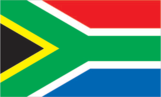
two equal width horizontal bands of red (top) and blue separated by a central green band which splits into a horizontal Y, the arms of which end at the corners of the hoist side, embracing a black isosceles triangle from which the arms are separated by narrow yellow bands; the red and blue bands are separated from the green band and its arms by narrow white stripes note: prior to 26 April 1994, the flag was actually four flags in one-three miniature flags reproduced in the center of the white band of the former flag of the Netherlands, which has three equal horizontal bands of orange (top), white, and blue; the miniature flags are a vertically hanging flag of the old Orange Free State with a horizontal flag of the UK adjoining on the hoist side and a horizontal flag of the old Transvaal Republic adjoining on the other side
Government type
republic
Independence
31 May 1910 (from UK)
International organization participation
AfDB, BIS, C, CCC, ECA, FAO, G-77, IAEA, IBRD, ICAO, ICC, ICFTU, ICRM, IDA, IFAD, IFC, IFRCS, IHO, ILO, IMF, IMO, Inmarsat, Intelsat, Interpol, IOC, IOM (observer), ISO, ITU, MTCR, NAM, OAU, SACU, SADC, UN, UNCTAD, UNESCO, UPU, WFTU, WHO, WIPO, WMO, WToO, WTrO, ZC Diplomatic representation in the US: chief of mission: Ambassador Franklin SONN chancery: 3051 Massachusetts Avenue NW, Washington, DC 20008 telephone: [1] (202) 232-4400
Judicial branch
Constitutional Court; Supreme Court of Appeals; High Courts; Magistrate Courts Political parties and leaders: African Christian Democratic Party or ACDP [Kenneth MESHOE, president]; African National Congress or ANC [Thabo MBEKI, president]; Democratic Party or DP [Tony LEON, president]; Freedom Front or FF [Constand VILJOEN, president]; Inkatha Freedom Party or IFP [Mangosuthu BUTHELEZI, president]; National Party or NP [Marthinus VAN SCHALKWYK, executive director]; Pan-Africanist Congress or PAC [Stanley MOGOBA, president]; United Democratic Movement or UDM [Roelf MEYER and Bantu HOLOMISA, leaders] note: 11 other parties won votes in the April 1994 elections but not enough to gain seats in the National Assembly; moreover, in September 1997, a substantial new party, the United Democratic Movement or UDM, was formed, with Roelf MEYER and Bantu HOLOMISA as leaders Political pressure groups and leaders: Congress of South African Trade Unions or COSATU [Sam SHILOWA, general secretary]; South African Communist Party or SACP [Charles NQAKULA, general secretary]; South African National Civics Organization or SANCO [Mlungisi HLONGWANE, national president]; note-COSATU and SACP are in a formal alliance with the ANC
Legal system
based on Roman-Dutch law and English common law; accepts compulsory ICJ jurisdiction, with reservations
Legislative branch
bicameral parliament consisting of the National Assembly (400 seats; members are elected by popular vote under a system of proportional representation to serve five-year terms) and the National Council of Provinces (90 seats, ten members elected by each of the nine provincial legislatures for five-year terms; has special powers to protect regional interests, including the safeguarding of cultural and linguistic traditions among ethnic minorities); note-following the implementation of the new constitution on 3 February 1997 the former Senate was disbanded and replaced by the National Council of Provinces with essentially no change in membership and party affiliations, although the new institution's responsibilities have been changed somewhat by the new constitution elections: National Assembly and Senate-last held 26-29 April 1994 (next to be held between May and July 1999); note-the Senate was disbanded and replaced by the National Council of Provinces on 6 February 1997 election results: National Assembly-percent of vote by party-ANC 62.6%, NP 20.4%, IFP 10.5%, FF 2.2%, DP 1.7%, PAC 1.2%, ACDP 0.5%, other 0.9%; seats by party - ANC 252, NP 82, IFP 43, FF 9, DP 7, PAC 5, ACDP 2; Senate-percent of vote by party-NA; seats by party-ANC 61, NP 17, FF 4, IFP 5, DP 3
National capital
Pretoria (administrative); Cape Town (legislative); Bloemfontein (judicial)
National holiday
Freedom Day, 27 April (1994)
Suffrage
18 years of age; universal
Economy
Agriculture-products
corn, wheat, sugarcane, fruits, vegetables; beef, poultry, mutton, wool, dairy products
Budget
revenues: $30.5 billion expenditures: $38 billion, including capital expenditures of $2.6 billion (FY94/95 est.)
Currency
1 rand (R) = 100 cents
Debt-external
$23.5 billion (1997 est.)
Economic aid
recipient: ODA, $NA note: current aid pledges include US $600 million over three years, 1994-96; UK $150 million over three years; Australia $21 million over three years; Japan $1.3 billion over two years ending in 1996; EU $833 million over five years
Economy-overview
South Africa is a middle-income, developing country with an abundant supply of resources, well developed financial, legal, communications, energy, and transport sectors, a stock exchange that ranks among the 10 largest in the world, and a modern infrastructure supporting an efficient distribution of goods to major urban centers throughout the region. Growth has been positive since the historic election of President Nelson MANDELA in the country's first multi-racial elections in 1994, but not strong enough to cut into the substantial unemployment. Daunting economic problems remain from the apartheid era, especially the problems of poverty and economic empowerment among the blacks. Other problems are crime and corruption. The new South African Government demonstrated its commitment to open markets, privatization, and a favorable investment climate with the release of its macroeconomic strategy in June 1996. Called "Growth, Employment and Redistribution," this policy framework includes the introduction of tax incentives to stimulate new investment in labor-intensive projects, expansion of basic infrastructure services, the restructuring and partial privatization of state assets, continued reduction of tariffs and subsidies to promote economic efficiency, improved services to the disadvantaged, and integration into the global economy.
Electricity-capacity
34.566 million kW (1995)
Electricity-consumption per capita
3,559 kWh (1995)
Electricity-production
163.56 billion kWh (1995)
Exchange rates
rand (R) per US$1-4.94193 (January 1998), 4.60796 (1997), 4.29935 (1996), 3.62709 (1995), 3.55080 (1994), 3.26774 (1993)
Exports
total value: $31.3 billion (f.o.b., 1997) commodities: gold 20%, other minerals and metals 20%-25%, food 5%, chemicals 3% (1997) partners: Italy, Japan, US, Germany, UK, other EU countries, Hong Kong
Fiscal year
1 April-31 March Communications
GDP
purchasing power parity-$270 billion (1997 est.)
GDP-composition by sector
agriculture: 5% industry: 37% services: 58% (1995 est.)
GDP-per capita
purchasing power parity-$6,200 (1997 est.)
GDP-real growth rate
3% (1997 est.)
Imports
total value: $28 billion (f.o.b., 1997) commodities: machinery 32%, transport equipment 15%, chemicals 11%, petroleum products, textiles, scientific instruments (1994) partners: Germany, US, Japan, UK, Italy
Industrial production growth rate
1.2% (1996 est.)
Industries
mining (world's largest producer of platinum, gold, chromium), automobile assembly, metalworking, machinery, textile, iron and steel, chemical, fertilizer, foodstuffs
Inflation rate-consumer price index
9.7% (1997 est.)
Labor force
total: 14.2 million economically active (1996) by occupation: services 35%, agriculture 30%, industry 20%, mining 9%, other 6%
Radio broadcast stations
AM 14, FM 286, shortwave 0
Radios
12.1 million (1992 est.)
Telephone system
the system is the best developed, most modern, and has the highest capacity in Africa domestic: consists of carrier-equipped open-wire lines, coaxial cables, microwave radio relay links, fiber-optic cable, and radiotelephone communication stations; key centers are Bloemfontein, Cape Town, Durban, Johannesburg, Port Elizabeth, and Pretoria international: 1 submarine cable; satellite earth stations-3 Intelsat (1 Indian Ocean and 2 Atlantic Ocean)
Telephones
5,206,235 (1993 est.)
Television broadcast stations
67 (1987 est.)
Televisions
3.45 million (1990 est.)
Unemployment rate
30% (1997 est.); note-an additional 11% of the workforce is underemployed
Transportation
Airports
750 (1997 est.) Airports-with paved runways: total: 143 over 3,047 m: 10 2,438 to 3,047 m: 4 1,524 to 2,437 m: 46 914 to 1,523 m: 74 under 914 m: 9 (1997 est.) Airports-with unpaved runways: total: 607 1,524 to 2,437 m: 35 914 to 1,523 m: 308 under 914 m: 264 (1997 est.)
Highways
total: 331,265 km paved: 137,475 km (including 1,142 km of expressways) unpaved: 193,790 km (1995 est.)
Merchant marine
total: 9 ships (1,000 GRT or over) totaling 274,797 GRT/270,837 DWT ships by type: container 6, oil tanker 2, roll-on/roll-off cargo 1 (1997 est.)
Pipelines
crude oil 931 km; petroleum products 1,748 km; natural gas 322 km Ports and harbors: Cape Town, Durban, East London, Mosselbaai, Port Elizabeth, Richards Bay, Saldanha
Railways
total: 21,431 km narrow gauge: 20,995 km 1.067-m gauge (9,087 km electrified); 436 km 0.610-m gauge (1995)
Military and Security
Military branches
South African National Defense Force or SANDF (includes Army, Navy, Air Force, and Medical Services), South African Police Service or SAPS
Military expenditures-dollar figure
$2.9 billion (FY95/96)
Military expenditures-percent of GDP
2.2% (FY95/96)
Military manpower-availability
males age 15-49: 11,144,895 (1998 est.) Military manpower-fit for military service: males: 6,777,677 (1998 est.)
Military manpower-military age
18 years of age
Military manpower-reaching military age annually
males: 445,110 (1998 est.)
Transnational Issues
Disputes-international
Swaziland has asked South Africa to open negotiations on reincorporating some nearby South African territories that are populated by ethnic Swazis or that were long ago part of the Swazi Kingdom
Illicit drugs
transshipment center for heroin and cocaine; cocaine consumption on the rise; world's largest market for illicit methaqualone, usually imported illegally from India through various east African countries; illicit cultivation of marijuana (dependent territory of the UK, also claimed by Argentina)