2003 Edition
CIA World Factbook 2003 (Project Gutenberg)
Introduction
Administrative divisions
- 182 municipalities (obcine, singular - obcina) and 11 urban municipalities* (mestne obcine , singular - mestna obcina ) Ajdovscina, Beltinci, Benedikt, Bistrica ob Sotli, Bled, Bloke, Bohinj, Borovnica, Bovec, Braslovce, Brda, Brezice, Brezovica, Cankova, Celje*, Cerklje na Gorenjskem, Cerknica, Cerkno, Cerkvenjak, Crensovci, Crna na Koroskem, Crnomelj, Destrnik, Divaca, Dobje, Dobrepolje, Dobrna, Dobrova-Horjul-Polhov Gradec, Dobrovnik-Dobronak, Dolenjske Toplice, Dol pri Ljubljani, Domzale, Dornava, Dravograd, Duplek, Gorenja Vas-Poljane, Gorisnica, Gornja Radgona, Gornji Grad, Gornji Petrovci, Grad, Grosuplje, Hajdina, Hoce-Slivnica, Hodos-Hodos, Horjul, Hrastnik, Hrpelje-Kozina, Idrija, Ig, Ilirska Bistrica, Ivancna Gorica, Izola-Isola, Jesenice, Jezersko, Jursinci, Kamnik, Kanal, Kidricevo, Kobarid, Kobilje, Kocevje, Komen, Komenda, Koper-Capodistria*, Kostel, Kozje, Kranj*, Kranjska Gora, Krizevci, Krsko, Kungota, Kuzma, Lasko, Lenart, Lendava-Lendva, Litija, Ljubljana*, Ljubno, Ljutomer, Logatec, Loska Dolina, Loski Potok, Lovrenc na Pohorju, Luce, Lukovica, Majsperk, Maribor*, Markovci, Medvode, Menges, Metlika, Mezica, Miklavz na Dravskem Polju, Miren-Kostanjevica, Mirna Pec, Mislinja, Moravce, Moravske Toplice, Mozirje, Murska Sobota*, Muta, Naklo, Nazarje, Nova Gorica*, Novo Mesto*, Odranci, Oplotnica, Ormoz, Osilnica, Pesnica, Piran-Pirano, Pivka, Podcetrtek, Podlehnik, Podvelka, Polzela, Postojna, Prebold, Preddvor, Prevalje, Ptuj*, Puconci, Race-Fram, Radece, Radenci, Radlje ob Dravi, Radovljica, Ravne na Koroskem, Razkrizje, Ribnica, Ribnica na Pohorju, Rogasovci, Rogaska Slatina, Rogatec, Ruse, Salovci, Selnica ob Dravi, Semic, Sempeter-Vrtojba, Sencur, Sentilj, Sentjernej, Sentjur pri Celju, Sevnica, Sezana, Skocjan, Skofja Loka, Skofljica, Slovenj Gradec*, Slovenska Bistrica, Slovenske Konjice, Smarje pri Jelsah, Smartno ob Paki, Smartno pri Litiji, Sodrazica, Solcava, Sostanj, Starse, Store, Sveta Ana, Sveti Andraz v Slovenskih Goricah, Sveti Jurij, Tabor, Tisina, Tolmin, Trbovlje, Trebnje, Trnovska Vas, Trzic, Trzin, Turnisce, Velenje*, Velika Polana, Velike Lasce, Verzej, Videm, Vipava, Vitanje, Vodice, Vojnik, Vransko, Vrhnika, Vuzenica, Zagorje ob Savi, Zalec, Zavrc, Zelezniki, Zetale, Ziri, Zirovnica, Zuzemberk, Zrece
- note
- there may be 45 more municipalities
Age structure
0-14 years: 15.3% (male 152,341; female 144,189) 15-64 years: 70% (male 687,939; female 666,194) 65 years and over: 14.7% (male 105,837; female 179,177) (2003 est.)
Agriculture - products
potatoes, hops, wheat, sugar beets, corn, grapes; cattle, sheep, poultry
Airports
16 (2002)
Airports - with paved runways
- over 3,047 m
- 1 2,438 to 3,047 m: 1 1,524 to 2,437 m: 1 914 to 1,523 m: 2
- total
- 6
- under 914 m
- 1 (2002)
Airports - with unpaved runways
- total
- 10 1,524 to 2,437 m: 2 914 to 1,523 m: 3
- under 914 m
- 5 (2002) Military Slovenia
Area
- land
- 20,151 sq km
- total
- 20,273 sq km
- water
- 122 sq km
Area - comparative
slightly smaller than New Jersey
Background
The Slovene lands were part of the Holy Roman Empire and Austria until 1918 when the Slovenes joined the Serbs and Croats in forming a new nation, renamed Yugoslavia in 1929. After World War II, Slovenia became a republic of the renewed Yugoslavia, which though Communist, distanced itself from Moscow's rule. Dissatisfied with the exercise of power of the majority Serbs, the Slovenes succeeded in establishing their independence in 1991 after a short 10-day war. Historical ties to Western Europe, a strong economy, and a stable democracy have assisted in Slovenia's transformation to a modern state. In December 2002, Slovenia received an invitation to join NATO, and it is scheduled to accede to the EU along with nine other states on 1 May 2004. In a March 2003 referendum on NATO and EU membership, Slovenes voted 90% in favor of joining the EU and 66% in favor of joining NATO. Geography Slovenia
Birth rate
9.23 births/1,000 population (2003 est.)
Budget
- expenditures
- $8.32 billion, including capital expenditures of $NA (1997 est.)
- revenues
- $8.11 billion
Capital
Ljubljana
Climate
Mediterranean climate on the coast, continental climate with mild to hot summers and cold winters in the plateaus and valleys to the east
Coastline
46.6 km
Constitution
adopted 23 December 1991, effective 23 December 1991
Country name
- conventional long form
- Republic of Slovenia
- conventional short form
- Slovenia
- local long form
- Republika Slovenija
- local short form
- Slovenija
Currency
tolar (SIT)
Currency code
SIT
Death rate
10.15 deaths/1,000 population (2003 est.)
Debt - external
$7.9 billion (2001)
Diplomatic representation from the US
- chief of mission
- Ambassador Johnny YOUNG
- embassy
- Presernova 31, 1000 Ljubljana
- mailing address
- American Embassy Ljubljana, Department of State, 7140 Ljubljana Place, Washington, DC 20521-7140
- telephone
- [386] (1) 200-5500
Diplomatic representation in the US
- chief of mission
- Ambassador Davorin KRACUN
Disputes - international
parliamentarians are far from ratifying the Croatia-Slovenia land and maritime boundary agreement, which would have ceded most of Piran Bay and maritime access to Slovenia and several villages to Croatia
Distribution of family income - Gini index
28.4 (1998)
Economic aid - recipient
ODA, $62 million (2000 est.)
Economy - overview
Slovenia, with its historical ties to Western Europe, enjoys a GDP per capita substantially higher than that of the other transitioning economies of Central Europe. Privatization of the economy proceeded at an accelerated pace in 2002-3, and the budget deficit dropped from 3.0% of GDP in 2002 to 1.9% in 2003. Despite the economic slowdown in Europe in 2001-03, Slovenia maintained 3% growth. Structural reforms to improve the business environment allow for greater foreign participation in Slovenia's economy and help to lower unemployment. Further measures to curb inflation are also needed. Corruption and the high degree of coordination between government, business, and central bank policy are issues of concern in the run-up to Slovenia's scheduled 1 May 2004 accession to the European Union.
Electricity - consumption
13.83 billion kWh (2001)
Electricity - exports
3 billion kWh (2001)
Electricity - imports
4.1 billion kWh (2001)
Electricity - production
13.69 billion kWh (2001)
Electricity - production by source
- fossil fuel
- 35.2%
- hydro
- 27.3%
- nuclear
- 36.8%
- other
- 0.7% (2001)
Elevation extremes
- highest point
- Triglav 2,864 m
- lowest point
- Adriatic Sea 0 m
Environment - current issues
Sava River polluted with domestic and industrial waste; pollution of coastal waters with heavy metals and toxic chemicals; forest damage near Koper from air pollution (originating at metallurgical and chemical plants) and resulting acid rain
Environment - international agreements
- party to
- Air Pollution, Air Pollution-Sulphur 94, Biodiversity, Climate Change, Desertification, Endangered Species, Hazardous Wastes, Law of the Sea, Marine Dumping, Nuclear Test Ban, Ozone Layer Protection, Ship Pollution, Wetlands
- signed, but not ratified
- Air Pollution-Persistent Organic Pollutants, Climate Change-Kyoto Protocol
Ethnic groups
Slovene 88%, Croat 3%, Serb 2%, Bosniak 1%, Yugoslav 0.6%, Hungarian 0.4%, other 5% (1991)
Exchange rates
tolars per US dollar - 240.25 (2002), 242.75 (2001), 222.66 (2000), 181.77 (1999), 166.13 (1998)
Executive branch
- cabinet
- Council of Ministers nominated by the prime minister and elected by the National Assembly
- chief of state
- President Janez DRNOVSEK (since 22 December 2002)
- election results
- Janez DRNOVSEK elected president; percent of vote - Janez DRNOVSEK 56.5%, Barbara BREZIGAR 43.5%; Anton ROP elected prime minister; National Assembly vote - 63 to 24
- elections
- president elected by popular vote for a five-year term; election last held 10 November and 1 December 2002 (next to be held in the fall of 2007); following National Assembly elections, the leader of the majority party or the leader of a majority coalition is usually nominated to become prime minister by the president and elected by the National Assembly; election last held 6 December 2002 (next National Assembly elections to be held NA October 2004)
- head of government
- Prime Minister Anton ROP (since 11 December 2002)
Exports
$10.3 billion f.o.b. (2002)
Exports - commodities
manufactured goods, machinery and transport equipment, chemicals, food
Exports - partners
Germany 23.9%, Italy 12.7%, Austria 9.5%, Croatia 8%, France 7.4%, Bosnia and Herzegovina 4.4% (2002)
FAX
- [1] (202) 667-4563
- [386] (1) 200-5555
- chancery
- 1525 New Hampshire Avenue NW, Washington, DC 20036
- consulate(s) general
- New York and Cleveland
- telephone
- [1] (202) 667-5363
Fiscal year
calendar year Communications Slovenia
Flag description
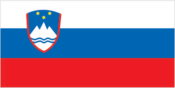
three equal horizontal bands of white (top), blue, and red, with the Slovenian seal (a shield with the image of Triglav, Slovenia's highest peak, in white against a blue background at the center; beneath it are two wavy blue lines depicting seas and rivers, and above it are three six-pointed stars arranged in an inverted triangle, which are taken from the coat of arms of the Counts of Celje, the great Slovene dynastic house of the late 14th and early 15th centuries); the seal is located in the upper hoist side of the flag centered in the white and blue bands Economy Slovenia
GDP
purchasing power parity - $37.06 billion (2002 est.)
GDP - composition by sector
- agriculture
- 3.2%
- industry
- 36.3%
- services
- 60.5% (2001 est.)
GDP - per capita
purchasing power parity - $19,200 (2002 est.)
GDP - real growth rate
3.2% (2002 est.)
Geographic coordinates
46 07 N, 14 49 E
Geography - note
despite its small size, this eastern Alpine country controls some of Europe's major transit routes People Slovenia
Government type
parliamentary democratic republic
Highways
- paved
- 20,157 km (including 427 km of expressways)
- total
- 20,177 km
- unpaved
- 20 km (2000)
HIV/AIDS - adult prevalence rate
less than 0.1% (2001 est.)
HIV/AIDS - deaths
less than 100 (2001 est.)
HIV/AIDS - people living with HIV/AIDS
280 (2001 est.)
Household income or consumption by percentage share
- highest 10%
- 23% (1998)
- lowest 10%
- 3.9%
Illicit drugs
minor transit point for cocaine and Southwest Asian heroin bound for Western Europe, and for precursor chemicals This page was last updated on 18 December, 2003
Imports
$11.1 billion f.o.b. (2002)
Imports - commodities
machinery and transport equipment, manufactured goods, chemicals, fuels and lubricants, food
Imports - partners
Germany 20%, Italy 19%, Austria 11.3%, France 10.5% (2002)
Independence
25 June 1991 (from Yugoslavia)
Industrial production growth rate
2.4% (2002)
Industries
ferrous metallurgy and aluminum products, lead and zinc smelting, electronics (including military electronics), trucks, electric power equipment, wood products, textiles, chemicals, machine tools
Infant mortality rate
- female
- 3.26 deaths/1,000 live births (2003 est.)
- male
- 5.53 deaths/1,000 live births
- total
- 4.42 deaths/1,000 live births
Inflation rate (consumer prices)
7.4% (2002 est.)
International organization participation
ABEDA, ACCT (observer), BIS, CE, CEI, EAPC, EBRD, ECE, EU (applicant), FAO, IADB, IAEA, IBRD, ICAO, ICC, ICCt, ICRM, IDA, IFC, IFRCS, ILO, IMF, IMO, Interpol, IOC, IOM, ISO, ITU, NAM (guest), NSG, OPCW, OSCE, PCA, PFP, UN, UNCTAD, UNESCO, UNIDO, UNMIK, UNTSO, UPU, WCO, WEU (associate partner), WHO, WIPO, WMO, WToO, WTrO, ZC
Internet country code
.si
Internet Service Providers (ISPs)
11 (2000)
Internet users
600,000 (2001) Transportation Slovenia
Irrigated land
20 sq km (1998 est.)
Judicial branch
Supreme Court (judges are elected by the National Assembly on the recommendation of the Judicial Council); Constitutional Court (judges elected for nine-year terms by the National Assembly and nominated by the president)
Labor force
857,400
Labor force - by occupation
agriculture NA%, industry NA%, services NA%
Land boundaries
- border countries
- Austria 330 km, Croatia 670 km, Italy 232 km, Hungary 102 km
- total
- 1,334 km
Land use
- arable land
- 11.48%
- other
- 85.84% (1998 est.)
- permanent crops
- 2.68%
Languages
Slovenian 91%, Serbo-Croatian 6%, other 3%
Legal system
based on civil law system
Legislative branch
- unicameral National Assembly or Drzavni Zbor (90 seats, 40 are directly elected and 50 are selected on a proportional basis; note - the numbers of directly elected and proportionally elected seats varies with each election; members are elected by popular vote to serve four-year terms)
- election results
- percent of vote by party - LDS 36%, SDS 16%, ZLSD 12%, SLS/SKD 10%, NSi 9%, SMS 4%, SNS 4%, DeSUS 5%, other 4%; seats by party - LDS 34, SDS 13, ZLSD 11, SLS 10, NSi 8, SMS 4, SNS 4, DeSUS 4, Hungarian and Italian minorities 1 each
- elections
- National Assembly - last held 15 October 2000 (next to be held NA October 2004)
- note
- the National Council or Drzavni Svet is an advisory body with limited legislative powers; it may propose laws and ask to review any National Assembly decisions; in the election of November 1997, 40 members were elected to represent local, professional, and socioeconomic interests
Life expectancy at birth
- female
- 79.58 years (2003 est.)
- male
- 71.65 years
- total population
- 75.51 years
Literacy
- definition
- NA
- female
- 99.6% (2003 est.) Government Slovenia
- male
- 99.7%
- total population
- 99.7%
Location
Central Europe, eastern Alps bordering the Adriatic Sea, between Austria and Croatia
Map references
Europe
Maritime claims
NA
Median age
- female
- 40.2 years (2002)
- male
- 37.1 years
- total
- 38.6 years
Military branches
Slovenian Army (includes Air and Naval Forces)
Military expenditures - dollar figure
$370 million (FY00)
Military expenditures - percent of GDP
1.7% (FY00) Transnational Issues Slovenia
Military manpower - availability
- males age 15-49
- 520,037 (2003 est.)
Military manpower - fit for military service
- males age 15-49
- 413,453 (2003 est.)
Military manpower - military age
19 years of age (2003 est.)
Military manpower - reaching military age annually
- males
- 13,704 (2003 est.)
National holiday
Independence Day/Statehood Day, 25 June (1991)
Nationality
- adjective
- Slovenian
- noun
- Slovene(s)
Natural gas - consumption
1.04 billion cu m (2001 est.)
Natural gas - exports
0 cu m (2001 est.)
Natural gas - imports
1.04 billion cu m (2001 est.)
Natural gas - production
0 cu m (2001 est.)
Natural hazards
flooding and earthquakes
Natural resources
lignite coal, lead, zinc, mercury, uranium, silver, hydropower, forests
Net migration rate
2.34 migrant(s)/1,000 population (2003 est.)
Oil - consumption
53,300 bbl/day (2001 est.)
Oil - exports
NA (2001)
Oil - imports
NA (2001)
Oil - production
20 bbl/day NA bbl/day (2001 est.)
Pipelines
gas 2,526 km; oil 11 km (2003)
Political parties and leaders
Democratic Party of Retired (Persons) of Slovenia or DeSUS [Anton ROUS]; Liberal Democratic or LDS [Anton ROP]; New Slovenia or NSi [Andrej BAJUK]; Slovene National Party or SNS [Zmago JELINCIC]; Slovene People's Party or SLS [Franc BUT]; Slovene Youth Party or SMS [Dominic CERNJAK]; Social Democratic Party of Slovenia or SDS [Janez JANSA]; United List of Social Democrats or ZLSD [Borut PAHOR]
Political pressure groups and leaders
NA
Population
1,935,677 (July 2003 est.)
Population below poverty line
NA%
Population growth rate
0.14% (2003 est.)
Ports and harbors
Izola, Koper, Piran
Radio broadcast stations
AM 17, FM 160, shortwave 0 (1998)
Radios
805,000 (1997)
Railways
- standard gauge
- 1,201 km 1.435-m gauge (499 km electrified) (2002)
- total
- 1,201 km
Religions
Roman Catholic (Uniate 2%) 70.8%, Lutheran 1%, Muslim 1%, atheist 4.3%, other 22.9%
Sex ratio
- at birth
- 1.06 male(s)/female
- total population
- 0.96 male(s)/female (2003 est.)
- under 15 years
- 1.06 male(s)/female 15-64 years: 1.03 male(s)/female 65 years and over: 0.59 male(s)/female
Suffrage
18 years of age; universal (16 years of age, if employed)
Telephone system
- domestic
- 100% digital (2000)
- general assessment
- NA
- international
- NA
Telephones - main lines in use
722,000 (1997)
Telephones - mobile cellular
1 million (2000)
Television broadcast stations
48 (2001)
Televisions
710,000 (1997)
Terrain
a short coastal strip on the Adriatic, an alpine mountain region adjacent to Italy and Austria, mixed mountains and valleys with numerous rivers to the east
Total fertility rate
1.27 children born/woman (2003 est.)
Unemployment rate
11% (2002 est.)
Waterways
NA