1994 Edition
CIA World Factbook 1994 (Project Gutenberg)
Introduction
Administrative divisions
60 provinces (pokajine, singular - pokajina) Ajdovscina, Brezice, Celje, Cerknica, Crnomelj, Dravograd, Gornja Radgona, Grosuplje, Hrastnik Lasko, Idrija, Ilirska Bistrica, Izola, Jesenice, Kamnik, Kocevje, Koper, Kranj, Krsko, Lenart, Lendava, Litija, Ljubljana-Bezigrad, Ljubljana-Center, Ljubljana-Moste-Polje, Ljubljana-Siska, Ljubljana-Vic-Rudnik, Ljutomer, Logatec, Maribor, Metlika, Mozirje, Murska Sobota, Nova Gorica, Novo Mesto, Ormoz, Pesnica, Piran, Postojna, Ptuj, Radlje Ob Dravi, Radovljica, Ravne Na Koroskem, Ribnica, Ruse, Sentjur Pri Celju, Sevnica, Sezana, Skofja Loka, Slovenj Gradec, Slovenska Bistrica, Slovenske Konjice, Smarje Pri Jelsah, Tolmin, Trbovlje, Trebnje, Trzic, Velenje, Vrhnika, Zagorje Ob Savi, Zalec
Agriculture
accounts for 5% of GDP; dominated by stock breeding (sheep and cattle) and dairy farming; main crops - potatoes, hops, hemp, flax; an export surplus in these commodities; Slovenia must import many other agricultural products and has a negative overall trade balance in this sector
Airports
total: 14 usable: 13 with permanent-surface runways: 6 with runways over 3,659 m: with runways 2,440-3,659 m: 2 with runways 1,220-2,439 m: 2
Area
total area: 20,296 sq km land area: 20,296 sq km comparative area: slightly larger than New Jersey
Birth rate
11.81 births/1,000 population (1994 est.)
Branches
Slovene Defense Forces
Budget
revenues: $NA expenditures: $NA, including capital expenditures of $NA
Capital
Ljubljana
Climate
Mediterranean climate on the coast, continental climate with mild to hot summers and cold winters in the plateaus and valleys to the east
Coastline
32 km
Constitution
adopted 23 December 1991, effective 23 December 1991
Currency
1 tolar (SlT) = 100 stotins
Death rate
9.5 deaths/1,000 population (1994 est.)
Defense expenditures
13.5 billion tolars, 4.5% of GDP (1993); note - conversion of the military budget into US dollars using the current exchange rate could produce misleading results
Digraph
SI
Diplomatic representation in US
chief of mission: Ambassador Ernest PETRIC chancery: 1525 New Hampshir Avenue NW, Washington, DC, 20036 telephone: (202) 667-5363 consulate(s) general: New York
Economic aid
$NA
Electricity
capacity: 2,900,000 kW production: 10 billion kWh consumption per capita: 5,090 kWh (1992)
Environment
current issues: Sava River polluted with domestic and industrial waste; heavy metals and toxic chemicals along coastal waters; forest damage near Koper from air pollution originating at metallurgical and chemical plants natural hazards: subject to flooding and earthquakes international agreements: party to - Air Pollution, Hazardous Wastes, Marine Dumping, Nuclear Test Ban, Ozone Layer Protection, Ship Pollution; signed, but not ratified - Biodiversity, Climate Change
Ethnic divisions
Slovene 91%, Croat 3%, Serb 2%, Muslim 1%, other 3%
Exchange rates
tolars (SIT) per US$1 - 112 (June 1993), 28 (January 1992)
Executive branch
chief of state: President Milan KUCAN (since 22 April 1990); election last held 6 December 1992 (next to be held NA 1996); results - Milan KUCAN reelected by direct popular vote head of government: Prime Minister Janez DRNOVSEK (since 14 May 1992); Deputy Prime Minister Lojze PETERLE (since NA) cabinet: Council of Ministers
Exports
$5.1 billion (f.o.b., 1993) commodities: machinery and transport equipment 38%, other manufactured goods 44%, chemicals 9%, food and live animals 4.6%, raw materials 3%, beverages and tobacco less than 1% (1992) partners: Germany 27%, Croatia 14%, Italy 13%, France 9% (1992)
External debt
$1.9 billion
FAX
[386] (61) 301-401
Fiscal year
calendar year
Flag
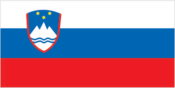
three equal horizontal bands of white (top), blue, and red with the Slovenian seal (a shield with the image of Triglav in white against a blue background at the center, beneath it are two wavy blue lines depicting seas and rivers, and around it, there are three six-sided stars arranged in an inverted triangle); the seal is located in the upper hoist side of the flag centered in the white and blue bands
Highways
total: 14,553 km paved: 10,525 km unpaved: gravel 4,028 km
Illicit drugs
NA
Imports
$5.3 billion (c.i.f., 1993) commodities: machinery and transport equipment 35%, other manufactured goods 26.7%, chemicals 14.5%, raw materials 9.4%, fuels and lubricants 7%, food and live animals 6% (1992) partners: Germany 23%, Croatia 14%, Italy 14%, France 8%, Austria 8% (1992)
Independence
25 June 1991 (from Yugoslavia)
Industrial production
growth rate -2.8% (1993); accounts for 30% of GDP
Industries
ferrous metallurgy and rolling mill products, aluminum reduction and rolled products, lead and zinc smelting, electronics (including military electronics), trucks, electric power equipment, wood products, textiles, chemicals, machine tools
Infant mortality rate
8.1 deaths/1,000 live births (1994 est.)
Inflation rate (consumer prices)
22.9% (1993)
Inland waterways
NA
International disputes
dispute with Croatia over fishing rights in the Adriatic and over some border areas; the border issue is currently under negotiation
Irrigated land
NA sq km
Judicial branch
Supreme Court, Constitutional Court
Labor force
786,036 by occupation: agriculture 2%, manufacturing and mining 46%
Land boundaries
total 1,045 km, Austria 262 km, Croatia 501 km, Italy 199 km, Hungary 83 km
Land use
arable land: 10% permanent crops: 2% meadows and pastures: 20% forest and woodland: 45% other: 23%
Languages
Slovenian 91%, Serbo-Croatian 7%, other 2%
Legal system
based on civil law system
Legislative branch
bicameral National Assembly
Life expectancy at birth
total population: 74.36 years male: 70.49 years female: 78.44 years (1994 est.)
Literacy
total population: NA% male: NA% female: NA%
Location
Balkan State, Southeastern Europe, bordering the Adriatic Sea, between Austria and Croatia
Manpower availability
males age 15-49 513,885; fit for military service 411,619; reach military age (19) annually 15,157 (1994 est.)
Map references
Ethnic Groups in Eastern Europe, Europe, Standard Time Zones of the World
Maritime claims
continental shelf: 200-m depth or to depth of exploitation territorial sea: 12 nm
Member of
CCC, CE, CEI, CSCE, EBRD, ECE, IAEA, IBRD, ICAO, IDA, IFC, ILO, IMF, IMO, INTELSAT (nonsignatory user), INTERPOL, IOC, IOM (observer), ITU, NAM (guest), UN, UNCTAD, UNESCO, UNIDO, UPU, WHO, WIPO, WMO
Merchant marine
19 ships (1,000 GRT or over) totaling 309,502 GRT/521,997 DWT controlled by Slovenian owners, bulk 13, cargo 6 note: most under the flag of Saint Vincent and the Grenadines; no ships remain under the Slovenian flag
Names
conventional long form: Republic of Slovenia conventional short form: Slovenia local long form: Republika Slovenije local short form: Slovenija
National holiday
Statehood Day, 25 June (1991)
National product
GDP - purchasing power equivalent - $15 billion (1993 est.)
National product per capita
$7,600 (1993 est.)
National product real growth rate
0% (1993 est.)
Nationality
noun: Slovene(s) adjective: Slovenian
Natural resources
lignite coal, lead, zinc, mercury, uranium, silver
Net migration rate
0 migrant(s)/1,000 population (1994 est.)
Other political or pressure groups
none
Overview
Slovenia was by far the most prosperous of the former Yugoslav republics, with a per capita income more than twice the Yugoslav average, indeed not far below the levels in neighboring Austria and Italy. Because of its strong ties to Western Europe and the small scale of damage during its brief fight for independence from Yugoslavia, Slovenia has the brightest prospects among the former Yugoslav republics for economic recovery over the next few years. The dissolution of Yugoslavia, however, has led to severe short-term dislocations in production, employment, and trade ties. For example, overall industrial production has fallen 26% since 1990; particularly hard hit have been the iron and steel, machine-building, chemical, and textile industries. Meanwhile, the continued fighting in other former Yugoslav republics has led to further destruction of long-established trade channels and to an influx of tens of thousands of Croatian and Bosnian refugees. The key program for breaking up and privatizing major industrial firms was established in late 1992. Despite slow progress in privatization Slovenia has reasonable prospects for an upturn in 1994. Bright spots for encouraging Western investors are Slovenia's comparatively well-educated work force, its developed infrastructure, and its Western business attitudes, but instability in Croatia is a deterrent. Slovenia in absolute terms is a small economy, and a little Western investment would go a long way.
Pipelines
crude oil 290 km; natural gas 305 km
Political parties and leaders
Slovene Christian Democrats (SKD), Lozje PETERLE, chairman; Liberal Democratic (LDS), Janez DRNOVSEK, chairman; Social-Democratic Party of Slovenia (SDSS), Joze PUCNIK, chairman; Socialist Party of Slovenia (SSS), Viktor ZAKELJ, chairman; Greens of Slovenia (ZS), Dusan PLUT, chairman; National Democratic, Rajko PIRNAT, chairman; Democratic Peoples Party, Marjan PODOBNIK, chairman; Reformed Socialists (former Communist Party), Ciril RIBICIC, chairman; United List (former Communists and allies); Slovene National Party, leader NA; Democratic Party, Igor BAVCAR; Slovene People's Party (SLS), Ivan OMAN note: parties have changed as of the December 1992 elections
Population
1,972,227 (July 1994 est.)
Population growth rate
0.23% (1994 est.)
Ports
coastal - Koper
Railroads
1,200 km, 1.435 m gauge (1991)
Religions
Roman Catholic 96% (including 2% Uniate), Muslim 1%, other 3%
State Assembly
elections last held 6 December 1992 (next to be held NA 1996); results - percent of vote by party NA; seats - (total 90) LDS 22, SKD 15, United List (former Communists and allies) 14, Slovene National Party 12, SLS 10, Democratic Party 6, ZS 5, SDSS 4, Hungarian minority 1, Italian minority 1
State Council
will become operational after next election in 1996; in the election of 6 December 1992 40 members were elected to represent local and socioeconomic interests
Suffrage
16 years of age, if employed; 18 years of age, universal
Telecommunications
130,000 telephones; broadcast stations - 6 AM, 5 FM, 7 TV; 370,000 radios; 330,000 TVs
Terrain
a short coastal strip on the Adriatic, an alpine mountain region adjacent to Italy, mixed mountain and valleys with numerous rivers to the east
Total fertility rate
1.67 children born/woman (1994 est.)
Type
emerging democracy
Unemployment rate
15.5% (1993)
US diplomatic representation
chief of mission: Ambassador E. Allan WENDT embassy: P.O. Box 254, Prazakova 4, 61000 Ljubljana mailing address: use embassy street address telephone: [386] (61) 301-427/472/485