2007 Edition
CIA World Factbook 2007 (Project Gutenberg)
Introduction
Administrative divisions
3 provinces and 1 area*; Eastern, Northern, Southern, Western*
Age structure
0-14 years: 44.8% (male 1,321,563/female 1,370,721) 15-64 years: 52% (male 1,494,502/female 1,625,733) 65 years and over: 3.2% (male 90,958/female 101,773) (2006 est.)
Agriculture - products
rice, coffee, cocoa, palm kernels, palm oil, peanuts; poultry, cattle, sheep, pigs; fish
Airports
10 (2006)
Airports - with paved runways
- over 3,047 m
- 1 (2006)
- total
- 1
Airports - with unpaved runways
- total
- 9 914 to 1,523 m: 7
- under 914 m
- 2 (2006)
Area
- land
- 71,620 sq km
- total
- 71,740 sq km
- water
- 120 sq km
Area - comparative
slightly smaller than South Carolina
Background
The government is slowly reestablishing its authority after the 1991 to 2002 civil war that resulted in tens of thousands of deaths and the displacement of more than 2 million people (about one-third of the population). The last UN peacekeepers withdrew in December 2005, leaving full responsibility for security with domestic forces, but a new civilian UN office remains to support the government. Mounting tensions related to planned 2007 elections, deteriorating political and economic conditions in Guinea, and the tenuous security situation in neighboring Liberia may present challenges to continuing progress in Sierra Leone's stability. Geography Sierra Leone
Birth rate
45.76 births/1,000 population (2006 est.)
Budget
- expenditures
- $351 million; including capital expenditures of $NA (2000 est.)
- revenues
- $96 million
Capital
- geographic coordinates
- 8 30 N, 13 15 W
- name
- Freetown
- time difference
- UTC 0 (5 hours ahead of Washington, DC during Standard Time)
Climate
tropical; hot, humid; summer rainy season (May to December); winter dry season (December to April)
Coastline
402 km
Constitution
1 October 1991; subsequently amended several times
Country name
- conventional long form
- Republic of Sierra Leone
- conventional short form
- Sierra Leone
- local long form
- Republic of Sierra Leone
- local short form
- Sierra Leone
Currency (code)
leone (SLL)
Currency code
SLL
Death rate
23.03 deaths/1,000 population (2006 est.)
Debt - external
$1.61 billion (2003 est.)
Diplomatic representation from the US
- chief of mission
- Ambassador Thomas N. HULL
- embassy
- Corner of Walpole and Siaka Stevens Streets, Freetown
- mailing address
- use embassy street address
- telephone
- [232] (22) 515 000 or [232] (76) 515 000
Diplomatic representation in the US
- chancery
- 1701 19th Street NW, Washington, DC 20009
- chief of mission
- Ambassador Ibrahim M. KAMARA
- telephone
- [1] (202) 939-9261 through 9263
Disputes - international
domestic fighting among disparate rebel groups, warlords, and youth gangs in Cote d'Ivoire, Guinea, Liberia, and Sierra Leone perpetuate insurgencies, street violence, looting, arms trafficking, ethnic conflicts, and refugees in border areas; UN Mission in Sierra Leone (UNAMSIL) has maintained over 4,000 peacekeepers in Sierra Leone since 1999; Sierra Leone considers excessive Guinea's definition of the flood plain limits to define the left bank boundary of the Makona and Moa rivers and protests Guinea's continued occupation of these lands, including the hamlet of Yenga occupied since 1998
Distribution of family income - Gini index
62.9 (1989)
Economic aid - recipient
$297.4 million (2003 est.)
Economy - overview
Sierra Leone is an extremely poor African nation with tremendous inequality in income distribution. While it possesses substantial mineral, agricultural, and fishery resources, its economic and social infrastructure is not well developed, and serious social disorders continue to hamper economic development. About two-thirds of the working-age population engages in subsistence agriculture. Manufacturing consists mainly of the processing of raw materials and of light manufacturing for the domestic market. Alluvial diamond mining remains the major source of hard currency earnings, accounting for nearly half of Sierra Leone's exports. The fate of the economy depends upon the maintenance of domestic peace and the continued receipt of substantial aid from abroad, which is essential to offset the severe trade imbalance and supplement government revenues. The IMF has completed a Poverty Reduction and Growth Facility program that helped stabilize economic growth and reduce inflation. A recent increase in political stability has led to a revival of economic activity, such as the rehabilitation of bauxite and rutile mining.
Electricity - consumption
226.9 million kWh (2004)
Electricity - exports
0 kWh (2004)
Electricity - imports
0 kWh (2004)
Electricity - production
244 million kWh (2004)
Electricity - production by source
- fossil fuel
- 100%
- hydro
- 0%
- nuclear
- 0%
- other
- 0% (2001)
Elevation extremes
- highest point
- Loma Mansa (Bintimani) 1,948 m
- lowest point
- Atlantic Ocean 0 m
Environment - current issues
rapid population growth pressuring the environment; overharvesting of timber, expansion of cattle grazing, and slash-and-burn agriculture have resulted in deforestation and soil exhaustion; civil war depleting natural resources; overfishing
Environment - international agreements
- party to
- Biodiversity, Climate Change, Desertification, Endangered Species, Law of the Sea, Marine Life Conservation, Ozone Layer Protection, Ship Pollution, Wetlands
- signed, but not ratified
- Environmental Modification
Ethnic groups
20 African ethnic groups 90% (Temne 30%, Mende 30%, other 30%), Creole (Krio) 10% (descendants of freed Jamaican slaves who were settled in the Freetown area in the late-18th century), refugees from Liberia's recent civil war, small numbers of Europeans, Lebanese, Pakistanis, and Indians
Exchange rates
leones per US dollar - 2,985.4 (2006), 2,889.6 (2005), 2,701.3 (2004), 2,347.9 (2003), 2,099 (2002)
Executive branch
- cabinet
- Ministers of State appointed by the president with the approval of the House of Representatives; the cabinet is responsible to the president
- chief of state
- President Ahmad Tejan KABBAH (since 29 March 1996, reinstated 10 March 1998); note - the president is both the chief of state and head of government
- election results
- Ahmad Tejan KABBAH reelected president; percent of vote - Ahmad Tejan KABBAH (SLPP) 70.6%, Ernest Bai KOROMA (APC) 22.4%
- elections
- president elected by popular vote for a five-year term (eligible for a second term); election last held 14 May 2002 (next to be held 28 July 2007)
- head of government
- President Ahmad Tejan KABBAH (since 29 March 1996, reinstated 10 March 1998); note - the president is both the chief of state and head of government
Exports
$185 million f.o.b. (2004 est.)
Exports - commodities
diamonds, rutile, cocoa, coffee, fish
Exports - partners
Belgium 66%, Germany 13.4%, US 4.6% (2005)
FAX
- [1] (202) 483-1793
- [232] (22) 225471
Fiscal year
calendar year Communications Sierra Leone
Flag description
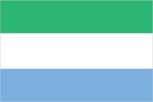
three equal horizontal bands of light green (top), white, and light blue Economy Sierra Leone
GDP - composition by sector
- agriculture
- 49%
- industry
- 31%
- services
- 21% (2001 est.)
GDP - per capita (PPP)
$900 (2006 est.)
GDP - real growth rate
6.8% (2006 est.)
GDP (official exchange rate)
$1.233 billion (2006 est.)
GDP (purchasing power parity)
$5.38 billion (2006 est.)
Geographic coordinates
8 30 N, 11 30 W
Geography - note
rainfall along the coast can reach 495 cm (195 inches) a year, making it one of the wettest places along coastal, western Africa People Sierra Leone
Government type
constitutional democracy
Heliports
2 (2006)
HIV/AIDS - adult prevalence rate
7% (2001 est.)
HIV/AIDS - deaths
11,000 (2001 est.)
HIV/AIDS - people living with HIV/AIDS
170,000 (2001 est.)
Household income or consumption by percentage share
- highest 10%
- 43.6% (1989)
- lowest 10%
- 0.5%
Imports
$531 million f.o.b. (2004 est.)
Imports - commodities
foodstuffs, machinery and equipment, fuels and lubricants, chemicals
Imports - partners
Germany 18.7%, Cote d'Ivoire 11.1%, UK 8.4%, US 6.8%, China 5.5%, Netherlands 5.3% (2005)
Independence
27 April 1961 (from UK)
Industrial production growth rate
NA%
Industries
diamond mining; small-scale manufacturing (beverages, textiles, cigarettes, footwear); petroleum refining, small commercial ship repair
Infant mortality rate
- female
- 142.8 deaths/1,000 live births (2006 est.)
- male
- 177.47 deaths/1,000 live births
- total
- 160.39 deaths/1,000 live births
Inflation rate (consumer prices)
1% (2002 est.)
International organization participation
ACP, AfDB, AU, C, ECOWAS, FAO, G-77, IAEA, IBRD, ICAO, ICCt, ICRM, IDA, IDB, IFAD, IFC, IFRCS, ILO, IMF, IMO, Interpol, IOC, IOM, ITU, ITUC, MIGA, NAM, OIC, OPCW, UN, UNCTAD, UNESCO, UNIDO, UNWTO, UPU, WCL, WCO, WFTU, WHO, WIPO, WMO, WTO
Internet country code
.sl
Internet hosts
20 (2006)
Internet Service Providers (ISPs)
1 (2001)
Internet users
10,000 (2005) Transportation Sierra Leone
Irrigated land
300 sq km (2003)
Judicial branch
Supreme Court; Appeals Court; High Court
Labor force
1.369 million (1981 est.)
Labor force - by occupation
- agriculture
- NA%
- industry
- NA%
- services
- NA%
Land boundaries
- border countries
- Guinea 652 km, Liberia 306 km
- total
- 958 km
Land use
- arable land
- 7.95%
- other
- 91% (2005)
- permanent crops
- 1.05%
Languages
English (official, regular use limited to literate minority), Mende (principal vernacular in the south), Temne (principal vernacular in the north), Krio (English-based Creole, spoken by the descendants of freed Jamaican slaves who were settled in the Freetown area, a lingua franca and a first language for 10% of the population but understood by 95%)
Legal system
based on English law and customary laws indigenous to local tribes; has not accepted compulsory ICJ jurisdiction
Legislative branch
- unicameral Parliament (124 seats - 112 elected by popular vote, 12 filled by paramount chiefs elected in separate elections; members serve five-year terms)
- election results
- percent of vote by party - SLPP 70.06%, APC 22.35%, PLP 3%, others 4.59%; seats by party - SLPP 83, APC 27, PLP 2
- elections
- last held 14 May 2002 (next to be held 28 July 2007)
Life expectancy at birth
- female
- 42.46 years (2006 est.)
- male
- 38.05 years
- total population
- 40.22 years
Literacy
- definition
- age 15 and over can read and write English, Mende, Temne, or Arabic
- female
- 20.5% (2000 est.) Government Sierra Leone
- male
- 39.8%
- total population
- 29.6%
Location
Western Africa, bordering the North Atlantic Ocean, between Guinea and Liberia
Major infectious diseases
- aerosolized dust or soil contact disease
- Lassa fever (2007)
- degree of risk
- very high
- food or waterborne diseases
- bacterial and protozoal diarrhea, hepatitis A, and typhoid fever
- vectorborne diseases
- malaria and yellow fever are high risks in some locations
- water contact disease
- schistosomiasis
Manpower available for military service
- males age 18-49
- 1,086,091 (2005 est.)
Manpower fit for military service
- males age 18-49
- 539,697 (2005 est.)
Map references
Africa
Maritime claims
- contiguous zone
- 24 nm
- continental shelf
- 200 nm
- exclusive economic zone
- 200 nm
- territorial sea
- 12 nm
Median age
- female
- 17.7 years (2006 est.)
- male
- 17.1 years
- total
- 17.4 years
Merchant marine
- by type
- bulk carrier 2, cargo 36, chemical tanker 3, combination ore/oil 3, liquefied gas 1, livestock carrier 1, passenger 1, passenger/cargo 3, petroleum tanker 2, roll on/roll off 2
- foreign-owned
- 14 (China 2, Cyprus 1, Egypt 1, Russia 1, Syria 1, UAE 3, Ukraine 4, US 1) (2006)
- total
- 54 ships (1000 GRT or over) 185,037 GRT/249,996 DWT
Military expenditures - dollar figure
$14.25 million (2005 est.)
Military expenditures - percent of GDP
1.7% (2005 est.) Transnational Issues Sierra Leone
Military service age and obligation
18 years of age (est.); no conscription (2001)
National holiday
Independence Day, 27 April (1961)
Nationality
- adjective
- Sierra Leonean
- noun
- Sierra Leonean(s)
Natural gas - consumption
0 cu m (2004 est.)
Natural gas - production
0 cu m (2004 est.)
Natural hazards
dry, sand-laden harmattan winds blow from the Sahara (December to February); sandstorms, dust storms
Natural resources
diamonds, titanium ore, bauxite, iron ore, gold, chromite
Net migration rate
- 0.23 migrant(s)/1,000 population
- note
- refugees currently in surrounding countries are slowly returning (2006 est.)
Oil - consumption
6,600 bbl/day (2004 est.)
Oil - exports
NA bbl/day
Oil - imports
NA bbl/day
Oil - production
3.993 bbl/day (2004 est.)
Political parties and leaders
All People's Congress or APC [Ernest Bai KOROMA]; Peace and Liberation Party or PLP [Darlington MORRISON, interim chairman]; People's Movement for Democratic Change or PMDC [Charles MARGAI]; Sierra Leone People's Party or SLPP [Solomon BEREWA]; numerous others
Political pressure groups and leaders
trade unions and student unions
Population
6,005,250 (July 2006 est.)
Population below poverty line
68% (1989 est.)
Population growth rate
2.3% (2006 est.)
Ports and terminals
Freetown, Pepel, Sherbro Islands Military Sierra Leone
Radio broadcast stations
AM 1, FM 9, shortwave 1 (1999)
Radios
1.12 million (1997)
Refugees and internally displaced persons
- refugees (country of origin)
- 59,952 (Liberia) (2006) This page was last updated on 8 February, 2007
Religions
Muslim 60%, indigenous beliefs 30%, Christian 10%
Republic of Sierra Leone Armed Forces (RSLAF)
Army (includes Air Wing, Maritime Wing)
Roadways
- paved
- 904 km
- total
- 11,300 km
- unpaved
- 10,396 km (2002)
Sex ratio
- at birth
- 1.03 male(s)/female
- total population
- 0.94 male(s)/female (2006 est.)
- under 15 years
- 0.96 male(s)/female 15-64 years: 0.92 male(s)/female 65 years and over: 0.89 male(s)/female
Suffrage
18 years of age; universal
Telephone system
- domestic
- the national microwave radio relay trunk system connects Freetown to Bo and Kenema
- general assessment
- marginal telephone and telegraph service
- international
- country code - 232; satellite earth station - 1 Intelsat (Atlantic Ocean)
Telephones - main lines in use
24,000 (2002)
Telephones - mobile cellular
113,200 (2003)
Television broadcast stations
2 (1999)
Televisions
53,000 (1997)
Terrain
coastal belt of mangrove swamps, wooded hill country, upland plateau, mountains in east
Total fertility rate
6.08 children born/woman (2006 est.)
Unemployment rate
NA%
Waterways
800 km (600 km year round) (2005)