1999 Edition
CIA World Factbook 1999 (Internet Archive)
Introduction
Background
On 25 May 1997, the democratically-elected government of President Ahmad Tejan KABBAH was overthrown by a disgruntled coalition of army personnel from the Armed Forces Revolutionary Council (AFRC) and the Revolutionary United Front (RUF) under the command of Major Johnny Paul KOROMA; President KABBAH fled to exile in Guinea. The Economic Community of West African States Cease-Fire Monitoring Group (ECOMOG) forces, led by a strong Nigerian contingent, undertook the suppression of the rebellion. They were initially unsuccessful, but, by October 1997, they forced the rebels to agree to a cease-fire and to a plan to return the government to democratic control. President KABBAH returned to office on 10 March 1998 to face the task of restoring order to a demoralized population and a disorganized and severely damaged economy. Many of the leaders of the coup were tried and executed in October 1998. In January 1999, the situation had deteriorated even further, with commerce at a standstill, hundreds of thousands of people driven from their homes, and bitter fighting between the AFRC/RUF and ECOMOG troops intensifying by large-scale import of arms.
Geography
Area
total: 71,740 sq km land: 71,620 sq km water: 120 sq km
Area--comparative
slightly smaller than South Carolina
Climate
tropical; hot, humid; summer rainy season (May to December); winter dry season (December to April)
Coastline
402 km
Elevation extremes
lowest point: Atlantic Ocean 0 m highest point: Loma Mansa (Bintimani) 1,948 m
Environment--current issues
rapid population growth pressuring the environment; overharvesting of timber, expansion of cattle grazing, and slash-and-burn agriculture have resulted in deforestation and soil exhaustion; civil war depleting natural resources; overfishing
Environment--international agreements
party to: Biodiversity, Climate Change, Desertification, Endangered Species, Law of the Sea, Marine Life Conservation, Nuclear Test Ban signed, but not ratified: Environmental Modification
Geographic coordinates
8 30 N, 11 30 W
Irrigated land
290 sq km (1993 est.)
Land boundaries
total: 958 km border countries: Guinea 652 km, Liberia 306 km
Land use
arable land: 7% permanent crops: 1% permanent pastures: 31% forests and woodland: 28% other: 33% (1993 est.)
Location
Western Africa, bordering the North Atlantic Ocean, between Guinea and Liberia
Map references
Africa
Maritime claims
territorial sea: 200 nm continental shelf: 200-m depth or to the depth of exploitation
Natural hazards
dry, sand-laden harmattan winds blow from the Sahara (November to May); sandstorms, dust storms
Natural resources
diamonds, titanium ore, bauxite, iron ore, gold, chromite
Terrain
coastal belt of mangrove swamps, wooded hill country, upland plateau, mountains in east
People and Society
Age structure
0-14 years: 45% (male 1,182,181; female 1,219,956) 15-64 years: 52% (male 1,307,475; female 1,423,046) 65 years and over: 3% (male 82,374; female 81,619) (1999 est.)
Birth rate
45.62 births/1,000 population (1999 est.)
Death rate
16.77 deaths/1,000 population (1999 est.)
Ethnic groups
20 native African tribes 90% (Temne 30%, Mende 30%, other 30%), Creole 10% (descendents of freed Jamaican slaves who were settled in the Freetown area in the late-eighteenth century), refugees from Liberia's recent civil war, small numbers of Europeans, Lebanese, Pakistanis, and Indians
Infant mortality rate
126.23 deaths/1,000 live births (1999 est.)
Languages
English (official, regular use limited to literate minority), Mende (principal vernacular in the south), Temne (principal vernacular in the north), Krio (English-based Creole, spoken by the descendents of freed Jamaican slaves who were settled in the Freetown area, a lingua franca and a first language for 10% of the population but understood by 95%)
Life expectancy at birth
total population: 49.13 years male: 46.07 years female: 52.27 years (1999 est.)
Literacy
definition: age 15 and over can read and write English, Mende, Temne, or Arabic total population: 31.4% male: 45.4% female: 18.2% (1995 est.)
Nationality
noun: Sierra Leonean(s) adjective: Sierra Leonean
Net migration rate
14.5 migrant(s)/1,000 population (1999 est.)
Population
5,296,651 (July 1999 est.)
Population growth rate
4.34% (1999 est.)
Religions
Muslim 60%, indigenous beliefs 30%, Christian 10%
Sex ratio
at birth: 1.03 male(s)/female under 15 years: 0.97 male(s)/female 15-64 years: 0.92 male(s)/female 65 years and over: 1.01 male(s)/female total population: 0.94 male(s)/female (1999 est.)
Total fertility rate
6.16 children born/woman (1999 est.)
Government
Administrative divisions
3 provinces and 1 area*; Eastern, Northern, Southern, Western*
Capital
Freetown
Constitution
1 October 1991; subsequently amended several times
Country name
conventional long form: Republic of Sierra Leone conventional short form: Sierra Leone
Data code
SL
Executive branch
chief of state: President Ahmad Tejan KABBAH (since 29 March 1996, reinstated 10 March 1998); note--the president is both the chief of state and head of government head of government: President Ahmad Tejan KABBAH (since 29 March 1996, reinstated 10 March 1998); note--the president is both the chief of state and head of government cabinet: Ministers of State appointed by the president with the approval of the House of Representatives; the cabinet is responsible to the president elections: president elected by popular vote for a five-year term; election held 26-27 February 1996 (next to be held NA 2001); note--president's tenure of office is limited to two five-year terms election results: Ahmad Tejan KABBAH elected president; percent of vote--first round--KABBAH 36.0%, second round--KABBAH 59.5%
Flag description
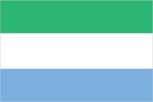
three equal horizontal bands of light green (top), white, and light blue
Government type
constitutional democracy
Independence
27 April 1961 (from UK)
International organization participation
ACP, AfDB, C, CCC, ECA, ECOWAS, FAO, G-77, IAEA, IBRD, ICAO, ICFTU, ICRM, IDA, IDB, IFAD, IFC, IFRCS, ILO, IMF, IMO, Intelsat (nonsignatory user), Interpol, IOC, ITU, NAM, OAU, OIC, OPCW, UN, UNCTAD, UNESCO, UNIDO, UPU, WCL, WFTU, WHO, WIPO, WMO, WToO, WTrO Diplomatic representation in the US: chief of mission: Ambassador John Ernest LEIGH chancery: 1701 19th Street NW, Washington, DC 20009 Diplomatic representation from the US: chief of mission: Ambassador Joseph MELROSE; note--embassy closed in late December 1998 embassy: Corner of Walpole and Siaka Stevens Streets, Freetown mailing address: use embassy street address
Judicial branch
Supreme Court Political parties and leaders: 15 parties registered for the M. B. JALLOH]; National Alliance for Democracy Party or NADP
Legal system
based on English law and customary laws indigenous to local tribes; has not accepted compulsory ICJ jurisdiction
Legislative branch
unicameral House of Representatives (80 seats--68 elected by popular vote, 12 filled by paramount chiefs elected in separate elections; members serve five-year terms) elections: last held 26-27 February 1996 (next to be held 2001) election results: percent of vote by party--NA; seats by party--SLPP 27, UNPP 17, PDP 12, APC 5, NUP 4, DCP 3; note--first elections since the former House of Representatives was shut down by the military coup of 29 April 1992
National holiday
Republic Day, 27 April (1961)
Suffrage
18 years of age; universal
Economy
Agriculture--products
rice, coffee, cocoa, palm kernels, palm oil, peanuts; poultry, cattle, sheep, pigs; fish
Budget
revenues: $96 million expenditures: $150 million, including capital expenditures of $NA (1996 est.)
Currency
1 leone (Le) = 100 cents
Debt--external
$1.15 billion (1998)
Economic aid--recipient
$203.7 million (1995)
Economy--overview
Sierra Leone has substantial mineral, agricultural, and fishery resources. However, the economic and social infrastructure is not well developed, and serious social disorders continue to hamper economic development. The period of AFRC/RUF junta rule (May 1997-February 1998) led to UN sanctions and 20% drop in GDP in 1997. The continued fighting at yearend 1997 set back what small progress had been made by the KABBAH government in recovering from the junta period and reestablishing a viable economy. About two-thirds of the working-age population engages in subsistence agriculture. Manufacturing consists mainly of the processing of raw materials and of light manufacturing for the domestic market. Bauxite and rutile mines have been shut down by civil strife. The major source of hard currency is found in the mining of diamonds, the large majority of which are smuggled out of the country. The fate of the economy in 1999 depends on the outcome of negotiations to end the civil strife.
Electricity--consumption
230 million kWh (1996)
Electricity--exports
0 kWh (1996)
Electricity--imports
0 kWh (1996)
Electricity--production
230 million kWh (1996)
Electricity--production by source
fossil fuel: 100% hydro: 0% nuclear: 0% other: 0% (1996)
Exchange rates
leones (Le) per US$1--1,630.5 (January 1999), 1,597.2 (1998), 981.48 (1997), 920.73 (1996), 755.22 (1995), 586.74 (1994)
Exports
$41 million (f.o.b., 1998)
Exports--commodities
diamonds, rutile, cocoa, coffee, fish
Exports--partners
Belgium 49%, Spain 10%, US 8%, UK 3% (1997)
Fiscal year
1 July--30 June
GDP
purchasing power parity--$2.7 billion (1998 est.)
GDP--composition by sector
agriculture: 52% industry: 16% services: 32% (1996)
GDP--per capita
purchasing power parity?$530 (1998 est.)
GDP--real growth rate
0.7% (1998 est.)
Household income or consumption by percentage share
lowest 10%: 0.5% highest 10%: 43.6% (1989)
Imports
$166 million (f.o.b., 1998)
Imports--commodities
foodstuffs, machinery and equipment, fuels and lubricants
Imports--partners
UK 16%, US 9%, Cote d'Ivoire 8%, Belgium-Luxembourg 3% (1997)
Industrial production growth rate
NA%
Industries
mining (diamonds); small-scale manufacturing (beverages, textiles, cigarettes, footwear); petroleum refining
Inflation rate (consumer prices)
37.4% (1998 est.)
Labor force
1.369 million (1981 est.) note: only about 65,000 wage earners (1985)
Labor force--by occupation
agriculture 65%, industry 19%, services 16% (1981 est.)
Population below poverty line
68% (1989 est.)
Unemployment rate
NA%
Communications
Radio broadcast stations
AM 1, FM 1, shortwave NA
Radios
980,000 (1992 est.)
Telephone system
marginal telephone and telegraph service domestic: national microwave radio relay system made unserviceable by military activities international: satellite earth station--1 Intelsat (Atlantic Ocean)
Telephones
17,526 (1991 est.)
Television broadcast stations
2 (1997)
Televisions
45,000 (1992 est.)
Transportation
Airports
10 (1998 est.) Airports--with paved runways: total: 2 over 3,047 m: 1 914 to 1,523 m: 1 (1998 est.) Airports--with unpaved runways: total: 8 914 to 1,523 m: 5 under 914 m: 3 (1998 est.)
Heliports
1 (1998 est.)
Highways
total: 11,700 km paved: 1,287 km unpaved: 10,413 km (1996 est.)
Merchant marine
none
Railways
total: 84 km used on a limited basis because the mine at Marampa is closed narrow gauge: 84 km 1.067-m gauge
Waterways
800 km; 600 km navigable year round Ports and harbors: Bonthe, Freetown, Pepel
Military and Security
Military branches
Army
Military expenditures--dollar figure
$46 million (FY96/97)
Military expenditures--percent of GDP
2% (FY96/97)
Military manpower--availability
males age 15-49: 1,119,239 (1999 est.) Military manpower--fit for military service: males age 15-49: 543,210 (1999 est.)
Transnational Issues
Disputes--international
none