1994 Edition
CIA World Factbook 1994 (Project Gutenberg)
Introduction
Administrative divisions
3 provinces and 1 area*; Eastern, Northern, Southern, Western*
Agriculture
accounts for over 30% of GDP and two-thirds of the labor force; largely subsistence farming; cash crops - coffee, cocoa, palm kernels; harvests of food staple rice meets 80% of domestic needs; annual fish catch averages 53,000 metric tons
Airports
total: 11 usable: 7 with permanent-surface runways: 3 with runways over 3,659 m: with runways 2,440-3,659 m: 1 with runways 1,220-2,439 m: 3
Area
total area: 71,740 sq km land area: 71,620 sq km comparative area: slightly smaller than South Carolina
Birth rate
45.06 births/1,000 population (1994 est.)
Branches
Army, Navy, Police, Security Forces
Budget
revenues: $68 million expenditures: $118 million, including capital expenditures of $28 million (1992 est.)
Capital
Freetown
Climate
tropical; hot, humid; summer rainy season (May to December); winter dry season (December to April)
Coastline
402 km
Constitution
1 October 1991; suspended following 19 April 1992 coup
Currency
1 leone (Le) = 100 cents
Death rate
18.87 deaths/1,000 population (1994 est.)
Defense expenditures
exchange rate conversion - $6 million, 0.7% of GDP (1988 est.)
Digraph
SL
Diplomatic representation in US
chief of mission: Ambassador Thomas Kahota KARGBO chancery: 1701 19th Street NW, Washington, DC 20009 telephone: (202) 939-9261
Economic aid
recipient: US commitments, including Ex-Im (FY70-89), $161 million; Western (non-US) countries, ODA and OOF bilateral commitments (1970-89), $848 million; OPEC bilateral aid (1979-89), $18 million; Communist countries (1970-89), $101 million
Electricity
capacity: 85,000 kW production: 185 million kWh consumption per capita: 45 kWh (1991)
Environment
current issues: rapid population growth pressuring the environment; overharvesting of timber, expansion of cattle grazing, and slash-and-burn agriculture have resulted in deforestation and soil exhaustion; civil war depleting natural resources natural hazards: dry, sand-laden harmattan winds blow from the Sahara (November to May) international agreements: party to - Marine Life Conservation, Nuclear Test Ban; signed, but not ratified - Climate Change, Environmental Modification, Law of the Sea
Ethnic divisions
13 native African tribes 99% (Temne 30%, Mende 30%, other 39%), Creole, European, Lebanese, and Asian 1%
Exchange rates
leones (Le) per US$1 - 578.17 (January 1994), 567.46 (1993), 499.44 (1992), 295.34 (1991), 144.9275 (1990), 58.1395 (1989)
Executive branch
chief of state and head of government: Chairman of the Supreme Council of State Capt. Valentine E. M. STRASSER (since 29 April 1992) cabinet: Council of Secretaries; responsible to the NPRC
Exports
$149 million (f.o.b., FY92) commodities: rutile 51%, bauxite 19%, diamonds 15%, coffee 5% partners: US, UK, Belgium, Germany, other Western Europe
External debt
$633 million (FY92 est.)
FAX
[232] (22) 225-471
Fiscal year
1 July - 30 June
Flag
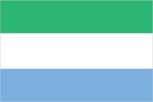
three equal horizontal bands of light green (top), white, and light blue
Highways
total: 7,400 km paved: 1,150 km unpaved: crushed stone, gravel 490 km; improved earth 5,760 km
Imports
$131 million (c.i.f., FY92) commodities: foodstuffs 33%, machinery and equipment 19%, fuels 16% partners: US, EC countries, Japan, China, Nigeria
Independence
27 April 1961 (from UK)
Industrial production
growth rate -1.2% (FY91); accounts for 11% of GDP
Industries
mining (diamonds, bauxite, rutile), small-scale manufacturing (beverages, textiles, cigarettes, footwear), petroleum refinery
Infant mortality rate
141.9 deaths/1,000 live births (1994 est.)
Inflation rate (consumer prices)
35% (1992)
Inland waterways
800 km; 600 km navigable year round
International disputes
none
Irrigated land
340 sq km (1989 est.)
Judicial branch
Supreme Court (suspended after coup of 29 April 1992)
Labor force
1.369 million (1981 est.) by occupation: agriculture 65%, industry 19%, services 16% (1981 est.) note: only about 65,000 wage earners (1985); 55% of population of working age
Land boundaries
total 958 km, Guinea 652 km, Liberia 306 km
Land use
arable land: 25% permanent crops: 2% meadows and pastures: 31% forest and woodland: 29% other: 13%
Languages
English (official; regular use limited to literate minority), Mende principal vernacular in the south, Temne principal vernacular in the north, Krio the language of the re-settled ex-slave population of the Freetown area and is lingua franca
Legal system
based on English law and customary laws indigenous to local tribes; has not accepted compulsory ICJ jurisdiction
Legislative branch
unicameral House of Representatives (suspended after coup of 29 April 1992); Chairman STRASSER promises multi-party elections sometime in 1995
Life expectancy at birth
total population: 46.4 years male: 43.58 years female: 49.3 years (1994 est.)
Literacy
age 15 and over can read and write English, Merde, Temne, or Arabic (1990 est.) total population: 21% male: 31% female: 11%
Location
Western Africa, bordering the North Atlantic Ocean between Guinea and Liberia
Manpower availability
males age 15-49 1,006,280; fit for military service 487,158
Map references
Africa, Standard Time Zones of the World
Maritime claims
territorial sea: 200 nm
Member of
ACP, AfDB, C, CCC, ECA, ECOWAS, FAO, G-77, GATT, IAEA, IBRD, ICAO, ICFTU, IDA, IDB, IFAD, IFC, ILO, IMF, IMO, INTELSAT (nonsignatory user), INTERPOL, IOC, ITU, LORCS, NAM, OAU, OIC, UN, UNCTAD, UNESCO, UNIDO, UNOMIG, UPU, WCL, WHO, WIPO, WMO, WTO
Merchant marine
1 cargo ship (over 1,000 GRT) totaling 5,592 GRT/9,107 DWT
Names
conventional long form: Republic of Sierra Leone conventional short form: Sierra Leone
National holiday
Republic Day, 27 April (1961)
National product
GDP - purchasing power equivalent - $4.5 billion (FY93 est.)
National product per capita
$1,000 (1993 est.)
National product real growth rate
NA
Nationality
noun: Sierra Leonean(s) adjective: Sierra Leonean
Natural resources
diamonds, titanium ore, bauxite, iron ore, gold, chromite
Net migration rate
0 migrant(s)/1,000 population (1994 est.)
Overview
The economic and social infrastructure is not well developed. Subsistence agriculture dominates the economy, generating about one-third of GDP and employing about two-thirds of the working population. Manufacturing, which accounts for roughly 10% of GDP, consists mainly of the processing of raw materials and of light manufacturing for the domestic market. Diamond mining provides an important source of hard currency. In 1990-93, the government, with the support of the IMF and the World Bank, has made substantial progress toward structural reform and better fiscal management. The government readily met all IMF/WB targets in December 1993. The budget deficit had been dramatically reduced; the government workforce had been cut by 25%; large amounts of domestic debt had been retired; arrears to the IMF, World Bank, and other creditors had been reduced. On the negative side, continued incursions by the Liberian rebels, bandits, and army deserters in southern and eastern Sierra Leone have severely strained the economy and threaten economically critical regions of the country.
Political parties and leaders
status of existing political parties is unknown following 29 April 1992 coup
Population
4,630,037 (July 1994 est.)
Population growth rate
2.62% (1994 est.)
Ports
Freetown, Pepel, Bonthe
Railroads
84 km 1.067-meter narrow-gauge mineral line is used on a limited basis because the mine at Marampa is closed
Religions
Muslim 60%, indigenous beliefs 30%, Christian 10%
Suffrage
18 years of age; universal
Telecommunications
marginal telephone and telegraph service; national microwave radio relay system unserviceable at present; 23,650 telephones; broadcast stations - 1 AM, 1 FM, 1 TV; 1 Atlantic Ocean INTELSAT earth station
Terrain
coastal belt of mangrove swamps, wooded hill country, upland plateau, mountains in east
Total fertility rate
5.96 children born/woman (1994 est.)
Type
military government
Unemployment rate
NA%
US diplomatic representation
chief of mission: Ambassador Lauralee M. PETERS embassy: Walpole and Siaka Stevens Street, Freetown mailing address: use embassy street address telephone: [232] (22) 226-481