1999 Edition
CIA World Factbook 1999 (Internet Archive)
Geography
Area
total: 455 sq km land: 455 sq km water: 0 sq km
Area--comparative
2.5 times the size of Washington, DC
Climate
tropical marine; humid; cooler season during southeast monsoon (late May to September); warmer season during northwest monsoon (March to May)
Coastline
491 km
Elevation extremes
lowest point: Indian Ocean 0 m highest point: Morne Seychellois 905 m
Environment--current issues
water supply depends on catchments to collect rain water
Environment--international agreements
party to: Biodiversity, Climate Change, Desertification, Endangered Species, Hazardous Wastes, Law of the Sea, Marine Dumping, Nuclear Test Ban, Ozone Layer Protection, Ship Pollution, Whaling signed, but not ratified: Climate Change-Kyoto Protocol
Geographic coordinates
4 35 S, 55 40 E
Geography--note
40 granitic and about 50 coralline islands
Irrigated land
NA sq km
Land boundaries
0 km
Land use
arable land: 2% permanent crops: 13% permanent pastures: NA% forests and woodland: 11% other: 74% (1993 est.)
Location
Eastern Africa, group of islands in the Indian Ocean, northeast of Madagascar
Map references
Africa
Maritime claims
continental shelf: 200 nm or to the edge of the continental margin exclusive economic zone: 200 nm territorial sea: 12 nm
Natural hazards
lies outside the cyclone belt, so severe storms are rare; short droughts possible
Natural resources
fish, copra, cinnamon trees
Terrain
Mahe Group is granitic, narrow coastal strip, rocky, hilly; others are coral, flat, elevated reefs
People and Society
Age structure
0-14 years: 29% (male 11,712; female 11,569) 15-64 years: 64% (male 24,879; female 26,038) 65 years and over: 7% (male 1,709; female 3,257) (1999 est.)
Birth rate
19.39 births/1,000 population (1999 est.)
Death rate
6.56 deaths/1,000 population (1999 est.)
Ethnic groups
Seychellois (mixture of Asians, Africans, Europeans)
Infant mortality rate
16.65 deaths/1,000 live births (1999 est.)
Languages
English (official), French (official), Creole
Life expectancy at birth
total population: 70.95 years male: 66.61 years female: 75.42 years (1999 est.)
Literacy
definition: age 15 and over can read and write total population: 58% male: 56% female: 60% (1971 est.)
Nationality
noun: Seychellois (singular and plural) adjective: Seychelles
Net migration rate
-6.32 migrant(s)/1,000 population (1999 est.)
Population
79,164 (July 1999 est.)
Population growth rate
0.65% (1999 est.)
Religions
Roman Catholic 90%, Anglican 8%, other 2%
Sex ratio
at birth: 1.03 male(s)/female under 15 years: 1.01 male(s)/female 15-64 years: 0.96 male(s)/female 65 years and over: 0.52 male(s)/female total population: 0.94 male(s)/female (1999 est.)
Total fertility rate
1.97 children born/woman (1999 est.)
Government
Administrative divisions
23 administrative districts; Anse aux Pins, Anse Boileau, Anse Etoile, Anse Louis, Anse Royale, Baie Lazare, Baie Sainte Anne, Beau Vallon, Bel Air, Bel Ombre, Cascade, Glacis, Grand' Anse (on Mahe), Grand' Anse (on Praslin), La Digue, La Riviere Anglaise, Mont Buxton, Mont Fleuri, Plaisance, Pointe La Rue, Port Glaud, Saint Louis, Takamaka
Capital
Victoria
Constitution
18 June 1993
Country name
conventional long form: Republic of Seychelles conventional short form: Seychelles
Data code
SE
Executive branch
chief of state: President France Albert RENE (since 5 June 1977); note--the president is both the chief of state and head of government head of government: President France Albert RENE (since 5 June 1977); note--the president is both the chief of state and head of government cabinet: Council of Ministers appointed by the president elections: president elected by popular vote for a five-year term; election last held 20-22 March 1998 (next to be held by NA 2003) election results: President France Albert RENE reelected; percent of vote--France Albert RENE (SPPF) 61%, Wavel RAMKALAWAN (UO) 27%, Sir James MANCHAM (DP) 12%
Flag description
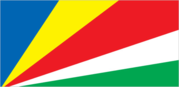
five oblique bands of blue (hoist side), yellow, red, white, and green (bottom) radiating from the bottom of the hoist side
Government type
republic
Independence
29 June 1976 (from UK)
International organization participation
ACCT, ACP, AfDB, C, ECA, FAO, G-77, IBRD, ICAO, ICFTU, ICRM, IFAD, IFC, IFRCS, ILO, IMF, IMO, InOC, Intelsat (nonsignatory user), Interpol, IOC, NAM, OAU, OPCW, SADC, UN, UNCTAD, UNESCO, UNIDO, UPU, WCL, WHO, WMO, WToO, WTrO (applicant) Diplomatic representation in the US: chief of mission: Ambassador Claude MOREL chancery: 800 Second Avenue, Suite 400C, New York, NY 10017 Diplomatic representation from the US: the US does not have an embassy in Seychelles; the ambassador to Mauritius is accredited to Seychelles
Judicial branch
Court of Appeal, judges are appointed by the president; Supreme Court, judges are appointed by the president Political parties and leaders: ruling party--Seychelles People's Political pressure groups and leaders: trade unions; Roman Catholic Church
Legal system
based on English common law, French civil law, and customary law
Legislative branch
unicameral National Assembly or Assemblee Nationale (35 seats--25 elected by popular vote, 10 allocated on a proportional basis to parties winning at least nine percent of the vote; members serve five-year terms) elections: last held 20-22 March 1998 (next to be held by NA 2003) election results: percent of vote by party--NA; seats by party (elected)--SPPF 24, DP 1; seats by party (awarded)--SPPF 6, DP 1, UO 3 note: the 10 awarded seats are apportioned according to the share of each party in the total vote
National holiday
National Day, 18 June (1993) (adoption of the constitution)
Suffrage
17 years of age; universal
Economy
Agriculture--products
coconuts, cinnamon, vanilla, sweet potatoes, cassava (tapioca), bananas; broiler chickens; tuna fish
Budget
revenues: $220 million expenditures: $241 million, including capital expenditures of $36 million (1994 est.)
Currency
1 Seychelles rupee (SRe) = 100 cents
Debt--external
$170 million (1994 est.)
Economic aid--recipient
$16.4 million (1995)
Economy--overview
Since independence in 1976, per capita output in this Indian Ocean archipelago has expanded to roughly seven times the old near-subsistence level. Growth has been led by the tourist sector, which employs about 30% of the labor force and provides more than 70% of hard currency earnings, and by tuna fishing, which accounted for 70% of GDP in 1996-97. In recent years the government has encouraged foreign investment in order to upgrade hotels and other services. At the same time, the government has moved to reduce the dependence on tourism by promoting the development of farming, fishing, and small-scale manufacturing. The vulnerability of the tourist sector was illustrated by the sharp drop in 1991-92 due largely to the Gulf war. Although the industry has rebounded, the government recognizes the continuing need for upgrading the sector in the face of stiff international competition. Other issues facing the government are the curbing of the budget deficit and further privatization of public enterprises.
Electricity--consumption
125 million kWh (1996)
Electricity--exports
0 kWh (1996)
Electricity--imports
0 kWh (1996)
Electricity--production
125 million kWh (1996)
Electricity--production by source
fossil fuel: 100% hydro: 0% nuclear: 0% other: 0% (1996)
Exchange rates
Seychelles rupees (SRe) per US$1--5.4540 (January 1999), 5.2622 (1998), 5.0263 (1997), 4.9700 (1996), 4.7620 (1995), 5.0559 (1994)
Exports
$53 million ( f.o.b., 1995)
Exports--commodities
fish, cinnamon bark, copra, petroleum products (reexports)
Exports--partners
France, UK, China, Germany, Japan (1993)
Fiscal year
calendar year
GDP
purchasing power parity--$550 million (1997 est.)
GDP--composition by sector
agriculture: 4% industry: 15% services: 81% (1994)
GDP--per capita
purchasing power parity?$7,000 (1997 est.)
GDP--real growth rate
4.3% (1997 est.)
Household income or consumption by percentage share
lowest 10%: NA% highest 10%: NA%
Imports
$340 million (c.i.f., 1997)
Imports--commodities
manufactured goods, food, petroleum products, tobacco, beverages, machinery and transportation equipment
Imports--partners
China, Singapore, South Africa, UK (1993)
Industrial production growth rate
4% (1992)
Industries
fishing; tourism; processing of coconuts and vanilla, coir (coconut fiber) rope, boat building, printing, furniture; beverages
Inflation rate (consumer prices)
0.6% (1997)
Labor force
26,000 (1996)
Labor force--by occupation
industry 19%, services 57%, government 14%, fishing, agriculture, and forestry 10% (1989)
Population below poverty line
NA%
Unemployment rate
NA%
Communications
Radio broadcast stations
AM 3, FM 0, shortwave 0
Radios
50,000 (1996 est.)
Telephone system
domestic: radiotelephone communications between islands in the archipelago international: direct radiotelephone communications with adjacent island countries and African coastal countries; satellite earth station--1 Intelsat (Indian Ocean)
Telephones
13,000 (1995 est.)
Television broadcast stations
2 (in addition, there are 9 repeaters) (1997)
Televisions
12,000 (1996 est.)
Transportation
Airports
14 (1998 est.) Airports--with paved runways: total: 6 2,438 to 3,047 m: 1 914 to 1,523 m: 3 under 914 m: 2 (1998 est.) Airports--with unpaved runways: total: 8 914 to 1,523 m: 4 under 914 m: 4 (1998 est.)
Highways
total: 280 km paved: 176 km unpaved: 104 km (1996 est.) Ports and harbors: Victoria
Merchant marine
none
Railways
0 km
Military and Security
Military branches
Army, Coast Guard, Marines, air wing, National Guard, Presidential Protection Unit, Police Force
Military expenditures--dollar figure
$13.7 million (1995)
Military expenditures--percent of GDP
NA%
Military manpower--availability
males age 15-49: 22,420 (1999 est.) Military manpower--fit for military service: males age 15-49: 11,242 (1999 est.)
Transnational Issues
Disputes--international
claims Chagos Archipelago in British Indian Ocean Territory