1992 Edition
CIA World Factbook 1992 (Project Gutenberg)
Geography
Climate
tropical marine; humid; cooler season during southeast monsoon (late May to September); warmer season during northwest monsoon (March to May)
Coastline
491 km
Comparative area
slightly more than 2.5 times the size of Washington, DC
Continental shelf
edge of continental margin or 200 nm
Disputes
claims Tromelin Island
Environment
lies outside the cyclone belt, so severe storms are rare; short droughts possible; no fresh water - catchments collect rain; 40 granitic and about 50 coralline islands
Exclusive economic zone
200 nm
Land area
455 km2
Land boundaries
none
Land use
arable land 4%; permanent crops 18%; meadows and pastures 0%; forest and woodland 18%; other 60%
Natural resources
fish, copra, cinnamon trees
Note
located north-northeast of Madagascar in the Indian Ocean
Terrain
Mahe Group is granitic, narrow coastal strip, rocky, hilly; others are coral, flat, elevated reefs
Territorial sea
12 nm
Total area
455 km2
People and Society
Birth rate
23 births/1,000 population (1992)
Death rate
7 deaths/1,000 population (1992)
Ethnic divisions
Seychellois (mixture of Asians, Africans, Europeans)
Infant mortality rate
15 deaths/1,000 live births (1992)
Labor force
27,700; industry and commerce 31%, services 21%, government 20%, agriculture, forestry, and fishing 12%, other 16% (1985); 57% of population of working age (1983)
Languages
English and French (official); Creole
Life expectancy at birth
65 years male, 75 years female (1992)
Literacy
85% (male NA%, female NA%) age 15 and over can read and write (1990)
Nationality
noun - Seychellois (singular and plural); adjective - Seychelles
Net migration rate
-8 migrants/1,000 population (1992)
Organized labor
three major trade unions
Population
69,519 (July 1992), growth rate 0.8% (1992)
Religions
Roman Catholic 90%, Anglican 8%, other 2%
Total fertility rate
2.4 children born/woman (1992)
Government
Administrative divisions
23 administrative districts; Anse aux Pins, Anse Boileau, Anse Etoile, Anse Louis, Anse Royale, Baie Lazare, Baie Sainte Anne, Beau Vallon, Bel Air, Bel Ombre, Cascade, Glacis, Grand' Anse (on Mahe Island), Grand' Anse (on Praslin Island), La Digue, La Riviere Anglaise, Mont Buxton, Mont Fleuri, Plaisance, Pointe La Rue, Port Glaud, Saint Louis, Takamaka
Capital
Victoria
Chief of State and Head of Government
President France Albert RENE (since 5 June 1977)
Constitution
5 June 1979
Diplomatic representation
Second Secretary, Charge d'Affaires ad interim Marc R. MARENGO; Chancery (temporary) at 820 Second Avenue, Suite 900F, New York, NY 10017; telephone (212) 687-9766 US: Ambassador Richard W. CARLSON; Embassy at 4th Floor, Victoria House, Victoria (mailing address is Box 148, Victoria, and Victoria House, Box 251, Victoria, Mahe, Seychelles, or APO AE 09815-2501); telephone (248) 25256; FAX (248) 25189
Elections
election of delegates to a multiparty constitutional conference is scheduled for June 1992
Executive branch
president, Council of Ministers
Flag
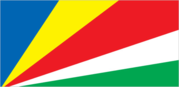
three horizontal bands of red (top), white (wavy), and green; the white band is the thinnest, the red band is the thickest
Independence
29 June 1976 (from UK)
Judicial branch
Court of Appeal, Supreme Court
Legal system
based on English common law, French civil law, and customary law
Legislative branch
unicameral People's Assembly (Assemblee du Peuple)
Long-form name
Republic of Seychelles
Member of
ACCT, ACP, AfDB, C, ECA, FAO, G-77, IBRD, ICAO, ICFTU, IFAD, IFC, ILO, IMF, IMO, INTERPOL, IOC, NAM, OAU, UN, UNCTAD, UNESCO, UNIDO, UPU, WCL, WHO, WMO
National holiday
Liberation Day (anniversary of coup), 5 June (1977)
Other political or pressure groups
trade unions, Roman Catholic Church
People's Assembly
last held 5 December 1987 (next to be held NA December 1992); results - SPPF was the only legal party; seats - (25 total, 23 elected) SPPF 23
Political parties and leaders
ruling party - Seychelles People's Progressive Front (SPPF), France Albert RENE; note - in December 1991, President RENE announced that the Seychelles would begin an immediate transition to a multiparty political system; registration of new political parties was scheduled to begin in January 1992
President
last held 9-11 June 1989 (next to be held NA June 1994); results - President France Albert RENE reelected without opposition
Suffrage
universal at age 17
Type
republic
Economy
Agriculture
accounts for 7% of GDP, mostly subsistence farming; cash crops - coconuts, cinnamon, vanilla; other products - sweet potatoes, cassava, bananas; broiler chickens; large share of food needs imported; expansion of tuna fishing under way
Budget
revenues $180 million; expenditures $202 million, including capital expenditures of $32 million (1989)
Currency
Seychelles rupee (plural - rupees); 1 Seychelles rupee (SRe) = 100 cents
Economic aid
US commitments, including Ex-Im (FY78-89), $26 million; Western (non-US) countries, ODA and OOF bilateral commitments (1978-89), $315 million; OPEC bilateral aid (1979-89), $5 million; Communist countries (1970-89), $60 million
Electricity
30,000 kW capacity; 80 million kWh produced, 1,160 kWh per capita (1991)
Exchange rates
Seychelles rupees (SRe) per US$1 - 5.2946 (March 1992), 5.2893 (1991), 5.3369 (1990), 5.6457 (1989), 5.3836 (1988), 5.6000 (1987)
Exports
$40 million (f.o.b., 1990 est.) commodities: fish, copra, cinnamon bark, petroleum products (reexports) partners: France 63%, Pakistan 12%, Reunion 10%, UK 7% (1987)
External debt
$189 million (1991 est.)
Fiscal year
calendar year
GDP
exchange rate conversion - $350 million, per capita $5,200; real growth rate -4.5% (1991 est.)
Imports
$186 million (f.o.b., 1990 est.) commodities: manufactured goods, food, tobacco, beverages, machinery and transportation equipment, petroleum products partners: UK 20%, France 14%, South Africa 13%, PDRY 13%, Singapore 8%, Japan 6% (1987)
Industrial production
growth rate 7% (1987); accounts for 10% of GDP
Industries
tourism, processing of coconut and vanilla, fishing, coir rope factory, boat building, printing, furniture, beverage
Inflation rate (consumer prices)
1.8% (1990 est.)
Overview
In this small, open, tropical island economy, the tourist industry employs about 30% of the labor force and provides more than 70% of hard currency earnings. In recent years the government has encouraged foreign investment in order to upgrade hotels and other services. At the same time, the government has moved to reduce the high dependence on tourism by promoting the development of farming, fishing, and small-scale manufacturing.
Unemployment rate
9% (1987)
Communications
Airports
14 total, 14 usable; 8 with permanent-surface runways; none with runways over 3,659 m; 1 with runways 2,440-3,659 m; none with runways 1,220-2,439 m
Civil air
1 major transport aircraft
Highways
260 km total; 160 km paved, 100 km crushed stone or earth
Merchant marine
1 refrigerated cargo totaling 1,827 GRT/2,170 DWT
Ports
Victoria
Telecommunications
direct radio communications with adjacent islands and African coastal countries; 13,000 telephones; broadcast stations - 2 AM, no FM, 2 TV; 1 Indian Ocean INTELSAT earth station; USAF tracking station
Military and Security
Branches
Army, Navy, Air Force, Presidential Protection Unit, Police Force, Militia
Defense expenditures
exchange rate conversion - $12 million, 4% of GDP (1990 est.)
Manpower availability
males 15-49, 17,739; 9,096 fit for military service