2010 Edition
CIA World Factbook 2010 (Project Gutenberg)
Introduction
Background
The French colonies of Senegal and the French Sudan were merged in 1959 and granted their independence as the Mali Federation in 1960. The union broke up after only a few months. Senegal joined with The Gambia to form the nominal confederation of Senegambia in 1982. The envisaged integration of the two countries was never carried out, and the union was dissolved in 1989. The Movement of Democratic Forces in the Casamance (MFDC) has led a low-level separatist insurgency in southern Senegal since the 1980s, and several peace deals have failed to resolve the conflict. Nevertheless, Senegal remains one of the most stable democracies in Africa. Senegal was ruled by a Socialist Party for 40 years until current President Abdoulaye WADE was elected in 2000. He was reelected in February 2007 and has amended Senegal's constitution over a dozen times to increase executive power and to weaken the opposition, part of the President's increasingly autocratic governing style. Senegal has a long history of participating in international peacekeeping and regional mediation.
Geography
Area
- land
- 192,530 sq km
- total
- 196,722 sq km
- water
- 4,192 sq km
Area - comparative
slightly smaller than South Dakota
Climate
tropical; hot, humid; rainy season (May to November) has strong southeast winds; dry season (December to April) dominated by hot, dry, harmattan wind
Coastline
531 km
Elevation extremes
- highest point
- unnamed elevation southwest of Kedougou 581 m
- lowest point
- Atlantic Ocean 0 m
Environment - current issues
wildlife populations threatened by poaching; deforestation; overgrazing; soil erosion; desertification; overfishing
Environment - international agreements
- party to
- Biodiversity, Climate Change, Climate Change-Kyoto Protocol, Desertification, Endangered Species, Hazardous Wastes, Law of the Sea, Marine Life Conservation, Ozone Layer Protection, Ship Pollution, Wetlands, Whaling signed, but not ratified: none of the selected agreements
Freshwater withdrawal (domestic/industrial/agricultural)
- per capita
- 190 cu m/yr (2002)
- total
- 2.22 cu km/yr (4%/3%/93%)
Geographic coordinates
14 00 N, 14 00 W
Geography - note
westernmost country on the African continent; The Gambia is almost an enclave within Senegal
Irrigated land
1,200 sq km (2003)
Land boundaries
- border countries
- The Gambia 740 km, Guinea 330 km, Guinea-Bissau 338 km, Mali 419 km, Mauritania 813 km
- total
- 2,640 km
Land use
- arable land
- 12.51%
- other
- 87.25% (2005)
- permanent crops
- 0.24%
Location
Western Africa, bordering the North Atlantic Ocean, between Guinea-Bissau and Mauritania
Map references
Africa
Maritime claims
- contiguous zone
- 24 nm
- continental shelf
- 200 nm or to the edge of the continental margin
- exclusive economic zone
- 200 nm
- territorial sea
- 12 nm
Natural hazards
lowlands seasonally flooded; periodic droughts
Natural resources
fish, phosphates, iron ore
Terrain
generally low, rolling, plains rising to foothills in southeast
Total renewable water resources
39.4 cu km (1987)
People and Society
Age structure
0-14 years: 42.2% (male 2,911,324/female 2,877,804) 15-64 years: 54.8% (male 3,728,664/female 3,786,000) 65 years and over: 3% (male 190,343/female 217,462) (2010 est.)
Birth rate
37.27 births/1,000 population (2010 est.)
Death rate
9.49 deaths/1,000 population (July 2010 est.)
Education expenditures
5.1% of GDP (2008)
Ethnic groups
Wolof 43.3%, Pular 23.8%, Serer 14.7%, Jola 3.7%, Mandinka 3%, Soninke 1.1%, European and Lebanese 1%, other 9.4%
HIV/AIDS - adult prevalence rate
1% (2007 est.)
HIV/AIDS - deaths
1,800 (2007 est.)
HIV/AIDS - people living with HIV/AIDS
67,000 (2007 est.)
Infant mortality rate
- female
- 50.86 deaths/1,000 live births (2010 est.)
- male
- 64.34 deaths/1,000 live births
- total
- 57.7 deaths/1,000 live births
Languages
French (official), Wolof, Pulaar, Jola, Mandinka
Life expectancy at birth
- female
- 61.34 years (2010 est.)
- male
- 57.48 years
- total population
- 59.38 years
Literacy
- definition: age 15 and over can read and write
- female
- 29.2% (2002 est.)
- male
- 51.1%
- total population
- 39.3%
Major infectious diseases
- animal contact disease
- rabies (2009)
- degree of risk
- very high
- food or waterborne diseases
- bacterial and protozoal diarrhea, hepatitis A, and typhoid fever
- respiratory disease
- meningococcal meningitis
- vectorborne diseases
- Crimean-Congo hemorrhagic fever, dengue fever, malaria, Rift Valley fever, and yellow fever
- water contact disease
- schistosomiasis
Median age
- female
- 18.7 years (2010 est.)
- male
- 17.1 years
- total
- 17.9 years
Nationality
- adjective
- Senegalese
- noun
- Senegalese (singular and plural)
Net migration rate
-1.99 migrant(s)/1,000 population (2010 est.)
Population
12,323,252 (July 2010 est.)
Population growth rate
2.579% (2010 est.)
Religions
Muslim 94%, Christian 5% (mostly Roman Catholic), indigenous beliefs 1%
School life expectancy (primary to tertiary education)
- female
- 7 years (2008)
- male
- 8 years
- total
- 8 years
Sex ratio
- at birth
- 1.03 male(s)/female under 15 years: 1.01 male(s)/female 15-64 years: 0.98 male(s)/female 65 years and over: 0.87 male(s)/female
- total population
- 0.99 male(s)/female (2010 est.)
Total fertility rate
4.86 children born/woman (2010 est.)
Urbanization
- rate of urbanization
- 3.1% annual rate of change (2005-10 est.)
- urban population
- 42% of total population (2008)
Government
Administrative divisions
14 regions (regions, singular - region); Dakar, Diourbel, Fatick, Kaffrine, Kaolack, Kedougou, Kolda, Louga, Matam, Saint-Louis, Sedhiou, Tambacounda, Thies, Ziguinchor
Capital
- geographic coordinates
- 14 40 N, 17 26 W
- name
- Dakar
- time difference
- UTC 0 (5 hours ahead of Washington, DC during Standard Time)
Constitution
adopted 7 January 2001
Country name
- conventional long form
- Republic of Senegal
- conventional short form
- Senegal
- former
- Senegambia (along with The Gambia), Mali Federation
- local long form
- Republique du Senegal
- local short form
- Senegal
Diplomatic representation from the US
- chief of mission
- Ambassador Marcia S. BERNICAT
- embassy
- Avenue Jean XXIII at the corner of Rue Kleber, Dakar
- FAX
- [221] 33-822-2991
- mailing address
- B. P. 49, Dakar
- telephone
- [221] 33-829-2100
Diplomatic representation in the US
- chancery
- 2112 Wyoming Avenue NW, Washington, DC 20008
- chief of mission
- Ambassador Fatou Danielle DIAGNE
- consulate(s) general
- Houston, New York
- FAX
- [1] (202) 332-6315
- telephone
- [1] (202) 234-0540
Executive branch
- cabinet
- Council of Ministers appointed by the prime minister in consultation with the president (For more information visit the World Leaders website )
- chief of state
- President Abdoulaye WADE (since 1 April 2000)
- election results
- Abdoulaye WADE reelected president; percent of vote - Abdoulaye WADE 55.9%, Idrissa SECK 14.9%, Ousmane Tanor DIENG 13.6%, Moustapha NIASSE 5.9%, other 9.7%
- elections
- president elected by popular vote for a five-year term (eligible for a second term) under new constitution; election last held on 25 February 2007 (next to be held in 2012); prime minister appointed by the president
- head of government
- Prime Minister Soulayemane Ndene NDIAYE (since 1 May 2009)
Flag description
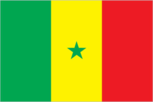
three equal vertical bands of green (hoist side), yellow, and red with a small green five-pointed star centered in the yellow band; green represents Islam, progress, and hope; yellow signifies natural wealth and progress; red symbolizes sacrifice and determination; the star denotes unity and hope note: uses the popular Pan-African colors of Ethiopia; the colors from left to right are the same as those of neighboring Mali and the reverse of those on the flag of neighboring Guinea
Government type
republic
Independence
4 April 1960 (from France); note - complete independence achieved upon dissolution of federation with Mali on 20 August 1960
International organization participation
ACP, AfDB, AU, CPLP (associate), ECOWAS, FAO, FZ, G-15, G-77, IAEA, IBRD, ICAO, ICC, ICCt, ICRM, IDA, IDB, IFAD, IFC, IFRCS, ILO, IMF, IMO, IMSO, Interpol, IOC, IOM, IPU, ISO, ITSO, ITU, ITUC, MIGA, MONUSCO, NAM, OIC, OIF, OPCW, PCA, UN, UNAMID, UNCTAD, UNESCO, UNIDO, Union Latina, UNMIL, UNOCI, UNWTO, UPU, WADB (regional), WAEMU, WCO, WFTU, WHO, WIPO, WMO, WTO
Judicial branch
Constitutional Court; Council of State; Court of Final Appeals or Cour de Cassation; Court of Appeals
Legal system
based on French civil law system; judicial review of legislative acts in Constitutional Court; the Council of State audits the government's accounting office; accepts compulsory ICJ jurisdiction with reservations
Legislative branch
- bicameral Parliament consisting of the Senate, reinstituted in 2007, (100 seats; 35 members indirectly elected and 65 members appointed by the president) and the National Assembly or Assemblee Nationale (150 seats; 90 members elected by direct popular vote and 60 elected by proportional representation from party lists to serve five-year terms)
- election results
- Senate results - percent of vote by party - NA; seats by party - PDS 34, AJ/PADS 1, 65 appointed by the president; National Assembly results - percent of vote by party - NA; seats by party - SOPI Coalition 131, other 19
- elections
- Senate - last held on 19 August 2007 (next to be held - NA); National Assembly - last held on 3 June 2007 (next to be held in 2012); note - the National Assembly in December 2005 voted to postpone legislative elections originally scheduled for 2006; legislative elections were first rescheduled to coincide with the 25 February 2007 presidential elections and later for 3 June 2007; the election was boycotted by 12 opposition parties, including the former ruling Socialist Party, which resulted in a record-low 35% voter turnout
National anthem
- lyrics/music
- Leopold Sedar SENGHOR/Herbert PEPPER note: adopted 1960; the lyrics were written by Leopold Sedar SENGHOR, Senegal"s first president; the anthem is sometimes played incorporating the Koras (harp-like stringed instruments) and Balafons (types of xylophones) mentioned in the title
- name
- "Pincez Tous vos Koras, Frappez les Balafons" (Pluck Your Koras, Strike the Balafons)
National holiday
Independence Day, 4 April (1960)
Political parties and leaders
African Party of Independence [Majhemout DIOP]; Alliance for the Republic-Yakaar [Macky Sall]; Alliance of Forces of Progress or AFP [Moustapha NIASSE]; And-Jef/African Party for Democracy and Socialism or AJ/PADS [Landing SAVANE]; Democratic League-Labor Party Movement or LD-MPT [Dr. Abdoulaye BATHILY]; Front for Socialism and Democracy/Benno Jubel or FSD/BJ [Cheikh Abdoulaye Bamba DIEYE]; Gainde Centrist Bloc or BGC [Jean-Paul DIAS]; Independence and Labor Party or PIT [Amath DANSOKHO]; Jef-Jel [Talla SYLLA]; National Democratic Rally or RND [Madior DIOUF]; People's Labor Party or PTP [El Hadji DIOUF]; Reform Party or PR [Abdourahim AGNE]; Rewmi Party [Idrissa Seck]; Senegalese Democratic Party or PDS [Abdoulaye WADE]; Socialist Party or PS [Ousmane Tanor DIENG]; SOPI Coalition [Abdoulaye WADE] (a coalition led by the PDS); Union for Democratic Renewal or URD [Djibo Leyti KA]
Political pressure groups and leaders
- other
- labor; students; Sufi brotherhoods, including the Mourides and Tidjanes; teachers
Suffrage
18 years of age; universal
Economy
Agriculture - products
peanuts, millet, corn, sorghum, rice, cotton, tomatoes, green vegetables; cattle, poultry, pigs; fish
Central bank discount rate
4.25% (31 December 2009) 4.75% (31 December 2008)
Commercial bank prime lending rate
NA%
Current account balance
-$1.046 billion (2010 est.) -$1.356 billion (2009 est.)
Debt - external
$3.885 billion (31 December 2010 est.) $3.462 billion (31 December 2009 est.)
Distribution of family income - Gini index
41.3 (2001) 41.3 (1995)
Economy - overview
Senegal relies heavily on donor assistance. The country's key export industries are phosphate mining, fertilizer production, and commercial fishing. The country is also working on iron ore and oil exploration projects. In January 1994, Senegal undertook a bold and ambitious economic reform program with the support of the international donor community. Government price controls and subsidies have been steadily dismantled. After seeing its economy contract by 2.1% in 1993, Senegal made an important turnaround, thanks to the reform program, with real growth in GDP averaging over 5% annually during 1995-2008. Annual inflation had been pushed down to the single digits. The country was adversely affected by the global economic downturn in 2009 and GDP growth fell below 2%. As a member of the West African Economic and Monetary Union (WAEMU), Senegal is working toward greater regional integration with a unified external tariff and a more stable monetary policy. High unemployment, however, continues to prompt illegal migrants to flee Senegal in search of better job opportunities in Europe. Under the IMF's Highly Indebted Poor Countries (HIPC) debt relief program, Senegal benefited from eradication of two-thirds of its bilateral, multilateral, and private-sector debt. In 2007, Senegal and the IMF agreed to a new, non-disbursing, Policy Support Initiative program which was completed in 2010. Senegal received its first disbursement from the $540 million Millennium Challenge Account compact it signed in September 2009 for infrastructure and agriculture development. In 2010, the Senegalese people protested against frequent power cuts. The government pledged to expand capacity by 2012 and to promote renewable energy but until Senegal has more capacity, more protests are likely and economic activity will be hindered. During the year, bakers protested government price controls on bread. Foreign investment in Senegal is constrained by Senegal's business environment, which has slipped in recent years, and by perceptions of corruption.
Electricity - consumption
1.384 billion kWh (2007 est.)
Electricity - exports
0 kWh (2008 est.)
Electricity - imports
0 kWh (2008 est.)
Electricity - production
1.88 billion kWh (2007 est.)
Exchange rates
Communaute Financiere Africaine francs (XOF) per US dollar - 507.71 (2010), 470.9 (2009), 447.81 (2008), 481.83 (2007), 522.89 (2006)
Exports
$2.112 billion (2010 est.) $1.902 billion (2009 est.)
Exports - commodities
fish, groundnuts (peanuts), petroleum products, phosphates, cotton
Exports - partners
Mali 20.12%, India 9.84%, Gambia 5.58%, France 5.02%, Italy 4.23% (2009)
GDP - composition by sector
- agriculture
- 14.9%
- industry
- 21.4%
- services
- 63.6% (2010 est.)
GDP - per capita (PPP)
$1,900 (2010 est.) $1,900 (2009 est.) $1,900 (2008 est.) note: data are in 2010 US dollars
GDP - real growth rate
3.9% (2010 est.) 1.8% (2009 est.) 3.3% (2008 est.)
GDP (official exchange rate)
$12.66 billion (2010 est.)
GDP (purchasing power parity)
$23.86 billion (2010 est.) $22.96 billion (2009 est.) $22.56 billion (2008 est.) note: data are in 2010 US dollars
Household income or consumption by percentage share
lowest 10%: 2.5% highest 10%: 30.1% (2005)
Imports
$4.474 billion (2010 est.) $4.549 billion (2009 est.)
Imports - commodities
food and beverages, capital goods, fuels
Imports - partners
France 19.58%, UK 9.64%, China 8.08%, Netherlands 5.64%, Thailand 4.75%, US 3.97% (2009)
Industrial production growth rate
3.8% (2010 est.)
Industries
agricultural and fish processing, phosphate mining, fertilizer production, petroleum refining; iron ore, zircon, and gold mining, construction materials, ship construction and repair
Inflation rate (consumer prices)
1.2% (2010 est.) -1% (2009 est.)
Investment (gross fixed)
25.9% of GDP (2010 est.)
Labor force
5.53 million (2010 est.)
Labor force - by occupation
- agriculture
- 77.5%
- industry and services
- 22.5% (2007 est.)
Market value of publicly traded shares
$NA
Natural gas - consumption
50 million cu m (2008 est.)
Natural gas - exports
0 cu m (2008 est.)
Natural gas - imports
0 cu m (2008 est.)
Natural gas - production
50 million cu m (2008 est.)
Natural gas - proved reserves
NA cu m (1 January 2010 est.)
Oil - consumption
39,000 bbl/day (2009 est.)
Oil - exports
5,653 bbl/day (2007 est.)
Oil - imports
42,850 bbl/day (2007 est.)
Oil - production
0 bbl/day (2008 est.)
Oil - proved reserves
0 bbl (1 January 2010 est.)
Population below poverty line
54% (2001 est.)
Public debt
32.1% of GDP (2010 est.) 29.6% of GDP (2009 est.)
Reserves of foreign exchange and gold
$2.2 billion (31 December 2010 est.) $2.123 billion (31 December 2009 est.)
Stock of broad money
$4.603 billion (31 December 2010 est.) $4.745 billion (31 December 2009 est.)
Stock of domestic credit
$3.516 billion (31 December 2010 est.) $3.412 billion (31 December 2009 est.)
Stock of narrow money
$2.8 billion (31 December 2010 est) $2.903 billion (31 December 2009 est)
Unemployment rate
48% (2007 est.)
Communications
Broadcast media
state-run Radiodiffusion Television Senegalaise (RTS) operates 2 TV stations; a few private TV subscription channels rebroadcast foreign channels without providing any local news or programs; RTS operates a national radio network and a number of regional FM stations; a large number of community and private-broadcast radio stations are available; transmissions of at least 2 international broadcasters are accessible on FM in Dakar (2007)
Internet country code
.sn
Internet hosts
241 (2010)
Internet users
1.818 million (2009)
Telephone system
- domestic
- above-average urban system with a fiber-optic network; nearly two-thirds of all fixed-line connections are in Dakar where a call-center industry is emerging; expansion of fixed-line services in rural areas needed; mobile-cellular service is expanding rapidly
- general assessment
- good system with microwave radio relay, coaxial cable and fiber-optic cable in trunk system
- international
- country code - 221; the SAT-3/WASC fiber optic cable provides connectivity to Europe and Asia while Atlantis-2 provides connectivity to South America; satellite earth station - 1 Intelsat (Atlantic Ocean) (2007)
Telephones - main lines in use
278,800 (2009)
Telephones - mobile cellular
6.902 million (2009)
Transportation
Airports
20 (2010)
Airports - with paved runways
- total
- 10 over 3,047 m: 2 1,524 to 2,437 m: 7 914 to 1,523 m: 1 (2010)
Airports - with unpaved runways
- total
- 10 1,524 to 2,437 m: 6 914 to 1,523 m: 3 under 914 m: 1 (2010)
Merchant marine
- by type
- passenger/cargo 1 (2010)
- total
- 1
Pipelines
gas 43 km; refined products 8 km (2009)
Ports and terminals
Dakar
Railways
- narrow gauge
- 906 km 1.000 meter gauge (2008)
- total
- 906 km
Roadways
- paved
- 3,972 km (includes 7 km of expressways)
- total
- 13,576 km
- unpaved
- 9,604 km (2003)
Waterways
1,000 km (primarily on Senegal, Saloum, and Casamance rivers) (2008)
Military and Security
Manpower available for military service
males age 16-49: 3,211,279 females age 16-49: 3,250,128 (2010 est.)
Manpower fit for military service
males age 16-49: 2,109,080 females age 16-49: 2,287,510 (2010 est.)
Manpower reaching militarily significant age annually
- female
- 156,689 (2010 est.)
- male
- 157,468
Military branches
- Senegalese Armed Forces
- Army, Senegalese Navy (Marine Senegalaise), Senegalese Air Force (Armee de l'Air du Senegal) (2009)
Military expenditures
1.4% of GDP (2005 est.)
Military service age and obligation
18 years of age for compulsory and voluntary military service; conscript service obligation - 2 years (2004)
Transnational Issues
Disputes - international
The Gambia and Guinea-Bissau attempt to stem separatist violence, cross border raids, and arms smuggling into their countries from Senegal's Casamance region, and in 2006, respectively accepted 6,000 and 10,000 Casamance residents fleeing the conflict; 2,500 Guinea-Bissau residents fled into Senegal in 2006 to escape armed confrontations along the border
Illicit drugs
transshipment point for Southwest and Southeast Asian heroin and South American cocaine moving to Europe and North America; illicit cultivator of cannabis page last updated on January 20, 2011 ======================================================================
Refugees and internally displaced persons
- IDPs
- 22,400 (approximately 65% of the IDP population returned in 2005, but new displacement is occurring due to clashes between government troops and separatists in Casamance region) (2007)
- refugees (country of origin)
- 19,630 (Mauritania)