2000 Edition
CIA World Factbook 2000 (Project Gutenberg)
Introduction
Background
Independent from France in 1960, Senegal joined with The Gambia to form the nominal confederation of Senegambia in 1982. However, the envisaged integration of the two countries was never carried out, and the union was dissolved in 1989. Despite peace talks, a southern separatist group sporadically has clashed with government forces since 1982. Senegal has a long history of participating in international peacekeeping.
Geography
Area
- land
- 192,000 sq km
- total
- 196,190 sq km
- water
- 4,190 sq km
Area - comparative
slightly smaller than South Dakota
Climate
tropical; hot, humid; rainy season (May to November) has strong southeast winds; dry season (December to April) dominated by hot, dry, harmattan wind
Coastline
531 km
Elevation extremes
- highest point
- unnamed feature near Nepen Diakha 581 m
- lowest point
- Atlantic Ocean 0 m
Environment - current issues
wildlife populations threatened by poaching; deforestation; overgrazing; soil erosion; desertification; overfishing
Environment - international agreements
- party to
- Biodiversity, Climate Change, Desertification, Endangered Species, Hazardous Wastes, Law of the Sea, Marine Life Conservation, Nuclear Test Ban, Ozone Layer Protection, Ship Pollution, Wetlands, Whaling signed, but not ratified: Marine Dumping
Geographic coordinates
14 00 N, 14 00 W
Geography - note
The Gambia is almost an enclave of Senegal
Irrigated land
710 sq km (1993 est.)
Land boundaries
- border countries
- The Gambia 740 km, Guinea 330 km, Guinea-Bissau 338 km, Mali 419 km, Mauritania 813 km
- total
- 2,640 km
Land use
- arable land
- 12%
- forests and woodland
- 54%
- other
- 18% (1993 est.)
- permanent crops
- 0%
- permanent pastures
- 16%
Location
Western Africa, bordering the North Atlantic Ocean, between Guinea-Bissau and Mauritania
Map references
Africa
Maritime claims
- contiguous zone
- 24 nm
- continental shelf
- 200 nm or to the edge of the continental margin
- exclusive economic zone
- 200 nm
- territorial sea
- 12 nm
Natural hazards
lowlands seasonally flooded; periodic droughts
Natural resources
fish, phosphates, iron ore
Terrain
generally low, rolling, plains rising to foothills in southeast
People and Society
Age structure
0-14 years: 45% (male 2,237,678; female 2,213,632) 15-64 years: 52% (male 2,501,649; female 2,729,412) 65 years and over: 3% (male 152,236; female 152,887) (2000 est.)
Birth rate
37.94 births/1,000 population (2000 est.)
Death rate
8.57 deaths/1,000 population (2000 est.)
Ethnic groups
Wolof 43.3%, Pular 23.8%, Serer 14.7%, Jola 3.7%, Mandinka 3%, Soninke 1.1%, European and Lebanese 1%, other 9.4%
Infant mortality rate
58.08 deaths/1,000 live births (2000 est.)
Languages
French (official), Wolof, Pulaar, Jola, Mandinka
Life expectancy at birth
- female
- 63.82 years (2000 est.)
- male
- 60.6 years
- total population
- 62.19 years
Literacy
- definition
- age 15 and over can read and write
- female
- 23.2% (1995 est.)
- male
- 43%
- total population
- 33.1%
Nationality
- adjective
- Senegalese
- noun
- Senegalese (singular and plural)
Net migration rate
0 migrant(s)/1,000 population (2000 est.)
Population
9,987,494 (July 2000 est.)
Population growth rate
2.94% (2000 est.)
Religions
Muslim 92%, indigenous beliefs 6%, Christian 2% (mostly Roman Catholic)
Sex ratio
- at birth
- 1.03 male(s)/female under 15 years: 1.01 male(s)/female 15-64 years: 0.92 male(s)/female 65 years and over: 1 male(s)/female
- total population
- 0.96 male(s)/female (2000 est.)
Total fertility rate
5.21 children born/woman (2000 est.)
Government
Administrative divisions
10 regions (regions, singular - region); Dakar, Diourbel, Fatick, Kaolack, Kolda, Louga, Saint-Louis, Tambacounda, Thies, Ziguinchor
Capital
Dakar
Constitution
3 March 1963, revised 1991
Country name
- conventional long form
- Republic of Senegal
- conventional short form
- Senegal
- local long form
- Republique du Senegal
- local short form
- Senegal
Data code
SG
Diplomatic representation from the US
- chief of mission
- Ambassador Harriet L. ELAM-THOMAS
- embassy
- Avenue Jean XXIII at the corner of Avenue Kleber, Dakar
- mailing address
- B. P. 49, Dakar
- telephone
- 823-4296, 823-7384
Diplomatic representation in the US
- chancery
- 2112 Wyoming Avenue NW, Washington, DC 20008
- chief of mission
- Ambassador Mamadou Mansour SECK
- telephone
- (202) 234-0540
Executive branch
- cabinet
- Council of Ministers appointed by the prime minister in consultation with the president
- chief of state
- President Abdoulaye WADE (since NA 2000)
- election results
- Abdoulaye WADE elected president; percent of vote in the second round of voting - Abdoulaye WADE (PDS) NA%, Abdou DIOUF (PS) NA%
- elections
- president elected by popular vote for a seven-year term; election last held 27 February 2000 (next to be held 27 February 2007); prime minister appointed by the president
- head of government
- Prime Minister Niasse MOUSTAPHA (since NA 2000)
FAX
822-2991
Flag description
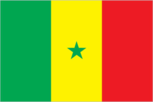
three equal vertical bands of green (hoist side), yellow, and red with a small green five-pointed star centered in the yellow band; uses the popular pan-African colors of Ethiopia
Government type
republic under multiparty democratic rule
Independence
4 April 1960 from France; complete independence was achieved upon dissolution of federation with Mali on 20 August 1960 (The Gambia and Senegal signed an agreement on 12 December 1981 (constituted February 1982) that called for the creation of a loose confederation to be known as Senegambia, but the agreement was dissolved on 30 September 1989)
International organization participation
ACCT, ACP, AfDB, CCC, ECA, ECOWAS, FAO, FZ, G-15, G-77, IAEA, IBRD, ICAO, ICC, ICFTU, ICRM, IDA, IDB, IFAD, IFC, IFRCS, ILO, IMF, IMO, Inmarsat, Intelsat, Interpol, IOC, IOM, ITU, MIPONUH, NAM, OAU, OIC, OPCW, PCA, UN, UNCTAD, UNESCO, UNIDO, UNIKOM, UNMIBH, UNMIK, UNTAET, UPU, WADB, WAEMU, WCL, WFTU, WHO, WIPO, WMO, WToO, WTrO
Judicial branch
- under the terms of a reform of the judicial system implemented in 1992, the principal organs of the judiciary are as
- follows
- Constitutional Court; Council of State; Court of Final Appeals or Cour de Cassation; Court of Appeals
Legal system
based on French civil law system; judicial review of legislative acts in Constitutional Court; the Council of State audits the government's accounting office; Senegal has not accepted compulsory ICJ jurisdiction
Legislative branch
- unicameral National Assembly or Assemblee Nationale (140 seats; members are elected by direct popular vote to serve five-year terms)
- election results
- percent of vote by party - PS 50%, PDS 19%, UDS-R 13%, And Jef 5%, LD-MPT 4%, CDP 2%, FSD 1%, PDS-R 1%, RND 1%, BGC 1%, PIT 1%, other 2%; seats by party - PS 93, PDS 23, UDS-R 11, And Jef 4, LD-MPT 3, CDP 1, FSD 1, PDS-R 1, RND 1, BGC 1, PIT 1
- elections
- last held 24 May 1998 (next to be held NA May 2003)
National holiday
Independence Day, 4 April (1960)
Political parties and leaders
African Party for Democracy and Socialism or And Jef (also known as PADS/AJ) [Landing SAVANE, secretary general]; African Party of Independence ; Democratic and Patriotic Convention or CDP (also known as Garab-Gi) ; Democratic League-Labor Party Movement or LD-MPT ; Front for Socialism and Democracy or FSD ; Gainde Centrist Bloc or BGC [Jean-Paul DIAS]; Independence and Labor Party or PIT ; National Democratic Rally or RND ; Senegalese Democratic Party or PDS ; Senegalese Democratic Party-Renewal or PDS-R ; Senegalese Democratic Union-Renewal or UDS-R ; Socialist Party or PS ; Union for Democratic Renewal or URD [Djibo Leyti KA]; other small parties
Political pressure groups and leaders
labor; Muslim brotherhoods; students; teachers
Suffrage
18 years of age; universal
Economy
Agriculture - products
peanuts, millet, corn, sorghum, rice, cotton, tomatoes, green vegetables; cattle, poultry, pigs; fish
Budget
- expenditures
- $885 million, including capital expenditures of $125 million (1996 est.)
- revenues
- $885 million
Currency
1 Communaute Financiere Africaine franc (CFAF) = 100 centimes
Debt - external
$3.4 billion (1998 est.)
Economic aid - recipient
$647.5 million (1995)
Economy - overview
In January 1994, Senegal undertook a bold and ambitious economic reform program with the support of the international donor community. This reform began with a 50% devaluation of Senegal's currency, the CFA franc, which is linked at a fixed rate to the French franc. Government price controls and subsidies have been steadily dismantled. After seeing its economy contract by 2.1% in 1993, Senegal made an important turnaround, thanks to the reform program, with real growth in GDP averaging 5% annually in 1995-99. Annual inflation has been pushed down to 2%, and the fiscal deficit has been cut to less than 1.5% of GDP. Investment rose steadily from 13.8% of GDP in 1993 to 16.5% in 1997. As a member of the West African Economic and Monetary Union (UEMOA), Senegal is working toward greater regional integration with a unified external tariff. Senegal also realized full Internet connectivity in 1996, creating a miniboom in information technology-based services. Private activity now accounts for 82% of GDP. On the negative side, Senegal faces deep-seated urban problems of chronic unemployment, juvenile delinquency, and drug addiction. Real GDP growth is expected to rise above 6%, while inflation is likely to hold at 2% in 2000-2001.
Electricity - consumption
1.116 billion kWh (1998)
Electricity - exports
0 kWh (1998)
Electricity - imports
0 kWh (1998)
Electricity - production
1.2 billion kWh (1998)
Electricity - production by source
- fossil fuel
- 100%
- hydro
- 0%
- nuclear
- 0%
- other
- 0% (1998)
Exchange rates
- Communaute Financiere Africaine francs (CFAF) per US$1 - 647.25 (January 2000), 615.70 (1999), 589.95 (1998), 583.67 (1997), 511.55 (1966), 499.15 (1995)
- note
- since 1 January 1999, the CFAF is pegged to the euro at a rate of 655.957 CFA francs per euro
Exports
$925 million (f.o.b., 1998)
Exports - commodities
fish, ground nuts (peanuts), petroleum products, phosphates, cotton
Exports - partners
France 22%, Italy, India, Cote d'Ivoire, Mali (1998)
Fiscal year
calendar year
GDP
purchasing power parity - $16.6 billion (1999 est.)
GDP - composition by sector
- agriculture
- 19%
- industry
- 20%
- services
- 61% (1997 est.)
GDP - per capita
purchasing power parity - $1,650 (1999 est.)
GDP - real growth rate
5% (1999 est.)
Household income or consumption by percentage share
lowest 10%: 1.4% highest 10%: 42.8% (1991)
Imports
$1.2 billion (f.o.b., 1998)
Imports - commodities
foods and beverages, consumer goods, capital goods, petroleum products
Imports - partners
France 36%, other EU countries, Nigeria, Cameroon, Cote d'Ivoire, Algeria, US, China, Japan (1998)
Industrial production growth rate
7% (1998 est.)
Industries
agricultural and fish processing, phosphate mining, fertilizer production, petroleum refining, construction materials
Inflation rate (consumer prices)
2% (1999 est.)
Labor force
NA
Labor force - by occupation
agriculture 60%
Population below poverty line
NA%
Unemployment rate
NA%; urban youth 40%
Communications
Internet Service Providers (ISPs)
4 (1999)
Radio broadcast stations
AM 10, FM 14, shortwave 0 (1998)
Radios
1.24 million (1997)
Telephone system
- domestic
- above-average urban system; microwave radio relay, coaxial cable and fiber-optic cable in trunk system
- international
- 4 submarine cables; satellite earth station - 1 Intelsat (Atlantic Ocean)
Telephones - main lines in use
82,000 (1995)
Telephones - mobile cellular
122 (1995)
Television broadcast stations
1 (1997)
Televisions
361,000 (1997)
Transportation
Airports
20 (1999 est.)
Airports - with paved runways
- total
- 10 over 3,047 m: 1 1,524 to 2,437 m: 7 914 to 1,523 m: 2 (1999 est.)
Airports - with unpaved runways
- total
- 10 1,524 to 2,437 m: 5 914 to 1,523 m: 4 under 914 m: 1 (1999 est.)
Highways
- paved
- 4,271 km
- total
- 14,576 km
- unpaved
- 10,305 km (1996 est.)
Ports and harbors
Dakar, Kaolack, Matam, Podor, Richard Toll, Saint-Louis, Ziguinchor
Railways
- narrow gauge
- 906 km 1.000-meter gauge (70 km double track)
- total
- 906 km
Waterways
897 km total; 785 km on the Senegal river, and 112 km on the Saloum river
Military and Security
Military branches
Army, Navy, Air Force, National Gendarmerie, National Police (Surete Nationale)
Military expenditures - dollar figure
$68 million (FY97)
Military expenditures - percent of GDP
1.4% (FY97)
Military manpower - availability
males age 15-49: 2,218,920 (2000 est.)
Military manpower - fit for military service
males age 15-49: 1,158,893 (2000 est.)
Military manpower - military age
18 years of age
Military manpower - reaching military age annually
- males
- 109,381 (2000 est.)
Transnational Issues
Disputes - international
short section of boundary with The Gambia is indefinite
Illicit drugs
- transshipment point for Southwest and Southeast Asian heroin moving to Europe and North America; illicit cultivator of cannabis
- SERBIA AND MONTENEGRO