1990 Edition
CIA World Factbook 1990 (Project Gutenberg)
Geography
Climate
tropical; hot, humid; rainy season (December to April) has strong southeast winds; dry season (May to November) dominated by hot, dry harmattan wind
Coastline
531 km
Comparative area
slightly smaller than South Dakota
Contiguous zone
24 nm;
Continental shelf
edge of continental margin or 200 nm;
Disputes
short section of the boundary with The Gambia is indefinite; the International Court of Justice (ICJ) rendered its decision on the Guinea-Bissau/Senegal maritime boundary in favor of Senegal--that decision has been rejected by Guinea-Bissau; boundary with Mauritania
Environment
lowlands seasonally flooded; deforestation; overgrazing; soil erosion; desertification
Exclusive fishing zone
200 nm;
Land boundaries
2,640 km total; The Gambia 740 km, Guinea 330 km, Guinea-Bissau 338 km, Mali 419 km, Mauritania 813 km
Land use
27% arable land; 0% permanent crops; 30% meadows and pastures; 31% forest and woodland; 12% other; includes 1% irrigated
Natural resources
fish, phosphates, iron ore
Note
The Gambia is almost an enclave
Terrain
generally low, rolling, plains rising to foothills in southeast
Territorial sea
12 nm
Total area
196,190 km2; land area: 192,000 km2
People and Society
Birth rate
44 births/1,000 population (1990)
Death rate
14 deaths/1,000 population (1990)
Ethnic divisions
36% Wolof, 17% Fulani, 17% Serer, 9% Toucouleur, 9% Diola, 9% Mandingo, 1% European and Lebanese, 2% other
Infant mortality rate
87 deaths/1,000 live births (1990)
Labor force
2,509,000; 77% subsistence agricultural workers; 175,000 wage earners--40% private sector, 60% government and parapublic; 52% of population of working age (1985)
Language
French (official); Wolof, Pulaar, Diola, Mandingo
Life expectancy at birth
53 years male, 56 years female (1990)
Literacy
28.1%
Nationality
noun--Senegalese (sing. and pl.); adjective--Senegalese
Net migration rate
0 migrants/1,000 population (1990)
Organized labor
majority of wage-labor force represented by unions; however, dues-paying membership very limited; major confederation is National Confederation of Senegalese Labor (CNTS), an affiliate of governing party
Population
7,713,851 (July 1990), growth rate 3.0% (1990)
Religion
92% Muslim, 6% indigenous beliefs, 2% Christian (mostly Roman Catholic)
Total fertility rate
6.3 children born/woman (1990)
Government
Administrative divisions
10 regions (regions, singular--region); Dakar, Diourbel, Fatick, Kaolack, Kolda, Louga, Saint-Louis, Tambacounda, Thies, Ziguinchor
Capital
Dakar
Communists
small number of Communists and sympathizers
Constitution
3 March 1963, last revised in 1984
Diplomatic representation
Ambassador Ibra Deguene KA; Chancery at 2112 Wyoming Avenue NW, Washington DC 20008; telephone (202) 234-0540 or 0541; US--Ambassador George E. MOOSE; Embassy on Avenue Jean XXIII at the corner of Avenue Kleber, Dakar (mailing address is B. P. 49, Dakar); telephone [221] 21-42-96
Elections
President--last held 28 February 1988 (next to be held February 1993); results--Abdou Diouf (PS) 73%, Abdoulaye Wade (PDS) 26%, others 1%; National Assembly--last held 28 February 1988 (next to be held February 1993); results--PS 71%, PDS 25%, others 4%; seats--(120 total) PS 103, PDS 17
Executive branch
president, Council of Ministers (cabinet)
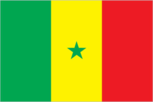
Flag
three equal vertical bands of green (hoist side), yellow, and red with a small green five-pointed star centered in the yellow band; uses the popular pan-African colors of Ethiopia
Independence
4 April 1960 (from France); The Gambia and Senegal signed an agreement on 12 December 1981 (effective 1 February 1982) that called for the creation of a loose confederation to be known as Senegambia, but the agreement was dissolved on 30 September 1989
Judicial branch
Supreme Court (Cour Supreme)
Leaders
Chief of State and Head of Government--President Abdou DIOUF (since 1 January 1981)
Legal system
based on French civil law system; judicial review of legislative acts in Supreme Court, which also audits the government's accounting office; has not accepted compulsory ICJ jurisdiction
Legislative branch
unicameral National Assembly (Assemblee Nationale)
Long-form name
Republic of Senegal
Member of
ACP, AfDB, APC, CCC, CEAO, EAMA, ECA, ECOWAS, EIB (associate), FAO, G-77, GATT, IAEA, IBRD, ICAO, IDA, IDB--Islamic Development Bank, IFAD, IFC, ILO, IMF, IMO, INTELSAT, INTERPOL, ITU, NAM, OAU, OCAM, OIC, OMVS (Organization for the Development of the Senegal River Valley), UN, UNESCO, UPU, WFTU, WHO, WIPO, WMO, WTO
National holiday
Independence Day, 4 April (1960)
Other political or pressure groups
students, teachers, labor, Muslim Brotherhoods
Political parties and leaders
Socialist Party (PS), Abdou Diouf; Senegalese Democratic Party (PDS), Abdoulaye Wade; 13 other small uninfluential parties
Suffrage
universal at age 21
Type
republic under multiparty democratic rule
Economy
Agriculture
including fishing, accounts for 20% of GDP and 75% of labor force; major products--peanuts (cash crop), millet, corn, sorghum, rice, cotton, tomatoes, green vegetables; estimated two-thirds self-sufficient in food; fish catch of 299,000 metric tons in 1987
Aid
US commitments, including Ex-Im (FY70-88), $492 million; Western (non-US) countries, ODA and OOF bilateral commitments (1970-87), $4.4 billion; OPEC bilateral aid (1979-89), $589 million; Communist countries (1970-88), $295 million
Budget
revenues $921 million; expenditures $1,024 million; including capital expenditures of $14 million (FY89 est.)
Currency
Communaute Financiere Africaine franc (plural--francs); 1 CFA franc (CFAF) = 100 centimes
Electricity
210,000 kW capacity; 760 million kWh produced, 100 kWh per capita (1989)
Exchange rates
Communaute Financiere Africaine francs (CFAF) per US$1--287.99 (January 1990), 319.01 (1989), 297.85 (1988), 300.54 (1987), 346.30 (1986), 449.26 (1985)
Exports
$761 million (f.o.b., 1988); commodities--manufactures 30%, fish products 27%, peanuts 11%, petroleum products 11%, phosphates 10%; partners--US, France, other EC, Ivory Coast, India
External debt
$3.8 billion (1988)
Fiscal year
1 July-30 June
GDP
$5.0 billion, per capita $680; real growth rate 5.1% (1988 est.)
Imports
$1.1 billion (c.i.f., 1988); commodities--semimanufactures 30%, food 27%, durable consumer goods 17%, petroleum 12%, capital goods 14%; partners--US, France, other EC, Nigeria, Algeria, China, Japan
Industrial production
growth rate 4.9% (1986)
Industries
fishing, agricultural processing, phosphate mining, petroleum refining, building materials
Inflation rate (consumer prices)
- 1.8% (1988 est.)
Overview
The agricultural sector accounts for about 20% of GDP and provides employment for about 75% of the labor force. About 40% of the total cultivated land is used to grow peanuts, an important export crop. The principal economic resource is fishing, which brought in about $200 million or about 25% of total foreign exchange earnings in 1987. Mining is dominated by the extraction of phosphate, but production has faltered because of reduced worldwide demand for fertilizers in recent years. Over the past 10 years tourism has become increasingly more important to the economy.
Unemployment rate
3.5% (1987)
Communications
Airports
25 total, 20 usable; 10 with permanent-surface runways; none with runways over 3,659 m; 1 with runways 2,440-3,659 m; 15 with runways 1,220-2,439 m
Civil air
2 major transport aircraft
Highways
14,000 km total; 3,770 km paved, 10,230 km laterite or improved earth
Inland waterways
900 km total; 785 km on the Senegal, 115 km on the Saloum
Merchant marine
3 ships (1,000 GRT and over) totaling 9,263 GRT/15,167 DWT; includes 2 cargo, 1 bulk
Ports
Dakar, Kaolack
Railroads
1,034 km 1.000-meter gauge; all single track except 70 km double track Dakar to Thies
Telecommunications
above-average urban system, using radio relay and cable; 40,200 telephones; stations--8 AM, no FM, 1 TV; 3 submarine cables; 1 Atlantic Ocean INTELSAT earth station
Military and Security
Branches
Army, Navy, Air Force, paramilitary Gendarmerie
Defense expenditures
2% of GDP, or $100 million (1989 est.)
Military manpower
males 15-49, 1,682,786; 878,812 fit for military service; 88,940 reach military age (18) annually