1985 Edition
CIA World Factbook 1985 (Internet Archive)
Geography
Agriculture
main crops — peanuts (primary cash crop); millet, sorghum, manioc, maize, rice, livestock; deficit production of food
Airfields
25 total, 22 usable; 10 with permanent-surface runways; 1 with runways 2,4403,659 m, 17 with runways 1,220-2,439 m
Amir ante
Mahe Isles ", • Island
Branches
- Saudi Arabian Land Forces, Royal Saudi Naval Forces, Royal Saudi Air Force, Saudi Arabian National Guard, Frontier Force, Coast Guard
- government dominated by the President; unicameral legislature (120-member National Assembly), elected for five years; President elected for five-year term by universal suffrage; judiciary headed by Supreme Court, with members appointed by President
- Army, Navy, Air Force, paramilitary Gendarmerie
Budget
(1983/84) public revenues, $500 million; current expenditures, $517 million; capital expenditures, $99 million
Capital
Dakar
Civil air
3 major transport aircraft
Coastline
531 km People
Elections
presidential and legislative elections held February 1983; Socialist Party holds 111 of 120 seats Political parties and leaders: Socialist Party (PS), Abdou Diouf ; Senegalese Democratic Party (PDS), Abdoulaye Wade; 13 other small uninfluential parties Senegal (continued) Seychelles Communist*: small number of Communists and sympathizers
Electric power
184,000 kW capacity (1984); 725 million kWh produced (1984), 110 kWh per capita
Ethnic divisions
36% Wolof, 17.5% Fulani, 16.5% Serer, 9% Toucouleur, 9% Diola, 6.5% Mandingo, 4.5% other African, 1% European and Lebanese
Exports
$438 million (f.o.b., 1983); peanuts and peanut products, phosphate rock, fish, petroleum products (reexport)
Fiscal year
1 July-30 June Communications
Fishing
catch 2 1 3,000 metric tons ( 1 982); exports $120 million (1982)
GDP
$2.5 billion (1983), $400(1983)per capita; real growth - 14.3% in 1983
Government leaders
Abdou DIOUF, President (since January 1981)
Highways
13,898 km total; 3,461 km paved, 6,741 km gravel or graded earth, 3,696 km of unimproved roads
Imports
$820 million (f.o.b., 1983); food, consumer goods, machinery, transport equipment, petroleum
Inland waterways
1,505 km
Labor force
1,732,000; 70% subsistence agricultural workers; 175,000 wage earners — 40% private sector, 60% government and parapublic
Land boundaries
2,680 km Water
Language
French (official); Wolof, Pulaar, Diola, Mandingo
Legal system
based on French civil law system; constitution adopted 1960, revised 1963, 1970, and 1981 Judicial review of legislative acts in Supreme Court (which also audits the government's accounting office); legal education at University of Dakar; has not accepted compulsory ICJ jurisdiction
Limits of territorial waters (claimed)
150 nm (fishing, 200 nm)
Literacy
10%
Major industries
fishing, agricultural processing plants, light manufacturing, mining
Major trade partners
France, other EC, and franc zone
Member of
AfDB, APC, CEAO, KAMA, ECA, ECOWAS, EIB (associate), FAO, G-77, GATT, IAEA, IBRD, ICAO, IDA, IDB— Islamic Development Bank, IFAD, IFC, ILO, IMF, IMO, INTELSAT, INTERPOL, ITU, NAM, OAU, OCAM, QIC, OMVS (Organization for the Development of the Senegal River Valley), UN, UNESCO, UPU, WFTU, WHO, WIPO, WMO, WTO Economy
Military budget
for fiscal year ending 30 June 1985, $66.9 million; about 8.8% of central government budget Aldabra .Islands VICTORIA*
Military manpower
- males 15-49, 2,981,000; 1,704,000 fit for military service; about 103,000 reach military age (18) annually Land 196,192 km2; the size of South Dakota; 40% agricultural (12% cultivated); 13% forest; 47% built up, waste, or other
- males 15-49, 1,505,000; 759,000 fit for military service; 70,000 reach military age (18) annually
Monetary conversion rate
about 479.8 Communaute Financiere Africaine (CFA) francs=US$l (December 1984)
National holiday
Independence Day, 4 April
Nationality
noun — Senegalese (sing, and pi.); adjective — Senegalese
Official name
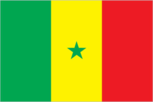
Republic of Senegal
Organized labor
majority of wage-labor force represented by unions; however, duespaying membership very limited; major confederation is National Confederation of Senegalese Labor (CNTS), an affiliate of governing party Government
Other political or pressure groups
students, teachers, labor, Muslim Brotherhood
Political subdivisions
10 regions, subdivided into 30 departments, 95 arrondissements
Population
6,755,000 (July 1985), average annual growth rate 3.2%
Ports
1 major (Dakar), 3 minor
Railroads
1,034 km 1.000-meter gauge; 70 km double track
Religion
92% Muslim, 6% indigenous beliefs, 2% Christian (mostly Roman Catholic)
Suffrage
universal adult
Telecommunications
above-average urban system, using radio-relay and cable; 40,200 telephones (0.8 per 100 popl.); 8 AM stations, no FM, 1 TV station; 3 submarine cables; 1 Atlantic Ocean satellite station Defense Forces
Type
republic under multiparty democratic rule; (early in 1982, Senegal and The Gambia formed a loose confederation named Senegambia, which calls for the eventual integration of their armed forces, economies and monetary systems, and foreign policies)