2018 Edition
CIA World Factbook 2018 Archive (Wayback Machine)
Introduction
Background
Saudi Arabia is the birthplace of Islam and home to Islam's two holiest shrines in Mecca and Medina. The king's official title is the Custodian of the Two Holy Mosques. The modern Saudi state was founded in 1932 by ABD AL-AZIZ bin Abd al-Rahman Al SAUD (Ibn Saud) after a 30-year campaign to unify most of the Arabian Peninsula. One of his male descendants rules the country today, as required by the country's 1992 Basic Law. Following Iraq's invasion of Kuwait in 1990, Saudi Arabia accepted the Kuwaiti royal family and 400,000 refugees while allowing Western and Arab troops to deploy on its soil for the liberation of Kuwait the following year. The continuing presence of foreign troops on Saudi soil after the liberation of Kuwait became a source of tension between the royal family and the public until all operational US troops left the country in 2003. Major terrorist attacks in May and November 2003 spurred a strong ongoing campaign against domestic terrorism and extremism. From 2005 to 2015, King ABDALLAH bin Abd al-Aziz Al Saud incrementally modernized the Kingdom. Driven by personal ideology and political pragmatism, he introduced a series of social and economic initiatives, including expanding employment and social opportunities for women, attracting foreign investment, increasing the role of the private sector in the economy, and discouraging businesses from hiring foreign workers. These reforms have accelerated under King SALMAN bin Abd al-Aziz, who ascended to the throne in 2015, and has since lifted the Kingdom's ban on women driving and allowed cinemas to operate for the first time in decades. Saudi Arabia saw some protests during the 2011 Arab Spring but not the level of bloodshed seen in protests elsewhere in the region. Shia Muslims in the Eastern Province protested primarily against the detention of political prisoners, endemic discrimination, and Bahraini and Saudi Government actions in Bahrain. Riyadh took a cautious but firm approach by arresting some protesters but releasing most of them quickly and by using its state-sponsored clerics to counter political and Islamist activism. The government held its first-ever elections in 2005 and 2011, when Saudis went to the polls to elect municipal councilors. In December 2015, women were allowed to vote and stand as candidates for the first time in municipal council elections, with 19 women winning seats. After King SALMAN ascended to the throne in 2015, he placed the first next-generation prince, MUHAMMAD BIN NAYIF bin Abd al-Aziz Al Saud, in the line of succession as Crown Prince. He designated his son, MUHAMMAD BIN SALMAN bin Abd al-Aziz Al Saud, as the Deputy Crown Prince. In March 2015, Saudi Arabia led a coalition of 10 countries in a military campaign to restore the legitimate government of Yemen, which had been ousted by Huthi forces allied with former president ALI ABDULLAH al-Salih. The war in Yemen has drawn international criticism for civilian casualties and its effect on the country’s dire humanitarian situation. In December 2015, then Deputy Crown Prince MUHAMMAD BIN SALMAN announced Saudi Arabia would lead a 34-nation Islamic Coalition to fight terrorism (it has since grown to 41 nations). In May 2017, Saudi Arabia inaugurated the Global Center for Combatting Extremist Ideology (also known as "Etidal") as part of its ongoing efforts to counter violent extremism. In June 2017, King SALMAN elevated MUHAMMAD BIN SALMAN to Crown Prince. The country remains a leading producer of oil and natural gas and holds about 16% of the world's proven oil reserves as of 2015. The government continues to pursue economic reform and diversification, particularly since Saudi Arabia's accession to the WTO in 2005, and promotes foreign investment in the Kingdom. In April 2016, the Saudi Government announced a broad set of socio-economic reforms, known as Vision 2030. Low global oil prices throughout 2015 and 2016 significantly lowered Saudi Arabia’s governmental revenue. In response, the government cut subsidies on water, electricity, and gasoline; reduced government employee compensation packages; and announced limited new land taxes. In coordination with OPEC and some key non-OPEC countries, Saudi Arabia agreed cut oil output in early 2017 to regulate supply and help elevate global prices.
Geography
Area
- land
- 2,149,690 sq km
- total
- 2,149,690 sq km
- water
- 0 sq km
Area Comparative
slightly more than one-fifth the size of the US
Climate
harsh, dry desert with great temperature extremes
Coastline
2,640 km
Elevation
- elevation extremes
- 0 m lowest point: Persian Gulf
- mean elevation
- 665 m
- note
- 3133 highest point: Jabal Sawda'
Environment Current Issues
desertification; depletion of underground water resources; the lack of perennial rivers or permanent water bodies has prompted the development of extensive seawater desalination facilities; coastal pollution from oil spills; air pollution; waste management
Environment International Agreements
- party to
- Biodiversity, Climate Change, Climate Change-Kyoto Protocol, Desertification, Endangered Species, Hazardous Wastes, Law of the Sea, Marine Dumping, Ozone Layer Protection, Ship Pollution
- signed, but not ratified
- none of the selected agreements
Geographic Coordinates
25 00 N, 45 00 E
Geography Note
Saudi Arabia is the largest country in the world without a river; extensive coastlines on the Persian Gulf and Red Sea allow for considerable shipping (especially of crude oil) through the Persian Gulf and Suez Canal
Irrigated Land
16,200 sq km (2012)
Land Boundaries
- border countries (7)
- Iraq 811 km, Jordan 731 km, Kuwait 221 km, Oman 658 km, Qatar 87 km, UAE 457 km, Yemen 1307 km
- total
- 4,272 km
Land Use
- arable land: 1.5% (2011 est.) / permanent crops: 0.1% (2011 est.) / permanent pasture: 79.1% (2011 est.)
- agricultural land
- 80.7% (2011 est.)
- forest
- 0.5% (2011 est.)
- other
- 18.8% (2011 est.)
Location
Middle East, bordering the Persian Gulf and the Red Sea, north of Yemen
Map References
Middle East
Maritime Claims
- contiguous zone
- 18 nm
- continental shelf
- not specified
- territorial sea
- 12 nm
Natural Hazards
frequent sand and dust stormsvolcanism: despite many volcanic formations, there has been little activity in the past few centuries; volcanoes include Harrat Rahat, Harrat Khaybar, Harrat Lunayyir, and Jabal Yar
Natural Resources
petroleum, natural gas, iron ore, gold, copper
Population Distribution
historically a population that was mostly nomadic or semi-nomadic, the Saudi population has become more settled since petroleum was discovered in the 1930s; most of the economic activities - and with it the country's population - is concentrated in a wide area across the middle of the peninsula, from Ad Dammam in the east, through Riyadh in the interior, to Mecca-Medina in the west near the Red Sea
Terrain
mostly sandy desert
People and Society
Age Structure
- 0-14 years
- 25.74% (male 4,348,227 /female 4,170,944)
- 15-24 years
- 15.58% (male 2,707,229 /female 2,447,519)
- 25-54 years
- 49.88% (male 9,951,080 /female 6,554,525)
- 55-64 years
- 5.48% (male 1,112,743 /female 700,553)
- 65 years and over
- 3.32% (male 586,606 /female 511,687) (2018 est.)
Birth Rate
15.6 births/1,000 population (2018 est.)
Contraceptive Prevalence Rate
24.6% (2016)
Death Rate
3.3 deaths/1,000 population (2018 est.)
Dependency Ratios
- elderly dependency ratio
- 4.3 (2015 est.)
- potential support ratio
- 23.2 (2015 est.)
- total dependency ratio
- 40.9 (2015 est.)
- youth dependency ratio
- 36.6 (2015 est.)
Drinking Water Source
- improved: urban: 97% of population
- rural: 97% of population
- total: 97% of population
- unimproved: rural: 3% of population
- total: 3% of population (2015 est.)
Education Expenditures
5.1% of GDP (2008)
Ethnic Groups
Arab 90%, Afro-Asian 10%
Health Expenditures
4.7% of GDP (2014)
Hiv Aids Adult Prevalence Rate
<.1% (2016 est.)
Hiv Aids Deaths
<500 (2016 est.)
Hiv Aids People Living With Hiv Aids
8,200 (2016 est.)
Hospital Bed Density
2.7 beds/1,000 population (2014)
Infant Mortality Rate
- female
- 11.1 deaths/1,000 live births (2018 est.)
- male
- 13 deaths/1,000 live births (2018 est.)
- total
- 12.1 deaths/1,000 live births (2018 est.)
Languages
Arabic (official)
Life Expectancy At Birth
- female
- 77.3 years (2018 est.)
- male
- 74.2 years (2018 est.)
- total population
- 75.7 years (2018 est.)
Literacy
- definition
- age 15 and over can read and write (2015 est.)
- female
- 91.1% (2015 est.)
- male
- 97% (2015 est.)
- total population
- 94.7% (2015 est.)
Major Urban Areas Population
6.907 million RIYADH (capital), 4.433 million Jeddah, 1.967 million Mecca, 1.43 million Medina, 1.197 million Ad Dammam (2018)
Maternal Mortality Rate
12 deaths/100,000 live births (2015 est.)
Median Age
- female
- 27.2 years (2018 est.)
- male
- 32.1 years
- total
- 29.9 years
Nationality
- adjective
- Saudi or Saudi Arabian
- noun
- Saudi(s)
Net Migration Rate
-0.5 migrant(s)/1,000 population (2017 est.)
Obesity Adult Prevalence Rate
35.4% (2016)
Physicians Density
2.57 physicians/1,000 population (2014)
Population
- 33,091,113 (July 2017 est.) (July 2018 est.)
- note
- immigrants make up 37% of the total population, according to UN data (2017)
Population Growth Rate
1.63% (2018 est.)
Religions
- Muslim (official; citizens are 85-90% Sunni and 10-15% Shia), other (includes Eastern Orthodox, Protestant, Roman Catholic, Jewish, Hindu, Buddhist, and Sikh) (2012 est.)
- note
- despite having a large expatriate community of various faiths (more than 30% of the population), most forms of public religious expression inconsistent with the government-sanctioned interpretation of Sunni Islam are restricted; non-Muslims are not allowed to have Saudi citizenship and non-Muslim places of worship are not permitted (2013)
Sanitation Facility Access
- improved: urban: 100% of population (2015 est.)
- rural: 100% of population (2015 est.)
- total: 100% of population (2015 est.)
- unimproved: urban: 0% of population (2015 est.)
- rural: 0% of population (2015 est.)
- total: 0% of population (2015 est.)
School Life Expectancy Primary To Tertiary Education
- female
- 15 years (2014)
- male
- 17 years (2014)
- total
- 16 years (2014)
Sex Ratio
- 0-14 years
- 1.05 male(s)/female (2017 est.)
- 15-24 years
- 1.15 male(s)/female (2017 est.)
- 25-54 years
- 1.31 male(s)/female (2017 est.)
- 55-64 years
- 1.21 male(s)/female (2017 est.)
- 65 years and over
- 1.05 male(s)/female (2017 est.)
- at birth
- 1.05 male(s)/female (2017 est.)
- total population
- 1.19 male(s)/female (2017 est.)
Total Fertility Rate
2.04 children born/woman (2018 est.)
Unemployment Youth Ages 15 24
- female
- 46.3% (2016 est.)
- male
- 17.4% (2016 est.)
- total
- 24.2% (2016 est.)
Urbanization
- rate of urbanization
- 2.17% annual rate of change (2015-20 est.)
- urban population
- 83.8% of total population (2018)
Government
Administrative Divisions
13 regions (manatiq, singular - mintaqah); Al Bahah, Al Hudud ash Shamaliyah (Northern Border), Al Jawf, Al Madinah al Munawwarah (Medina), Al Qasim, Ar Riyad (Riyadh), Ash Sharqiyah (Eastern), 'Asir, Ha'il, Jazan, Makkah al Mukarramah (Mecca), Najran, Tabuk
Capital
- geographic coordinates
- 24 39 N, 46 42 E
- name
- Riyadh
- time difference
- UTC+3 (8 hours ahead of Washington, DC, during Standard Time)
Citizenship
- citizenship by birth
- no
- citizenship by descent only
- the father must be a citizen of Saudi Arabia; a child born out of wedlock in Saudi Arabia to a Saudi mother and unknown father
- dual citizenship recognized
- no
- residency requirement for naturalization
- 5 years
Constitution
- amendments
- proposed by the king directly or proposed to the king by the Consultative Assembly or by the Council of Ministers; passage by the king through royal decree; Basic Law amended many times, last in 2005 (2016)
- history
- 1 March 1992 - Basic Law of Government, issued by royal decree, serves as the constitutional framework and is based on the Qur'an and the life and traditions of the Prophet Muhammad (2016)
Country Name
- conventional long form
- Kingdom of Saudi Arabia
- conventional short form
- Saudi Arabia
- etymology
- named after the ruling dynasty of the country, the House of Saud; the name "Arabia" can be traced back many centuries B.C., the ancient Egyptians referred to the region as "Ar Rabi"
- local long form
- Al Mamlakah al Arabiyah as Suudiyah
- local short form
- Al Arabiyah as Suudiyah
Diplomatic Representation From The Us
- chief of mission
- Ambassador (vacant); Charge d'Affaires Christopher HENZEL (since 9 January 2017)
- consulate(s) general
- Dhahran, Jiddah (Jeddah)
- embassy
- P.O. Box 94309, Riyadh 4693
- FAX
- [966] (11) 488-7360
- mailing address
- American Embassy, Unit 61307, APO AE 09803-1307; International Mail: P. O. Box 94309, Riyadh 11693
- telephone
- [966] (11) 488-3800
Diplomatic Representation In The Us
- chancery
- 601 New Hampshire Avenue NW, Washington, DC 20037
- chief of mission
- Ambassador Khalid bin Salman bin Abdulaziz AL SAUD (since 21 July 2017)
- consulate(s) general
- Houston, Los Angeles, New York
- FAX
- [1] (202) 944-5983
- telephone
- [1] (202) 342-3800
Executive Branch
- cabinet
- Council of Ministers appointed by the monarch every 4 years and includes many royal family members
- chief of state
- King and Prime Minister SALMAN bin Abd al-Aziz Al Saud (since 23 January 2015); Crown Prince MUHAMMAD BIN SALMAN bin Abd al-Aziz Al Saud (born 31 August 1985); note - the monarch is both chief of state and head of government
- elections/appointments
- none; the monarchy is hereditary; an Allegiance Council created by royal decree in October 2006 established a committee of Saudi princes for a voice in selecting future Saudi kings
- head of government
- King and Prime Minister SALMAN bin Abd al-Aziz Al Saud (since 23 January 2015); Crown Prince MUHAMMAD BIN SALMAN bin Abd al-Aziz Al Saud (born 31 August 1985)
Flag Description
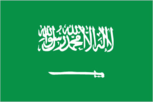
- green, a traditional color in Islamic flags, with the Shahada or Muslim creed in large white Arabic script (translated as "There is no god but God; Muhammad is the Messenger of God") above a white horizontal saber (the tip points to the hoist side); design dates to the early twentieth century and is closely associated with the Al Saud family, which established the kingdom in 1932; the flag is manufactured with differing obverse and reverse sides so that the Shahada reads - and the sword points - correctly from right to left on both sides
- note
- the only national flag to display an inscription as its principal design; one of only three national flags that differ on their obverse and reverse sides - the others are Moldova and Paraguay
Government Type
absolute monarchy
Independence
23 September 1932 (unification of the kingdom)
International Law Organization Participation
has not submitted an ICJ jurisdiction declaration; non-party state to the ICCt
International Organization Participation
ABEDA, AfDB (nonregional member), AFESD, AMF, BIS, CAEU, CP, FAO, G-20, G-77, GCC, IAEA, IBRD, ICAO, ICC (national committees), ICRM, IDA, IDB, IFAD, IFC, IFRCS, IHO, ILO, IMF, IMO, IMSO, Interpol, IOC, IOM (observer), IPU, ISO, ITSO, ITU, LAS, MIGA, NAM, OAPEC, OAS (observer), OIC, OPCW, OPEC, PCA, UN, UNCTAD, UNESCO, UNIDO, UNRWA, UNWTO, UPU, WCO, WFTU (NGOs), WHO, WIPO, WMO, WTO
Judicial Branch
- highest courts
- High Court (consists of the court chief and is organized into circuits with 3-judge panels, except for the criminal circuit, which has a 5-judge panel for cases involving major punishments)
- judge selection and term of office
- High Court chief and chiefs of the High Court Circuits appointed by royal decree upon the recommendation of the Supreme Judiciary Council, a 10-member body of high-level judges and other judicial heads; new judges and assistant judges serve 1- and 2-year probations, respectively, before permanent assignment
- subordinate courts
- Court of Appeals; Specialized Criminal Court, first-degree courts composed of general, criminal, personal status, and commercial courts; Labor Court; a hierarchy of administrative courts
Legal System
Islamic (sharia) legal system with some elements of Egyptian, French, and customary law; note - several secular codes have been introduced; commercial disputes handled by special committees
Legislative Branch
- description
- unicameral Consultative Council or Majlis al-Shura (150 seats; members appointed by the monarch to serve 4-year terms); note - in early 2013, the monarch granted women 30 seats on the Council
- note
- composition as of 2013 - men 121, women 30, percent of women 19.9%
National Anthem
- lyrics/music
- Ibrahim KHAFAJI/Abdul Rahman al-KHATEEB
- name
- "Aash Al Maleek" (Long Live Our Beloved King)
- note
- music adopted 1947, lyrics adopted 1984
National Holiday
Saudi National Day (Unification of the Kingdom), 23 September (1932)
National Symbol S
palm tree surmounting two crossed swords; national colors: green, white
Political Parties And Leaders
none
Suffrage
18 years of age; restricted to males; universal for municipal elections
Economy
Agriculture Products
wheat, barley, tomatoes, melons, dates, citrus; mutton, chickens, eggs, milk
Budget
- expenditures
- 241.8 billion (2017 est.)
- revenues
- 181 billion (2017 est.)
Budget Surplus Or Deficit
-8.9% (of GDP) (2017 est.)
Central Bank Discount Rate
2.5% (31 December 2008)
Commercial Bank Prime Lending Rate
- 8.3% (31 December 2017 est.)
- 7.1% (31 December 2016 est.)
Current Account Balance
- $15.23 billion (2017 est.)
- -$23.87 billion (2016 est.)
Debt External
- $205.1 billion (31 December 2017 est.)
- $189.3 billion (31 December 2016 est.)
Distribution Of Family Income Gini Index
45.9 (2013 est.)
Economy Overview
Saudi Arabia has an oil-based economy with strong government controls over major economic activities. It possesses about 16% of the world's proven petroleum reserves, ranks as the largest exporter of petroleum, and plays a leading role in OPEC. The petroleum sector accounts for roughly 87% of budget revenues, 42% of GDP, and 90% of export earnings.Saudi Arabia is encouraging the growth of the private sector in order to diversify its economy and to employ more Saudi nationals. Approximately 6 million foreign workers play an important role in the Saudi economy, particularly in the oil and service sectors; at the same time, however, Riyadh is struggling to reduce unemployment among its own nationals. Saudi officials are particularly focused on employing its large youth population.In 2017, the Kingdom incurred a budget deficit estimated at 8.3% of GDP, which was financed by bond sales and drawing down reserves. Although the Kingdom can finance high deficits for several years by drawing down its considerable foreign assets or by borrowing, it has cut capital spending and reduced subsidies on electricity, water, and petroleum products and recently introduced a value-added tax of 5%. In January 2016, Crown Prince and Deputy Prime Minister MUHAMMAD BIN SALMAN announced that Saudi Arabia intends to list shares of its state-owned petroleum company, ARAMCO - another move to increase revenue and outside investment. The government has also looked at privatization and diversification of the economy more closely in the wake of a diminished oil market. Historically, Saudi Arabia has focused diversification efforts on power generation, telecommunications, natural gas exploration, and petrochemical sectors. More recently, the government has approached investors about expanding the role of the private sector in the health care, education and tourism industries. While Saudi Arabia has emphasized their goals of diversification for some time, current low oil prices may force the government to make more drastic changes ahead of their long-run timeline.
Exchange Rates
- Saudi riyals (SAR) per US dollar -
- 3.75 (2017 est.)
- 3.75 (2016 est.)
- 3.75 (2015 est.)
- 3.75 (2014 est.)
- 3.75 (2013 est.)
Exports
- $221.1 billion (2017 est.)
- $183.6 billion (2016 est.)
Exports Commodities
petroleum and petroleum products 90% (2012 est.)
Exports Partners
Japan 12.2%, China 11.7%, South Korea 9%, India 8.9%, US 8.3%, UAE 6.7%, Singapore 4.2% (2017)
Fiscal Year
calendar year
Gdp Composition By End Use
- exports of goods and services
- 34.8% (2017 est.)
- government consumption
- 24.5% (2017 est.)
- household consumption
- 41.3% (2017 est.)
- imports of goods and services
- -28.6% (2017 est.)
- investment in fixed capital
- 23.2% (2017 est.)
- investment in inventories
- 4.7% (2017 est.)
Gdp Composition By Sector Of Origin
- agriculture
- 2.6% (2017 est.)
- industry
- 44.2% (2017 est.)
- services
- 53.2% (2017 est.)
Gdp Official Exchange Rate
$686.7 billion (2017 est.) (2017 est.)
Gdp Per Capita Ppp
- $54,500 (2017 est.)
- $56,400 (2016 est.)
- $56,800 (2015 est.)
- note
- data are in 2017 dollars
Gdp Purchasing Power Parity
- $1.775 trillion (2017 est.)
- $1.79 trillion (2016 est.)
- $1.761 trillion (2015 est.)
- note
- data are in 2017 dollars
Gdp Real Growth Rate
- -0.9% (2017 est.)
- 1.7% (2016 est.)
- 4.1% (2015 est.)
Gross National Saving
- 30.1% of GDP (2017 est.)
- 27.2% of GDP (2016 est.)
- 26.5% of GDP (2015 est.)
Household Income Or Consumption By Percentage Share
- highest 10%
- NA
- lowest 10%
- NA
Imports
- $119.3 billion (2017 est.)
- $127.8 billion (2016 est.)
Imports Commodities
machinery and equipment, foodstuffs, chemicals, motor vehicles, textiles
Imports Partners
China 15.4%, US 13.6%, UAE 6.5%, Germany 5.8%, Japan 4.1%, India 4.1%, South Korea 4% (2017)
Industrial Production Growth Rate
-2.4% (2017 est.)
Industries
crude oil production, petroleum refining, basic petrochemicals, ammonia, industrial gases, sodium hydroxide (caustic soda), cement, fertilizer, plastics, metals, commercial ship repair, commercial aircraft repair, construction
Inflation Rate Consumer Prices
- -0.9% (2017 est.)
- 2% (2016 est.)
Labor Force
- 13.8 million (2017 est.)
- note
- comprised of 3.1 million Saudis and 10.7 million non-Saudis
Labor Force By Occupation
- agriculture
- 6.7%
- industry
- 21.4%
- services
- 71.9% (2005 est.)
Market Value Of Publicly Traded Shares
- $421.1 billion (31 December 2015 est.)
- $483.1 billion (31 December 2014 est.)
- $467.4 billion (31 December 2013 est.)
Population Below Poverty Line
NA
Public Debt
- 17.2% of GDP (2017 est.)
- 13.1% of GDP (2016 est.)
Reserves Of Foreign Exchange And Gold
- $496.4 billion (31 December 2017 est.)
- $535.8 billion (31 December 2016 est.)
Stock Of Broad Money
- $312.6 billion (31 December 2017 est.)
- $305.2 billion (31 December 2016 est.)
Stock Of Direct Foreign Investment Abroad
- $56.09 billion (31 December 2017 est.)
- $46.45 billion (31 December 2016 est.)
Stock Of Direct Foreign Investment At Home
- $264.6 billion (31 December 2017 est.)
- $258.1 billion (31 December 2016 est.)
Stock Of Domestic Credit
- $267.1 billion (31 December 2017 est.)
- $219.7 billion (31 December 2016 est.)
Stock Of Narrow Money
- $312.6 billion (31 December 2017 est.)
- $305.2 billion (31 December 2016 est.)
Taxes And Other Revenues
26.4% (of GDP) (2017 est.)
Unemployment Rate
- 6% (2017 est.)
- 5.6% (2016 est.)
- note
- data are for total population; unemployment among Saudi nationals is more than double
Energy
Carbon Dioxide Emissions From Consumption Of Energy
657.1 million Mt (2017 est.)
Crude Oil Exports
7.341 million bbl/day (2015 est.)
Crude Oil Imports
0 bbl/day (2015 est.)
Crude Oil Production
10.13 million bbl/day (2017 est.)
Crude Oil Proved Reserves
266.2 billion bbl (1 January 2018 est.)
Electricity Access
- electrification - rural areas
- 93% (2013)
- electrification - total population
- 98% (2013)
- electrification - urban areas
- 99% (2013)
- population without electricity
- 200,000 (2013)
Electricity Consumption
296.2 billion kWh (2016 est.)
Electricity Exports
0 kWh (2016 est.)
Electricity From Fossil Fuels
100% of total installed capacity (2016 est.)
Electricity From Hydroelectric Plants
0% of total installed capacity (2017 est.)
Electricity From Nuclear Fuels
0% of total installed capacity (2017 est.)
Electricity From Other Renewable Sources
0% of total installed capacity (2017 est.)
Electricity Imports
0 kWh (2016 est.)
Electricity Installed Generating Capacity
82.94 million kW (2016 est.)
Electricity Production
324.1 billion kWh (2016 est.)
Natural Gas Consumption
109.3 billion cu m (2017 est.)
Natural Gas Exports
0 cu m (2017 est.)
Natural Gas Imports
0 cu m (2017 est.)
Natural Gas Production
109.3 billion cu m (2017 est.)
Natural Gas Proved Reserves
8.619 trillion cu m (1 January 2018 est.)
Refined Petroleum Products Consumption
3.287 million bbl/day (2016 est.)
Refined Petroleum Products Exports
1.784 million bbl/day (2015 est.)
Refined Petroleum Products Imports
609,600 bbl/day (2015 est.)
Refined Petroleum Products Production
2.476 million bbl/day (2015 est.)
Communications
Broadband Fixed Subscriptions
- subscriptions per 100 inhabitants
- 9 (2017 est.)
- total
- 2,498,692 (2017 est.)
Broadcast Media
broadcast media are state-controlled; state-run TV operates 4 networks; Saudi Arabia is a major market for pan-Arab satellite TV broadcasters; state-run radio operates several networks; multiple international broadcasters are available (2007)
Internet Country Code
.sa
Internet Users
- percent of population
- 73.8% (July 2016 est.)
- total
- 20,768,456 (July 2016 est.)
Telephone System
- domestic
- mobile-cellular subscribership has been increasing rapidly (2016)
- general assessment
- modern system including a combination of extensive microwave radio relays, coaxial cables, and fiber-optic cables (2016)
- international
- country code - 966; landing point for the international submarine cable Fiber-Optic Link Around the Globe (FLAG) and for both the SEA-ME-WE-3 and SEA-ME-WE-4 submarine cable networks providing connectivity to Asia, Middle East, Europe, and US; microwave radio relay to Bahrain, Jordan, Kuwait, Qatar, UAE, Yemen, and Sudan; coaxial cable to Kuwait and Jordan; satellite earth stations - 5 Intelsat (3 Atlantic Ocean and 2 Indian Ocean), 1 Arabsat, and 1 Inmarsat (Indian Ocean region) (2016)
Telephones Fixed Lines
- subscriptions per 100 inhabitants
- 13 (2017 est.)
- total subscriptions
- 3,619,352 (2017 est.)
Telephones Mobile Cellular
- subscriptions per 100 inhabitants
- 141 (2017 est.)
- total subscriptions
- 40,210,965 (2017 est.)
Transportation
Airports
214 (2013)
Airports With Paved Runways
- 1,524 to 2,437 m
- 27 (2017)
- 2,438 to 3,047 m
- 16 (2017)
- 914 to 1,523 m
- 2 (2017)
- over 3,047 m
- 33 (2017)
- total
- 82 (2017)
- under 914 m
- 4 (2017)
Airports With Unpaved Runways
- 1,524 to 2,437 m
- 72 (2013)
- 2,438 to 3,047 m
- 7 (2013)
- 914 to 1,523 m
- 37 (2013)
- total
- 132 (2013)
- under 914 m
- 16 (2013)
Civil Aircraft Registration Country Code Prefix
HZ (2016)
Heliports
10 (2013)
Merchant Marine
- by type
- bulk carrier 5, container ship 1, general cargo 19, oil tanker 31, other 301 (2017)
- total
- 357 (2017)
National Air Transport System
- annual freight traffic on registered air carriers
- 1,783,086,000 mt-km (2015)
- annual passenger traffic on registered air carriers
- 32,778,827 (2015)
- inventory of registered aircraft operated by air carriers
- 214 (2015)
- number of registered air carriers
- 12 (2015)
Pipelines
209 km condensate, 2940 km gas, 1183 km liquid petroleum gas, 5117 km oil, 1151 km refined products (2013)
Ports And Terminals
- container port(s) (TEUs)
- Ad Dammam (1,785,000), Jeddah (3,956,856), King Abdulla (1,402,225) (2016)
- major seaport(s)
- Ad Dammam, Al Jubayl, Jeddah, King Abdulla, Yanbu'
Railways
- standard gauge
- 5,410 km 1.435-m gauge (with branch lines and sidings) (2016)
- total
- 5,410 km (2016)
Roadways
- paved
- 47,529 km (includes 3,891 km of expressways) (2006)
- total
- 221,372 km (2006)
- unpaved
- 173,843 km (2006)
Military and Security
Military Branches
Ministry of Defense: Royal Saudi Land Forces, Royal Saudi Naval Forces (includes Marine Forces and Special Forces), Royal Saudi Air Force (Al-Quwwat al-Jawwiya al-Malakiya as-Sa'udiya), Royal Saudi Air Defense Forces, Royal Saudi Strategic Rocket Forces, Ministry of the National Guard (SANG) (2015)
Military Expenditures
- 9.85% of GDP (2016)
- 13.33% of GDP (2015)
- 10.68% of GDP (2014)
- 8.98% of GDP (2013)
- 7.68% of GDP (2012)
Military Service Age And Obligation
17 is the legal minimum age for voluntary military service; no conscription (2012)
Transnational Issues
Disputes International
Saudi Arabia has reinforced its concrete-filled security barrier along sections of the now fully demarcated border with Yemen to stem illegal cross-border activitiesKuwait and Saudi Arabia continue discussions on a maritime boundary with IranSaudi Arabia claims Egyptian-administered islands of Tiran and Sanafir
Illicit Drugs
regularly enforces the death penalty for drug traffickers, with foreigners being convicted and executed disproportionately; improving anti-money-laundering legislation and enforcement
Refugees And Internally Displaced Persons
- refugees (country of origin)
- 30,000 (Yemen) (2017)
- stateless persons
- 70,000 (2017); note - thousands of biduns (stateless Arabs) are descendants of nomadic tribes who were not officially registered when national borders were established, while others migrated to Saudi Arabia in search of jobs; some have temporary identification cards that must be renewed every five years, but their rights remain restricted; most Palestinians have only legal resident status; some naturalized Yemenis were made stateless after being stripped of their passports when Yemen backed Iraq in its invasion of Kuwait in 1990; Saudi women cannot pass their citizenship on to their children, so if they marry a non-national, their children risk statelessness
Trafficking In Persons
- current situation
- Saudi Arabia is a destination country for men and women subjected to forced labor and, to a lesser extent, forced prostitution; men and women from South and East Asia, the Middle East, and Africa who voluntarily travel to Saudi Arabia as domestic servants or low-skilled laborers subsequently face conditions of involuntary servitude, including nonpayment and withholding of passports; some migrant workers are forced to work indefinitely beyond the term of their contract because their employers will not grant them a required exit visa; female domestic workers are particularly vulnerable because of their isolation in private homes; women, primarily from Asian and African countries, are believed to be forced into prostitution in Saudi Arabia, while other foreign women were reportedly kidnapped and forced into prostitution after running away from abusive employers; children from South Asia, East Africa, and Yemen are subjected to forced labor as beggars and street vendors in Saudi Arabia, facilitated by criminal gangs
- tier rating
- Tier 2 Watch List - Saudi Arabia does not fully comply with the minimum standards for the elimination of trafficking; however, it is making significant efforts to do so; government officials and high-level religious leaders demonstrated greater political will to combat trafficking and publically acknowledged the problem – specifically forced labor; the government reported increased numbers of prosecutions and convictions of trafficking offenders; however, it did not proactively investigate and prosecute employers for potential labor trafficking crimes following their withholding of workers’ wages and passports, which are illegal; authorities did not systematically use formal criteria to proactively identify victims, resulting in some unidentified victims being arrested, detained, deported, and sometimes prosecuted; more victims were identified and referred to protective services in 2014 than the previous year, but victims of sex trafficking and male trafficking victims were not provided with shelter and remained vulnerable to punishment (2015)
Terrorism
Terrorist Groups Foreign Based
- al-Qa'ida (AQ)
- aim(s): oppose the Saudi Islamic monarchy due to its cooperation with the US and the West, particularly US military bases in the Kingdom; eradicate US and Western influence and presence from Saudi Arabiaarea(s) of operation: maintains familial connections but lacks a persistent operational presence; probably retains some supporters in the country who could facilitate future operations (April 2018)
- al-Qa'ida in the Arabian Peninsula (AQAP)
- aim(s): ultimately overthrow the Saudi Islamic monarchy; eradicate US and Western influence and presence from Yemen and the rest of the Arabian Peninsulaarea(s) of operation: maintains familial connections but lacks an operational presence inside Saudi Arabia; operates widely in neighboring Yemen (April 2018)
- Islamic State of Iraq and ash-Sham (ISIS)-Saudi Arabia
- aim(s): replace the Saudi Islamic monarchy with an Islamic state applying ISIS's strict interpretation of Sharia; target minority Shia Muslims, Saudi security personnel, and their interestsarea(s) of operation: maintains a recruitment presence; conducts deadly strikes against Saudi security personnel and bombs Shia Muslim mosques, markets, and other places where Shia Muslims gather (April 2018)