2010 Edition
CIA World Factbook 2010 (Project Gutenberg)
Introduction
Background
Saudi Arabia is the birthplace of Islam and home to Islam's two holiest shrines in Mecca and Medina. The king's official title is the Custodian of the Two Holy Mosques. The modern Saudi state was founded in 1932 by ABD AL-AZIZ bin Abd al-Rahman Al SAUD (Ibn Saud) after a 30-year campaign to unify most of the Arabian Peninsula. A male descendent of Ibn Saud, his son ABDALLAH bin Abd al-Aziz, rules the country today as required by the country's 1992 Basic Law. Following Iraq's invasion of Kuwait in 1990, Saudi Arabia accepted the Kuwaiti royal family and 400,000 refugees while allowing Western and Arab troops to deploy on its soil for the liberation of Kuwait the following year. The continuing presence of foreign troops on Saudi soil after the liberation of Kuwait became a source of tension between the royal family and the public until all operational US troops left the country in 2003. Major terrorist attacks in May and November 2003 spurred a strong on-going campaign against domestic terrorism and extremism. King ABDALLAH has continued the cautious reform program begun when he was crown prince. To promote increased political participation, the government held elections nationwide from February through April 2005 for half the members of 179 municipal councils. In December 2005, King ABDALLAH completed the process by appointing the remaining members of the advisory municipal councils. The king instituted an Inter-Faith Dialogue initiative in 2008 to encourage religious tolerance on a global level; in February 2009, he reshuffled the cabinet, which led to more moderates holding ministerial and judicial positions, and appointed the first female to the cabinet. The country remains a leading producer of oil and natural gas and holds more than 20% of the world's proven oil reserves. The government continues to pursue economic reform and diversification, particularly since Saudi Arabia's accession to the WTO in December 2005, and promotes foreign investment in the kingdom. A burgeoning population, aquifer depletion, and an economy largely dependent on petroleum output and prices are all ongoing governmental concerns.
Geography
Area
- land
- 2,149,690 sq km
- total
- 2,149,690 sq km
- water
- 0 sq km
Area - comparative
slightly more than one-fifth the size of the US
Climate
harsh, dry desert with great temperature extremes
Coastline
2,640 km
Elevation extremes
- highest point
- Jabal Sawda' 3,133 m
- lowest point
- Persian Gulf 0 m
Environment - current issues
desertification; depletion of underground water resources; the lack of perennial rivers or permanent water bodies has prompted the development of extensive seawater desalination facilities; coastal pollution from oil spills
Environment - international agreements
- party to
- Biodiversity, Climate Change, Climate Change-Kyoto Protocol, Desertification, Endangered Species, Hazardous Wastes, Law of the Sea, Marine Dumping, Ozone Layer Protection, Ship Pollution signed, but not ratified: none of the selected agreements
Freshwater withdrawal (domestic/industrial/agricultural)
- per capita
- 705 cu m/yr (2000)
- total
- 17.32 cu km/yr (10%/1%/89%)
Geographic coordinates
25 00 N, 45 00 E
Geography - note
extensive coastlines on Persian Gulf and Red Sea provide great leverage on shipping (especially crude oil) through Persian Gulf and Suez Canal
Irrigated land
16,200 sq km (2003)
Land boundaries
- border countries
- Iraq 814 km, Jordan 744 km, Kuwait 222 km, Oman 676 km, Qatar 60 km, UAE 457 km, Yemen 1,458 km
- total
- 4,431 km
Land use
- arable land
- 1.67%
- other
- 98.24% (2005)
- permanent crops
- 0.09%
Location
Middle East, bordering the Persian Gulf and the Red Sea, north of Yemen
Map references
Middle East
Maritime claims
- contiguous zone
- 18 nm
- continental shelf
- not specified
- territorial sea
- 12 nm
Natural hazards
- frequent sand and dust storms
- volcanism
- Despite Saudi Arabia's many volcanic formations, there has been little activity in the past few centuries; volcanoes include Harrat Rahat, Harrat Khaybar, Harrat Lunayyir, and Jabal Yar
Natural resources
petroleum, natural gas, iron ore, gold, copper
Terrain
mostly uninhabited, sandy desert
Total renewable water resources
2.4 cu km (1997)
People and Society
Age structure
0-14 years: 38% (male 5,557,453/female 5,340,614) 15-64 years: 59.5% (male 9,608,032/female 7,473,543) 65 years and over: 2.5% (male 363,241/female 343,750) (2010 est.)
Birth rate
19.43 births/1,000 population (2010 est.)
Death rate
3.34 deaths/1,000 population (July 2010 est.)
Education expenditures
5.7% of GDP (2008)
Ethnic groups
Arab 90%, Afro-Asian 10%
HIV/AIDS - adult prevalence rate
0.01% (2001 est.)
HIV/AIDS - deaths
NA
HIV/AIDS - people living with HIV/AIDS
NA
Infant mortality rate
- female
- 14.14 deaths/1,000 live births (2010 est.)
- male
- 19.19 deaths/1,000 live births
- total
- 16.73 deaths/1,000 live births
Languages
Arabic (official)
Life expectancy at birth
- female
- 75.9 years (2010 est.)
- male
- 71.93 years
- total population
- 73.87 years
Literacy
- definition: age 15 and over can read and write
- female
- 70.8% (2003 est.)
- male
- 84.7%
- total population
- 78.8%
Median age
- female
- 23.4 years (2010 est.)
- male
- 26 years
- total
- 24.9 years
Nationality
- adjective
- Saudi or Saudi Arabian
- noun
- Saudi(s)
Net migration rate
-0.61 migrant(s)/1,000 population (2010 est.)
Population
25,731,776 note: includes 5,576,076 non-nationals (July 2010 est.)
Population growth rate
1.548% (2010 est.)
Religions
Muslim 100%
School life expectancy (primary to tertiary education)
- female
- 13 years (2008)
- male
- 14 years
- total
- 14 years
Sex ratio
- at birth
- 1.05 male(s)/female under 15 years: 1.04 male(s)/female 15-64 years: 1.27 male(s)/female 65 years and over: 1.03 male(s)/female
- total population
- 1.17 male(s)/female (2010 est.)
Total fertility rate
2.35 children born/woman (2010 est.)
Urbanization
- rate of urbanization
- 2.5% annual rate of change (2005-10 est.)
- urban population
- 82% of total population (2008)
Government
Administrative divisions
13 provinces (mintaqat, singular - mintaqah); Al Bahah, Al Hudud ash Shamaliyah (Northern Border), Al Jawf, Al Madinah (Medina), Al Qasim, Ar Riyad (Riyadh), Ash Sharqiyah (Eastern), 'Asir, Ha'il, Jizan, Makkah (Mecca), Najran, Tabuk
Capital
- geographic coordinates
- 24 38 N, 46 43 E
- name
- Riyadh
- time difference
- UTC+3 (8 hours ahead of Washington, DC during Standard Time)
Constitution
governed according to Islamic law; the Basic Law that articulates the government's rights and responsibilities was promulgated by royal decree in 1992
Country name
- conventional long form
- Kingdom of Saudi Arabia
- conventional short form
- Saudi Arabia
- local long form
- Al Mamlakah al Arabiyah as Suudiyah
- local short form
- Al Arabiyah as Suudiyah
Diplomatic representation from the US
- chief of mission
- Ambassador James B. SMITH
- consulate(s) general
- Dhahran, Jiddah (Jeddah)
- embassy
- Collector Road M, Diplomatic Quarter, Riyadh
- FAX
- [966] (1) 488-7360
- International Mail
- P. O. Box 94309, Riyadh 11693
- mailing address
- American Embassy, Unit 61307, APO AE 09803-1307;
- telephone
- [966] (1) 488-3800
Diplomatic representation in the US
- chancery
- 601 New Hampshire Avenue NW, Washington, DC 20037
- chief of mission
- Ambassador Adil al-Ahmad al-JUBAYR
- consulate(s) general
- Houston, Los Angeles, New York
- FAX
- [1] (202) 944-3113
- telephone
- [1] (202) 342-3800
Executive branch
- cabinet
- Council of Ministers appointed by the monarch every four years and includes many royal family members (For more information visit the World Leaders website )
- chief of state
- King and Prime Minister ABDALLAH bin Abd al-Aziz Al Saud (since 1 August 2005); Heir Apparent Crown Prince SULTAN bin Abd al- Aziz Al Saud (half brother of the monarch); note - the monarch is both the chief of state and head of government
- elections
- none; the monarchy is hereditary; note - an Allegiance Commission created by royal decree in October 2006 established a committee of Saudi princes that will play a role in selecting future Saudi kings, but the system will not take effect until after Crown Prince Sultan becomes king
- head of government
- King and Prime Minister ABDALLAH bin Abd al-Aziz Al Saud (since 1 August 2005); Deputy Prime Minister SULTAN bin Abd al-Aziz Al Saud; Second Deputy Prime Minister NAYIF bin Abd Al-Aziz Al Saud
Flag description
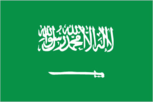
green, a traditional color in Islamic flags, with the Shahada or Muslim creed in large white Arabic script (translated as "There is no god but God; Muhammad is the Messenger of God") above a white horizontal saber (the tip points to the hoist side); design dates to the early twentieth century and is closely associated with the Al Saud family which established the kingdom in 1932; the flag is manufactured with differing obverse and reverse sides so that the Shahada reads - and the sword points - correctly from right to left on both sides note: one of only three national flags that differ on their obverse and reverse sides - the others are Moldova and Paraguay
Government type
monarchy
Independence
23 September 1932 (unification of the kingdom)
International organization participation
ABEDA, AfDB (nonregional member), AFESD, AMF, BIS, FAO, G-20, G-77, GCC, IAEA, IBRD, ICAO, ICC, ICRM, IDA, IDB, IFAD, IFC, IFRCS, IHO, ILO, IMF, IMO, IMSO, Interpol, IOC, IOM (observer), IPU, ISO, ITSO, ITU, LAS, MIGA, NAM, OAPEC, OAS (observer), OIC, OPCW, OPEC, PCA, UN, UNCTAD, UNESCO, UNIDO, UNRWA, UNWTO, UPU, WCO, WFTU, WHO, WIPO, WMO, WTO
Judicial branch
Supreme Council of Justice
Legal system
based on sharia law, several secular codes have been introduced; commercial disputes handled by special committees; has not accepted compulsory ICJ jurisdiction
Legislative branch
Consultative Council or Majlis al-Shura (150 members and a chairman appointed by the monarch to serve four-year terms); note - though the Council of Ministers announced in October 2003 its intent to introduce elections for a third of the Majlis al-Shura incrementally over a period of four to five years, to date no such elections have been held or announced
National anthem
- lyrics/music
- Ibrahim KHAFAJI/Abdul Rahman al-KHATEEB note: music adopted 1947, lyrics adopted 1984
- name
- "Aash Al Maleek" (Long Live Our Beloved King)
National holiday
Unification of the Kingdom, 23 September (1932)
Political parties and leaders
none
Political pressure groups and leaders
- Ansar Al Marah (supports women's rights)
- other
- gas companies; religious groups
Suffrage
21 years of age; male
Economy
Agriculture - products
wheat, barley, tomatoes, melons, dates, citrus; mutton, chickens, eggs, milk
Central bank discount rate
2.5% (31 December 2008) NA% (31 December 2007)
Commercial bank prime lending rate
NA%
Current account balance
$52.03 billion (2010 est.) $22.77 billion (2009 est.)
Debt - external
$82.92 billion (31 December 2010 est.) $72.77 billion (31 December 2009 est.)
Economy - overview
Saudi Arabia has an oil-based economy with strong government controls over major economic activities. It possesses about 20% of the world's proven petroleum reserves, ranks as the largest exporter of petroleum, and plays a leading role in OPEC. The petroleum sector accounts for roughly 80% of budget revenues, 45% of GDP, and 90% of export earnings. Saudi Arabia is encouraging the growth of the private sector in order to diversify its economy and to employ more Saudi nationals. Diversification efforts are focusing on power generation, telecommunications, natural gas exploration, and petrochemical sectors. Almost 6 million foreign workers play an important role in the Saudi economy, particularly in the oil and service sectors, while Riyadh is struggling to reduce unemployment among its own nationals. Saudi officials are particularly focused on employing its large youth population, which generally lacks the education and technical skills the private sector needs. Riyadh has substantially boosted spending on job training and education, most recently with the opening of the King Abdallah University of Science and Technology - Saudi Arabia's first co-educational university. As part of its effort to attract foreign investment, Saudi Arabia acceded to the WTO in December 2005 after many years of negotiations. The government has begun establishing six "economic cities" in different regions of the country to promote foreign investment and plans to spend $373 billion between 2010 and 2014 on social development and infrastructure projects to advance Saudi Arabia's economic development.
Electricity - consumption
165.1 billion kWh (2007 est.)
Electricity - exports
0 kWh (2008 est.)
Electricity - imports
0 kWh (2008 est.)
Electricity - production
179.1 billion kWh (2007 est.)
Exchange rates
Saudi riyals (SAR) per US dollar - 3.75 (2010), 3.75 (2009), 3.75 (2008), 3.745 (2007), 3.745 (2006)
Exports
$235.3 billion (2010 est.) $192.3 billion (2009 est.)
Exports - commodities
petroleum and petroleum products 90%
Exports - partners
Japan 15.33%, South Korea 12.71%, US 12.2%, China 10.38%, India 7.12%, Taiwan 4.54%, Singapore 4.25% (2009)
GDP - composition by sector
- agriculture
- 2.7%
- industry
- 61.9%
- services
- 35.4% (2010 est.)
GDP - per capita (PPP)
$24,200 (2010 est.) $23,700 (2009 est.) $24,000 (2008 est.) note: data are in 2010 US dollars
GDP - real growth rate
3.8% (2010 est.) 0.1% (2009 est.) 4.3% (2008 est.)
GDP (official exchange rate)
$434.4 billion (2010 est.)
GDP (purchasing power parity)
$622.5 billion (2010 est.) $599.7 billion (2009 est.) $599.1 billion (2008 est.) note: data are in 2010 US dollars
Household income or consumption by percentage share
lowest 10%: NA% highest 10%: NA%
Imports
$99.17 billion (2010 est.) $87.1 billion (2009 est.)
Imports - commodities
machinery and equipment, foodstuffs, chemicals, motor vehicles, textiles
Imports - partners
US 12.32%, China 12.06%, Germany 7.67%, Japan 6.15%, South Korea 5.32%, India 4.99%, UK 4.72%, France 4.05% (2009)
Industrial production growth rate
3.1% (2010 est.)
Industries
crude oil production, petroleum refining, basic petrochemicals, ammonia, industrial gases, sodium hydroxide (caustic soda), cement, fertilizer, plastics, metals, commercial ship repair, commercial aircraft repair, construction
Inflation rate (consumer prices)
5.7% (2010 est.) 5.1% (2009 est.)
Investment (gross fixed)
24.5% of GDP (2010 est.)
Labor force
7.337 million note: about 80% of the labor force is non-national (2010 est.)
Labor force - by occupation
- agriculture
- 6.7%
- industry
- 21.4%
- services
- 71.9% (2005 est.)
Market value of publicly traded shares
$318.8 billion (31 December 2009) $246.3 billion (31 December 2008) $515.1 billion (31 December 2007)
Natural gas - consumption
77.1 billion cu m (2009 est.)
Natural gas - exports
0 cu m (2008 est.)
Natural gas - imports
0 cu m (2008 est.)
Natural gas - production
77.1 billion cu m (2009 est.)
Natural gas - proved reserves
7.461 trillion cu m (1 January 2010 est.)
Oil - consumption
2.43 million bbl/day (2009 est.)
Oil - exports
8.728 million bbl/day (2007 est.)
Oil - imports
79,250 bbl/day (2007 est.)
Oil - production
9.764 million bbl/day (2009 est.)
Oil - proved reserves
264.6 billion bbl (1 January 2010 est.)
Population below poverty line
NA%
Public debt
16.7% of GDP (2010 est.) 22.6% of GDP (2009 est.)
Reserves of foreign exchange and gold
$456.2 billion (31 December 2010 est.) $410.1 billion (31 December 2009 est.)
Stock of broad money
$286.9 billion (31 December 2010 est.) $274.4 billion (31 December 2009 est.)
Stock of direct foreign investment - abroad
$18 billion (31 December 2010 est.) $11.41 billion (31 December 2009 est.)
Stock of direct foreign investment - at home
$204.3 billion (31 December 2010 est.) $167 billion (31 December 2009 est.)
Stock of domestic credit
$11.24 billion (31 December 2010 est.) $2.248 billion (31 December 2009 est.)
Stock of narrow money
$166.9 billion (31 December 2010 est) $139.1 billion (31 December 2009 est)
Unemployment rate
10.8% (2010 est.) 10.5% (2009 est.) note: data are for Saudi males only (local bank estimates; some estimates range as high as 25%)
Communications
Broadcast media
broadcast media are state-controlled; state-run TV operates 4 networks; Saudi Arabia is a major market for pan-Arab satellite TV broadcasters; state-run radio operates several networks; multiple international broadcasters are available (2007)
Internet country code
.sa
Internet hosts
488,598 (2010)
Internet users
9.774 million (2009)
Telephone system
- domestic
- mobile-cellular subscribership has been increasing rapidly
- general assessment
- modern system including a combination of extensive microwave radio relays, coaxial cables, and fiber-optic cables
- international
- country code - 966; landing point for the international submarine cable Fiber-Optic Link Around the Globe (FLAG) and for both the SEA-ME-WE-3 and SEA-ME-WE-4 submarine cable networks providing connectivity to Asia, Middle East, Europe, and US; microwave radio relay to Bahrain, Jordan, Kuwait, Qatar, UAE, Yemen, and Sudan; coaxial cable to Kuwait and Jordan; satellite earth stations - 5 Intelsat (3 Atlantic Ocean and 2 Indian Ocean), 1 Arabsat, and 1 Inmarsat (Indian Ocean region) (2008)
Telephones - main lines in use
4.171 million (2009)
Telephones - mobile cellular
44.864 million (2009)
Transportation
Airports
217 (2010)
Airports - with paved runways
- total
- 81 over 3,047 m: 33 2,438 to 3,047 m: 15 1,524 to 2,437 m: 27 914 to 1,523 m: 2 under 914 m: 4 (2010)
Airports - with unpaved runways
- total
- 136 2,438 to 3,047 m: 8 1,524 to 2,437 m: 71 914 to 1,523 m: 41 under 914 m: 16 (2010)
Heliports
9 (2010)
Merchant marine
- by type
- cargo 2, chemical tanker 22, container 4, liquefied gas 2, passenger/cargo 11, petroleum tanker 22, refrigerated cargo 3, roll on/roll off 8
- foreign-owned
- 15 (Egypt 1, Greece 4, Kuwait 4, UAE 6)
- registered in other countries
- 55 (Bahamas 16, Dominica 3, Liberia 24, Norway 3, Panama 8) (2010)
- total
- 74
Pipelines
condensate 212 km; gas 1,880 km; liquid petroleum gas 1,183 km; oil 4,241 km; refined products 1,148 km (2009)
Ports and terminals
Ad Dammam, Al Jubayl, Jiddah, Yanbu' al Sinaiyah
Railways
- standard gauge
- 1,392 km 1.435-m gauge (with branch lines and sidings) (2008)
- total
- 1,392 km
Roadways
- paved
- 47,529 km (includes 3,891 km of expressways)
- total
- 221,372 km
- unpaved
- 173,843 km (2006)
Military and Security
Manpower available for military service
males age 16-49: 8,752,167 females age 16-49: 6,680,315 (2010 est.)
Manpower fit for military service
males age 16-49: 7,560,216 females age 16-49: 5,773,033 (2010 est.)
Manpower reaching militarily significant age annually
- female
- 269,580 (2010 est.)
- male
- 280,041
Military branches
- Ministry of Defense and Aviation Forces
- Royal Saudi Land Forces, Royal Saudi Naval Forces (includes Marine Forces and Special Forces), Royal Saudi Air Force (Al-Quwwat al-Jawwiya al-Malakiya as-Sa'udiya), Royal Saudi Air Defense Forces, Royal Saudi Strategic Rocket Forces, Saudi Arabian National Guard (SANG)
Military expenditures
10% of GDP (2005 est.)
Military service age and obligation
18 years of age (est.); no conscription (2004)
Transnational Issues
Disputes - international
Saudi Arabia has reinforced its concrete-filled security barrier along sections of the now fully demarcated border with Yemen to stem illegal cross-border activities; Kuwait and Saudi Arabia continue discussions on a maritime boundary with Iran; Saudi Arabia claims Egyptian-administered islands of Tiran and Sanafir
Illicit drugs
death penalty for traffickers; improving anti-money-laundering legislation and enforcement page last updated on January 13, 2011 ======================================================================
Refugees and internally displaced persons
- refugees (country of origin)
- 240,015 (Palestinian Territories) (2007)
Trafficking in persons
- current situation
- Saudi Arabia is a destination country for workers from South and Southeast Asia who are subjected to conditions that constitute involuntary servitude including being subjected to physical and sexual abuse, non-payment of wages, confinement, and withholding of passports as a restriction on their movement; domestic workers are particularly vulnerable because some are confined to the house in which they work unable to seek help; Saudi Arabia is also a destination country for Nigerian, Yemeni, Pakistani, Afghan, Somali, Malian, and Sudanese children trafficked for forced begging and involuntary servitude as street vendors; some Nigerian women were reportedly trafficked into Saudi Arabia for commercial sexual exploitation
- tier rating
- Tier 3 - Saudi Arabia does not fully comply with the minimum standards for the elimination of trafficking and is not making significant efforts to do so; the government continues to lack adequate anti-trafficking laws and, despite evidence of widespread trafficking abuses, did not report any criminal prosecutions, convictions, or prison sentences for trafficking crimes committed against foreign domestic workers (2008)