2007 Edition
CIA World Factbook 2007 (Project Gutenberg)
Introduction
Administrative divisions
13 provinces (mintaqat, singular - mintaqah); Al Bahah, Al Hudud ash Shamaliyah, Al Jawf, Al Madinah, Al Qasim, Ar Riyad, Ash Sharqiyah (Eastern Province), 'Asir, Ha'il, Jizan, Makkah, Najran, Tabuk
Age structure
0-14 years: 38.2% (male 5,261,530/female 5,059,041) 15-64 years: 59.4% (male 9,159,519/female 6,895,616) 65 years and over: 2.4% (male 342,020/female 302,005) (2006 est.)
Area
- land
- 2,149,690 sq km
- total
- 2,149,690 sq km
- water
- 0 sq km
Area - comparative
slightly more than one-fifth the size of the US
Background
Saudi Arabia is the birthplace of Islam and home to Islam's two holiest shrines in Mecca and Medina, and the king's official title is the Custodian of the Two Holy Mosques. The modern Saudi state was founded in 1932 by ABD AL-AZIZ bin Abd al-Rahman AL SAUD (Ibn Saud) after a 30-year campaign to unify most of the Arabian Peninsula. A male descendent of Ibn Saud, his son ABDALLAH bin Abd al-Aziz, rules the country today as required by the country's 1992 Basic Law. Following Iraq's invasion of Kuwait in 1990, Saudi Arabia accepted the Kuwaiti royal family and 400,000 refugees while allowing Western and Arab troops to deploy on its soil for the liberation of Kuwait the following year. The continuing presence of foreign troops on Saudi soil after the liberation of Kuwait became a source of tension between the royal family and the public until all operational US troops left the country in 2003. Major terrorist attacks in May and November 2003 spurred a strong on-going campaign against domestic terrorism and extremism. King ABDALLAH has continued the cautious reform program begun when he was crown prince. To promote increased political participation, the government held elections nationwide from February through April 2005 - for half the members of 179 municipal councils. In December 2005, King ABDALLAH completed the process by appointing the remaining members of the advisory municipal councils. The country remains a leading producer of oil and natural gas and holds approximately 25% of the world's proven oil reserves. The government continues to pursue economic reform and diversification, particularly since Saudi Arabia's accession to the WTO in December 2005, and promotes foreign investment in the kingdom. A burgeoning population, aquifer depletion, and an economy largely dependent on petroleum output and prices are all ongoing governmental concerns. Geography Saudi Arabia
Birth rate
29.34 births/1,000 population (2006 est.)
Capital
- geographic coordinates
- 24 38 N, 46 43 E
- name
- Riyadh
- time difference
- UTC+3 (8 hours ahead of Washington, DC during Standard Time)
Climate
harsh, dry desert with great temperature extremes
Coastline
2,640 km
Constitution
governed according to Shari'a law; the Basic Law that articulates the government's rights and responsibilities was introduced in 1993
Country name
- conventional long form
- Kingdom of Saudi Arabia
- conventional short form
- Saudi Arabia
- local long form
- Al Mamlakah al Arabiyah as Suudiyah
- local short form
- Al Arabiyah as Suudiyah
Death rate
2.58 deaths/1,000 population (2006 est.)
Elevation extremes
- highest point
- Jabal Sawda' 3,133 m
- lowest point
- Persian Gulf 0 m
Environment - current issues
desertification; depletion of underground water resources; the lack of perennial rivers or permanent water bodies has prompted the development of extensive seawater desalination facilities; coastal pollution from oil spills
Environment - international agreements
- party to
- Biodiversity, Climate Change, Climate Change-Kyoto Protocol, Desertification, Endangered Species, Hazardous Wastes, Law of the Sea, Marine Dumping, Ozone Layer Protection
- signed, but not ratified
- none of the selected agreements
Ethnic groups
Arab 90%, Afro-Asian 10%
Executive branch
- chief of state
- King and Prime Minister ABDALLAH bin Abd al-Aziz Al Saud (since 1 August 2005); Heir Apparent Crown Prince SULTAN bin Abd al- Aziz Al Saud (half brother of the monarch, born 5 January 1928) note - the monarch is both the chief of state and head of
Geographic coordinates
25 00 N, 45 00 E
Geography - note
extensive coastlines on Persian Gulf and Red Sea provide great leverage on shipping (especially crude oil) through Persian Gulf and Suez Canal People Saudi Arabia
Government type
monarchy
HIV/AIDS - adult prevalence rate
0.01% (2001 est.)
HIV/AIDS - deaths
NA
HIV/AIDS - people living with HIV/AIDS
NA
Independence
23 September 1932 (unification of the kingdom)
Infant mortality rate
- female
- 10.83 deaths/1,000 live births (2006 est.)
- male
- 14.71 deaths/1,000 live births
- total
- 12.81 deaths/1,000 live births
Irrigated land
16,200 sq km (2003)
Land boundaries
- border countries
- Iraq 814 km, Jordan 744 km, Kuwait 222 km, Oman 676 km, Qatar 60 km, UAE 457 km, Yemen 1,458 km
- total
- 4,431 km
Land use
- arable land
- 1.67%
- other
- 98.24% (2005)
- permanent crops
- 0.09%
Languages
Arabic
Legal system
based on Shari'a law, several secular codes have been introduced; commercial disputes handled by special committees; has not accepted compulsory ICJ jurisdiction
Life expectancy at birth
- female
- 77.78 years (2006 est.)
- male
- 73.66 years
- total population
- 75.67 years
Literacy
- definition
- age 15 and over can read and write
- female
- 70.8% (2003 est.) Government Saudi Arabia
- male
- 84.7%
- total population
- 78.8%
Location
Middle East, bordering the Persian Gulf and the Red Sea, north of Yemen
Map references
Middle East
Maritime claims
- contiguous zone
- 18 nm
- continental shelf
- not specified
- territorial sea
- 12 nm
Median age
- female
- 19.4 years (2006 est.)
- male
- 22.9 years
- total
- 21.4 years
National holiday
Unification of the Kingdom, 23 September (1932)
Nationality
- adjective
- Saudi or Saudi Arabian
- noun
- Saudi(s)
Natural hazards
frequent sand and dust storms
Natural resources
petroleum, natural gas, iron ore, gold, copper
Net migration rate
-4.94 migrant(s)/1,000 population (2006 est.)
Population
- 27,019,731
- note
- includes 5,576,076 non-nationals (July 2006 est.)
Population growth rate
2.18% (2006 est.)
Religions
Muslim 100%
Sex ratio
- at birth
- 1.05 male(s)/female
- total population
- 1.2 male(s)/female (2006 est.)
- under 15 years
- 1.04 male(s)/female 15-64 years: 1.33 male(s)/female 65 years and over: 1.13 male(s)/female
Suffrage
- adult male citizens age 21 or older
- note
- voter registration began in November 2004 for partial municipal council elections held nationwide from February through April 2005
Terrain
mostly uninhabited, sandy desert
Total fertility rate
4 children born/woman (2006 est.)
Government
Agriculture - products
wheat, barley, tomatoes, melons, dates, citrus; mutton, chickens, eggs, milk
Airports
208 (2006)
Airports - with paved runways
- over 3,047 m
- 32 2,438 to 3,047 m: 13 1,524 to 2,437 m: 24 914 to 1,523 m: 2
- total
- 73
- under 914 m
- 2 (2006)
Airports - with unpaved runways
- over 3,047 m
- 1 2,438 to 3,047 m: 7 1,524 to 2,437 m: 75 914 to 1,523 m: 40
- total
- 135
- under 914 m
- 12 (2006)
Budget
- expenditures
- $107.6 billion; including capital expenditures of $NA (2006 est.)
- revenues
- $189.2 billion
Currency (code)
Saudi riyal (SAR)
Currency code
SAR
Current account balance
$103.8 billion (2006 est.)
Debt - external
$47.39 billion (2006 est.)
Diplomatic representation from the US
- chief of mission
- Ambassador James C. OBERWETTER
- embassy
- Collector Road M, Diplomatic Quarter, Riyadh
- mailing address
- American Embassy, Unit 61307, APO AE 09803-1307;
Diplomatic representation in the US
- chancery
- 601 New Hampshire Avenue NW, Washington, DC 20037
- chief of mission
- Ambassador (vacant); Ambassador Designate Adil al-Ahmed al-JUBAYR
- telephone
- [1] (202) 342-3800
Disputes - international
Saudi Arabia has reinforced its concrete-filled security barrier along sections of the now fully demarcated border with Yemen to stem illegal cross-border activities; Kuwait and Saudi Arabia continue discussions on a maritime boundary with Iran
Economic aid - donor
pledged $100 million in 1993 to fund reconstruction of Lebanon; since 2000, Saudi Arabia has committed $307 million for assistance to the Palestinians; pledged $230 million to development in Afghanistan; pledged $1 billion in export guarantees and soft loans to Iraq; pledged $133 million in direct grant aid, $187 million in concessional loans, and $153 million in export credits for Pakistan earthquake relief
Economy - overview
This is an oil-based economy with strong government controls over major economic activities. Saudi Arabia possesses 25% of the world's proven petroleum reserves, ranks as the largest exporter of petroleum, and plays a leading role in OPEC. The petroleum sector accounts for roughly 75% of budget revenues, 45% of GDP, and 90% of export earnings. About 40% of GDP comes from the private sector. Roughly 5.5 million foreign workers play an important role in the Saudi economy, particularly in the oil and service sectors. The government is encouraging private sector growth to lessen the kingdom's dependence on oil and increase employment opportunities for the swelling Saudi population. The government is promoting private sector and foreign participation in the power generation, telecom, natural gas, and petrochemical industries. As part of its effort to attract foreign investment and diversify the economy, Saudi Arabia acceded to the WTO in December 2005 after many years of negotiations. With high oil revenues enabling the government to post large budget surpluses, Riyadh has been able to substantially boost spending on job training and education, infrastructure development, and government salaries.
Electricity - consumption
144.4 billion kWh (2004)
Electricity - exports
0 kWh (2004)
Electricity - imports
0 kWh (2004)
Electricity - production
155.2 billion kWh (2004)
Electricity - production by source
- fossil fuel
- 100%
- hydro
- 0%
- nuclear
- 0%
- other
- 0% (2001)
Exchange rates
Saudi riyals per US dollar - 3.745 (2006), 3.747 (2005), 3.75 (2004), 3.75 (2003), 3.75 (2002)
Exports
$204.5 billion f.o.b. (2006 est.)
Exports - commodities
petroleum and petroleum products 90%
Exports - partners
US 16.8%, Japan 16.5%, South Korea 9.3%, China 7.1%, Singapore 5.2%, Taiwan 4.3% (2005)
FAX
- [1] (202) 944-3113
- [966] (1) 488-3989
- consulate(s) general
- Houston, Los Angeles, New York
- consulate(s) general
- Dhahran, Jiddah (Jeddah)
Fiscal year
1 March - 28 February Communications Saudi Arabia
Flag description
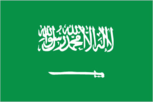
green, a traditional color in Islamic flags, with the Shahada or Muslim creed in large white Arabic script (translated as "There is no god but God; Muhammad is the Messenger of God") above a white horizontal saber (the tip points to the hoist side); design dates to the early twentieth century and is closely associated with the Al Saud family which established the kingdom in 1932 Economy Saudi Arabia
GDP - composition by sector
- agriculture
- 3.3%
- industry
- 67%
- services
- 29.8% (2006 est.)
GDP - per capita (PPP)
$13,800 (2006 est.)
GDP - real growth rate
5.9% (2006 est.)
GDP (official exchange rate)
$286.2 billion (2006 est.)
GDP (purchasing power parity)
$374 billion (2006 est.)
Heliports
6 (2006)
Household income or consumption by percentage share
- highest 10%
- NA%
- lowest 10%
- NA%
Illicit drugs
death penalty for traffickers; increasing consumption of heroin, cocaine, and hashish; improving anti-money-laundering legislation and enforcement This page was last updated on 8 February, 2007
Imports
$64.16 billion f.o.b. (2006 est.)
Imports - commodities
machinery and equipment, foodstuffs, chemicals, motor vehicles, textiles
Imports - partners
US 14.8%, Japan 9%, Germany 8.2%, China 7.4%, UK 4.7% (2005)
Industrial production growth rate
1.9% (2006 est.)
Industries
crude oil production, petroleum refining, basic petrochemicals; ammonia, industrial gases, sodium hydroxide (caustic soda), cement, fertilizer, plastics; metals, commercial ship repair, commercial aircraft repair, construction
Inflation rate (consumer prices)
1.9% (2006 est.)
International Mail
- P. O. Box 94309, Riyadh 11693
- telephone
- [966] (1) 488-3800
International organization participation
ABEDA, AfDB, AFESD, AMF, BIS, FAO, G-77, GCC, IAEA, IBRD, ICAO, ICC, ICRM, IDA, IDB, IFAD, IFC, IFRCS, ILO, IMF, IMO, Interpol, IOC, IPU, ISO, ITU, LAS, MIGA, NAM, OAPEC, OAS (observer), OIC, OPCW, OPEC, PCA, UN, UNCTAD, UNESCO, UNIDO, UNRWA, UNWTO, UPU, WCO, WFTU, WHO, WIPO, WMO, WTO
Internet country code
.sa
Internet hosts
10,931 (2006)
Internet Service Providers (ISPs)
22 (2003)
Internet users
3.2 million (2006) Transportation Saudi Arabia
Investment (gross fixed)
16.2% of GDP (2006 est.)
Judicial branch
Supreme Council of Justice
Labor force
- 7.125 million
- note
- more than 35% of the population in the 15-64 age group is non-national (2006 est.)
Labor force - by occupation
- agriculture
- 12%
- industry
- 25%
- services
- 63% (1999 est.)
Legislative branch
Consultative Council or Majlis al-Shura (120 members and a chairman appointed by the monarch for four-year terms); note - in October 2003, Council of Ministers announced its intent to introduce elections for half of the members of local and provincial assemblies and a third of the members of the national Consultative Council or Majlis al-Shura, incrementally over a period of four to five years; in November 2004, the Ministry of Municipal and Rural Affairs initiated voter registration for partial municipal council elections held nationwide from February through April 2005
Manpower available for military service
- females age 18-49
- 5,417,922 (2005 est.)
- males age 18-49
- 7,648,999
Manpower fit for military service
- females age 18-49
- 4,659,347 (2005 est.)
- males age 18-49
- 6,592,709
Manpower reaching military service age annually
- females age 18-49
- 234,500 (2005 est.)
- males age 18-49
- 247,334
Merchant marine
- by type
- cargo 5, chemical tanker 15, container 4, passenger/cargo 8, petroleum tanker 18, refrigerated cargo 1, roll on/roll off 9
- foreign-owned
- 9 (Egypt 2, Kuwait 5, Sudan 1, UAE 1)
- registered in other countries
- 55 (Bahamas 12, Comoros 3, Dominica 3, French Southern and Antarctic Lands 1, Liberia 24, Marshall Islands 1, Norway 3, Panama 8) (2006)
- total
- 60 ships (1000 GRT or over) 837,272 GRT/1,064,377 DWT
Military branches
Land Forces (Army), Navy, Air Force, Air Defense Force, National Guard, Ministry of Interior Forces (paramilitary)
Military expenditures - dollar figure
$18 billion (2002)
Military expenditures - percent of GDP
10% (2002) Transnational Issues Saudi Arabia
Military service age and obligation
18 years of age (est.); no conscription (2004)
Natural gas - consumption
65.68 billion cu m (2004 est.)
Natural gas - exports
0 cu m (2004 est.)
Natural gas - imports
0 cu m (2004 est.)
Natural gas - production
65.68 billion cu m (2004 est.)
Natural gas - proved reserves
6.654 trillion cu m (1 January 2005 est.)
Oil - consumption
1.845 million bbl/day (2004)
Oil - exports
7.92 million bbl/day (2003)
Oil - imports
0 bbl/day (2003)
Oil - production
9.475 million bbl/day (2005 est.)
Oil - proved reserves
262.7 billion bbl (2006 est.)
Pipelines
condensate 212 km; gas 1,880 km; liquid petroleum gas 1,183 km; oil 4,531 km; refined products 1,150 km (2006)
Political parties and leaders
none
Political pressure groups and leaders
none
Population below poverty line
NA%
Ports and terminals
Ad Dammam, Al Jubayl, Jiddah, Yanbu' al Sinaiyah Military Saudi Arabia
Public debt
32.5% of GDP (2006 est.)
Radio broadcast stations
AM 43, FM 31, shortwave 2 (1998)
Radios
6.25 million (1997)
Railways
- standard gauge
- 1,392 km 1.435-m gauge (with branch lines and sidings) (2005)
- total
- 1,392 km
Refugees and internally displaced persons
- refugees (country of origin)
- 240,015 (Palestinian Territories) (2006)
Reserves of foreign exchange and gold
$31.63 billion (2006 est.)
Roadways
- paved
- 45,461 km
- total
- 152,044 km
- unpaved
- 106,583 km (2000)
Telephone system
- domestic
- extensive microwave radio relay, coaxial cable, and fiber-optic cable systems
- general assessment
- modern system
- international
- country code - 966; microwave radio relay to Bahrain, Jordan, Kuwait, Qatar, UAE, Yemen, and Sudan; coaxial cable to Kuwait and Jordan; submarine cable to Djibouti, Egypt and Bahrain; satellite earth stations - 5 Intelsat (3 Atlantic Ocean and 2 Indian Ocean), 1 Arabsat, and 1 Inmarsat (Indian Ocean region)
Telephones - main lines in use
4.5 million (2006)
Telephones - mobile cellular
13.3 million (2005)
Television broadcast stations
117 (1997)
Televisions
5.1 million (1997)
Trafficking in persons
- current situation
- Saudi Arabia is a destination country for workers from South and Southeast Asia who are subjected to conditions that constitute involuntary servitude including being subjected to physical and sexual abuse, non-payment of wages, confinement, and withholding of passports as a restriction on their movement; domestic workers are particularly vulnerable because some are confined to the house in which they work, unable to seek help; Saudi Arabia is also a destination country for Nigerian, Yemeni, Pakistani, Afghan, Somali, Malian, and Sudanese children trafficked for forced begging and involuntary servitude as street vendors; some Nigerian women were reportedly trafficked into Saudi Arabia for commercial sexual exploitation
- tier rating
- Tier 3 - Saudi Arabia does not fully comply with the minimum standards for the elimination of trafficking and is not making significant efforts to do so
Unemployment rate
13% among Saudi males only (local bank estimate; some estimates range as high as 25%) (2004 est.)