1994 Edition
CIA World Factbook 1994 (Project Gutenberg)
Introduction
Administrative divisions
14 emirates (imarat, singular - imarah); Al Bahah, Al Hudud ash Shamaliyah, Al Jawf, Al Madinah, Al Qasim, Al Qurayyat, Ar Riyad, Ash Sharqiyah, Asir, Hail, Jizan, Makkah, Najran, Tabuk
Agriculture
accounts for about 10% of GDP, 16% of labor force; subsidized by government; products - wheat, barley, tomatoes, melons, dates, citrus fruit, mutton, chickens, eggs, milk; approaching self-sufficiency in food
Airports
total: 215 usable: 195 with permanent-surface runways: 71 with runways over 3,659 m: 14 with runways 2,440-3,659 m: 38 with runways 1,220-2,439 m: 105
Area
total area: 1,960,582 sq km land area: 1,960,582 sq km comparative area: slightly less than one-fourth the size of the US
Birth rate
38.25 births/1,000 population (1994 est.)
Branches
Land Force (Army), Navy, Air Force, Air Defense Force, National Guard, Coast Guard, Frontier Forces, Special Security Force, Public Security Force
Budget
revenues: $39 billion expenditures: $50 billion, including capital expenditures of $7.5 billion (1993 est.)
Capital
Riyadh
Climate
harsh, dry desert with great extremes of temperature
Coastline
2,640 km
Constitution
none; governed according to Shari'a (Islamic law)
Currency
1 Saudi riyal (SR) = 100 halalah
Death rate
5.83 deaths/1,000 population (1994 est.)
Defense expenditures
exchange rate conversion - $16.5 billion, 13% of GDP (1993 budget)
Digraph
SA
Diplomatic representation in US
chief of mission: Ambassador BANDAR bin Sultan Abd al-Aziz Al Saud chancery: 601 New Hampshire Avenue NW, Washington, DC 20037 telephone: (202) 342-3800 consulate(s) general: Houston, Los Angeles, and New York
Economic aid
donor: pledged bilateral aid (1979-89), $64.7 billion; pledged $100 million in 1993 to fund reconstruction of Lebanon
Electricity
capacity: 28,554,000 kW production: 63 billion kWh consumption per capita: 3,690 kWh (1992)
Environment
current issues: desertification; depletion of underground water resources; the lack of perennial rivers or permanent water bodies has prompted the development of extensive seawater desalination facilities; coastal pollution from oil spills natural hazards: frequent sand and dust storms international agreements: party to - Hazardous Wastes, Ozone Layer Protection; signed, but not ratified - Law of the Sea
Ethnic divisions
Arab 90%, Afro-Asian 10%
Exchange rates
Saudi riyals (SR) per US$1 - 3.7450 (fixed rate since late 1986), 3.7033 (1986)
Executive branch
chief of state and head of government: King and Prime Minister FAHD bin Abd al-Aziz Al Saud (since 13 June 1982); Crown Prince and First Deputy Prime Minister ABDALLAH bin Abd al-Aziz Al Saud (half-brother to the King, appointed heir to the throne 13 June 1982) cabinet: Council of Ministers; mostly made up of the royal family appointed by the king
Exports
$42.3 billion (f.o.b., 1993 est.) commodities: petroleum and petroleum products 92% partners: US 21%, Japan 18%, Singapore 6%, France 6%, Korea 5%
External debt
$18.9 billion (December 1989 est., includes short-term trade credits)
FAX
[966] (1) 482-4364 consulate(s) general: Dhahran, Jiddah (Jeddah)
Fiscal year
calendar year
Flag
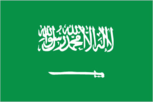
green with large white Arabic script (that may be translated as There is no God but God; Muhammad is the Messenger of God) above a white horizontal saber (the tip points to the hoist side); green is the traditional color of Islam
Highways
total: 74,000 km paved: 35,000 km unpaved: gravel, improved earth 39,000 km
Illicit drugs
death penalty for traffickers; increasing consumption of heroin and cocaine
Imports
$26 billion (f.o.b., 1993 est.) commodities: machinery and equipment, chemicals, foodstuffs, motor vehicles, textiles partners: US 18%, UK 12%, Japan 10%, Germany 5%, France 5%
Independence
23 September 1932 (unification)
Industrial production
growth rate 20% (1991 est.); accounts for 46% of GDP, including petroleum
Industries
crude oil production, petroleum refining, basic petrochemicals, cement, two small steel-rolling mills, construction, fertilizer, plastics
Infant mortality rate
52.1 deaths/1,000 live births (1994 est.)
Inflation rate (consumer prices)
1% (1993 est.)
International disputes
large section of boundary with Yemen not defined; status of boundary with UAE not final; Kuwaiti ownership of Qaruh and Umm al Maradim islands is disputed by Saudi Arabia
Irrigated land
4,350 sq km (1989 est.)
Judicial branch
Supreme Council of Justice
Labor force
5 million-6 million by occupation: government 34%, industry and oil 28%, services 22%, agriculture 16%
Land boundaries
total 4,415 km, Iraq 814 km, Jordan 728 km, Kuwait 222 km, Oman 676 km, Qatar 60 km, UAE 457 km, Yemen 1,458 km
Land use
arable land: 1% permanent crops: 0% meadows and pastures: 39% forest and woodland: 1% other: 59%
Languages
Arabic
Legal system
based on Islamic law, several secular codes have been introduced; commercial disputes handled by special committees; has not accepted compulsory ICJ jurisdiction
Legislative branch
a consultative council comprised of 60 members and a chairman who are appointed by the King for a term of four years
Life expectancy at birth
total population: 67.91 years male: 66.25 years female: 69.65 years (1994 est.)
Literacy
age 15 and over can read and write (1990 est.) total population: 62% male: 73% female: 48%
Location
Middle East, between the Red Sea and the Persian Gulf
Manpower availability
males age 15-49 5,682,036; fit for military service 3,140,464; reach military age (17) annually 147,420 (1994 est.)
Map references
Africa, Middle East, Standard Time Zones of the World
Maritime claims
contiguous zone: 18 nm continental shelf: not specified territorial sea: 12 nm
Member of
ABEDA, AfDB, AFESD, AL, AMF, CCC, ESCWA, FAO, G-19, G-77, GCC, IAEA, IBRD, ICAO, ICC, IDA, IDB, IFAD, IFC, ILO, IMF, IMO, INMARSAT, INTELSAT, INTERPOL, IOC, ISO, ITU, LORCS, NAM, OAPEC, OAS (observer), OIC, OPEC, UN, UNCTAD, UNESCO, UNIDO, UNOSOM, UPU, WFTU, WHO, WIPO, WMO
Merchant marine
74 ships (1,000 GRT or over) totaling 865,343 GRT/1,240,874 DWT, bulk 1, cargo 11, chemical tanker 4, container 3, liquefied gas 1, livestock carrier 5, oil tanker 23, passenger 1, refrigerated cargo 6, roll-on/roll-off cargo 11, short-sea passenger 7, specialized tanker 1
Names
conventional long form: Kingdom of Saudi Arabia conventional short form: Saudi Arabia local long form: Al Mamlakah al Arabiyah as Suudiyah local short form: Al Arabiyah as Suudiyah
National holiday
Unification of the Kingdom, 23 September (1932)
National product
GDP - purchasing power equivalent - $194 billion (1993 est.)
National product per capita
$11,000 (1993 est.)
National product real growth rate
1% (1993 est.)
Nationality
noun: Saudi(s) adjective: Saudi or Saudi Arabian
Natural resources
petroleum, natural gas, iron ore, gold, copper
Net migration rate
0 migrant(s)/1,000 population (1994 est.)
Note
extensive coastlines on Persian Gulf and Red Sea provide great leverage on shipping (especially crude oil) through Persian Gulf and Suez Canal
Overview
The petroleum sector accounts for roughly 75% of budget revenues, 35% of GDP, and almost all export earnings. Saudi Arabia has the largest reserves of petroleum in the world, ranks as the largest exporter of petroleum, and plays a leading role in OPEC. For the 1990s the government intends to bring its budget, which has been in deficit since 1983, back into balance, and to encourage private economic activity. Roughly four million foreign workers play an important role in the Saudi economy, for example, in the oil and banking sectors. For about a decade, Saudi Arabia's domestic and international outlays have outstripped its income, and the government has cut its foreign assistance and is beginning to rein in domestic programs.
Pipelines
crude oil 6,400 km; petroleum products 150 km; natural gas 2,200 km (includes natural gas liquids 1,600 km)
Political parties and leaders
none allowed
Population
18,196,783 (July 1994 est.) note: the population figure is consistent with a 3.24% growth rate; a 1992 census gives the number of Saudi citizens as 12,304,835 and the number of residents who are not citizens as 4,624,459
Population growth rate
3.24% (1994 est.)
Ports
Jiddah, Ad Dammam, Ras Tanura, Jizan, Al Jubayl, Yanbu' al Bahr, Yanbu' al Sinaiyah
Railroads
1390 km 1.435-meter standard gauge; 448 km are double tracked
Religions
Muslim 100%
Suffrage
none
Telecommunications
modern system with extensive microwave and coaxial and fiber optic cable systems; 1,624,000 telephones; broadcast stations - 43 AM, 13 FM, 80 TV; microwave radio relay to Bahrain, Jordan, Kuwait, Qatar, UAE, Yemen, and Sudan; coaxial cable to Kuwait and Jordan; submarine cable to Djibouti, Egypt and Bahrain; earth stations - 3 Atlantic Ocean INTELSAT, 2 Indian Ocean INTELSAT, 1 ARABSAT, 1 INMARSAT
Terrain
mostly uninhabited, sandy desert
Total fertility rate
6.67 children born/woman (1994 est.)
Type
monarchy
Unemployment rate
6.5% (1992 est.)
US diplomatic representation
chief of mission: (vacant); Charge d'Affaires C. David Welch embassy: Collector Road M, Diplomatic Quarter, Riyadh mailing address: American Embassy, Unit 61307, Riyadh; International Mail: P. O. Box 94309, Riyadh 11693; or APO AE 09803-1307 telephone: [966] (1) 488-3800