1992 Edition
CIA World Factbook 1992 (Project Gutenberg)
Geography
Climate
Mediterranean; mild to cool winters; warm, sunny summers
Coastline
none - landlocked
Comparative area
about 0.3 times the size of Washington, DC
Disputes
none
Environment
dominated by the Appenines
Land area
60 km2
Land boundaries
39 km; Italy 39 km
Land use
arable land 17%; permanent crops 0%; meadows and pastures 0%; forest and woodland 0%; other 83%
Maritime claims
none - landlocked
Natural resources
building stones
Note
landlocked; world's smallest republic; enclave of Italy
Terrain
rugged mountains
Total area
60 km2
People and Society
Birth rate
8 births/1,000 population (1992)
Death rate
7 deaths/1,000 population (1992)
Ethnic divisions
Sanmarinese, Italian
Infant mortality rate
8 deaths/1,000 live births (1992)
Labor force
about 4,300
Languages
Italian
Life expectancy at birth
74 years male, 79 years female (1992)
Literacy
96% (male 96%, female 95%) age 14 and over can read and write (1976)
Nationality
noun - Sanmarinese (singular and plural); adjective - Sanmarinese
Net migration rate
5 migrants/1,000 population (1992)
Organized labor
Democratic Federation of Sanmarinese Workers (affiliated with ICFTU) has about 1,800 members; Communist-dominated General Federation of Labor, 1,400 members
Population
23,404 (July 1992), growth rate 0.6% (1992)
Religions
Roman Catholic
Total fertility rate
1.3 children born/woman (1992)
Government
Administrative divisions
9 municipalities (castelli, singular - castello); Acquaviva, Borgo Maggiore, Chiesanuova, Domagnano, Faetano, Fiorentino, Monte Giardino, San Marino, Serravalle
Capital
San Marino
Co-Chiefs of State
Captain Regent Edda CETCOLI and Captain Regent Marino RICCARDI (since 1 October 1991)
Communists
about 300 members
Constitution
8 October 1600; electoral law of 1926 serves some of the functions of a constitution
Diplomatic representation
San Marino maintains honorary Consulates General in Washington and New York and an honorary Consulate in Detroit
Executive branch
two captains regent, Congress of State (cabinet); real executive power is wielded by the secretary of state for foreign affairs and the secretary of state for internal affairs
Flag
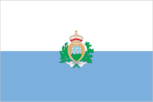
- two equal horizontal bands of white (top) and light blue with the national coat of arms superimposed in the center; the coat of arms has a shield (featuring three towers on three peaks) flanked by a wreath, below a crown and above a scroll bearing the word
- AS (Liberty)
Great and General Council
last held 29 May 1988 (next to be held by NA May 1993); results - percent of vote by party NA; seats - (60 total) DCS 27, PCS 18, PSU 8, PSS 7
Head of Government
Secretary of State Gabriele GATTI (since July 1986)
Independence
301 AD (by tradition)
Judicial branch
Council of Twelve (Consiglio dei XII)
Legal system
based on civil law system with Italian law influences; has not accepted compulsory ICJ jurisdiction
Legislative branch
unicameral Great and General Council (Consiglio Grande e Generale)
Long-form name
Republic of San Marino
Member of
CE, CSCE, ICAO, ICFTU, ILO, IMF (observer), IOC, IOM (observer), ITU, LORCS, NAM (guest), UN, UNCTAD, UNESCO, UPU, WHO, WTO
National holiday
Anniversary of the Foundation of the Republic, 3 September
Political parties and leaders
Christian Democratic Party (DCS), Piermarino MENICUCCI; San Marino Democratic Progressive Party (PPDS) formerly San Marino Communist Party (PCS), Gilberto GHIOTTI; San Marino Socialist Party (PSS), Remy GIACOMINI; Unitary Socialst Party (PSU); Democratic Movement (MD), Emilio Della BALDA; San Marino Social Democratic Party (PSDS), Augusto CASALI; San Marino Republican Party (PRS), Cristoforo BUSCARINI
Suffrage
universal at age 18
Type
republic
Economy
Budget
revenues $99.2 million; expenditures $NA, including capital expenditures of $NA (1983)
GDP
purchasing power equivalent - $400 million, per capita $17,000; real growth rate NA% (1991 est.)
Inflation rate (consumer prices)
6% (1990)
Overview
More than 2 million tourists visit each year, contributing about 60% to GDP. The sale of postage stamps to foreign collectors is another important income producer. The manufacturing sector employs nearly 40% of the labor force and agriculture less than 4%. The per capita level of output and standard of living are comparable to northern Italy.
Unemployment rate
6.5% (1985)
Communications
Highways
104 km
Telecommunications
automatic telephone system completely integrated into Italian system; 11,700 telephones; broadcast services from Italy; microwave and cable links into Italian networks; no communication satellite facilities
Military and Security
Branches
public security or police force of less than 50 people
Defense expenditures
exchange rate conversion - $NA, NA% of GDP
Manpower availability
all fit men ages 16-60 constitute a militia that can serve as an army