1987 Edition
CIA World Factbook 1987 (Internet Archive)
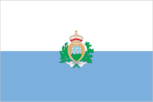
Geography
Climate
Mediterranean; mild to cool winters; warm, sunny summers
Comparative area
about one-third the size of Washington, D. C.
Environment
dominated by the Appenines
Land boundary
34 km with Italy
Land use
17% arable land; 0% permanent crops; 0% meadows and pastures; 0% forest and woodland; 83% other
Special notes
landlocked; world’s smallest republic; enclave of Italy
Terrain
rugged mountains
Total area
- Z2km Com Acquaviva . 2 orga Maggiore 4 SAN MARINO Fiorentino Chiesangova, ° Monte” Giardino j
- 60 km?; land area: 60 km?
People and Society
Infant mortality rate
9.6/1,000 (1983)
Labor force
about 4,300
Language
Italian
Literacy
97%
Nationality
noun—Sanmarinese (sing. and pl.); adjective—Sanmarinese
Organized labor
Democratic Federation of Sanmarinese Workers (affiliated with ICFTU) has about 1,800 members; Communist-dominated General Federation of Labor, 1,400 members
Population
22,791 (July 1987), average annual growth rate 0.86%
Religion
Roman Catholic
Government
Administrative divisions
San Marino is divided into 9 castles—Acquaviva, Borgo Maggiore, Chiesanuova, Domagnano, Faetano, Fiorentino, Monte Giardino, San Marino, Serravalle
Branches
the Grand and General Council is the legislative body elected by popular vote; its 60 members serve five-year terms; Council in turn elects two Captains-Regent who exercise executive power for term of six months, the Congress of State whose members head government administrative departments, and the Council of Twelve, the supreme judicial body; actual executive power is wielded by the Secretary of State for Foreign Affairs and the Secretary of State for Internal Affairs
Capital
San Marino
Communists
about 300 members; the PCS, in conjunction with the PSS, PSU, and PSDS, has led the government since Other political parties or pressure groups: political parties influenced by policies of their counterparts in Italy
Elections
elections to the Grand and General Council required at least every five years; last election was held 29 May Political parties and leaders: Christian Democratic Party (DCS), Clara Boscaglia; Social Democratic Party (PSDS), Alvaro Casali; Socialist Party (PSS), Remy Giacomini; Communist Party (PCS), Gilberto Ghiotti; Unitary Socialist Party (PSU), Emilio Della Balda; Committee for the Defense of the Republic (CDR), leader unknown
Government leaders
Gabriele GATTI (Christian Democrat), Secretary of State for Foreign and Political Affairs and for Information (since July 1986); Alvaro SELVA (Communist), Secretary of State for Internal Affairs and Justice (since July 1978); Gabriele GATTI (Christian Democrat), Secretary of State for Budget, Finance, and Planning (since July 1986)
Legal system
based on civil law system with Italian law influences; electoral law of 1926 serves some of the functions of a constitution; has not accepted compulsory IC] jurisdiction
Member of
ICJ, International Institute for Unification of Private Law, International Relief Union, ITU, IRC, UNESCO, UPU, WFTU, WHO, WTO; observer status in NAM
National holiday
Anniversary of the Liberation of the Republic, 5 February
Official name
Republic of San Marino
Suffrage
universal (since 1960)
Type
republic
Voting strength
(1983 election) 42.1% DCS, 24.4% PCS, 14.8% PSS, 13.9% PSU, 2.9% PSDS
Economy
Agriculture
wheat, grapes, other grains, fruits, vegetables, animal feedstuffs, cheese, livestock hides
Electric power
supplied by Italy
Foreign transactions
dominated by tourism (in summer months about 25,000 foreigners visit every day); remittances from Sanmarinese abroad also represent an important net foreign inflow; commodity trade consists primarily of exchanging building stone, lime, wood, chestnuts, wheat, wine, baked goods, hides, and ceramics for a wide variety of consumer manufactures
Manufacturing
cotton textiles, brick and tile production, cement, pottery, tanned hides, paper, candy, baked goods, Moscato wine, gold and silver souvenirs
Monetary conversion rate
1337.0 Italian lire=US$1 (January 1987)
Natural resources
building stones
Communications
Airfields
none
Civil air
no major transport aircraft
Highways
about 104 km
Railroads
none
Telecommunications
automatic telephone system serving 11,700 telephones (34.2 per 100 popl.); no radiobroadcasting or television facilities; radio-relay and cable links into Italian networks Sao Tome and Principe slihéu Bombom Ihe do Principe?, Pedras , Tinhosas ¢ Gulf of anto Antonio ithéu Carocgo