1999 Edition
CIA World Factbook 1999 (Internet Archive)
Introduction
Background
Throughout their colonial rule, first Germany and then Belgium favored Rwanda's minority Tutsi ethnic group in education and employment. In 1959, the majority ethnic group, the Hutus, overthrew the ruling Tutsi monarch. The Hutus killed hundreds of Tutsis and drove tens of thousands into exile in neighboring countries. The children of these exiles later formed a rebel group, the Rwandan Patriotic Front (RPF), and began a civil war in October 1990. The war, along with several political and economic upheavals, exasperated ethnic tensions culminating in April 1994 in a genocide in which roughly 800,000 Tutsis and moderate Hutus were killed. The Tutsi rebels defeated the Hutu regime and ended the genocide in July 1994, but approximately 2 million Hutu refugees--many fearing Tutsi retribution--fled to neighboring Burundi, Tanzania, Uganda, and Zaire, now called the Democratic Republic of the Congo (DROC). According to the UN Office of the High Commissioner for Refugees, in 1996 and early 1997 nearly 1.3 million Hutus returned to Rwanda. Even with substantial international aid, these civil dislocations have hindered efforts to foster reconciliation and to boost investment and agricultural output. Although much of the country is now at peace, members of the former regime continue to destabilize the northwest area of the country through a low-intensity insurgency. Rwandan troops are currently involved in a crisis engulfing neighboring DROC.
Geography
Area
total: 26,340 sq km land: 24,950 sq km water: 1,390 sq km
Area--comparative
slightly smaller than Maryland
Climate
temperate; two rainy seasons (February to April, November to January); mild in mountains with frost and snow possible
Coastline
0 km (landlocked)
Elevation extremes
lowest point: Rusizi River 950 m highest point: Volcan Karisimbi 4,519 m
Environment--current issues
deforestation results from uncontrolled cutting of trees for fuel; overgrazing; soil exhaustion; soil erosion; widespread poaching
Environment--international agreements
party to: Biodiversity, Climate Change, Desertification, Endangered Species, Nuclear Test Ban signed, but not ratified: Law of the Sea
Geographic coordinates
2 00 S, 30 00 E
Geography--note
landlocked; predominantly rural population
Irrigated land
40 sq km (1993 est.)
Land boundaries
total: 893 km border countries: Burundi 290 km, Democratic Republic of the Congo 217 km, Tanzania 217 km, Uganda 169 km
Land use
arable land: 35% permanent crops: 13% permanent pastures: 18% forests and woodland: 22% other: 12% (1993 est.)
Location
Central Africa, east of Democratic Republic of the Congo
Map references
Africa
Maritime claims
none (landlocked)
Natural hazards
periodic droughts; the volcanic Birunga mountains are in the northwest along the border with Democratic Republic of the Congo
Natural resources
gold, cassiterite (tin ore), wolframite (tungsten ore), methane, hydropower
Terrain
mostly grassy uplands and hills; relief is mountainous with altitude declining from west to east
People and Society
Age structure
0-14 years: 44% (male 1,807,695; female 1,793,590) 15-64 years: 53% (male 2,148,477; female 2,179,119) 65 years and over: 3% (male 92,490; female 133,562) (1999 est.)
Birth rate
38.97 births/1,000 population (1999 est.)
Death rate
19.53 deaths/1,000 population (1999 est.)
Ethnic groups
Hutu 80%, Tutsi 19%, Twa (Pygmoid) 1%
Infant mortality rate
112.86 deaths/1,000 live births (1999 est.)
Languages
Kinyarwanda (official) universal Bantu vernacular, French (official), English (official), Kiswahili (Swahili) used in commercial centers
Life expectancy at birth
total population: 41.31 years male: 40.84 years female: 41.8 years (1999 est.)
Literacy
definition: age 15 and over can read and write total population: 60.5% male: 69.8% female: 51.6% (1995 est.)
Nationality
noun: Rwandan(s) adjective: Rwandan
Net migration rate
4.91 migrant(s)/1,000 population (1999 est.) note: following the outbreak of genocidal strife in Rwanda in April 1994 between Tutsi and Hutu factions, more than 2 million refugees fled to neighboring Burundi, Tanzania, Uganda, and Democratic Republic of the Congo (formerly Zaire); according to the UN High Commission on Refugees, in 1996 and early 1997 nearly 1.3 million Hutus returned to Rwanda--of these 720,000 returned from Democratic Republic of the Congo, 480,000 from Tanzania, 88,000 from Burundi, and 10,000 from Uganda; probably fewer than 100,000 Rwandans remained outside of Rwanda by the end of 1997
Population
8,154,933 (July 1999 est.)
Population growth rate
2.43% (1999 est.)
Religions
Roman Catholic 65%, Protestant 9%, Muslim 1%, indigenous beliefs and other 25%
Sex ratio
at birth: 1.03 male(s)/female under 15 years: 1.01 male(s)/female 15-64 years: 0.99 male(s)/female 65 years and over: 0.69 male(s)/female total population: 0.99 male(s)/female (1999 est.)
Total fertility rate
5.8 children born/woman (1999 est.)
Government
Administrative divisions
12 prefectures (in French--prefectures, singular--prefecture; in Kinyarwanda--plural--NA, singular--prefegitura); Butare, Byumba, Cyangugu, Gikongoro, Gisenyi, Gitarama, Kibungo, Kibuye, Kigali, Kigaliville, Umutara, Ruhengeri
Capital
Kigali
Constitution
on 5 May 1995, the Transitional National Assembly adopted a new constitution which included elements of the constitution of 18 June 1991 as well as provisions of the 1993 Arusha peace accord and the November 1994 multi-party protocol of understanding
Country name
conventional long form: Rwandese Republic conventional short form: Rwanda local long form: Republika y'u Rwanda local short form: Rwanda
Data code
RW
Executive branch
chief of state: President Pasteur BIZIMUNGU (since 19 July 1994); Vice President Maj. Gen. Paul KAGAME (since 19 July 1994) head of government: Prime Minister Celestin RWIGEMA (since 1 September 1995) cabinet: Council of Ministers appointed by the president elections: normally the president is elected by popular vote for a five-year term; election last held in December 1988 (next to be held NA); prime minister is appointed by the president election results: Juvenal HABYARIMANA elected president; percent of vote--99.98% (HABYARIMANA was the sole candidate) note: President HABYARIMANA was killed in a plane crash on 6 April 1994 which ignited the genocide and was replaced by President BIZIMUNGU who was installed by the military forces of the ruling Rwandan Patriotic Front on 19 July 1994
Flag description
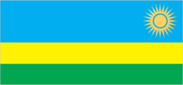
three equal vertical bands of red (hoist side), yellow, and green with a large black letter R centered in the yellow band; uses the popular pan-African colors of Ethiopia; similar to the flag of Guinea, which has a plain yellow band
Government type
republic; presidential, multiparty system
Independence
1 July 1962 (from Belgium-administered UN trusteeship)
International organization participation
ACCT, ACP, AfDB, CCC, CEEAC, CEPGL, ECA, FAO, G-77, IBRD, ICAO, ICFTU, ICRM, IDA, IFAD, IFC, IFRCS, ILO, IMF, Intelsat, Interpol, IOC, IOM (observer), ITU, NAM, OAU, OPCW, UN, UNCTAD, UNESCO, UNIDO, UPU, WCL, WHO, WIPO, WMO, WToO, WTrO Diplomatic representation in the US: chief of mission: Ambassador Theogene N. RUDASINGWA chancery: 1714 New Hampshire Ave. NW, Washington, DC 20009 Diplomatic representation from the US: chief of mission: Ambassador George M. STAPLES embassy: Boulevard de la Revolution, Kigali mailing address: B. P. 28, Kigali
Judicial branch
Constitutional Court, consists of the Court of Cassation and the Council of State in joint session Political parties and leaders: significant parties include: Political pressure groups and leaders: Rwanda Patriotic Army or Return (RDR)
Legal system
based on German and Belgian civil law systems and customary law; judicial review of legislative acts in the Supreme Court; has not accepted compulsory ICJ jurisdiction
Legislative branch
unicameral Transitional National Assembly or Assemblee Nationale de Transition (a power-sharing body with 70 seats established on 12 December 1994 following a multi-party protocol understanding; members were predetermined by the Arusha peace accord) elections: the last national legislative elections were held 16 December 1988 for the National Development Council (the legislature prior to the advent of the Transitional National Assembly); no elections have been held for the Transitional National Assembly as the distribution of seats was predetermined by the Arusha peace accord election results: percent of vote by party--NA; seats by party--RPF 19, MDR 13, PSD 13, PL 13, PDC 6, PSR 2, PDI 2, other 2; note--the distribution of seats was predetermined
National holiday
Independence Day, 1 July (1962)
Suffrage
NA years of age; universal adult
Economy
Agriculture--products
coffee, tea, pyrethrum (insecticide made from chrysanthemums), bananas, beans, sorghum, potatoes; livestock
Budget
revenues: $231 million expenditures: $319 million, including capital expenditures of $13 million (1996 est.)
Currency
1 Rwandan franc (RF) = 100 centimes
Debt--external
$1.2 billion (1998)
Economic aid--recipient
$711.2 million (1995); note?since 1994, World Bank financing to Rwanda has totaled more than $120 million; in June 1998, Rwanda signed an Enhanced Structural Adjustment Facility (ESAF) with the IMF; in summer 1998, Rwanda presented its policy objectives and development priorities to donor governments resulting in multi-year pledges in the amount of $250 million
Economy--overview
Rwanda is a rural country with about 90% of the population engaged in (mainly subsistence) agriculture. It is the most densely populated country in Africa; is landlocked, and has few natural resources and minimal industry. Primary exports are coffee and tea. The 1994 genocide decimated Rwanda's fragile economic base, severely impoverished the population, particularly women, and eroded the country's ability to attract private and external investment. However, Rwanda has made significant progress in stabilizing and rehabilitating its economy. GDP has rebounded, and inflation has been curbed. In June 1998, Rwanda signed an Enhanced Structural Adjustment Facility (ESAF) with the IMF. Rwanda has also embarked upon an ambitious privatization program with the World Bank.
Electricity--consumption
177 million kWh (1996)
Electricity--exports
2 million kWh (1996)
Electricity--imports
15 million kWh (1996)
Electricity--production
164 million kWh (1996)
Electricity--production by source
fossil fuel: 2.44% hydro: 97.56% nuclear: 0% other: 0% (1996)
Exchange rates
Rwandan francs (RF) per US$1--320.63 (February 1999), 312.31 (1998), 301.53 (1997), 306.82 (1996), 262.20 (1995)
Exports
$82.1 million (f.o.b., 1998 est.)
Exports--commodities
coffee 55%, tea 21%, hides, tin ore (1997)
Exports--partners
Brazil 49%, Germany 16%, US, Netherlands, UK (1996)
Fiscal year
calendar year
GDP
purchasing power parity--$5.5 billion (1998 est.)
GDP--composition by sector
agriculture: 36% industry: 24% services: 40% (1997 est.)
GDP--per capita
purchasing power parity?$690 (1998 est.)
GDP--real growth rate
10.5% (1998 est.)
Household income or consumption by percentage share
lowest 10%: 4.2% highest 10%: 24.2% (1983-85)
Imports
$326 million (f.o.b., 1998 est.)
Imports--commodities
foodstuffs, machinery and equipment, steel, petroleum products, cement and construction material (1997)
Imports--partners
Italy, Kenya, Tanzania, US, Belgium-Luxembourg (1997)
Industrial production growth rate
4.9% (1995 est.)
Industries
production of cement, processing of agricultural products, small-scale beverage production, manufacture of soap, furniture, shoes, plastic goods, textiles, cigarettes
Inflation rate (consumer prices)
10% (1998)
Labor force
3.6 million
Labor force--by occupation
agriculture 90%, government and services, industry and commerce
Population below poverty line
51.2% (1993 est.)
Unemployment rate
NA%
Communications
Radio broadcast stations
AM 1, FM 1, shortwave 0
Radios
630,000 (1993 est.)
Telephone system
telephone system primarily serves business and government domestic: the capital, Kigali, is connected to the centers of the prefectures by microwave radio relay; the remainder of the network depends on wire and HF radiotelephone international: international connections employ microwave radio relay to neighboring countries and satellite communications to more distant countries; satellite earth stations--1 Intelsat (Indian Ocean) in Kigali (includes telex and telefax service)
Telephones
6,400 (1983 est.)
Television broadcast stations
2 (1997)
Televisions
NA
Transportation
Airports
7 (1998 est.) Airports--with paved runways: total: 4 over 3,047 m: 1 914 to 1,523 m: 2 under 914 m: 1 (1998 est.) Airports--with unpaved runways: total: 3 914 to 1,523 m: 1 under 914 m: 2 (1998 est.)
Highways
total: 12,000 km paved: 1,000 km unpaved: 11,000 km (1997 est.)
Railways
0 km
Waterways
Lac Kivu navigable by shallow-draft barges and native craft Ports and harbors: Cyangugu, Gisenyi, Kibuye
Military and Security
Military branches
Army, Gendarmerie
Military expenditures--dollar figure
$92 million (1999)
Military expenditures--percent of GDP
3.8% (1999)
Military manpower--availability
males age 15-49: 1,964,118 (1999 est.) Military manpower--fit for military service: males age 15-49: 1,000,204 (1999 est.)
Transnational Issues
Disputes--international
Rwandan military forces are supporting the rebel forces in the civil war in the Democratic Republic of the Congo