1998 Edition
CIA World Factbook 1998 (Internet Archive)
Geography
Area
total: 26,340 sq km land: 24,950 sq km water: 1,390 sq km
Area-comparative
slightly smaller than Maryland
Climate
temperate; two rainy seasons (February to April, November to January); mild in mountains with frost and snow possible
Coastline
0 km (landlocked)
Elevation extremes
lowest point: Rusizi River 950 m highest point: Volcan Karisimbi 4,519 m
Environment-current issues
deforestation results from uncontrolled cutting of trees for fuel; overgrazing; soil exhaustion; soil erosion
Environment-international agreements
party to: Biodiversity, Endangered Species, Nuclear Test Ban signed, but not ratified: Climate Change, Desertification, Law of the Sea
Geographic coordinates
2 00 S, 30 00 E
Geography-note
landlocked; predominantly rural population
Irrigated land
40 sq km (1993 est.)
Land boundaries
total: 893 km border countries: Burundi 290 km, Democratic Republic of the Congo 217 km, Tanzania 217 km, Uganda 169 km
Land use
arable land: 35% permanent crops: 13% permanent pastures: 18% forests and woodland: 22% other: 12% (1993 est.)
Location
Central Africa, east of Democratic Republic of the Congo
Map references
Africa
Maritime claims
none (landlocked)
Natural hazards
periodic droughts; the volcanic Virunga mountains are in the northwest along the border with Democratic Republic of the Congo
Natural resources
gold, cassiterite (tin ore), wolframite (tungsten ore), natural gas, hydropower
Terrain
mostly grassy uplands and hills; relief is mountainous with altitude declining from west to east
People and Society
Age structure
0-14 years: 45% (male 1,785,650; female 1,772,609) 15-64 years: 53% (male 2,070,401; female 2,106,809) 65 years and over: 2% (male 90,941; female 129,762) (July 1998 est.)
Birth rate
38.99 births/1,000 population (1998 est.)
Death rate
19 deaths/1,000 population (1998 est.)
Ethnic groups
Hutu 80%, Tutsi 19%, Twa (Pygmoid) 1%
Infant mortality rate
113.31 deaths/1,000 live births (1998 est.)
Languages
Kinyarwanda (official) universal Bantu vernacular, French (official), English (official), Kiswahili (Swahili) used in commercial centers
Life expectancy at birth
total population: 41.93 years male: 41.49 years female: 42.4 years (1998 est.)
Literacy
definition: age 15 and over can read and write total population: 60.5% male: 69.8% female: 51.6% (1995 est.)
Nationality
noun: Rwandan(s) adjective: Rwandan
Net migration rate
5.03 migrant(s)/1,000 population (1998 est.) note: following the outbreak of genocidal strife in Rwanda in April 1994 between Tutsi and Hutu factions, more than 2 million refugees fled to neighboring Burundi, Tanzania, Uganda, and Democratic Republic of the Congo, formerly Zaire; according to the UN High Commission on Refugees, in 1996 and early 1997 nearly 1,300,000 Hutus returned to Rwanda; of these 720,000 returned from Democratic Republic of the Congo, 480,000 from Tanzania, 88,000 from Burundi, and 10,000 from Uganda; probably fewer than 100,000 Rwandans remained outside of Rwanda at the end of 1997
Population
7,956,172 (July 1998 est.)
Population growth rate
2.5% (1998 est.)
Religions
Roman Catholic 65%, Protestant 9%, Muslim 1%, indigenous beliefs and other 25%
Sex ratio
at birth: 1.03 male(s)/female under 15 years: 1 male(s)/female 15-64 years: 0.98 male(s)/female 65 years and over: 0.7 male(s)/female (1998 est.)
Total fertility rate
5.86 children born/woman (1998 est.)
Government
Administrative divisions
12 prefectures (prefectures, singular-prefecture in French; plural - NA, singular-prefegitura in Kinyarwanda); Butare, Byumba, Cyangugu, Gikongoro, Gisenyi, Gitarama, Kibungo, Kibuye, Kigali, Kigaliville, Umutara, Ruhengeri
Constitution
on 5 May 1995, the Transitional National Assembly adopted a new constitution which included elements of the constitution of 18 June 1991 as well as provisions of the 1993 Arusha peace accord and the November 1994 multi-party protocol of understanding
Country name
conventional long form: Rwandese Republic conventional short form: Rwanda local long form: Republika y'u Rwanda local short form: Rwanda
Data code
RW
Executive branch
chief of state: President Pasteur BIZIMUNGU (since 19 July 1994); Vice President Maj. Gen. Paul KAGAME (since 19 July 1994) head of government: Prime Minister Celestin RWIGEMA (since 1 September 1995) cabinet: Council of Ministers appointed by the president elections: normally the president is elected by popular vote for a five-year term; election last held in December 1988 (next to be held NA); prime minister is appointed by the president election results: Juvenal HABYARIMANA elected president; percent of vote-99.98% (HABYARIMANA was the sole candidate) note: President HABYARIMANA was assassinated on 6 April 1994 and replaced by President BIZIMUNGU who was installed by the military forces of the ruling Rwandan Patriotic Front on 19 July 1994
FAX
- [1] (202) 232-4544 Diplomatic representation from the US: chief of mission: Ambassador Robert GRIBBIN III embassy: Boulevard de la Revolution, Kigali mailing address: B. P. 28, Kigali telephone: [250] 756 01 through 03, 721 26, 771 47
- [250] 721 28
Flag description
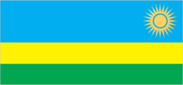
three equal vertical bands of red (hoist side), yellow, and green with a large black letter R centered in the yellow band; uses the popular pan-African colors of Ethiopia; similar to the flag of Guinea, which has a plain yellow band
Government type
republic; presidential, multiparty system
Independence
1 July 1962 (from Belgium-administered UN trusteeship)
International organization participation
ACCT, ACP, AfDB, CCC, CEEAC, CEPGL, ECA, FAO, G-77, IBRD, ICAO, ICFTU, ICRM, IDA, IFAD, IFC, IFRCS, ILO, IMF, Intelsat, Interpol, IOC, IOM (observer), ITU, NAM, OAU, UN, UNCTAD, UNESCO, UNIDO, UPU, WCL, WHO, WIPO, WMO, WToO, WTrO Diplomatic representation in the US: chief of mission: Ambassador Theogene N. RUDASINGWA chancery: (temporary) 1814 New Hampshire Ave. NW, Washington, DC 20007 telephone: [1] (202) 232-2882
Judicial branch
Constitutional Court, consists of the Court of Cassation and the Council of State in joint session Political parties and leaders: significant parties include: Rwandan Patriotic Front or RPF [Alexis KANYARENGWE, chairman]; Democratic Republican Movement or MDR; Liberal Party or PL; Democratic and Socialist Party or PSD; Christian Democratic Party or PDC; Islamic Democratic Party or PDI; Rwandan Socialist Party or PSR; National Movement for Democracy and Development or MRND (former ruling party) Political pressure groups and leaders: Rwanda Patriotic Army or RPA, the RPF military wing [Maj. Gen. Paul KAGAME, commander]; Rally for the Democracy and Return (RDR)
Legal system
based on German and Belgian civil law systems and customary law; judicial review of legislative acts in the Supreme Court; has not accepted compulsory ICJ jurisdiction
Legislative branch
unicameral Transitional National Assembly or Assemblee Nationale de Transition (70 seats; members were predetermined by the Arusha peace accord to serve NA-year terms) elections: last held 26 December 1988 (next to be held NA); note-the Transitional National Assembly is a power-sharing body established on 12 December 1994 following a multi-party protocol of understanding election results: percent of vote by party-NA; seats by party-RPF 19, MDR 13, PSD 13, PL 13, PDC 6, PSR 2, PDI 2, other 2; note-the distribution of seats was predetermined
National capital
Kigali
National holiday
Independence Day, 1 July (1962)
Suffrage
NA years of age; universal adult
Economy
Agriculture-products
coffee, tea, pyrethrum (insecticide made from chrysanthemums), bananas, beans, sorghum, potatoes; livestock
Budget
revenues: $231 million expenditures: $319 million, including capital expenditures of $13 million (1996 est.)
Currency
1 Rwandan franc (RF) = 100 centimes
Debt-external
$1 billion (December 1995)
Economic aid
recipient: ODA, $NA note: in October 1990 Rwanda launched a Structural Adjustment Program with the IMF; since September 1991, the EU has given $46 million and the US $25 million in support of this program (1993)
Economy-overview
Rwanda is a poor African nation that has suffered bitterly from ethnic-based civil war. The agricultural sector dominates the economy; coffee and tea normally make up 80%-90% of exports. The amount of fertile land is limited, however, and deforestation and soil erosion continue to reduce the production potential. Manufacturing focuses mainly on the processing of agricultural products. A structural adjustment program with the World Bank began in October 1990. Civil war in 1990 devastated wide areas, especially in the north, and displaced hundreds of thousands of people. A peace accord in mid-1993 temporarily ended most of the fighting, but resumption of large-scale violence and genocide in April 1994 in the capital city Kigali and elsewhere took 500,000 lives in that year alone and severely damaged already poor economic prospects. In 1994-96, peace was restored throughout much of the country. In 1996-97 most of the refugees who fled the war returned to Rwanda. Sketchy data suggest that GDP dropped 50% in 1994 and came back partially, by 25%, in 1995. Plentiful rains helped agriculture in 1996, and outside aid continued to support this desperately poor economy. The economy continues to face significant challenges in rehabilitating infrastructure, agriculture, health care facilities, and capital plant. Recovery of domestic production will proceed slowly.
Electricity-capacity
34,000 kW (1995)
Electricity-consumption per capita
21 kWh (1995)
Electricity-production
169 million kWh (1995)
Exchange rates
Rwandan francs (RF) per US$1-302.28 (January 1998), 301.53 (1997), 306.82 (1996), 262.20 (1995), 144.31 (1993)
Exports
total value: $62.3 million (f.o.b., 1996 est.) commodities: coffee 74%, tea, cassiterite, wolframite, pyrethrum (1995) partners: Brazil, EU
Fiscal year
calendar year Communications
GDP
purchasing power parity-$3 billion (1996 est.)
GDP-composition by sector
agriculture: 37% industry: 17% services: 46% (1995 est.)
GDP-per capita
purchasing power parity-$440 (1996 est.)
GDP-real growth rate
13.3% (1996)
Imports
total value: $202.4 million (f.o.b., 1996 est.) commodities: foodstuffs 35%, machines and equipment, capital goods, steel, petroleum products, cement and construction material (1995) partners: US, EU, Kenya, Tanzania
Industrial production growth rate
4.9% (1995 est.)
Industries
mining of cassiterite (tin ore) and wolframite (tungsten ore), tin, cement, processing of agricultural products, small-scale beverage production, soap, furniture, shoes, plastic goods, textiles, cigarettes
Inflation rate-consumer price index
7.4% (1996)
Labor force
total: 3.6 million by occupation: agriculture 93%, government and services 5%, industry and commerce 2%
Radio broadcast stations
AM 1, FM 1, shortwave 0
Radios
630,000 (1993 est.)
Telephone system
telephone system does not provide service to the general public but is intended for business and government use domestic: the capital, Kigali, is connected to the centers of the prefectures by microwave radio relay; the remainder of the network depends on wire and HF radiotelephone international: international connections employ microwave radio relay to neighboring countries and satellite communications to more distant countries; satellite earth stations-1 Intelsat (Indian Ocean) in Kigali (includes telex and telefax service)
Telephones
6,400 (1983 est.)
Television broadcast stations
1
Televisions
NA
Unemployment rate
NA%
Transportation
Airports
7 (1997 est.) Airports-with paved runways: total: 4 over 3,047 m: 1 914 to 1,523 m: 2 under 914 m: 1 (1997 est.) Airports-with unpaved runways: total: 3 914 to 1,523 m: 1 under 914 m: 2 (1997 est.)
Highways
total: 12,000 km paved: 1,000 km unpaved: 11,000 km (1997 est.)
Railways
0 km
Waterways
Lac Kivu navigable by shallow-draft barges and native craft Ports and harbors: Cyangugu, Gisenyi, Kibuye
Military and Security
Military branches
Army, Gendarmerie
Military expenditures-dollar figure
$112.5 million (1992)
Military expenditures-percent of GDP
7% (1992)
Military manpower-availability
males age 15-49: 1,892,503 (1998 est.) Military manpower-fit for military service: males: 963,218 (1998 est.)
Transnational Issues
Disputes-international
none (dependent territory of the UK)