1991 Edition
CIA World Factbook 1991 (Project Gutenberg)
Geography
Climate
temperate; two rainy seasons (February to April, November to January); mild in mountains with frost and snow possible
Coastline
none--landlocked
Comparative area
slightly smaller than Maryland
Environment
deforestation; overgrazing; soil exhaustion; soil erosion; periodic droughts
Land boundaries
893 km total; Burundi 290 km, Tanzania 217 km, Uganda 169 km, Zaire 217 km
Land use
arable land 29%; permanent crops 11%; meadows and pastures 18%; forest and woodland 10%; other 32%; includes irrigated NEGL%
Maritime claims
none--landlocked
Natural resources
gold, cassiterite (tin ore), wolframite (tungsten ore), natural gas, hydropower
Note
landlocked
Terrain
mostly grassy uplands and hills; mountains in west
Total area
26,340 km2; land area: 24,950 km2
People and Society
Birth rate
52 births/1,000 population (1991)
Death rate
15 deaths/1,000 population (1991)
Ethnic divisions
Hutu 90%, Tutsi 9%, Twa (Pygmoid) 1%
Infant mortality rate
110 deaths/1,000 live births (1991)
Labor force
3,600,000; agriculture 93%, government and services 5%, industry and commerce 2%; 49% of population of working age (1985)
Language
Kinyarwanda, French (official); Kiswahili used in commercial centers
Life expectancy at birth
51 years male, 54 years female (1991)
Literacy
50% (male 64%, female 37%) age 15 and over can read and write (1990 est.)
Nationality
noun and adjective--Rwandan(s)
Net migration rate
0 migrants/1,000 population (1991)
Organized labor
NA
Population
7,902,644 (July 1991), growth rate 3.8% (1991)
Religion
Roman Catholic 65%, Protestant 9%, Muslim 1%, indigenous beliefs and other 25%
Total fertility rate
8.4 children born/woman (1991)
Government
Administrative divisions
10 prefectures (prefectures, singular--prefecture in French; plural--NA, singular--prefegitura in Kinyarwanda); Butare, Byumba, Cyangugu, Gikongoro, Gisenyi, Gitarama, Kibungo, Kibuye, Rigali, Ruhengeri
Capital
Kigali
Communists
no Communist party
Constitution
17 December 1978
Diplomatic representation
Ambassador Aloys UWIMANA; Chancery at 1714 New Hampshire Avenue NW, Washington DC 20009; telephone (202) 232-2882; US--Ambassador Robert A. FLATEN; Embassy at Boulevard de la Revolution, Kigali (mailing address is B. P. 28, Kigali); telephone [250] 75601 through 75603 or 72126 through 72128
Elections
President--last held 19 December 1988 (next to be held December 1993); results--President Maj. Gen. Juvenal HABYARIMANA reelected; National Development Council--last held 19 December 1988 (next to be held December 1993); results--MRND is the only party; seats--(70 total); MRND 70
Executive branch
president, Council of Ministers (cabinet)
Flag
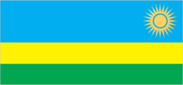
three equal vertical bands of red (hoist side), yellow, and green with a large black letter R centered in the yellow band; uses the popular pan-African colors of Ethiopia; similar to the flag of Guinea, which has a plain yellow band
Independence
1 July 1962 (from UN trusteeship under Belgian administration)
Judicial branch
Constitutional Court (consists of the Court of Cassation and the Council of State in joint session)
Leaders
Chief of State and Head of Government--President Maj. Gen. Juvenal HABYARIMANA (since 5 July 1973)
Legal system
based on German and Belgian civil law systems and customary law; judicial review of legislative acts in the Supreme Court; has not accepted compulsory ICJ jurisdiction
Legislative branch
unicameral National Development Council (Conseil National de Developpement)
Long-form name
Republic of Rwanda
Member of
ACCT, ACP, AfDB, ECA, CCC, CEEAC, CEPGL, FAO, G-77, GATT, IBRD, ICAO, IDA, IFAD, IFC, ILO, IMF, INTELSAT, INTERPOL, IOC, ITU, LORCS, NAM, OAU, UN, UNCTAD, UNESCO, UNIDO, UPU, WCL, WHO, WIPO, WMO, WTO
National holiday
Independence Day, 1 July (1962)
Political parties and leaders
only party--National Revolutionary Movement for Development (MRND), Maj. Gen. Juvenal HABYARIMANA; note--the MRND is officially a development movement, not a party
Suffrage
universal adult, exact age NA
Type
republic; presidential system in which military leaders hold key offices; on 31 December 1990, the government announced a National Political Charter to serve as a basis for transition to a presidential/parliamentary political system; the charter will be voted upon in a national referendum to be held June 1991
Economy
Agriculture
accounts for almost 50% of GDP and about 90% of the labor force; cash crops--coffee, tea, pyrethrum (insecticide made from chrysanthemums); main food crops--bananas, beans, sorghum, potatoes; stock raising; self-sufficiency declining; country imports foodstuffs as farm production fails to keep up with a 3.8% annual growth in population
Budget
revenues $391 million; expenditures $491 million, including capital expenditures of $225 million (1989 est.)
Currency
Rwandan franc (plural--francs); 1 Rwandan franc (RF) = 100 centimes
Economic aid
US commitments, including Ex-Im (FY70-89), $128 million; Western (non-US) countries, ODA and OOF bilateral commitments (1970-88), $1.8 billion; OPEC bilateral aid (1979-89), $45 million; Communist countries (1970-89), $58 million
Electricity
26,000 kW capacity; 112 million kWh produced, 15 kWh per capita (1989)
Exchange rates
Rwandan francs (RF) per US$1--120.00 (December 1990), 82.60 (1990), 79.98 (1989), 76.45 (1988), 79.67 (1987), 87.64 (1986), 101.26 (1985)
Exports
$117 million (f.o.b., 1989 est.); commodities--coffee 85%, tea, tin, cassiterite, wolframite, pyrethrum; partners--FRG, Belgium, Italy, Uganda, UK, France, US
External debt
$689 million (December 1990 est.)
Fiscal year
calendar year
GDP
$2.2 billion, per capita $300; real growth rate - 2.2% (1989 est.)
Imports
$293 million (f.o.b., 1989 est.); commodities--textiles, foodstuffs, machines and equipment, capital goods, steel, petroleum products, cement and construction material; partners--US, Belgium, FRG, Kenya, Japan
Industrial production
growth rate 1.2% (1988); accounts for 16% of GDP
Industries
mining of cassiterite (tin ore) and wolframite (tungsten ore), tin, cement, agricultural processing, small-scale beverage production, soap, furniture, shoes, plastic goods, textiles, cigarettes
Inflation rate (consumer prices)
1% (1989)
Overview
Almost 50% of GDP comes from the agricultural sector; coffee and tea make up 80-90% of total exports. The amount of fertile land is limited, however, and deforestation and soil erosion have created problems. The industrial sector in Rwanda is small, contributing only 16% to GDP. Manufacturing focuses mainly on the processing of agricultural products. The Rwandan economy remains dependent on coffee exports and foreign aid, with no relief in sight. Weak international prices since 1986 have caused the economy to contract and per capita GDP to decline. A structural adjustment program with the World Bank began in October 1990. An outbreak of insurgency, also in October, has dampened any prospects for economic improvement.
Unemployment rate
NA%
Communications
Airports
8 total, 8 usable; 3 with permanent-surface runways; none with runways over 3,659 m; 1 with runways 2,440-3,659 m; 2 with runways 1,220-2,439 m
Civil air
1 major transport aircraft
Highways
4,885 km total; 460 km paved, 1,725 km gravel and/or improved earth, 2,700 km unimproved
Inland waterways
Lac Kivu navigable by shallow-draft barges and native craft
Telecommunications
fair system with low-capacity radio relay system centered on Kigali; 6,600 telephones; stations--2 AM, 5 FM, no TV; earth stations--1 Indian Ocean INTELSAT and 1 SYMPHONIE
Military and Security
Branches
Army, Gendarmerie
Defense expenditures
$37 million, 1.6% of GDP (1988 est.) _%_
Manpower availability
males 15-49, 1,651,224; 842,480 fit for military service; no conscription